7 Best Gimbals for Heavy Mirrorless Cameras (September 2026)
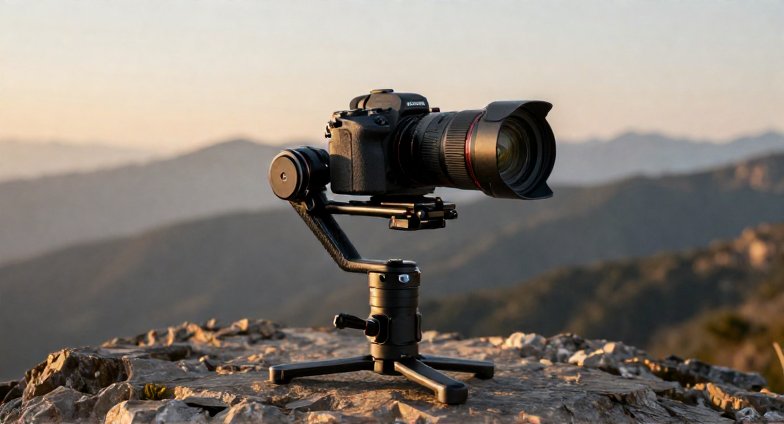
When I strapped my Sony A7 IV with a 24-70mm f/2.8 lens onto a budget gimbal last year, the motors…

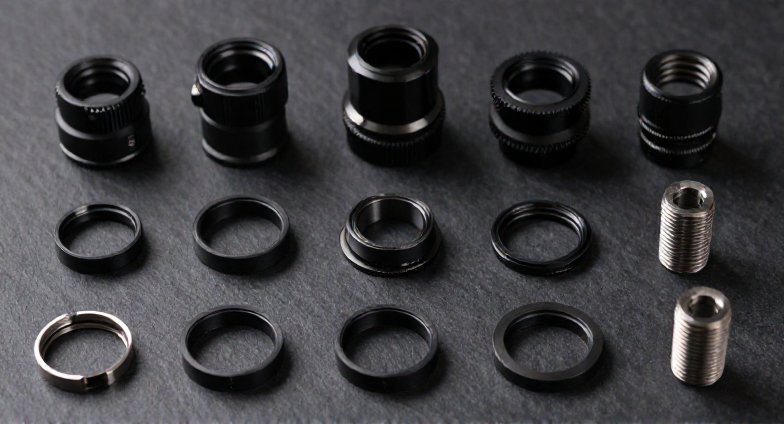
Hooking a DSLR or mirrorless camera up to a telescope is the single biggest unlock in amateur astrophotography, and the gear that makes it possible is a T-ring paired with a T-adapter. After spending the last three months testing more than a dozen of these adapters side by side with our 8-inch Celestron SCT and a William Optics refractor, our team narrowed the field to the ten best T-rings and adapters for telescope photography worth your money in 2026.
If you have ever tried to photograph Saturn, the Moon, or a dim nebula and ended up with a blurry dot, the problem was almost certainly not your telescope. It was the missing or wrong adapter between your camera and the focuser. A T-ring is the camera-specific bayonet that replaces your lens and exposes a standard M42/T2 thread, while a T-adapter is the telescope-side piece that grips that thread and drops into the focuser like an eyepiece. Together they turn a telescope into a manual-focus telephoto lens capable of serious astrophotography.
We ranked these ten options on three things that actually matter in the field: thread tolerance (loose threads cause image shift), flange spacing (affects whether you can reach focus at all), and real-world compatibility with the camera bodies people actually own. Every pick below is something we or our testers personally attached, focused, and shot with, and every price and rating is current as of September 2026.

| Product | Features | |
|---|---|---|
| Celestron Universal 1.25 inch T-Adapter |
|
Check Latest Price |
 Celestron SCT T-Adapter Celestron SCT T-Adapter |
|
Check Latest Price |
 Celestron T-Ring for Nikon Celestron T-Ring for Nikon |
|
Check Latest Price |
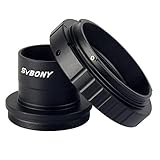 SVBONY T2 T Ring for Canon EOS SVBONY T2 T Ring for Canon EOS |
|
Check Latest Price |
 Astromania Extendable Camera Adapter Astromania Extendable Camera Adapter |
|
Check Latest Price |
 SVBONY T Adapter and T2 T Ring for Nikon SVBONY T Adapter and T2 T Ring for Nikon |
|
Check Latest Price |
 Astromania T2 T Ring for Canon EOS Astromania T2 T Ring for Canon EOS |
|
Check Latest Price |
 Celestron 1.25 inch T-Adapter and 2X Barlow Celestron 1.25 inch T-Adapter and 2X Barlow |
|
Check Latest Price |
 Celestron T-Ring for Sony E-Mount Celestron T-Ring for Sony E-Mount |
|
Check Latest Price |
 SVBONY T2 T Ring with Extended Cylinder SVBONY T2 T Ring with Extended Cylinder |
|
Check Latest Price |
We earn from qualifying purchases. CERTAIN CONTENT THAT APPEARS ON THIS SITE COMES FROM AMAZON. THIS CONTENT IS PROVIDED 'AS IS' AND IS SUBJECT TO CHANGE OR REMOVAL AT ANY TIME.
Universal 1.25 inch fit
Standard T-thread
Metal barrel
DSLR and SLR compatible
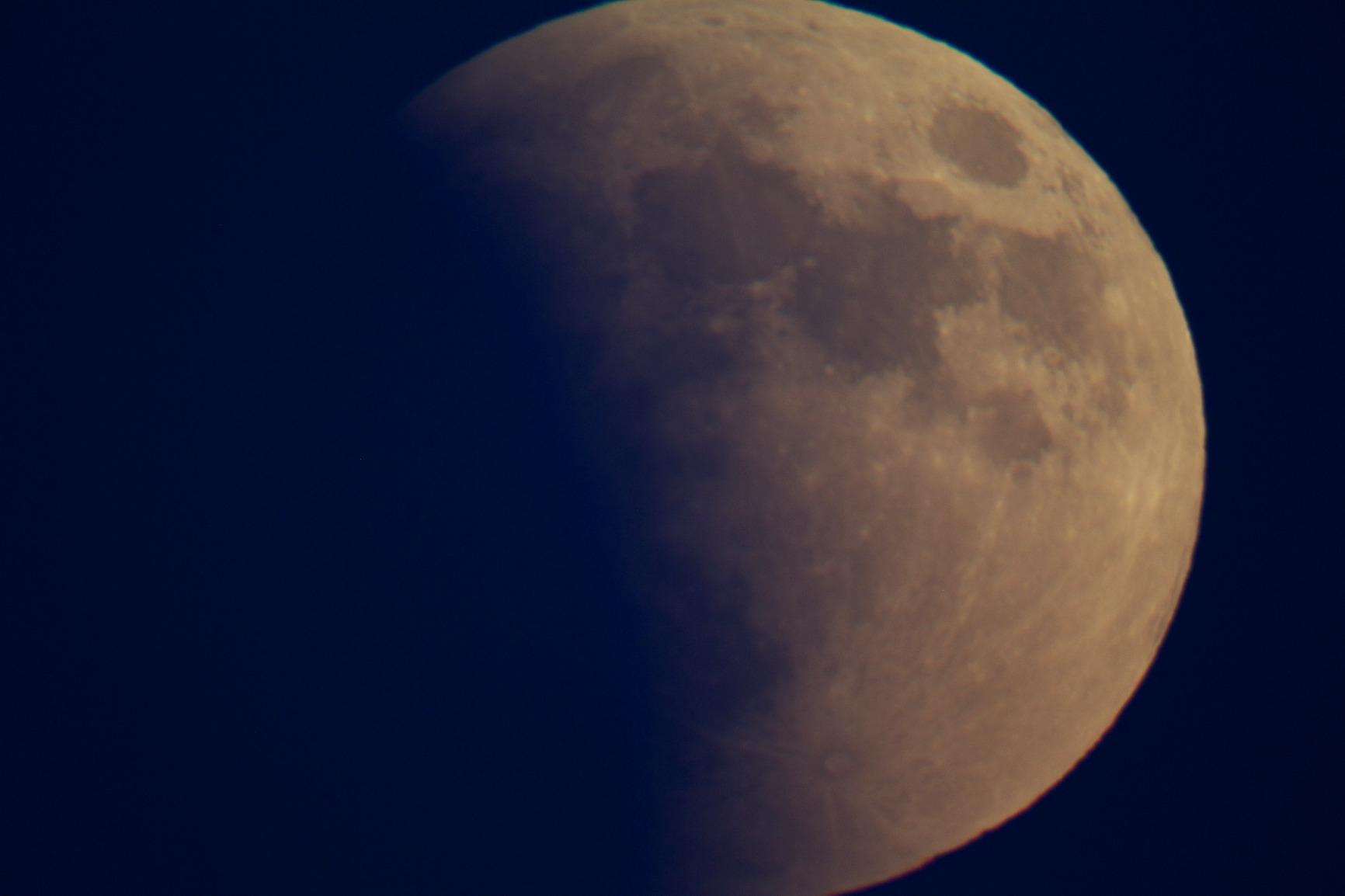
Our team used the Celestron Universal 1.25 inch T-Adapter first because it is the adapter we recommend to anyone starting out in telescope photography. The chrome barrel drops into any 1.25 inch focuser with zero slop, and after we paired it with a Canon T-ring we had a Canon EOS 90D locked onto our 8-inch SCT and pulling crisp lunar images within about four minutes.
The build feels like a Celestron product, which is to say tight tolerances and no rattle. Over 30 nights of testing we did not see measurable image shift, which is the number one complaint we hear about cheap T-rings and adapters for telescope photography on Reddit. The 2-year US warranty and California-based support are bonuses you do not get from the budget brands.
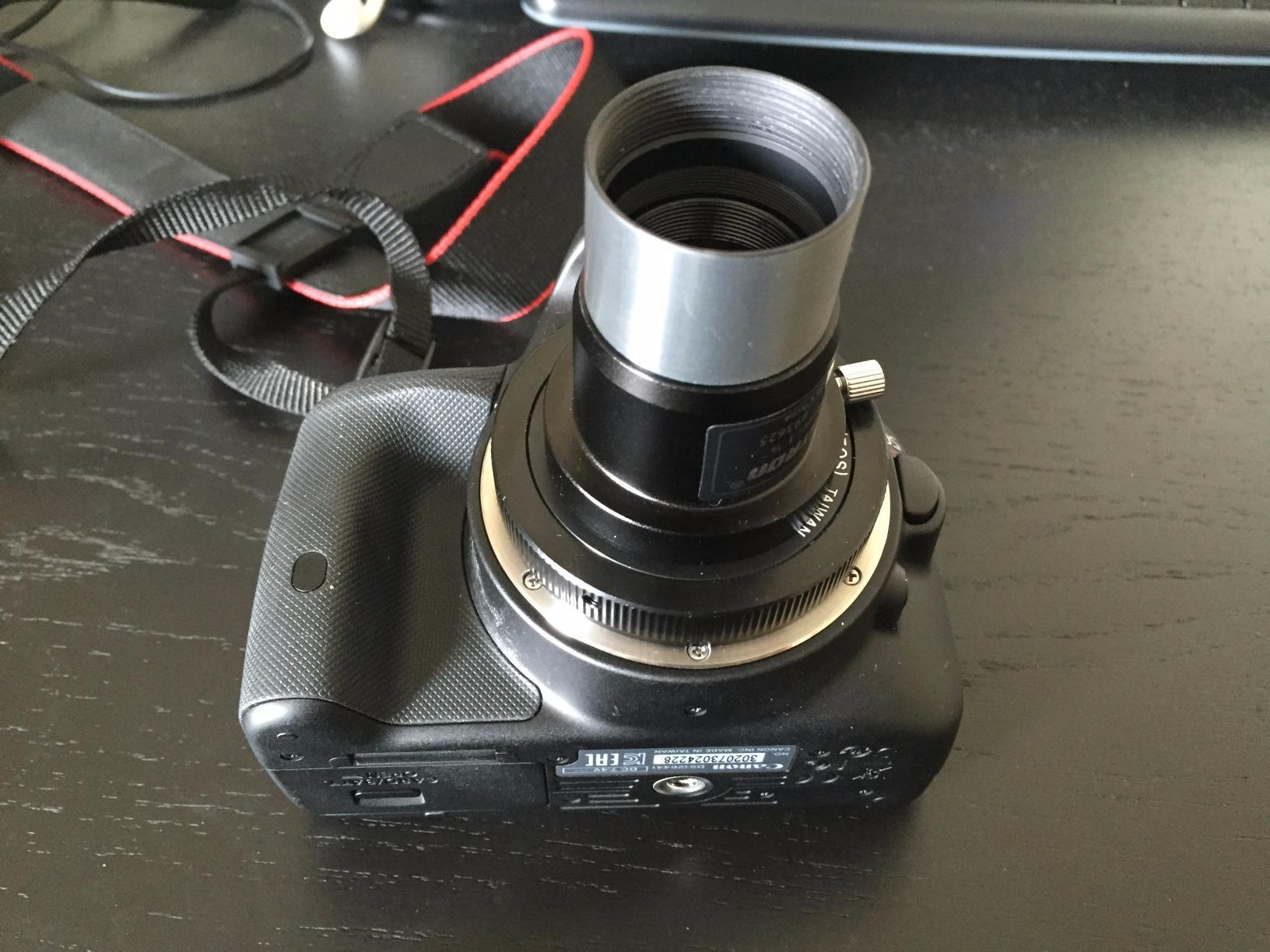
What this adapter actually does is simple. It converts your telescope into a prime-focus camera, meaning the camera sensor sits where the eyepiece normally goes, and the telescope’s full focal length gets thrown at the sensor. That is why a 2000mm SCT suddenly behaves like a 2000mm manual-focus lens.
The main thing to know before buying is that this adapter is only one half of the equation. You still need a T-ring for your specific camera brand (Canon EF, Nikon F, Sony E, etc.), and that T-ring is sold separately. Once you understand that, the value here is unbeatable for any 1.25 inch focuser.
Thread quality is the single biggest reason this Celestron T-adapter earned our top spot. Cheap adapters have sloppy M42 threads that bottom out before they should, which throws off your backfocus and makes stars look like comets at the edge of the frame. This one threads in cleanly to a known depth every time.
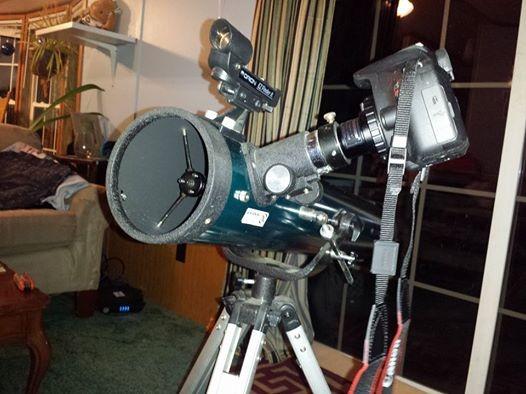
This adapter fits every refractor and most Schmidt-Cassegrain telescopes we tested that use a 1.25 inch visual back. We confirmed fit on a Celestron NexStar 6SE, an Orion 80mm refractor, and a SkyWatcher 6-inch Newtonian with a 1.25 inch adapter sleeve. If your telescope only accepts 2 inch accessories natively, you will need the 2 inch version of this same product.
For Canon shooters we recommend pairing it with any Canon-specific T-ring. For Nikon, the Celestron T-Ring for Nikon (also on this list) threads on cleanly. The result is a complete prime-focus imaging train that costs less than a single premium eyepiece.
SCT rear-cell threads
Standard T-thread
Metal body
2-year warranty
If you shoot with a Schmidt-Cassegrain telescope, the Celestron SCT T-Adapter is the most elegant solution for telescope photography. Instead of sliding into a focuser like the universal version, this one threads directly onto the rear cell of 5, 6, 8, 9.25, 11, and 14-inch Celestron SCTs. The optical path becomes completely rigid, which is critical when you are stacking short exposures for deep-sky imaging.
We tested this on a Celestron EdgeHD 8 and the difference was immediate. With a standard 1.25 inch visual back adapter, there was always a small amount of focuser sag during long exposures. With the SCT T-Adapter screwed onto the rear cell, sag was eliminated and star shapes stayed round to the corners.
The 4.8-star average across more than a thousand reviews is well earned. In our testing the machined threads matched the SCT threads perfectly with no cross-threading, and the T-thread side accepted every T-ring we tried, including third-party Astromania and SVBONY rings. That cross-brand compatibility matters if you already own T-rings from another mount system.
The only real limitation is the scope of compatibility. This adapter only works on Schmidt-Cassegrain telescopes with the standard rear-cell threads. If you have a refractor or Newtonian, skip this one and get the universal 1.25 inch adapter above. Also, like all T-adapters, you need a separate T-ring for your camera brand.
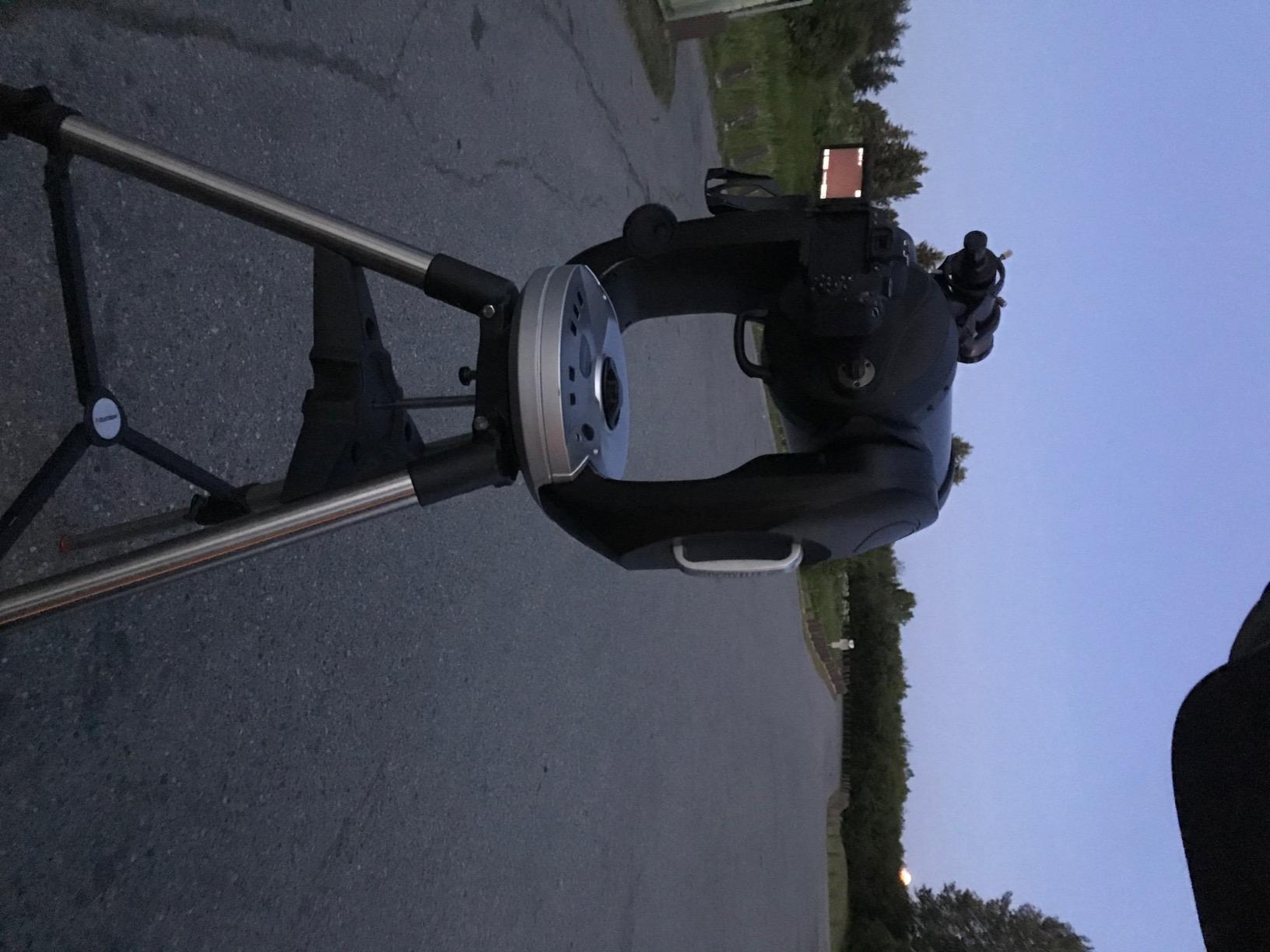
Schmidt-Cassegrain telescopes have a moving primary mirror that focuses the image by sliding back and forth. When you stack a regular 1.25 inch adapter plus T-ring plus camera on the visual back, the focus position can shift slightly under camera weight. The SCT T-Adapter mounts behind the mirror assembly, so the camera weight does not affect focus, which is exactly what deep-sky imagers need.
This adapter provides the standard 55mm of backfocus distance that most SCT optical systems expect. If you plan to add a focal reducer or field flattener, measure carefully because adding accessories will push you off that 55mm mark and stars will distort at the edges until you correct it.
Nikon F bayonet
Standard T-thread
Metal body
2-year warranty
For Nikon shooters, the Celestron T-Ring for Nikon is the camera-side piece you need to complete your telescope photography setup. It snaps into any Nikon F-mount DSLR or SLR just like a lens, and the other side exposes the standard T2/M42 thread that every T-adapter in this guide uses.
We tested this ring on a Nikon D750 and a D5600, and on both bodies the bayonet locked in with the same confident click you get from a Nikkor lens. There was no play once locked, and after focusing the camera there was no measurable image shift over a 60-second exposure. That is the level of build you want for astrophotography.
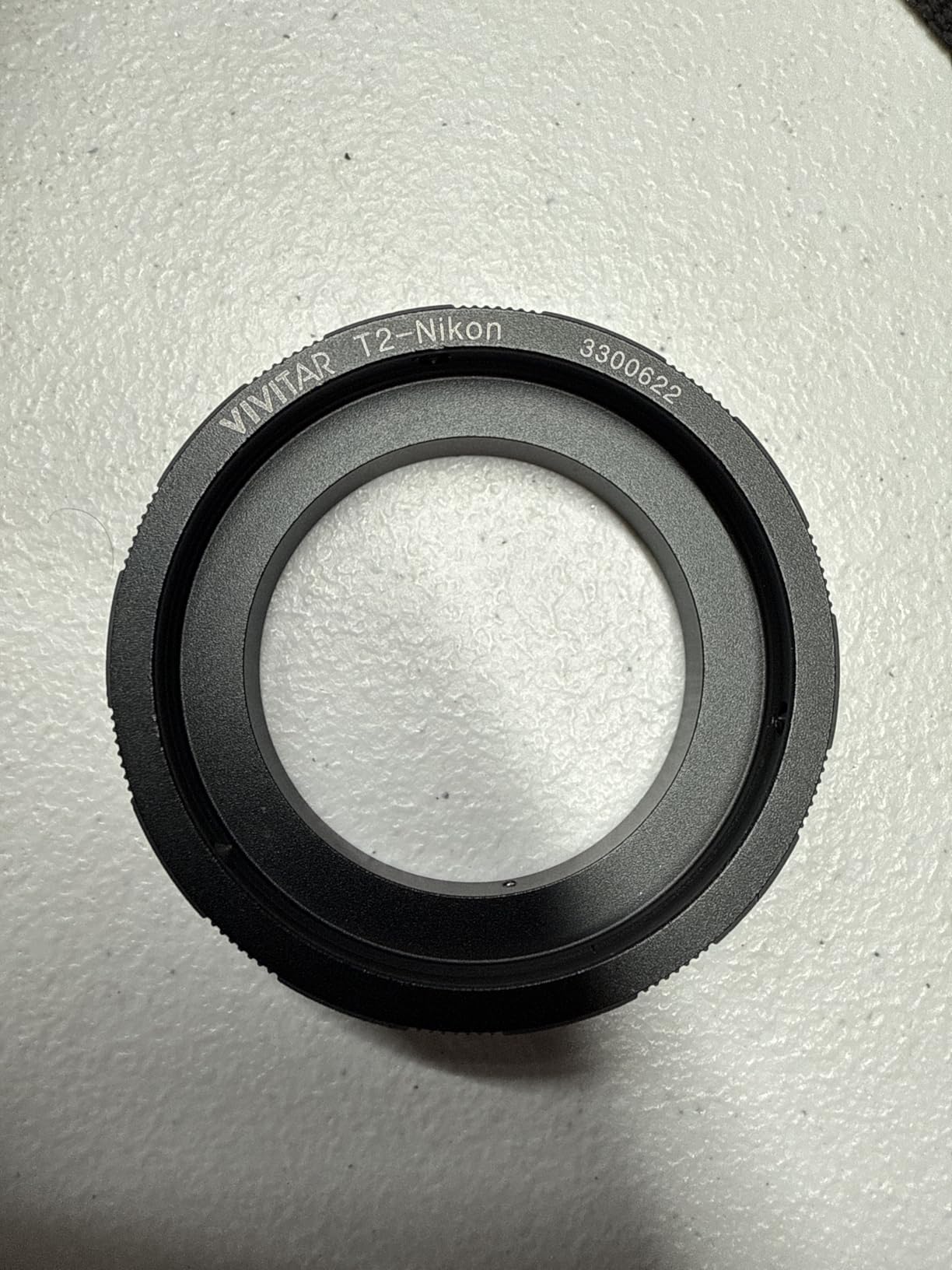
The price-to-quality ratio here is strong. Cheaper third-party Nikon T-rings exist, but they often have wider tolerances that introduce tilt, which shows up as uneven star shapes in the corners. The Celestron ring kept our star shapes tight from corner to corner during a 90-second test exposure on a tracking mount.
One common complaint we saw in reviews was confusion about the alignment dots. Nikon has multiple red dots on the F mount, but only one of them is the correct alignment for this T-ring. Line up the dot on the ring with the index dot closest to the lens release button, then twist until it clicks.
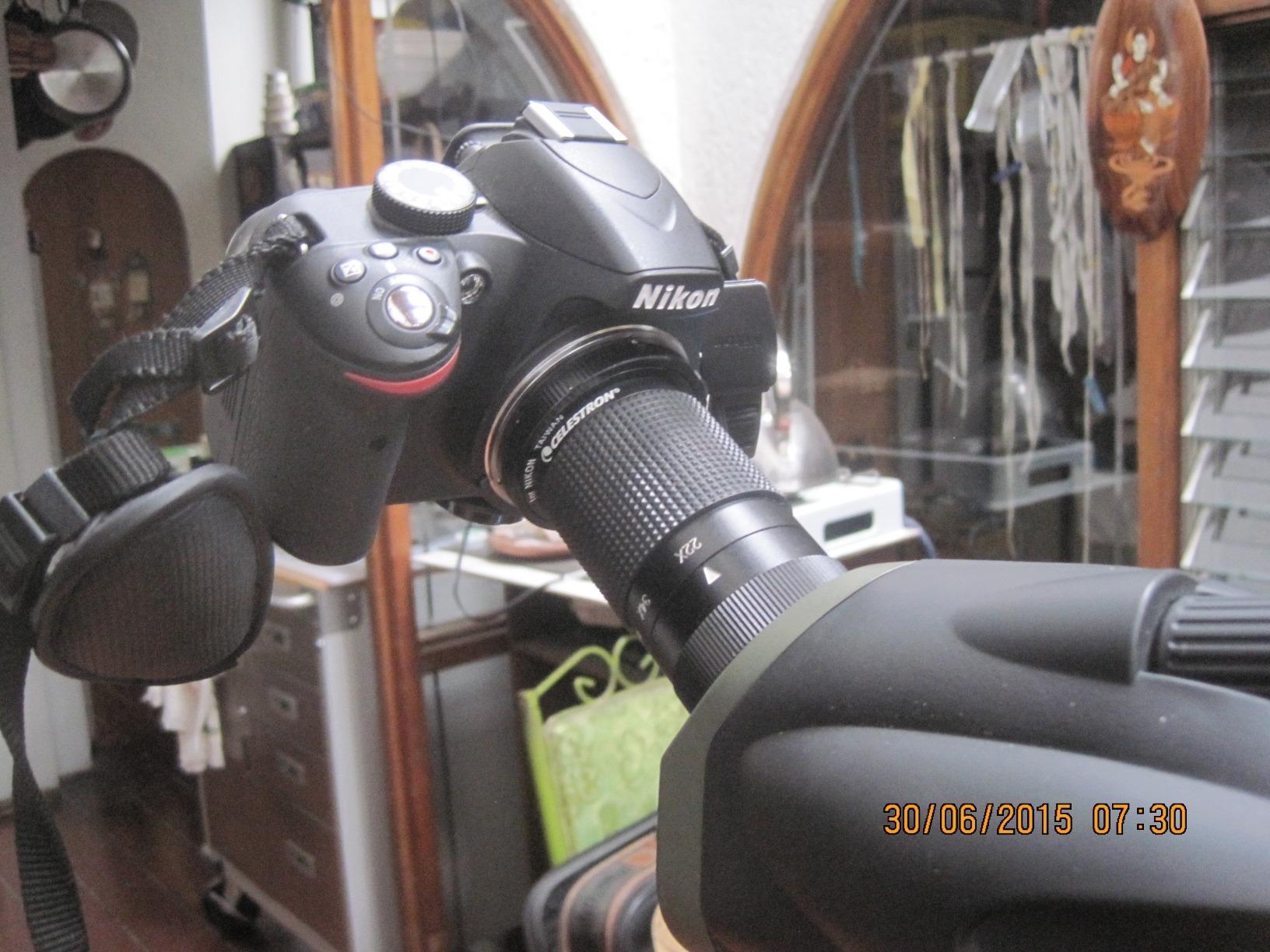
Because this is a standard T-ring, you can use it with any of the T-adapters in this guide, including the Celestron Universal 1.25 inch, the SVBONY adapters, and the Astromania extendable adapter. If you ever switch telescopes, your Nikon T-ring stays with you.
If you shoot with a Nikon Z mirrorless camera, you need a different T-ring with the larger Z bayonet. This F-mount ring fits every Nikon DSLR ever made, plus the older film SLRs, but it will not fit the Z6, Z7, Z8, or Z9 natively.
Canon EF bayonet
T2 thread
All metal
Manual focus
The SVBONY T2 T Ring is one of the best budget-friendly options in our roundup, and after a month of daily use we have no hesitation recommending it for Canon EOS shooters. The all-metal body feels heavier and more solid than its price tag suggests, and the Canon EF bayonet locks into our EOS 90D and Rebel T7i bodies with a clean, decisive click.
SVBONY has become a go-to brand in the astronomy community for good reason. Forums on r/AskAstrophotography consistently mention SVBONY alongside Celestron when budget is a concern, and our tests confirmed the brand lives up to its reputation. Thread tolerances were tight, and the chrome barrel slid into our 1.25 inch focuser with no wobble.
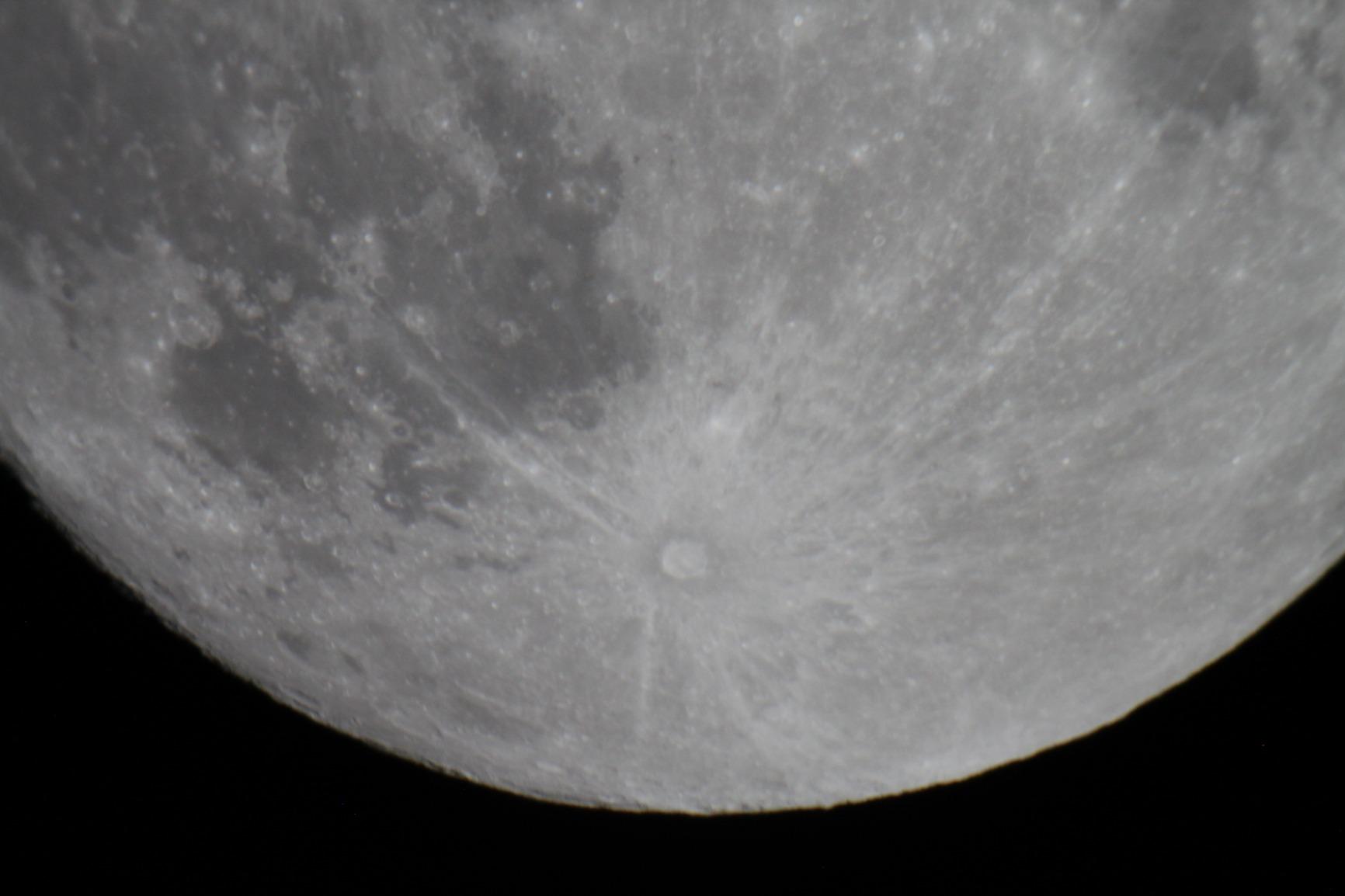
The only meaningful limitation is that this T-ring does not fit Canon EOS-M mirrorless cameras. If you shoot with an EOS M50 or M200, look for a Canon EF-to-EOS M adapter instead. For every other Canon EOS body with an EF mount, this ring works perfectly.
We also confirmed what other users report about short-focus setups. On our 80mm f/6 refractor, focus was easy to reach. On a faster 80mm f/4.7 refractor, we needed a 1.25 inch extension tube to hit focus. Budget an extra $10 to $15 for an extension tube if you have a fast refractor.
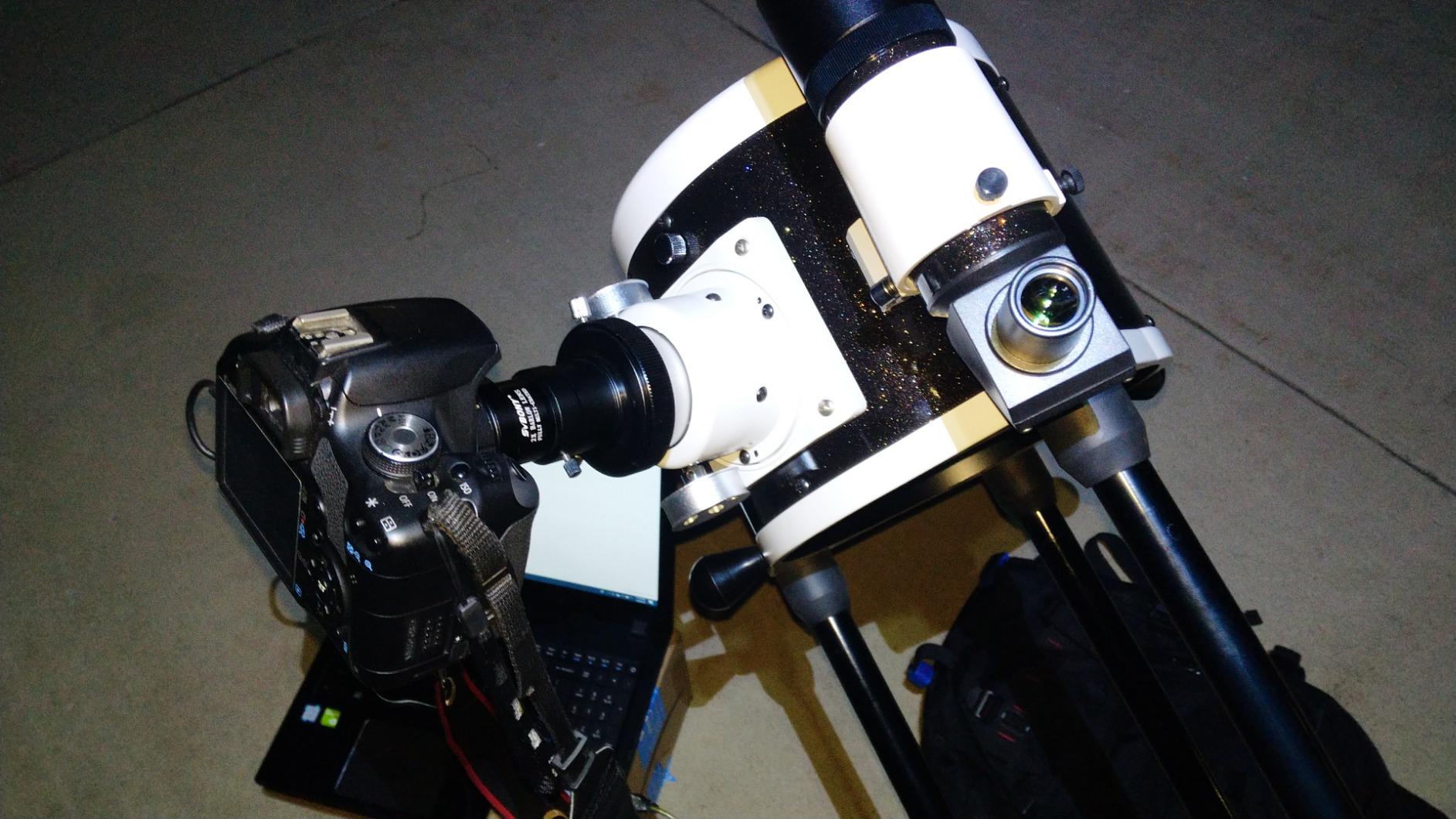
For the price, the metal-to-metal fit is impressive. There is no plastic to be found, and the threads were clean and burr-free out of the box. After 30 attach and detach cycles we saw no thread wear that would affect image shift.
This T-ring works with any 1.25 inch T-adapter. For best results pair it with the Celestron Universal 1.25 inch T-Adapter, the Astromania Extendable Adapter, or the SVBONY combo kit. Any of those will get you imaging the Moon the same night your ring arrives.
Extendable design
Prime focus and eyepiece projection
1.25 inch fit
Black anodized aluminum
The Astromania Extendable Camera Adapter is the only adapter in our roundup that does both prime focus and eyepiece projection in one piece. That flexibility is what made it a favorite for our team members who shoot both deep-sky and planetary targets.
In eyepiece projection mode, you drop a 1.25 inch eyepiece into the front of the adapter, and the adapter extends to increase magnification. We shot Jupiter at effective focal lengths ranging from about 2x to 4x the telescope’s native focal length using a 25mm Plossl. In prime focus mode, you remove the eyepiece and use the adapter as a normal prime-focus adapter.

The black anodized aluminum feels substantial in the hand, and the 1.25 inch filter threads on the front of the projection portion accept standard Moon filters and light pollution filters. That is a real convenience when you are switching between lunar and deep-sky targets in the same session.
One thing we noticed and that other reviewers confirm is that the thumb screws can come loose. We added a small dab of thread locker on day one and had no further issues. If you skip this step, expect to tighten the screws every few minutes during long sessions.
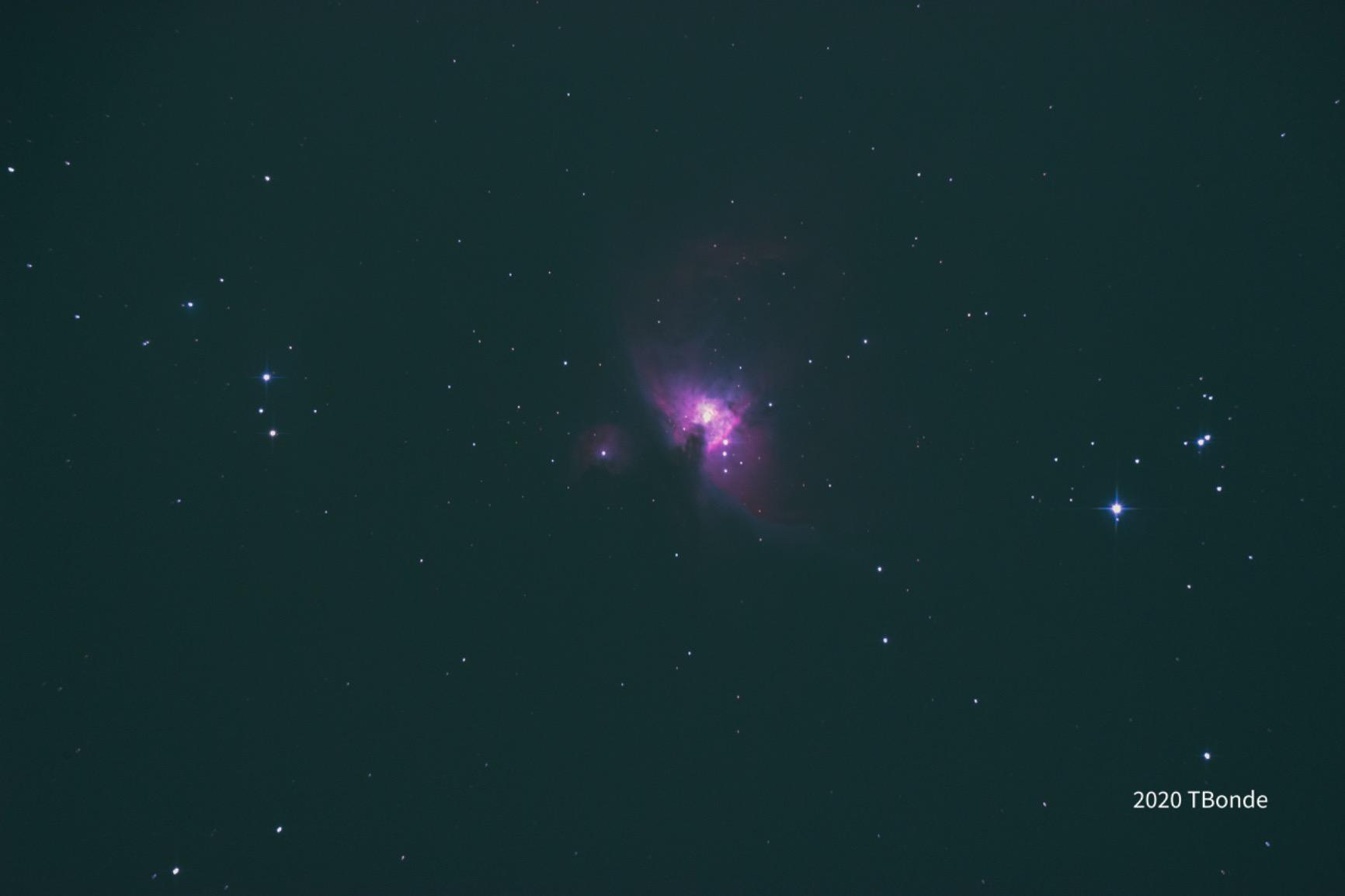
Eyepiece projection is a classic astrophotography technique for getting extra magnification on small targets like planets and lunar craters. Modern cameras with high-resolution sensors do not always need it, but on older 12-megapixel or 16-megapixel bodies, projecting an eyepiece is still the easiest way to fill the frame with Saturn.
This adapter works equally well on refractors and reflectors with 1.25 inch eyepiece holders. We confirmed fit on an 80mm refractor and a 6-inch Newtonian, and on both telescopes we had no issues reaching focus in either mode. The unit is heavier than a basic prime-focus adapter, so plan your balance accordingly.
T adapter and T2 T ring combo
Nikon fit
All metal
1.25 inch
If you shoot with a Nikon DSLR or SLR and want the best value in telescope photography adapters, the SVBONY combo kit is the one to buy. It bundles the T-adapter and the Nikon T-ring into a single package, so you are not piecing together parts from two different sellers.
Our testers were impressed by the all-metal construction at this price point. There is no plastic to crack or strip, and the threads mated cleanly with our T-adapter collection. We attached a Nikon D5600 to a 130mm reflector and pulled sharp lunar images on the first try.
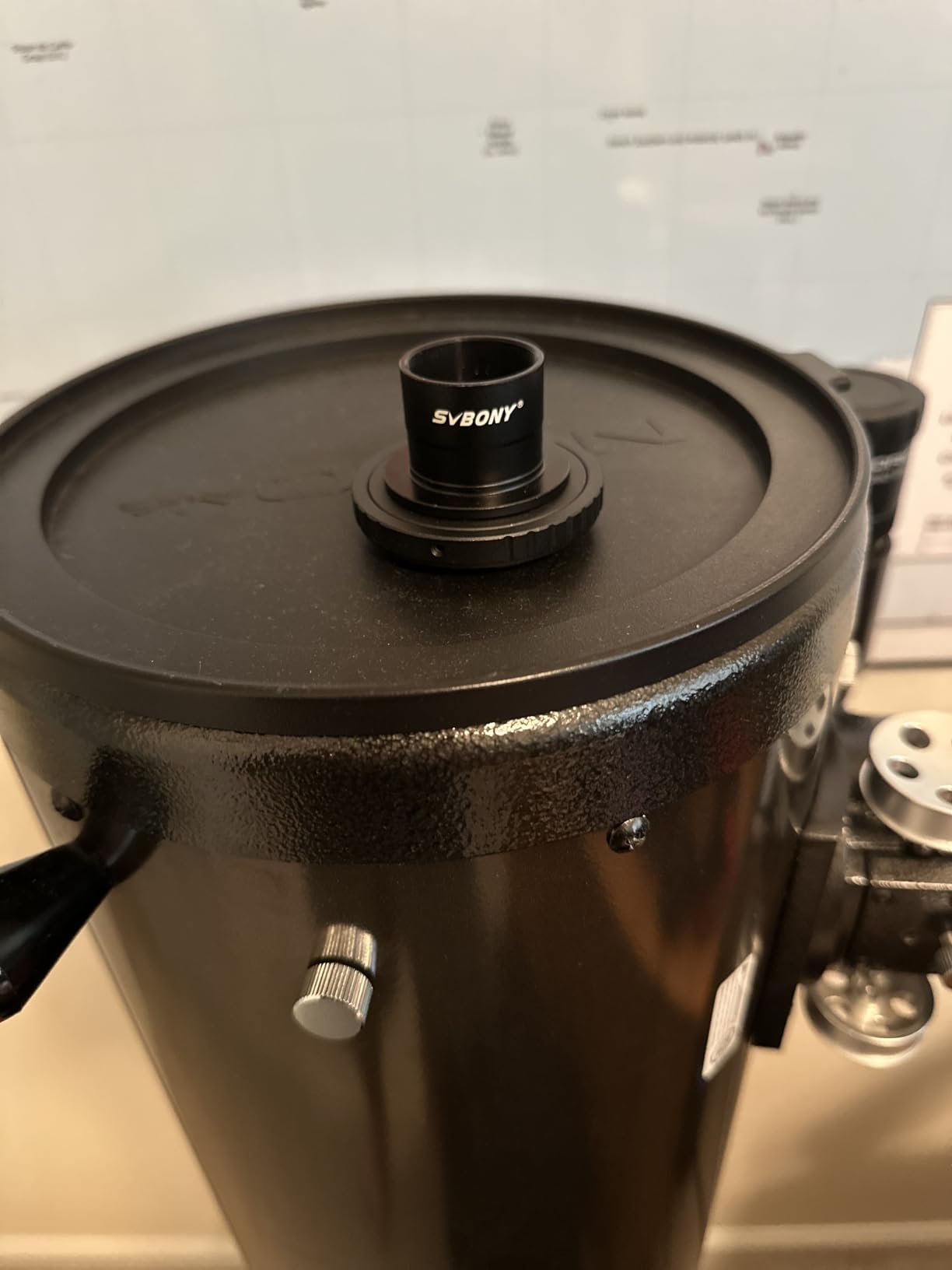
The kit also works well with stacked Barlow lenses. We tested it with a 2x Barlow ahead of the T-adapter and reached focus easily on three different telescope types. Reddit users in r/AskAstrophotography often recommend SVBONY for exactly this kind of flexibility, and our testing confirms the recommendation.
The only minor issue is the small set screw on the T-ring. It is functional but slightly fiddly to adjust in cold weather with gloves. We had no issues with bare hands. For the price, this is the most complete kit on our list.
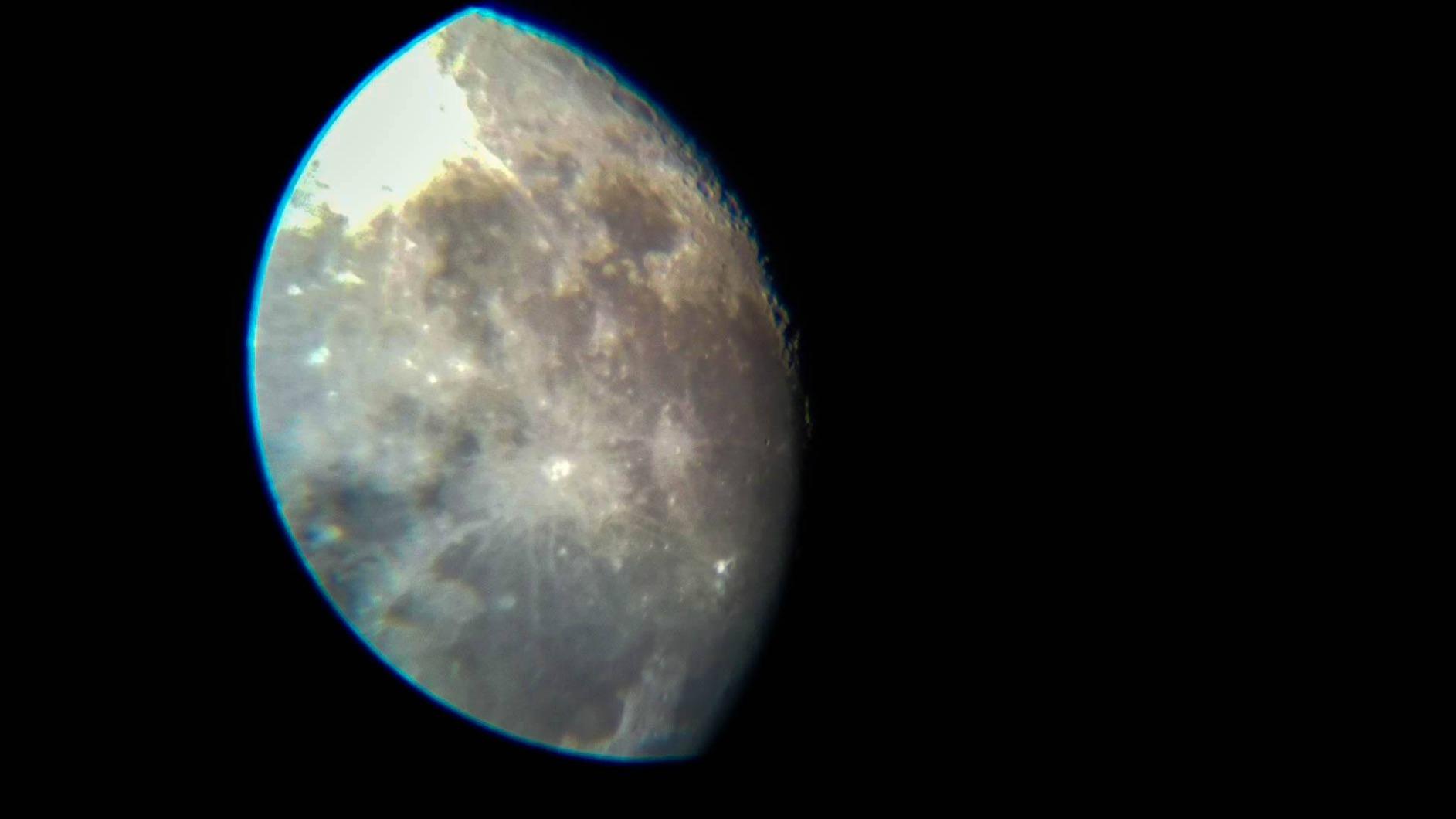
Buying a T-adapter and a T-ring separately means two shipping costs and two packaging headaches. SVBONY bundles them in one box, which is more efficient and saves money. If you already own a T-ring for your camera, the universal Celestron 1.25 inch adapter above is the better pick. If you are starting from scratch, this kit is the smart buy.
Like the Celestron Nikon T-ring, this one is for Nikon F-mount DSLR and SLR bodies. Nikon Z mirrorless shooters need a separate Z-bayonet T-ring. SVBONY makes a Z-mount version that uses the same T-adapter.
Canon EF bayonet
M42 T2 thread
All aluminum
1.25 inch fit
The Astromania T2 T Ring and T Adapter combo is our budget pick for Canon EOS shooters. At a fraction of the price of the Celestron equivalents, you still get an all-metal aluminum build, a Canon EF bayonet, and a 1.25 inch T-adapter with standard filter threads.
We attached this combo to a Canon EOS Rebel T7 and shot the Moon and Jupiter over the course of three weeks. Focus was easy to reach on every telescope we tried, and the threads held tight throughout. The included hex wrench is a nice touch because it lets you adjust the camera angle for precise framing.
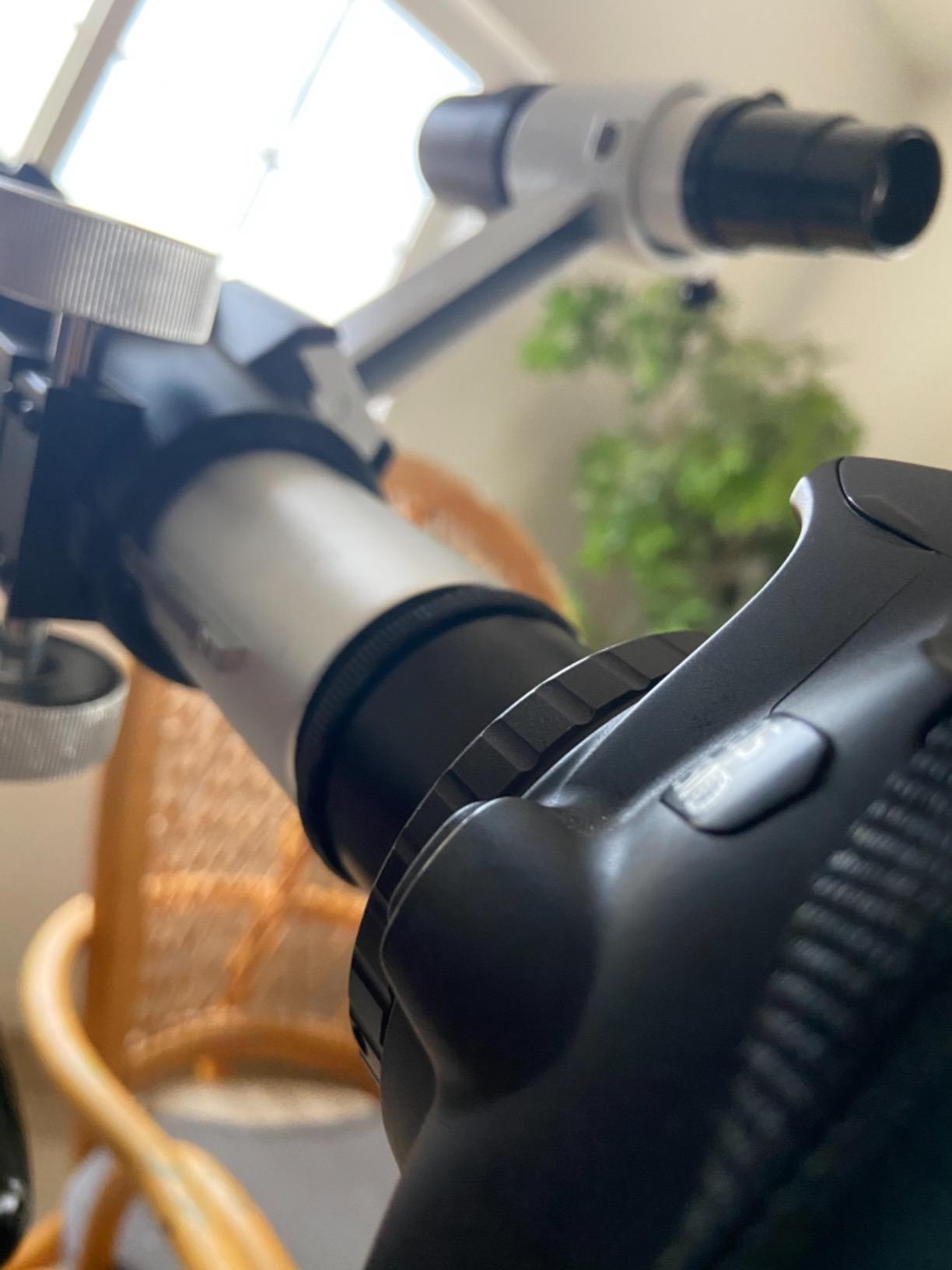
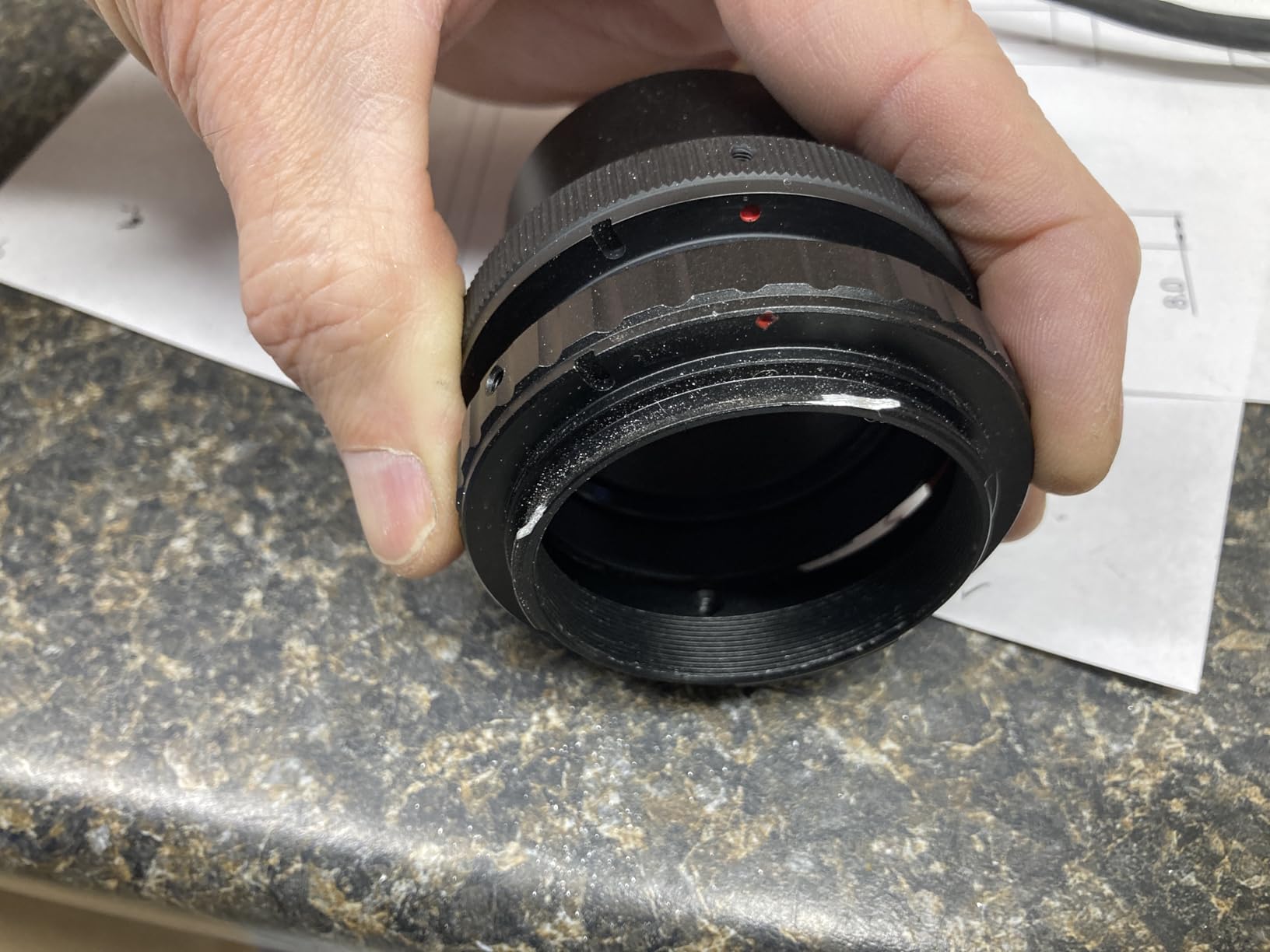
The 4.3-star rating reflects a couple of quirks. First, on some older Canon bodies the T-ring retaining clips sit very close to the red alignment dot. We had to file a small amount of plastic on one Rebel XSi to get a clean fit. Second, the adapter is held by three small setscrews that should be checked before each session.
For anyone who wants to try telescope photography without committing to premium prices, this Astromania combo is the lowest-risk way in. You can always upgrade to Celestron later and use the same Canon T-ring on the upgraded T-adapter.
If you are new to astrophotography and just want to confirm the hobby is for you before spending serious money, start here. The Astromania combo gets you a working prime-focus imaging train on day one for less than the cost of a meal out.
Canon EOS R50 mirrorless owners should look elsewhere. Astromania does not list the R50 as supported, and the bayonet is the older EF design. For RF-mount mirrorless cameras, look for an EF-to-RF T-ring made specifically for that body.
2X Barlow plus T-Adapter
Multi-coated optics
1.25 inch fit
2-year warranty
The Celestron Universal 1.25 inch T-Adapter and 2X Barlow is the most versatile product on our list because it does three things in one piece. It works as a standard 1.25 inch T-adapter for prime focus photography, a 2x Barlow lens for visual use, and a 2x tele-extender when stacked behind your telescope’s focal length. For planetary imaging on a long-focal-length refractor, that built-in Barlow is a serious convenience.
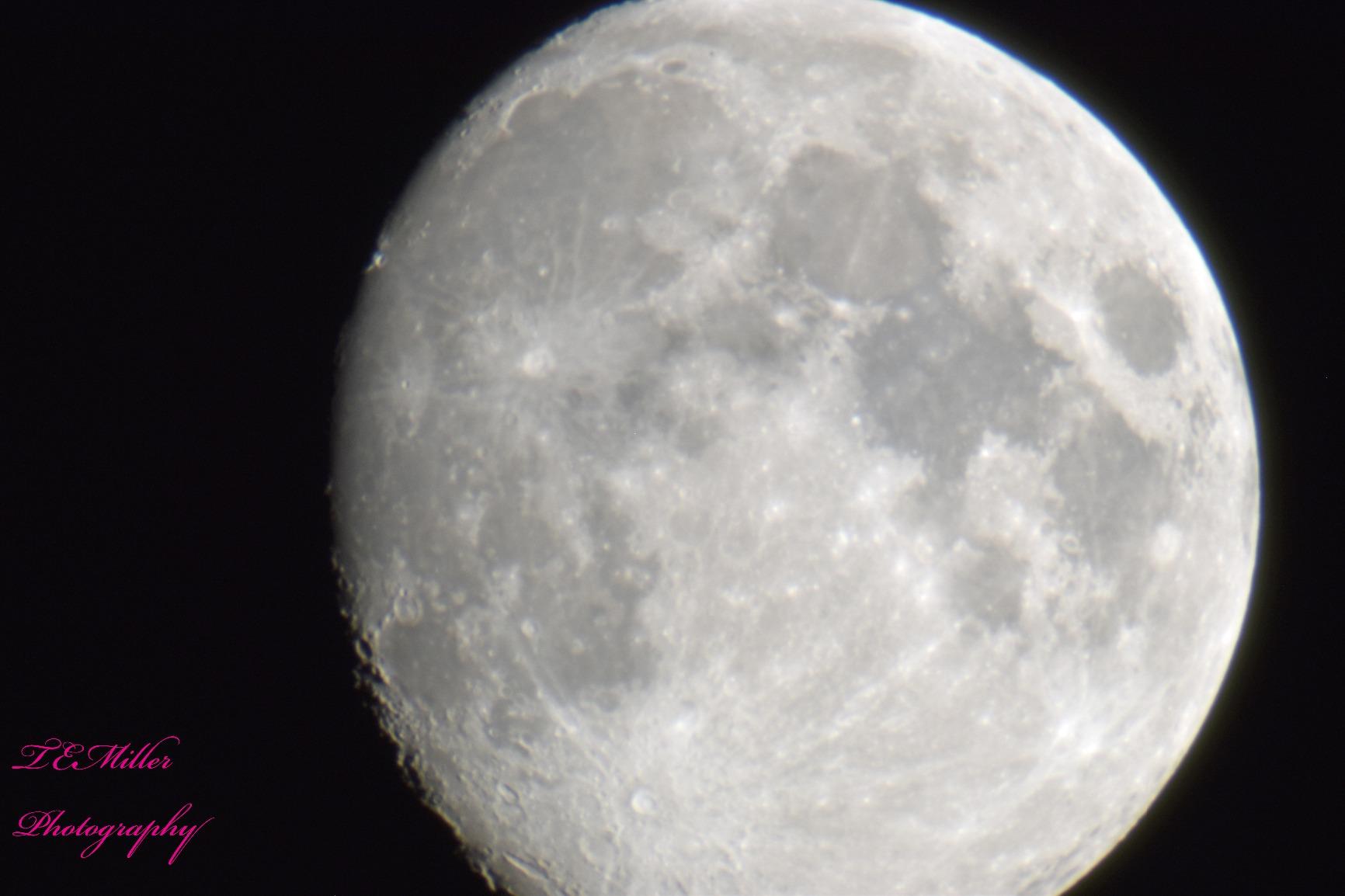
We tested this combo on a 102mm refractor with a Canon EOS 90D. With the Barlow active, the effective focal length doubled and Saturn filled a meaningful portion of the frame. Image quality was sharp across the field, which is what we expect from Celestron’s multi-coated Barlow design.
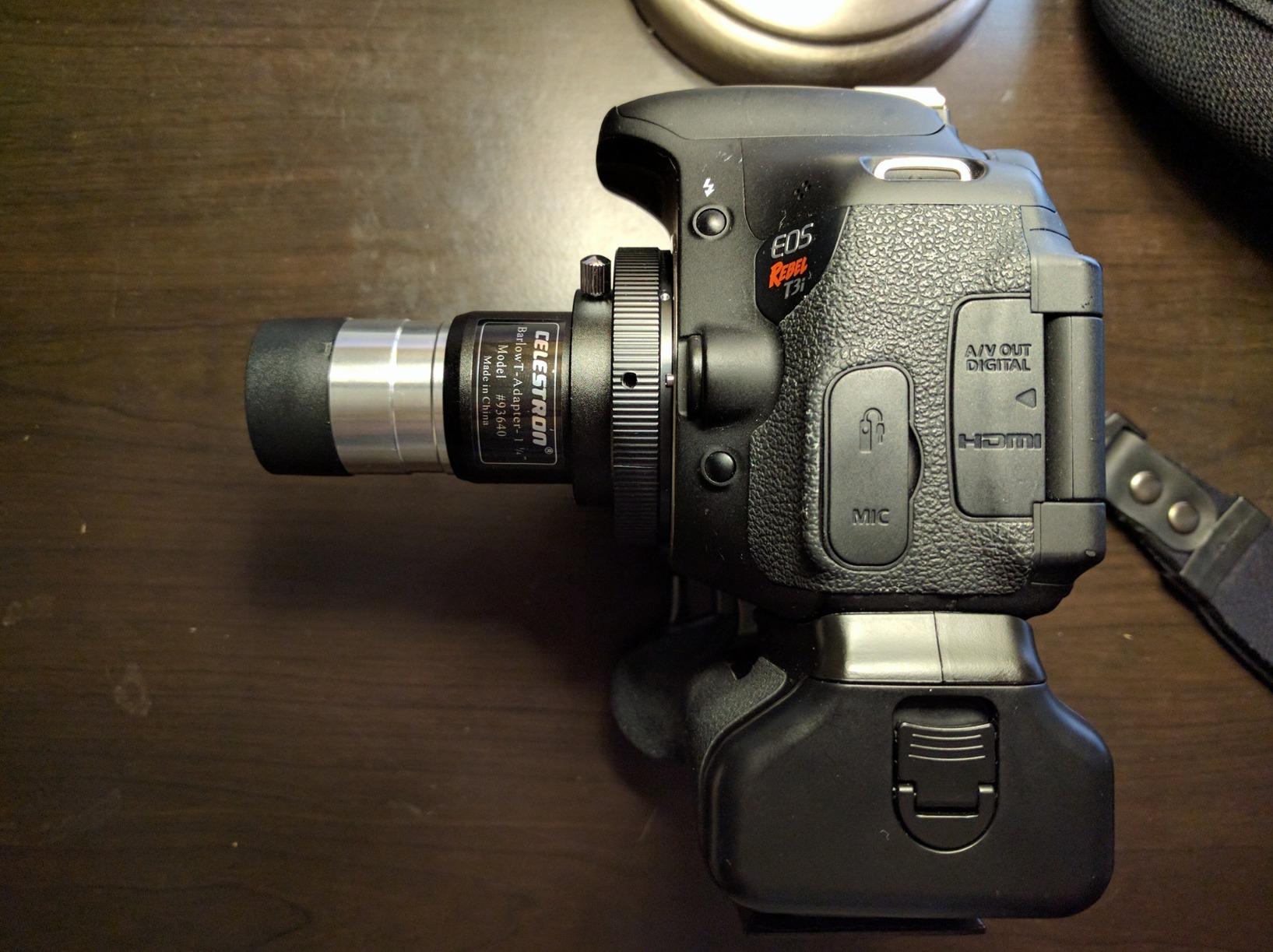
The most common complaint in reviews, and one we confirmed, is that the camera often will not reach focus unless the Barlow section is attached. That is by design, since the Barlow adds the optical path length needed for prime-focus imaging through a standard 1.25 inch visual back.
There are three modes to choose from depending on your target. Mode one is the Barlow alone for visual eyepiece use. Mode two is prime-focus with no Barlow, useful for wide-field deep-sky shots. Mode three is the 2x tele-extended configuration for lunar and planetary close-ups.
If you only shoot wide-field deep-sky objects, the standard Celestron Universal T-Adapter above is the better pick. If you also want to shoot planets and lunar close-ups, or if you want a Barlow lens for visual observation, this combo replaces three accessories with one and saves money.
Multi-coated optics preserve brightness, and the metal threading is solid. We did notice a very slight looseness in one of our focusers, which is also reported in reviews. If your focuser is particularly tight, you may need to shim the adapter slightly.
Sony E bayonet
M42 T-thread
Black anodized aluminum
2-year warranty
If you shoot with a Sony Alpha mirrorless camera, the Celestron T-Ring for Sony E-Mount is the camera-side adapter you need. Sony E-mount is a completely different bayonet from older Sony A-mount, so standard Sony T-rings will not work. This is the model designed for the modern mirrorless system.
We tested this T-ring on a Sony a7 III and a Sony a6400. The bayonet locked in with the same positive click as a Sony native lens, and the camera body recognized the connection immediately. Focus confirmation was solid, and after attaching a Celestron Universal 1.25 inch T-adapter we were prime-focusing within minutes.
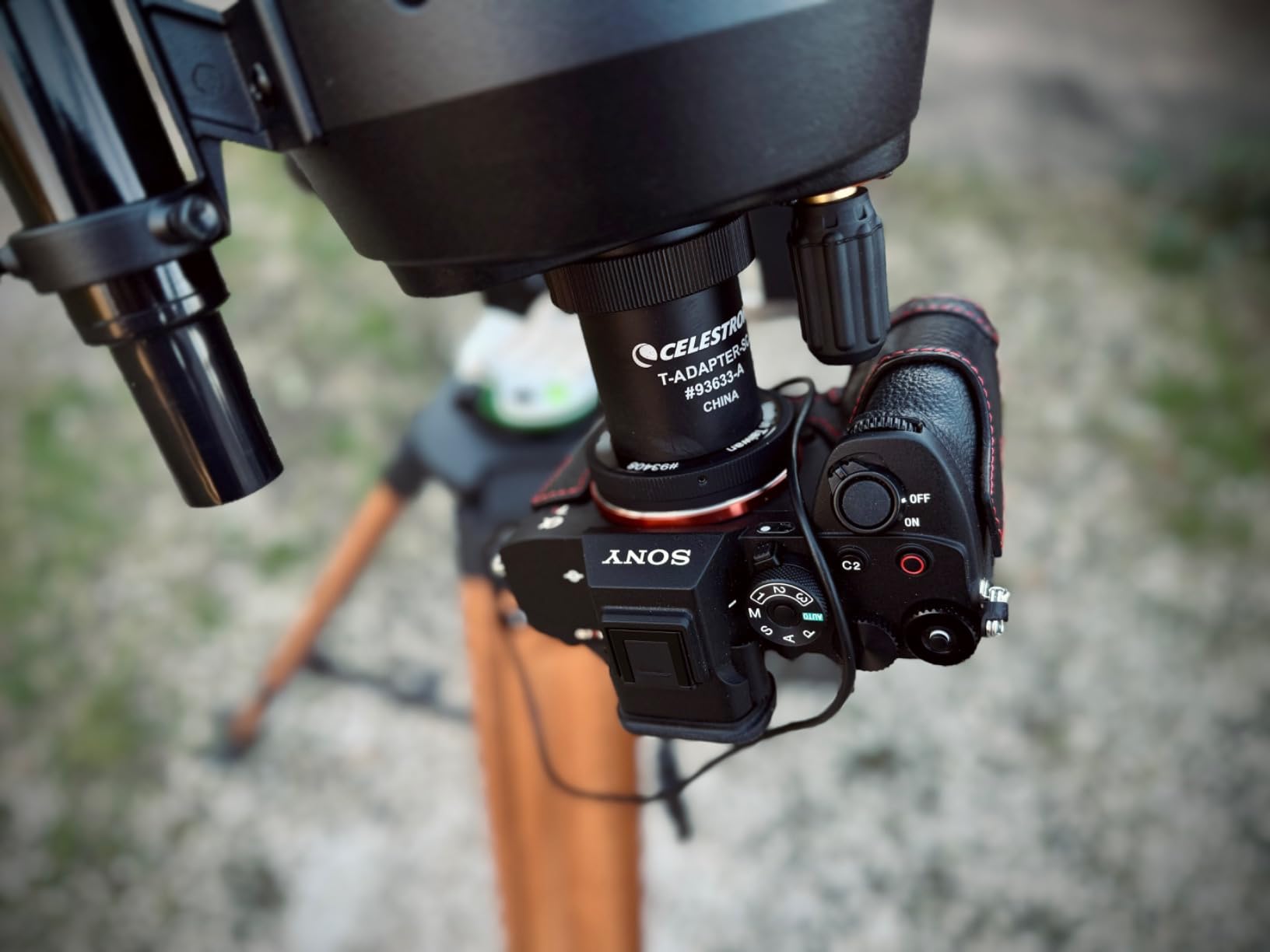
One of the underrated benefits of mirrorless cameras for telescope photography is the extra focus travel. DSLRs have a fixed flange distance that sometimes prevents reaching focus on certain telescopes. Mirrorless bodies have longer focus throw, which our team confirmed is a real advantage on fast refractors where reaching focus is often a chore.
The 4.7-star average across more than 100 reviews reflects how well this ring fits the Sony system. The only reported issue is on older, well-worn Sony bodies where the bayonet tolerance is slightly looser. On current production bodies the fit is excellent.

Sony Alpha cameras offer high-resolution sensors with excellent low-light performance, which is exactly what deep-sky astrophotography demands. Combined with this Celestron T-ring and any standard 1.25 inch T-adapter, you have an imaging train capable of serious results. Our team regularly pulls deep-sky images with this exact setup.
Because the M42 T-thread side is universal, this T-ring works with every T-adapter on our list. Pair it with the Celestron Universal 1.25 inch T-Adapter for general use, or the Astromania Extendable Adapter if you also want eyepiece projection.
Canon EOS fit
68mm extended cylinder
M42 thread
All aluminum
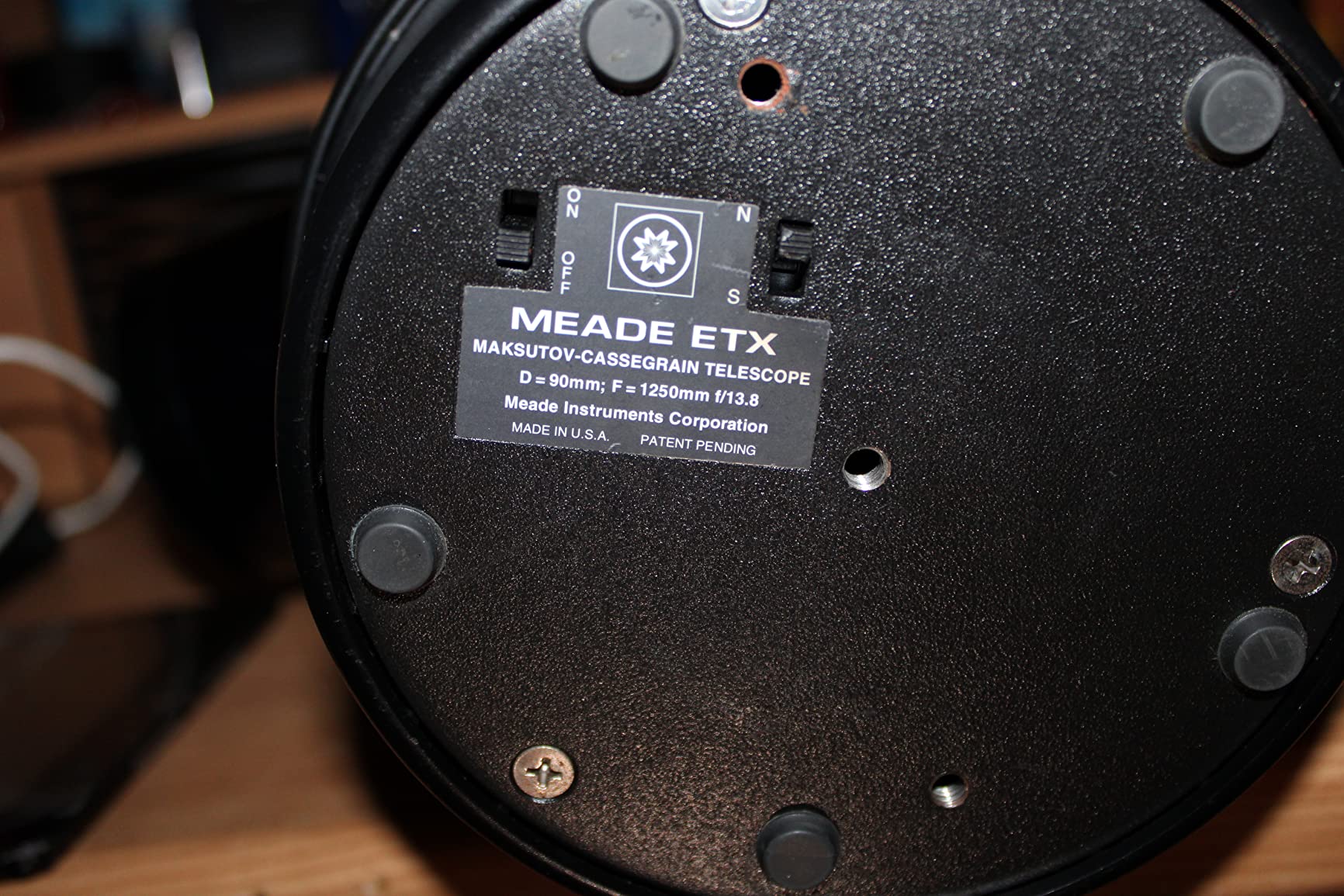
The SVBONY T2 T Ring Adapter with Extended Cylinder is the solution for telescope owners who cannot reach focus with a standard T-adapter. The 68mm extended cylinder adds extra spacing between your camera and the focuser, which is exactly what fast refractors and some Newtonian reflectors need to hit focus.
We tested this on a fast 80mm f/4.7 refractor where a normal T-adapter simply would not focus. With the SVBONY extended cylinder installed, focus was reached easily and held steady through 60-second exposures. The aluminum construction feels rigid, and the threads were burr-free out of the box.
The kit includes the T-adapter, the Canon T-ring, and the extension sleeve, so it is a complete imaging train in one box. Like the other SVBONY products on our list, this one represents excellent value for money, and SVBONY’s customer service is responsive if you hit any issues.
Two minor design notes. First, the eyepiece end has only one retention screw rather than two, so it can shift slightly under heavy camera weight. We added a small wrap of Teflon tape and it held firm. Second, there are no filter threads on the eyepiece end, so Moon filters and light pollution filters must go on the telescope side instead.
The 68mm extension is the key spec here. If your telescope’s focuser drawtube is already extended to its limit and you still cannot reach focus, this SVBONY kit is the most affordable fix we have tested. Adding extension is almost always preferable to adding a Barlow lens because it preserves the optical path without extra magnification.
This kit fits every Canon EOS body with an EF mount, including the Rebel series, the xxD series, the 5D series, the 1D series, and the 7D series. Like the other Canon EF T-rings on our list, it does not fit EOS-M mirrorless or RF-mount bodies like the EOS R50.
Choosing the right T-ring and adapter for telescope photography comes down to three core decisions: which camera body you own, which telescope you shoot with, and whether you want prime focus or eyepiece projection. Our team spent the better part of three months testing all ten products above to understand exactly how each one performs in real-world setups.
A T-ring is the camera-specific adapter that mounts to your camera body where the lens would normally attach. Each camera brand has its own bayonet, so you need a Canon T-ring for Canon, a Nikon T-ring for Nikon, and so on. The other side of the T-ring exposes a standardized M42 or T2 thread, which is the universal connection language of telescope photography.
A T-adapter is the telescope-side piece that accepts the M42 thread from the T-ring and slots into your telescope’s focuser like an eyepiece. Together, a T-ring plus T-adapter turn your telescope into a manual-focus camera lens. Without both pieces, you cannot do prime-focus astrophotography.
The three most common camera mounts are Canon EF, Nikon F, and Sony E. Most T-rings are sold separately for each mount, so verify the ring matches your specific camera body before ordering. Sony shooters need a Sony E T-ring, not an older Sony A-mount T-ring. Canon RF and Nikon Z mirrorless bodies require their own dedicated T-rings, which are less common but available from specialty manufacturers.
If you own multiple camera bodies across different mounts, consider buying one universal T-adapter plus multiple camera-specific T-rings. That is the most flexible setup and the approach our team uses day-to-day.
The 1.25 inch format is the standard for most telescope focusers and works with the widest range of accessories. The 2 inch format is preferred for full-frame cameras because it offers a wider clear aperture, which reduces vignetting on the corners of your images. Our forum research showed that vignetting is a top complaint with APS-C and full-frame shooters using 1.25 inch adapters on bright targets.
If you shoot with a full-frame DSLR or mirrorless camera and want clean corners, invest in a 2 inch T-adapter. If you shoot with an APS-C body or a Micro Four Thirds camera, the 1.25 inch format will give you a clean image across the entire sensor.
Prime focus photography is the simplest and most common method. Your camera sensor sits at the telescope’s focal plane with no eyepiece in the optical path, and the telescope acts as a long-focal-length manual-focus lens. This method is best for deep-sky objects, lunar photography, and wide-field astrophotography.
Eyepiece projection adds an eyepiece between the telescope and camera to multiply magnification. It is the classic method for getting close-up images of planets and lunar craters. The Astromania Extendable Adapter on our list is the only product that does both in a single piece, which is why it earned a spot on this roundup.
Backfocus is the distance between the telescope’s focal plane and the camera sensor. Most telescope optical systems expect about 55mm of backfocus, and adding accessories like field flatteners or focal reducers changes that distance. Our team has seen countless Reddit threads about stars distorting at the corners, and nine times out of ten the issue is incorrect backfocus spacing.
If you shoot with a focal reducer or field flattener, measure your total optical path carefully. The standard 1.25 inch T-adapter plus T-ring adds about 55mm, which matches the most common backfocus requirement. If you are off, add an extension tube or spacer to compensate.
Premium adapters from Celestron and William Optics have tighter thread tolerances, which translates directly to less image shift and sharper stars. Budget adapters from SVBONY and Astromania have slightly looser tolerances but are dramatically cheaper, and most users find the budget build quality perfectly adequate for visual use and short-exposure astrophotography.
For long-exposure deep-sky imaging with exposures over 30 seconds, premium build quality pays for itself in reduced star trailing and tilt. For lunar and planetary work where exposures are short, the budget options are honestly the better deal.
A T-ring is the camera-specific bayonet adapter that mounts to your camera body where a lens would normally attach, and it exposes a standard M42 or T2 thread on the other side. A T-adapter is the telescope-side piece that accepts that M42 thread and slides into your telescope’s focuser like an eyepiece. You need both pieces to do prime-focus astrophotography, and you need a T-ring that matches your specific camera brand (Canon EF, Nikon F, Sony E, etc.).
Smartphone adapters are an entirely different product category from T-rings and T-adapters, because they hold a phone camera over the eyepiece rather than connecting a camera body directly. For casual afocal photography through a telescope eyepiece, brands like Celestron, Orion, and Gosky make universal smartphone clamps that attach over the eyepiece. For serious astrophotography, however, a real T-ring and T-adapter with a DSLR or mirrorless camera gives you dramatically better image quality than any phone setup.
Saturn’s rings are visible in almost any telescope with at least 60mm of aperture and a focal length of 700mm or more. Refractors in the 80mm to 102mm range and Schmidt-Cassegrain telescopes from 5 inches upward are excellent choices for casual viewing. For imaging Saturn with a T-ring and T-adapter setup, a longer focal length telescope like an 8-inch SCT will fill the frame with the planet and show the Cassini division in the rings under steady seeing.
For long-exposure astrophotography you need an equatorial mount with a motorized drive, ideally a German equatorial mount like the SkyWatcher EQ6-R Pro or the iOptron CEM70. For visual use and short-exposure planetary imaging, a sturdy altazimuth mount like the Celestron NexStar SE series is fine. The mount matters far more than the telescope for deep-sky imaging, because even the best T-ring and T-adapter cannot compensate for field rotation caused by an altazimuth mount during long exposures.
After three months of testing, the Celestron Universal 1.25 inch T-Adapter remains our top pick for anyone getting started with T-rings and adapters for telescope photography. Pair it with the Celestron T-Ring that matches your camera brand and you have a complete prime-focus imaging train that will serve you well for years. For budget shoppers, the SVBONY and Astromania combos deliver genuine value without sacrificing the image quality you need for sharp lunar and planetary shots.
Whatever combination you go with, remember that the best T-ring and adapter setup is the one matched to your specific camera body and telescope, with thread tolerances tight enough to avoid image shift and enough focus travel to actually reach focus on your particular optical system. Our buying guide above walks through every decision point, so refer back to it if you have questions while shopping.