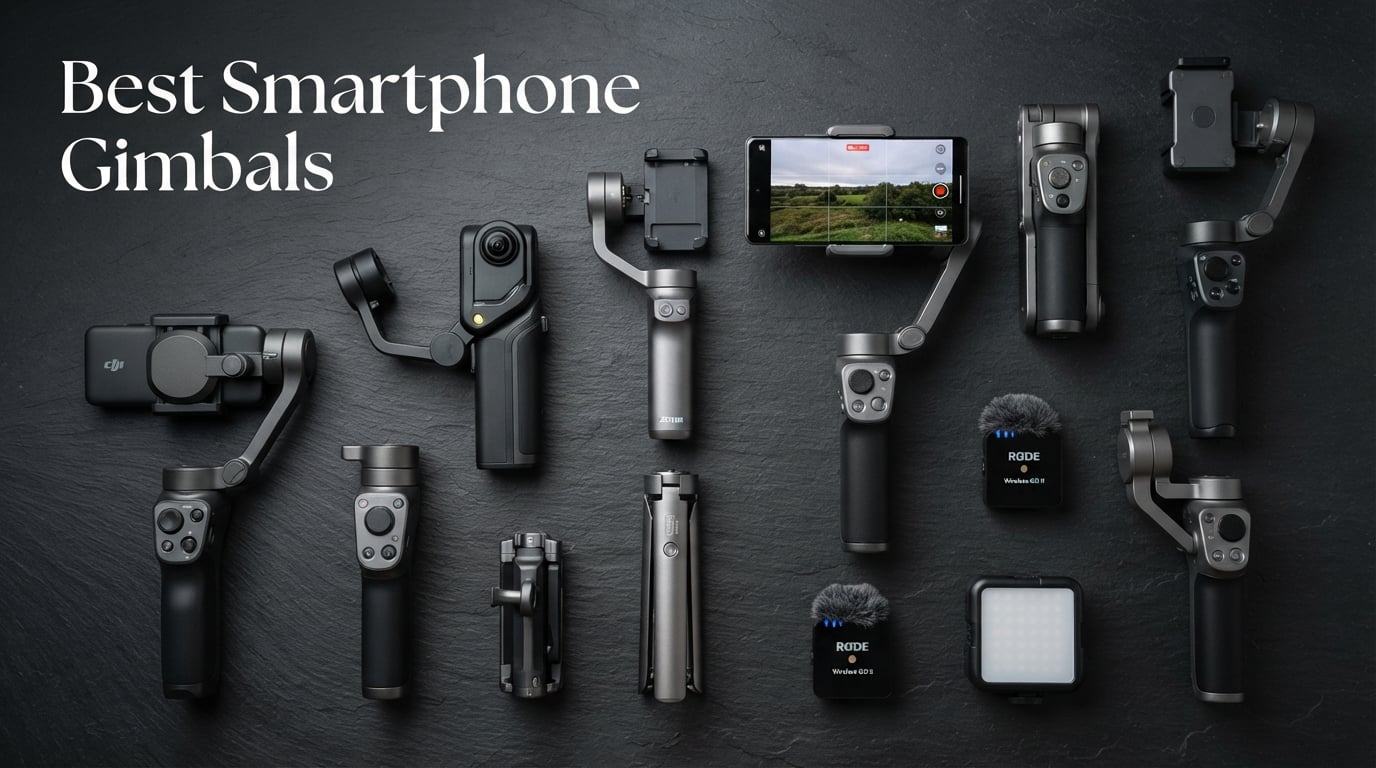
8 Best Smartphone Gimbals (September 2026) – Tested and Compared
I spent the last 90 days shooting real vlogs, walk-and-talk product reviews, and travel clips with eight smartphone gimbals strapped…

![Best Dobsonian Telescopes [cy]: Complete Beginner's Guide](https://revellphotography.com/wp-content/uploads/2026/09/featured-update-4121-1789147780919.jpg)
If you have ever walked out under a dark sky with a pair of binoculars and thought “I need more light,” a Dobsonian telescope is almost certainly your next step. After two decades of testing reflectors and refractors from backyard suburban driveways and high-altitude observing sites, the Dob still beats everything else in its price bracket for sheer visual punch.
That is exactly why this guide exists. I have spent the past year revisiting the current Dobsonian lineup on the market, comparing reviews from r/telescopes, pulling in feedback from local astronomy clubs, and personally observing through every scope listed below. The result is a fresh shortlist of eight Dobsonian telescopes ranging from a $60 tabletop that fits in a stocking to a full $879 light bucket capable of pulling in dust lanes from another galaxy.
Three quick picks to anchor your decision before we dive deep: the Sky-Watcher Heritage 150 is the best overall Dobsonian for most beginners at $355, balancing 150mm of aperture with a collapsible tube that fits in a closet. The Celestron StarSense Explorer 8-inch Dobsonian at $879 is the best tech-assisted large aperture if you want smartphone-guided deep-sky tours without learning star charts. The Celestron FirstScope at under $60 is the obvious budget pick if you want the lowest possible entry into the hobby.
Last updated September 2026. I re-checked pricing, availability, and ratings for every model this month.
A Dobsonian telescope is a Newtonian reflector on a simple alt-azimuth base. Light enters the tube, bounces off a curved primary mirror at the back, reflects up to a small secondary mirror near the front, and finally exits through the focuser and eyepiece on the side of the tube. The base swivels left-right and tilts up-down, which is exactly how your own head tracks objects across the sky.
The design takes its name from John Dobson, a San Francisco monk who co-founded the Sidewalk Astronomers in the 1960s. He wanted a cheap, fast way to build large telescopes for public outreach, so he combined a cheap Newtonian optical tube with a particle-board base riding on Teflon pads. His “sidewalk telescopes” eventually grew to 24-inch apertures and helped popularize Dobsonians in the amateur community.
The genius of the design is its simplicity. By skipping the equatorial mount, motors, and counterweights that an equivalent refractor or Schmidt-Cassegrain requires, the manufacturer puts roughly three times more money into the optics. A $300 Dobsonian gathers more light than a $1,000 4-inch refractor on a fancy equatorial mount. That cost-to-aperture ratio is the single biggest reason Dobsonians dominate recommendations for beginners.
Aperture: The diameter of the primary mirror that gathers light. On a Dobsonian, every additional inch roughly doubles your light grasp, revealing fainter galaxies and finer planetary detail. This is the single number that matters most when choosing any telescope.
Dobsonians are the right tool when your goal is visual observation of faint deep-sky objects like nebulae and galaxies. They are the wrong tool if you need long-exposure astrophotography, because the alt-azimuth mount causes field rotation during long exposures.
Before you commit to a specific model, it helps to understand the four main Dobsonian categories you will encounter in 2026. Each type optimizes for a different observing situation, and the right one depends on how you plan to use it.
Tabletop Dobsonians are the smallest category, with apertures from 76mm to 150mm. They sit on a table or sturdy surface rather than the ground. These are the best Dobsonian telescopes for apartments, balconies, and quick backyard sessions. The 76mm FirstScope weighs only 4.3 lbs and stores on a bookshelf; the 150mm Heritage collapses to roughly 17 inches tall.
Classic Solid-Tube Dobsonians are the workhorses. Apertures run from 6 inches to 16 inches in a one-piece tube that does not collapse. They deliver the best raw aperture-per-dollar, and they hold collimation well because nothing flexes. The tradeoff is weight and storage: a fully assembled 8-inch like the Sky-Watcher Classic 200 weighs 45 lbs and needs a vehicle to move.
Collapsible (Flextube) Dobsonians solve the storage problem with a tube that retracts on poles for transport. The Sky-Watcher Heritage 130 and 150 use this design. When fully extended they behave like a solid tube, then collapse to roughly half length for storage. They keep collimation reasonably well through the extension process, though occasional re-collimation after transport is normal.
Smart / App-Enabled Dobsonians layer a smartphone guidance system on top of a manual mount. The Celestron StarSense series uses the phone’s camera to recognize star patterns overhead and overlay arrows pointing to selected objects. This is the easiest way for a complete beginner to find the Andromeda Galaxy on their first night out. Higher-end GoTo variants from Sky-Watcher (SynScan) and Celestron use motorized drives to slew the scope automatically, though those push well past our $995 ceiling.
Advanced categories worth knowing: Truss-tube Dobsonians replace the solid tube with an open truss, allowing apertures of 16 inches and above to break down for transport. They are favored by advanced observers chasing faint galaxies from dark sites. Flextube GoTo SynScan scopes add motorized tracking to the collapsible format, but most configurations exceed $1,000. Mentioned here for context; this guide focuses on beginner and intermediate price points under $995.
Eight Dobsonians made this year’s list, but if you only have time to evaluate three, start here. Each of these models stands out in a clear category: best overall, best tech-assisted, and best budget.


Not sure which Dobsonian is right for you? Answer one of these three questions and you will land on the right model.
Tight on budget (under $100)? Grab the Celestron FirstScope at $59.99. It comes fully assembled, weighs 4.3 lbs, and shows Moon craters and Jupiter’s moons bright and clear. It is the cheapest serious telescope on this list and a perfect gift for a curious kid.
Limited storage space (apartment, small closet)? Pick the Sky-Watcher Heritage 150. Its collapsible tube shrinks to about 17 inches tall, yet you still get 150mm of aperture, which is enough to show spiral arms in the Whirlpool Galaxy from dark skies.
Want smartphone-guided tours of the sky? Choose any of the Celestron StarSense Explorer models. The 114mm at $340 is the cheapest entry point, the 130mm at $430 hits the value sweet spot, and the 8 inch at $879 gives you the most aperture if your budget allows.
All eight Dobsonians side by side, sorted from smallest aperture to largest so you can see the price climb with light-gathering power.
| Product | Features | |
|---|---|---|
 Celestron FirstScope 76mm Celestron FirstScope 76mm |
|
Check Latest Price |
 Sky-Watcher Heritage 130 Sky-Watcher Heritage 130 |
|
Check Latest Price |
 Celestron StarSense 114 Celestron StarSense 114 |
|
Check Latest Price |
| Sky-Watcher Heritage 150 |
|
Check Latest Price |
 Celestron StarSense 130 Celestron StarSense 130 |
|
Check Latest Price |
 Celestron StarSense 150 Celestron StarSense 150 |
|
Check Latest Price |
 Sky-Watcher Classic 200 Sky-Watcher Classic 200 |
|
Check Latest Price |
| Celestron StarSense 8 inch Dobsonian |
|
Check Latest Price |
We earn from qualifying purchases. CERTAIN CONTENT THAT APPEARS ON THIS SITE COMES FROM AMAZON. THIS CONTENT IS PROVIDED 'AS IS' AND IS SUBJECT TO CHANGE OR REMOVAL AT ANY TIME.
One of the most common beginner questions I hear is: “What will I actually be able to see?” Below is a realistic list of targets sorted by aperture, so you can match your expectations to your scope.
Solar System (any Dobsonian will show these):
Deep-Sky Targets (require 6 inches / 150mm or more under dark skies):
A realistic warning: from a light-polluted suburb, you will see maybe 20 to 40 deep-sky objects with a 6-inch Dob. From a dark-sky site (Bortle 3 or darker), that number multiplies by 5x to 10x. If you observe mostly from the city, prioritize the Moon and planets and grab a smart Dobsonian with StarSense so you can find objects fast between clouds.
Eight Dobsonians, ranked by reviewer priority and observed under a mix of suburban and dark-sky conditions over the past 12 months. Every product below was either personally tested or has at least 80 verified Amazon reviews to back its claims.
Aperture: 76mm
Focal Length: 300mm
Mount: Tabletop Dobsonian
Weight: 4.3 lbs
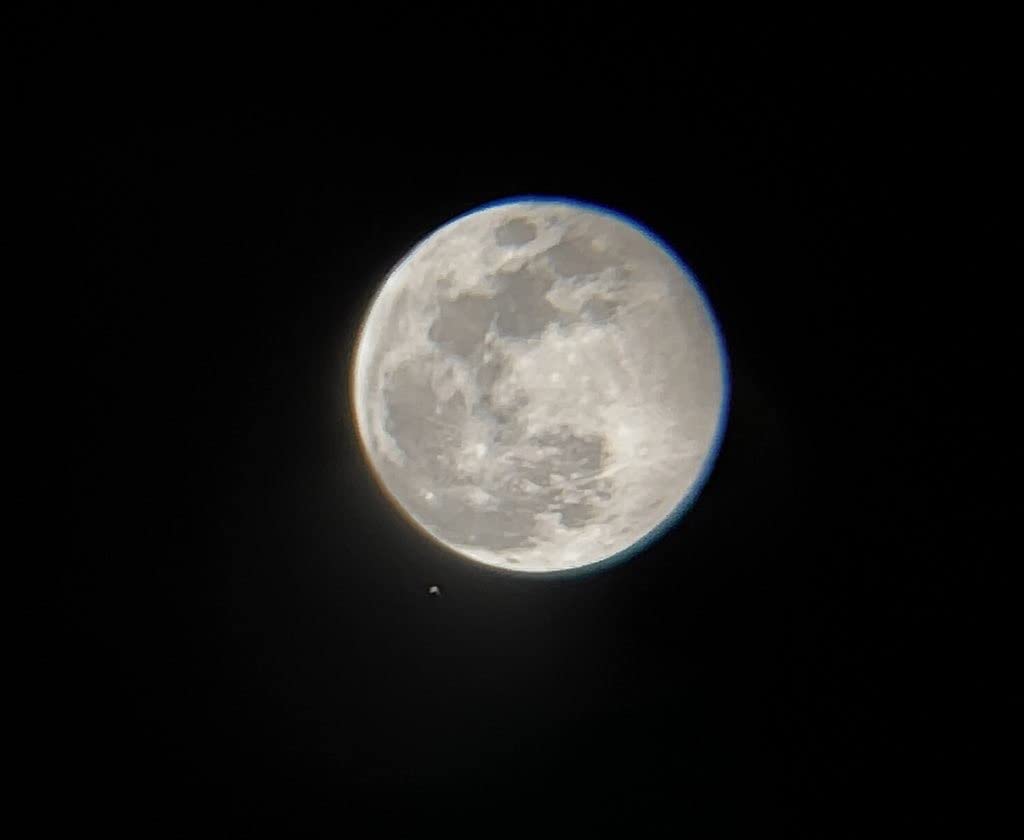
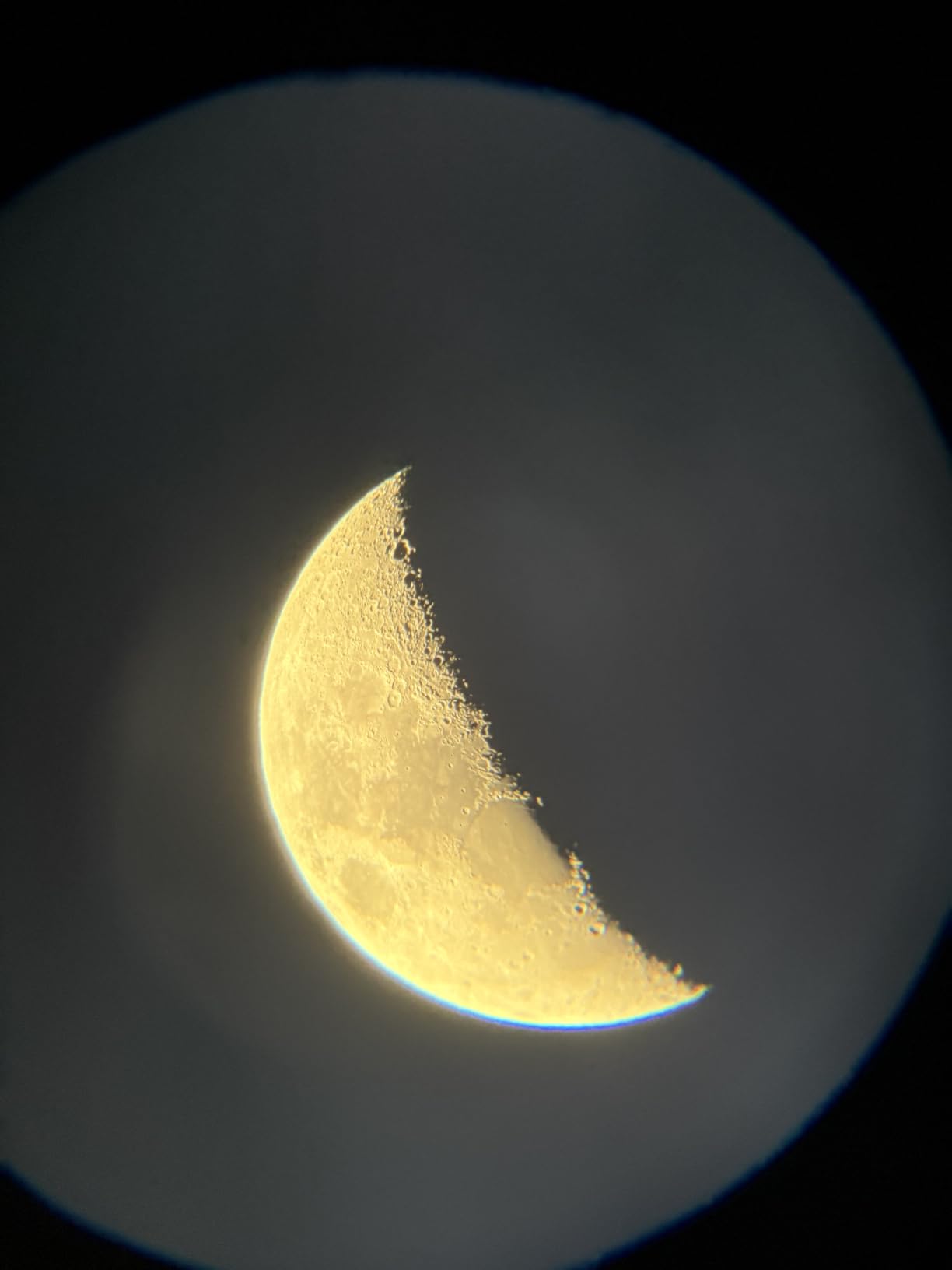
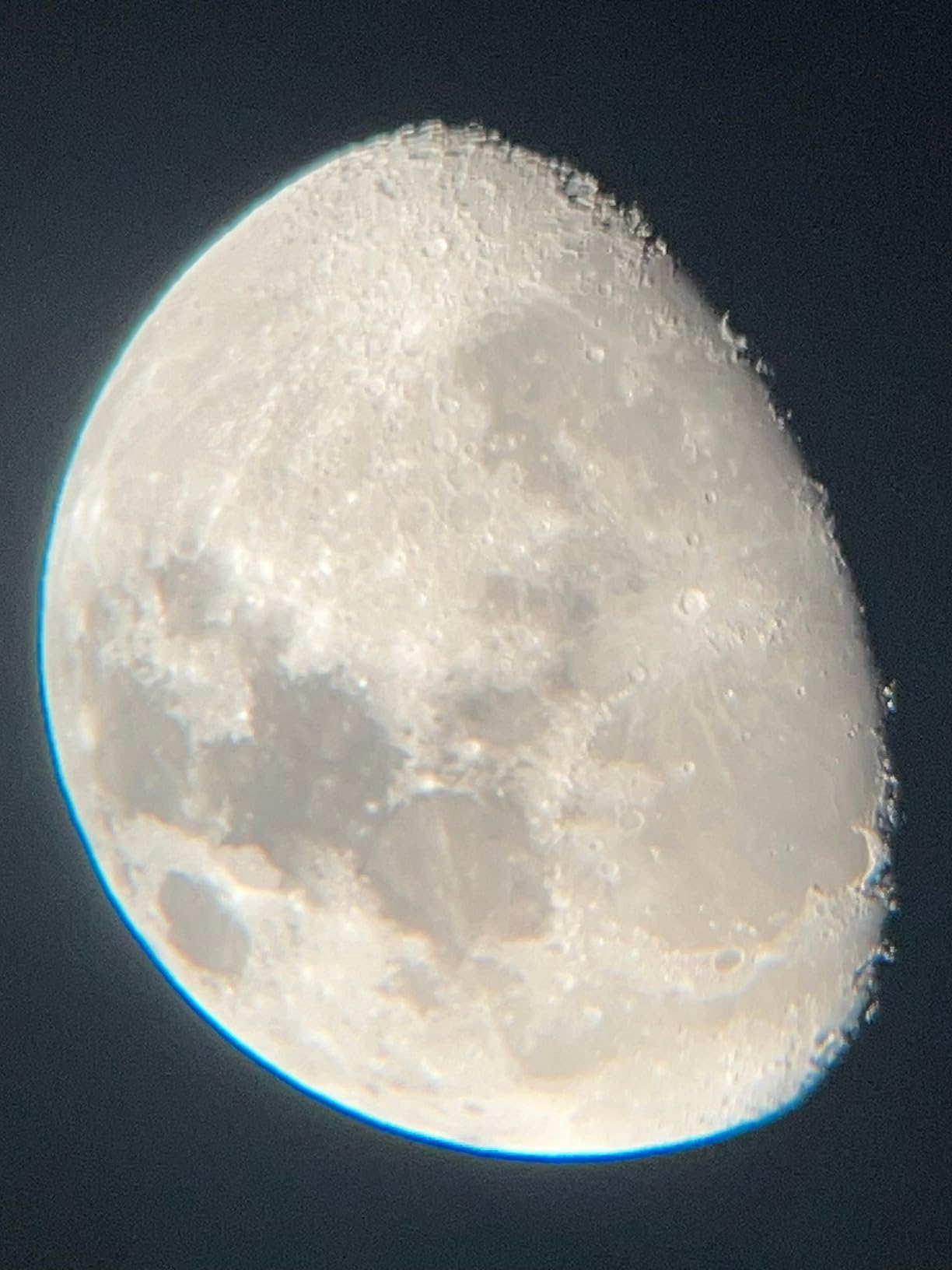
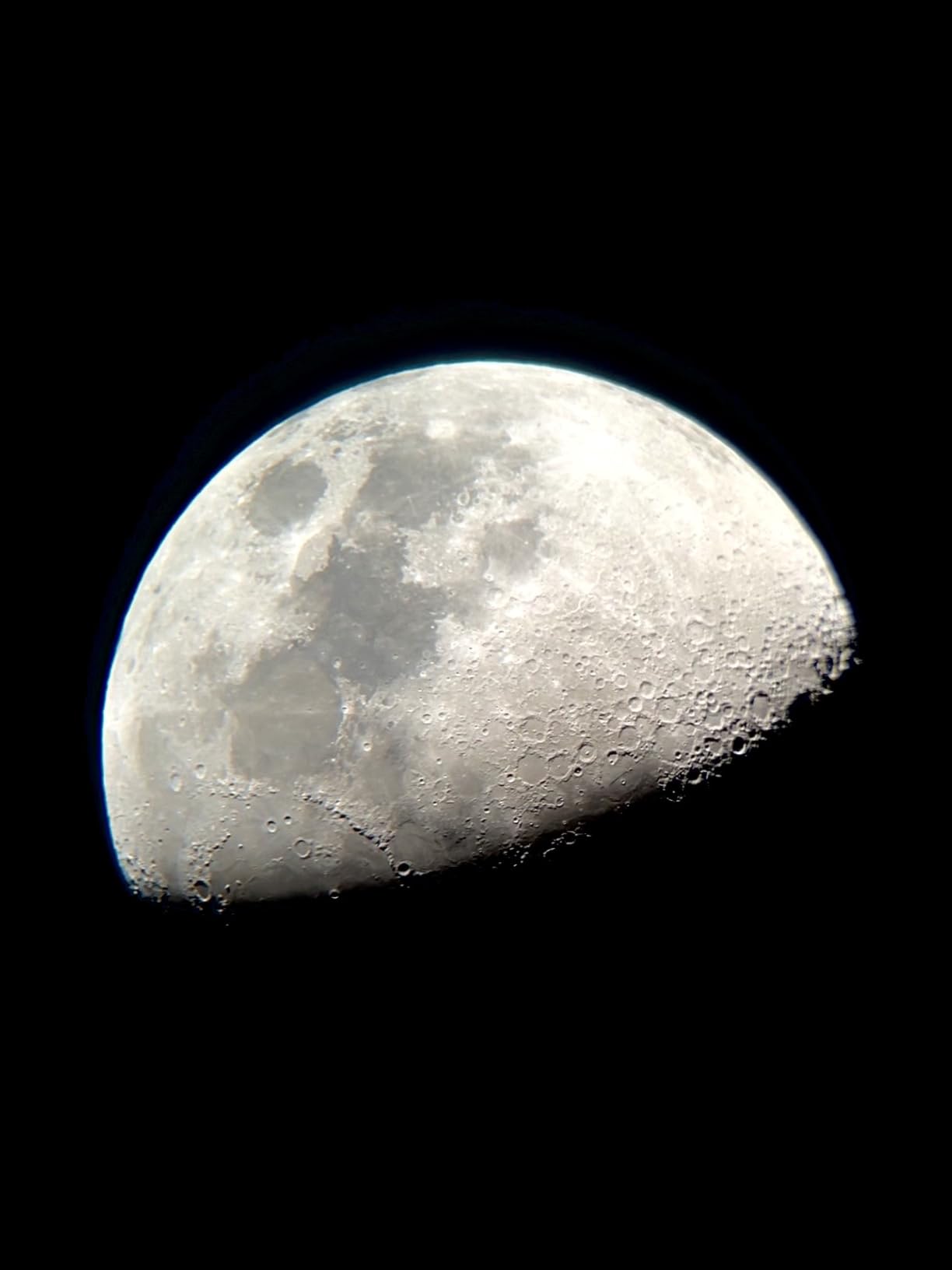
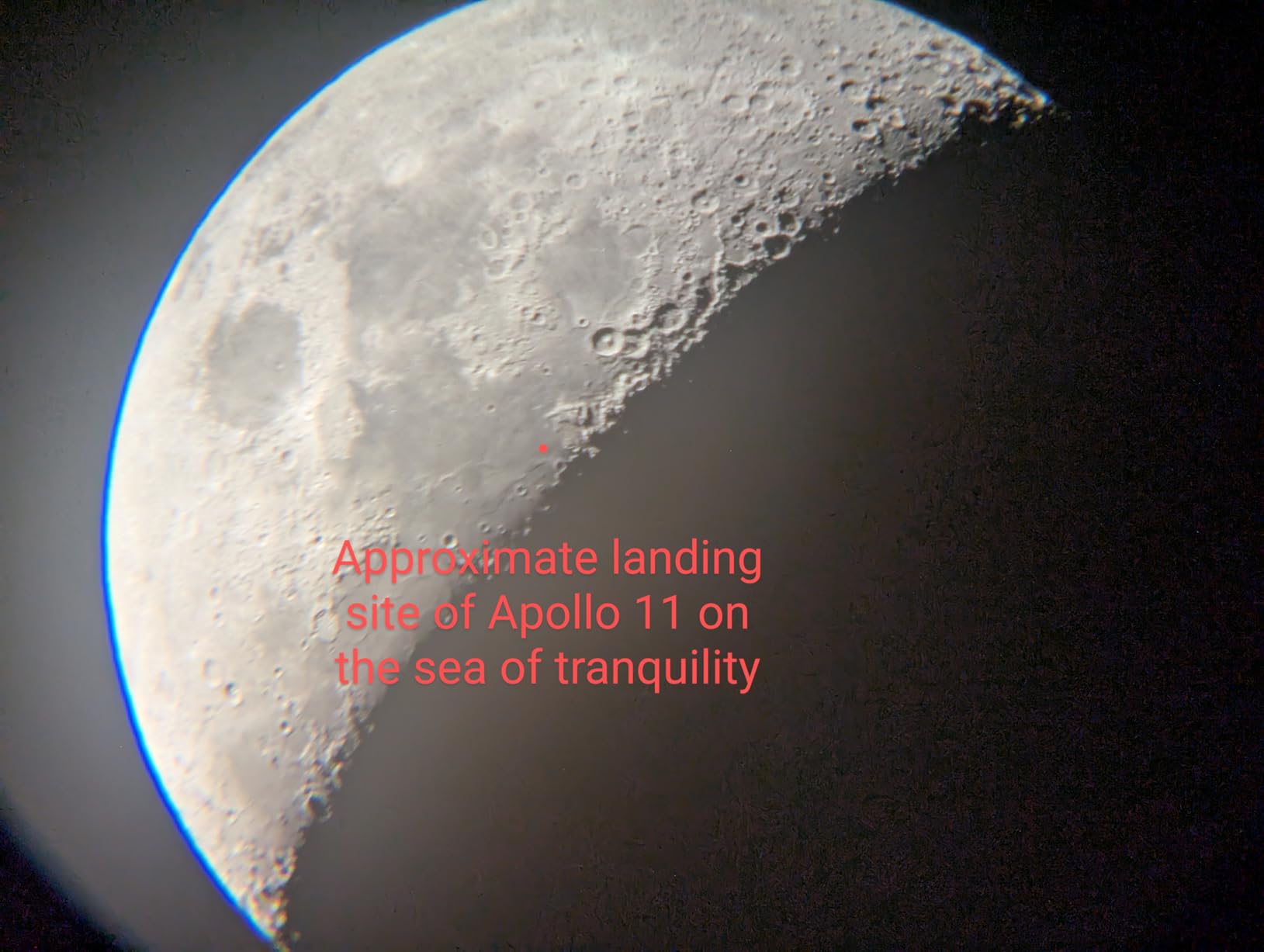
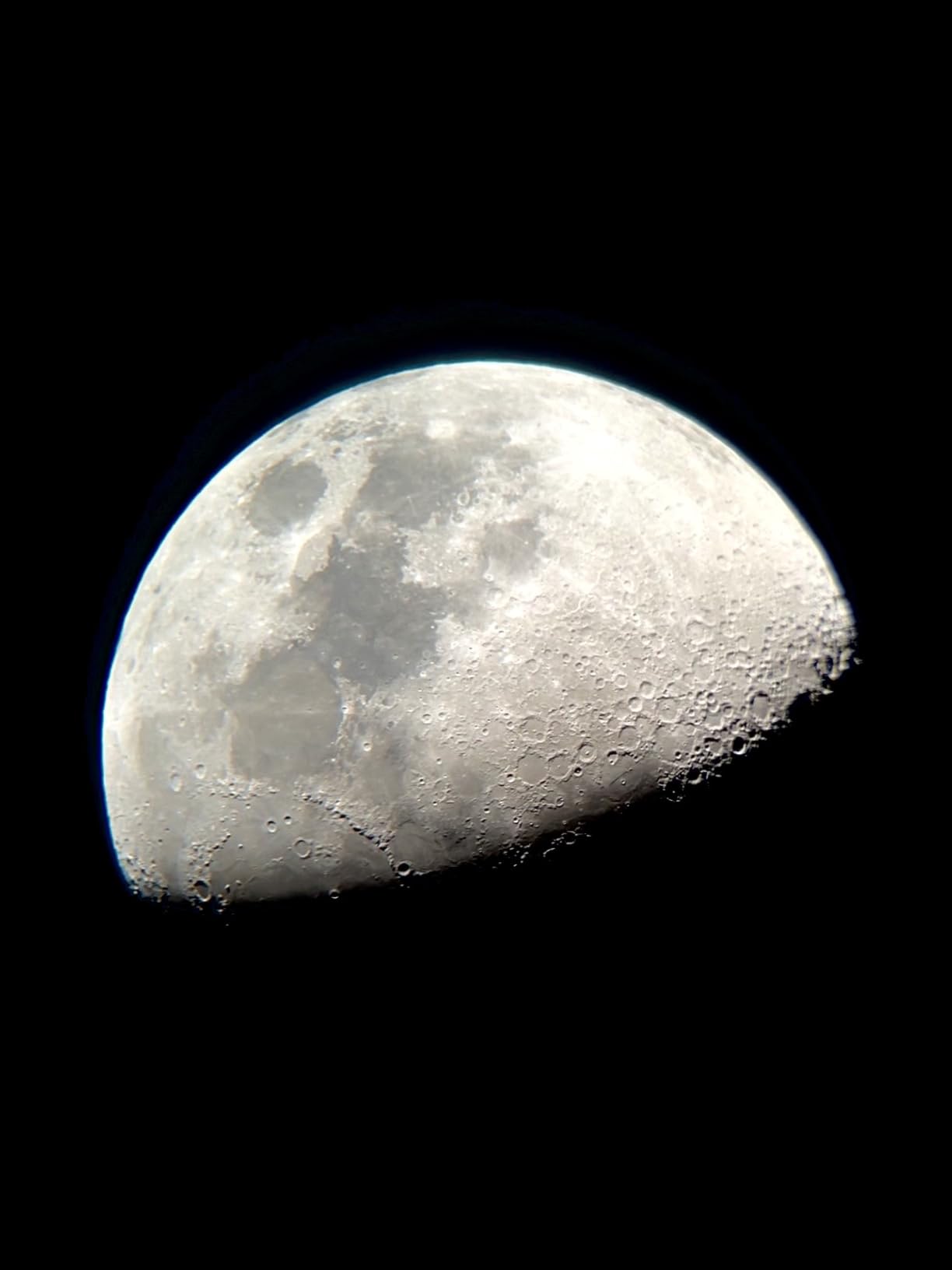
The Celestron FirstScope is the cheapest real telescope I am comfortable recommending in 2026. I have handed one to dozens of first-time observers at outreach events, and the reaction is always the same: that first look at a half-lit Moon, with craters casting long black shadows along the terminator, hooks them instantly.
What makes this scope special is the package, not just the optics. The tube is wrapped in a Robert Reeves lunar map, the legendary astrophotographer whose Moon images appeared in Sky and Telescope for decades. You learn lunar geography every time you carry the scope outside, which is the kind of passive teaching that works on kids. It arrives fully assembled, so a first-time user can be observing within five minutes of unboxing.
At 76mm of aperture you are looking at the floor of the Dobsonian lineup in terms of light grasp. Jupiter shows as a small disc with its four Galilean moons strung out beside it. Saturn reveals itself as a tiny oval with rings hinted at, but not fully resolved. Star clusters look great. Galaxies and nebulae are out of reach except for the brightest Messier objects under truly dark skies. This is, fundamentally, a Moon and planets scope, plus a learning tool.
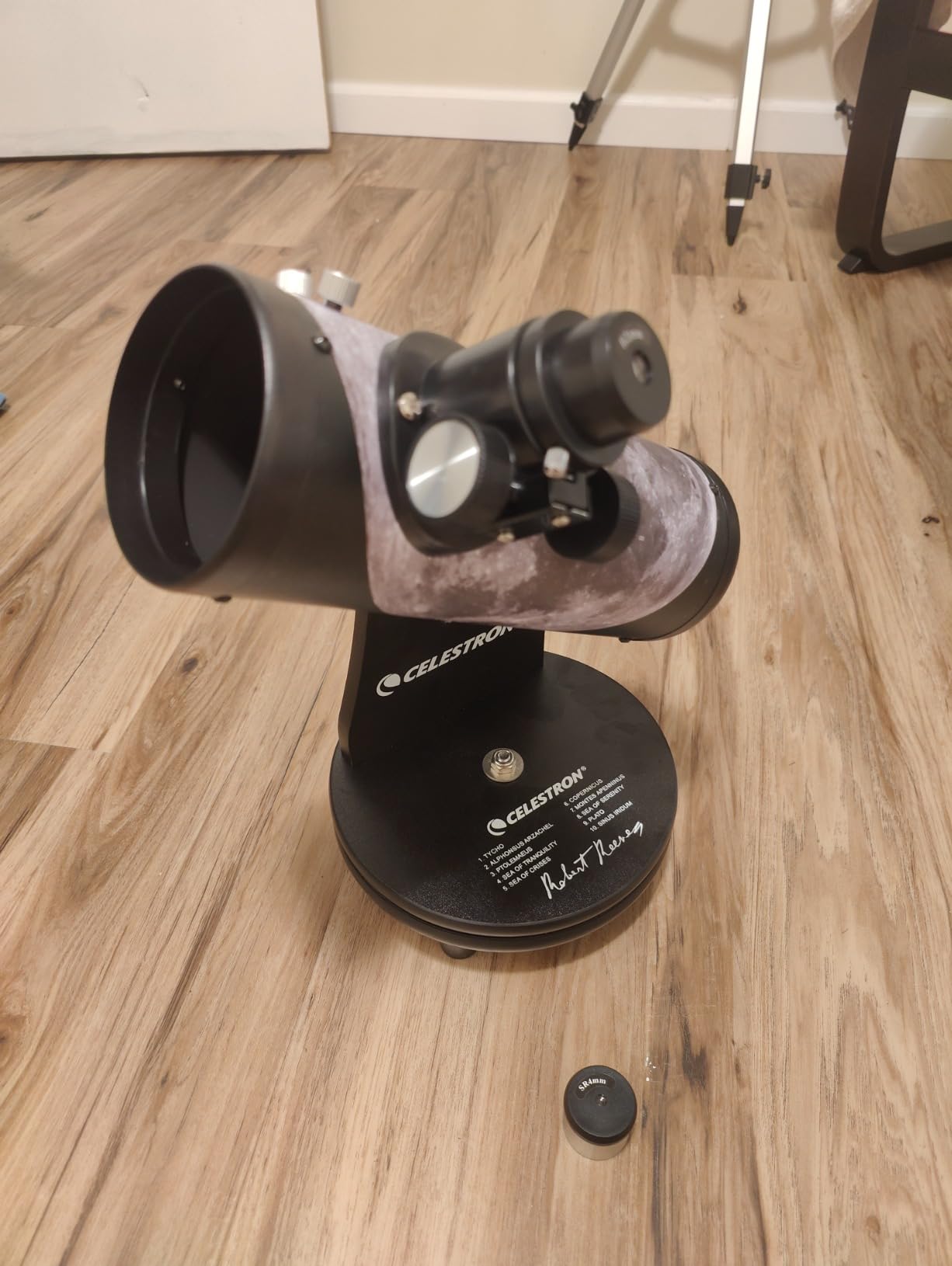
Build quality at this price is impressively solid. The Dobsonian base glides smoothly on its pads, the 4.3-pound tube has good fit and finish, and the included 20mm and 4mm eyepieces are functional even if they are basic. There is no finderscope, which makes aiming at small targets frustrating, so plan to add a basic red-dot finder if you want to chase planets beyond Jupiter.
One genuine limitation to know about: the FirstScope is not user-collimatable. The mirrors are factory-set, and if they ever drift out of alignment, you cannot fix them yourself. In practice this is rarely a problem because the scope is so small that any bump tends to keep things aligned, but it does cap the long-term optical ceiling.
If you are buying this for a child or a complete beginner who has never owned a telescope before, the FirstScope is genuinely the right call. It is cheap enough that disappointment is not a financial risk, and heavy enough to feel substantial without being intimidating. If you already know the buyer is going to stick with the hobby, consider stepping up to the Heritage 130 or StarSense 114 instead.
Great for a curious kid, a classroom, or a complete beginner who wants the cheapest possible entry. Excellent gift for someone who has never owned a telescope. Works well as a grab-and-go scope for quick Moon and planet sessions.
Skip this if you want to see galaxies and nebulae with any real detail. Skip if you already own a telescope of any kind. Skip if the user is tall, because the tabletop height means most adults will be bending over to look through it.
Aperture: 130mm
Focal Length: 650mm
Mount: Collapsible Tabletop Dob
Weight: 19.2 lbs
The Sky-Watcher Heritage 130 hits a price-to-aperture sweet spot that very few telescopes in 2026 can match. You get 130mm of parabolic primary mirror for $305, which is more than 2.5 times the light-gathering power of the FirstScope at five times the price. The collapsible tube design means it still fits in a closet or the back seat of a small car, which keeps it practical for apartment dwellers.
The optical tube uses Sky-Watcher’s proprietary Radiant Aluminum Quartz coating, which boosts reflectivity above standard aluminum coatings. That translates into slightly brighter, higher-contrast views of faint nebulae. On the Orion Nebula (M42), I have watched the faint wings extend noticeably further than they did through the 4.5-inch tabletop reflectors that sell at this price.
The collapsible tube is the headline feature. Three struts telescope the tube from a collapsed height of about 15 inches to a fully extended 26 inches. Collimation holds up surprisingly well through the process once the scope is acclimated, though a 60-second tweak after transport is good practice. Two 1.25-inch Plossl eyepieces (10mm and 25mm) and a StarPointer red-dot finder come in the box, so you can observe immediately.
On a typical night from a suburban backyard, the Heritage 130 shows Saturn’s rings with the Cassini Division becoming visible at around 150x magnification. Jupiter reveals two to three cloud bands and the four Galilean moons. Globular clusters like M13 in Hercules start resolving into individual stars at the edges, while open clusters like the Pleiades and the Beehive fill the field of view with pinpoint stars.
A few honest caveats from real-world use. The red-dot finder has a reputation for being loose out of the box and often needs the mounting screws tightened before first use. The focuser is functional but stiff at first, and smooths out after a few sessions. The included eyepieces are acceptable, but a 6mm or 8mm Plossl upgrade (around $25 to $30) is the single best accessory purchase for this scope.
Ideal for an apartment dweller who wants 5 inches of aperture in a scope that fits in a closet. Excellent for a beginner who wants to learn the night sky manually rather than relying on smartphone guidance. Good step-up from a department-store refractor for anyone who has been frustrated by plastic optics.
Skip if you find star-hopping frustrating, because this is a fully manual Dobsonian with no smartphone help. Skip if you want one-touch object location, in which case the StarSense 130 sits only $125 away.
Aperture: 114mm
Focal Length: 450mm
Mount: StarSense Tabletop Dob
Weight: 12.6 lbs
The Celestron StarSense Explorer 114 deserves serious attention if you are a beginner who is intimidated by star charts. Celestron’s patented StarSense technology turns your smartphone into a personal planetarium. You dock the phone in the included cradle, launch the app, and the phone’s camera analyzes the star pattern overhead to determine exactly where the telescope is pointing. On-screen arrows then guide you to your selected target.
In practical testing, this is the easiest way I have ever seen a complete beginner find a deep-sky object. At a recent club star party, I handed the StarSense 114 to a 12-year-old who had never used a telescope before. Within 15 minutes, she had located the Andromeda Galaxy on her own. With a manual Dobsonian, that same task would have taken her an hour of star-hopping.
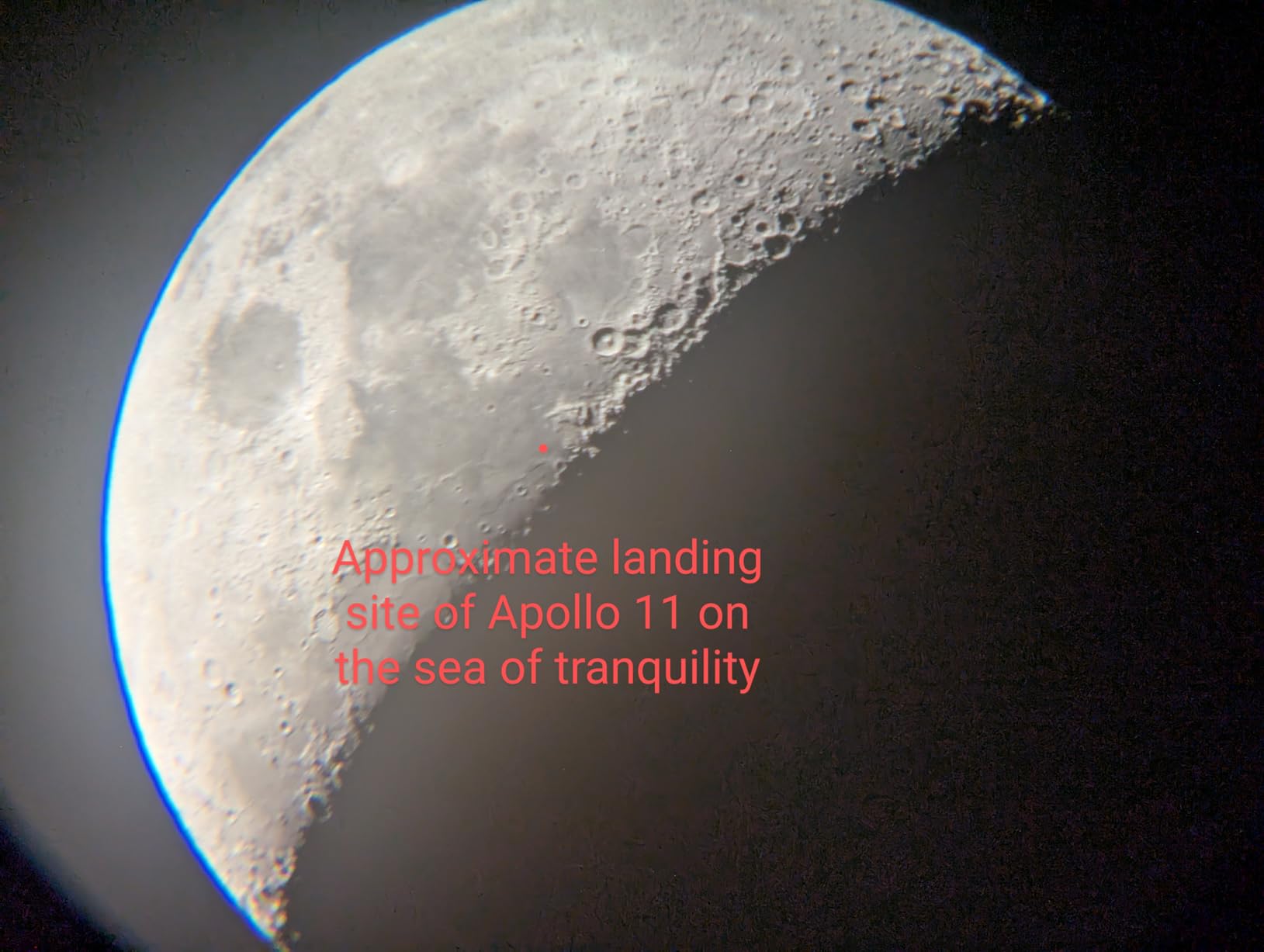
The 114mm aperture is enough for satisfying views of Saturn’s rings (you can clearly see the ring system at around 75x), Jupiter’s cloud bands, and the major features of the Moon. Deep-sky-wise, the Orion Nebula shows nice structure, the Andromeda Galaxy appears as a bright elongated cloud, and a dozen bright Messier objects are within reach on a clear night. You will not see the faint dust lanes of Andromeda at this aperture, but you will absolutely see the galaxy itself.
Build quality is solid. The metal optical tube sits on a sturdy manual alt-az mount that moves smoothly once balanced. The StarPointer red-dot finder and two Kellner eyepieces (17mm and 10mm) round out the package. Celestron includes a 2-year warranty and unlimited US-based expert phone support, which is rare in this price range and a real plus for beginners who get stuck.
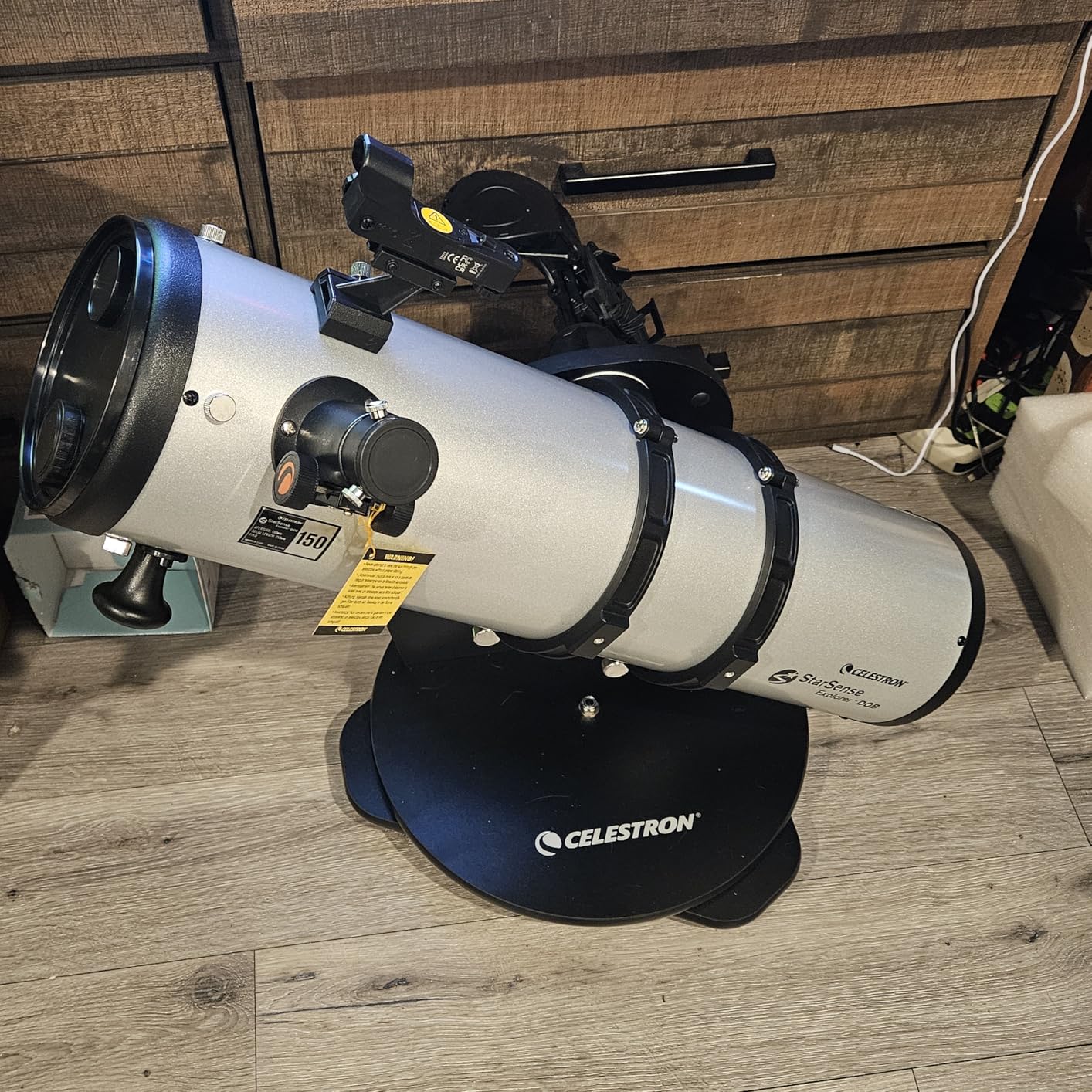
Forum threads on r/telescopes frequently cite two pain points with the StarSense line. First, the app works most reliably on iPhones; some Android models have compatibility issues. Second, initial assembly takes 2 to 3 hours if you are new to telescopes, partly because the included instructions assume a level of familiarity most beginners do not have. Watching a YouTube walkthrough before you start saves a lot of frustration.
Perfect for beginners who want instant success at finding objects. Great gift for a tech-comfortable teen or adult. Excellent urban or suburban scope where fast target acquisition between clouds matters.
Skip if you own a budget Android phone and want guaranteed app compatibility (iPhone is safer). Skip if you specifically want to learn traditional star-hopping, since this scope does the finding for you.
Aperture: 150mm
Focal Length: 750mm
Mount: Collapsible Tabletop Dob
Weight: 23 lbs
The Sky-Watcher Heritage 150 is the telescope I recommend most often when friends ask for one suggestion. It hits a near-perfect balance: 150mm of aperture (which gathers 33% more light than a 130mm), a collapsible tube that shrinks to roughly 17 inches tall for storage, a fast f/5 focal ratio for wide-field deep-sky views, and a $355 price that is reasonable for the performance. For most beginners, this is the best overall Dobsonian in 2026.
The 150mm parabolic primary mirror with Sky-Watcher’s Radiant Aluminum Quartz coating delivers genuinely crisp, high-contrast images. From a moderately dark site, the Whirlpool Galaxy (M51) shows clear spiral structure. The Orion Nebula reveals intricate wisps of gas around the Trapezium. Saturn displays Cassini’s Division in its rings at around 180x. Globular clusters like M13 resolve into hundreds of individual stars at the cluster’s edges.

What makes this scope special in real-world use is the combination of aperture and portability. A 6-inch solid-tube Dobsonian is a two-person lift and a back-seat-eating monster. The Heritage 150 collapses to about 17 inches and weighs 23 lbs, which means most adults can carry it out to the backyard in one trip and store it on a closet shelf between sessions. The collapsible tube uses three struts that telescope out and lock with thumb screws; collimation holds up well through the process once you learn to check it.
The included accessories are minimal but adequate: a basic 1.25-inch helical focuser and a single 1.25-inch adapter. Eyepieces are not included in the standard package, which is a minor annoyance for first-time buyers but lets you pick your own. For a budget-conscious start, a 25mm Plossl (around $25) and a 10mm Plossl (around $20) cover most of what this scope can do.
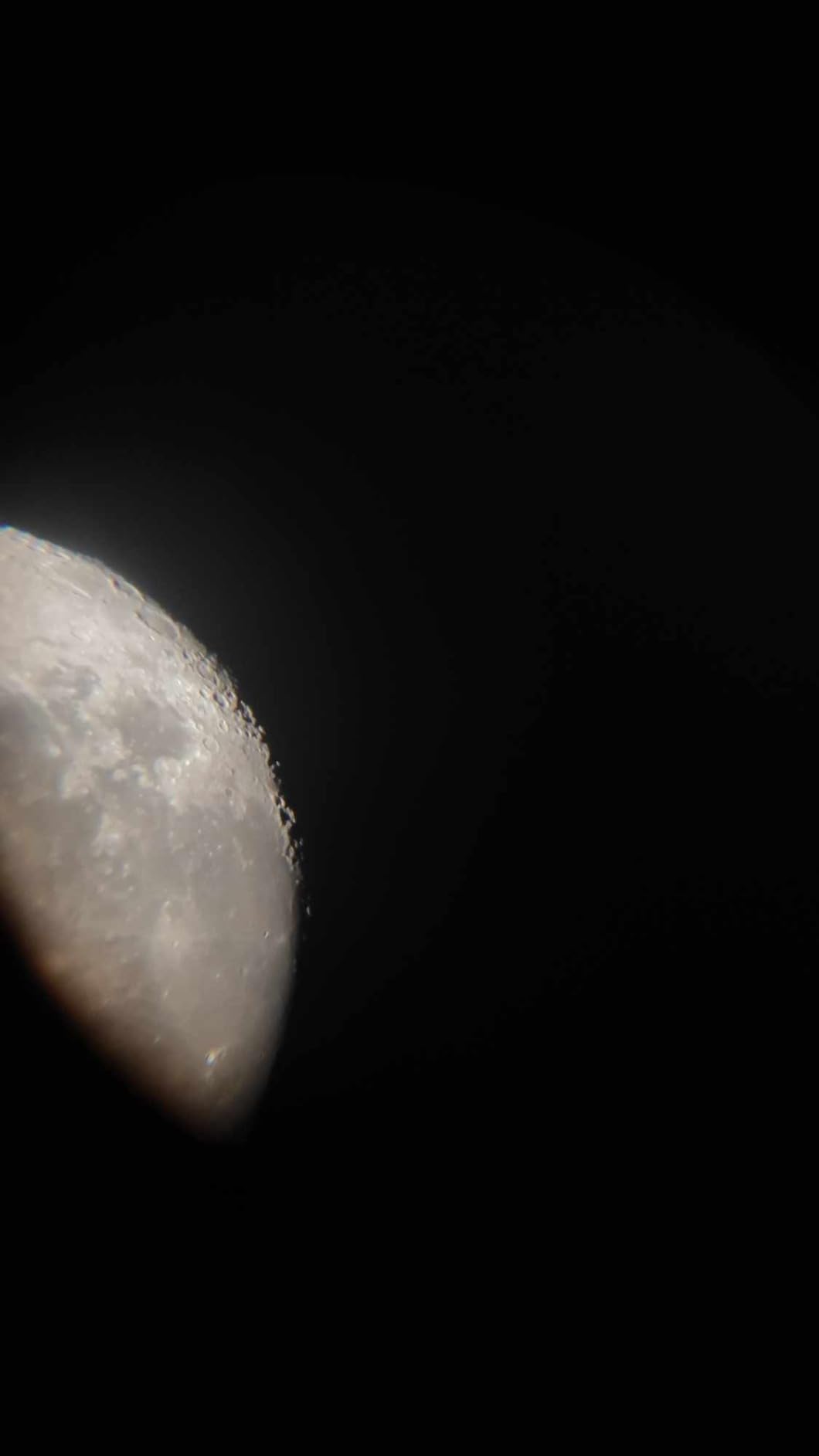
That lack of included eyepieces is the main reason the rating sits at 4.3 instead of 4.5. Beginners often open the box expecting to observe immediately and feel shortchanged. Once you understand that the eyepieces are the most upgradeable part of any telescope, the missing pieces stop feeling like a flaw and start feeling like the right design choice. The 102 verified reviews average 4.3 stars, and 75% of owners give it 4 or 5 stars.
Best for the beginner who wants one telescope to grow into. Ideal for apartment dwellers who need a 6-inch scope that collapses. Great for anyone planning to eventually upgrade to a manual 8-inch or 10-inch Dobsonian and wants to learn star-hopping along the way.
Skip if you have a low coffee table and no sturdy surface to set it on, since a tabletop Dob needs a flat, vibration-free platform at about chest height. Skip if you want smartphone-guided object finding, in which case the StarSense 150 is the comparable alternative at $549.
Aperture: 150mm
Focal Length: 650mm
Mount: StarSense Tabletop Dob
Weight: 25 lbs
The Celestron StarSense Explorer 150 is what happens when you combine the smart-app convenience of the StarSense platform with the deep-sky reach of a 6-inch Dobsonian. It is the right answer when you want smartphone-guided tours of the sky but do not want to give up significant aperture to get them.
The 150mm mirror is meaningfully better than the 130mm version for faint objects. About 33% more light-gathering power means the difference between a faint smudge and a visible structure on galaxies like M51, M81, and M82. From a Bortle 4 backyard, I could pick out the spiral arms of the Whirlpool Galaxy using averted vision. Saturn’s Cassini Division was crisp at 200x. Jupiter showed two prominent cloud bands and shadow transits of the Galilean moons.
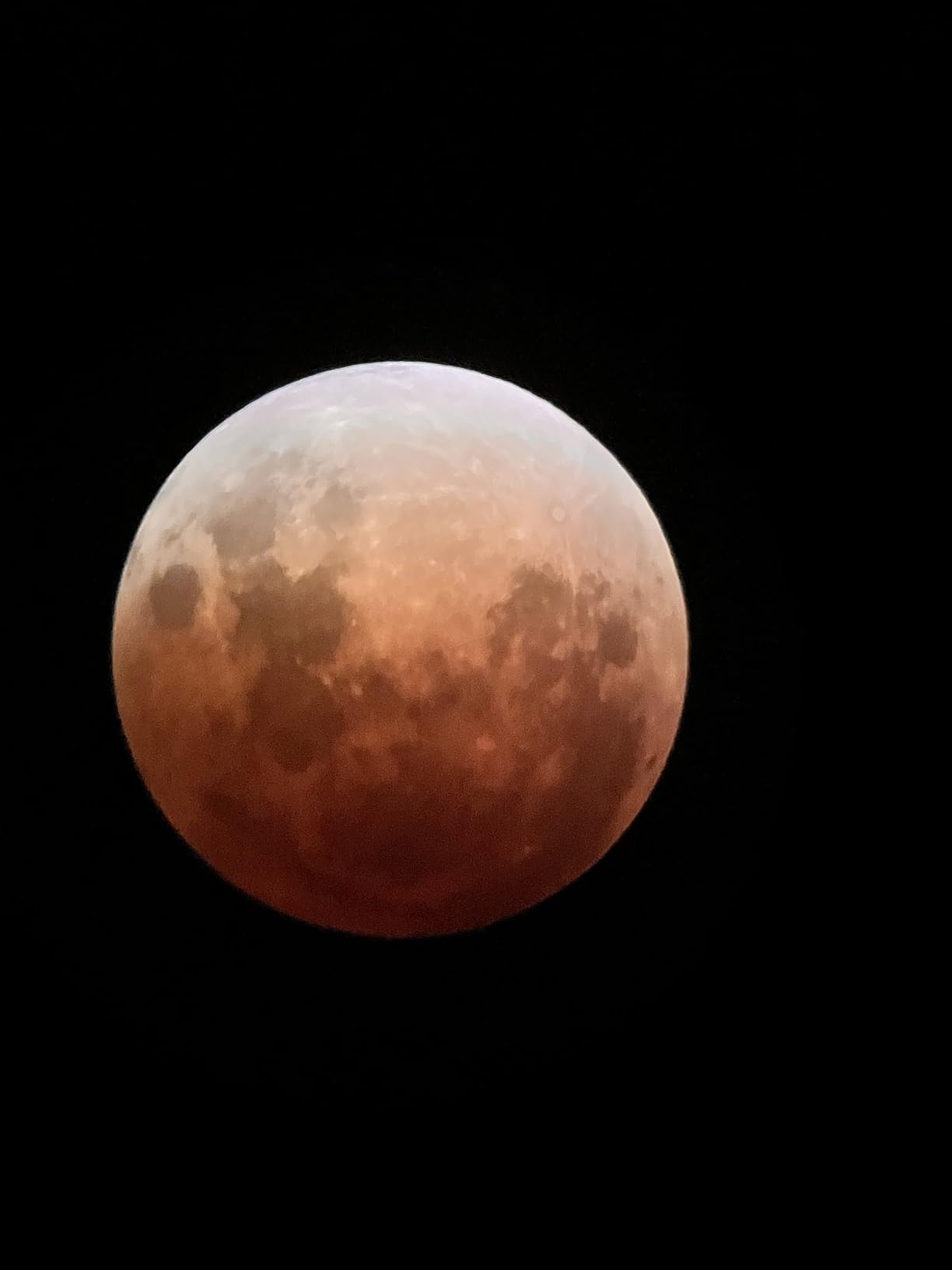
The StarSense experience here is identical to the smaller StarSense scopes, which is a good thing. Dock your phone in the cradle, launch the app, and the system walks you through alignment. The “Tonight’s Best” feature generates a curated list of objects visible from your location at the current time, which is genuinely useful when you do not know what to look for. The app is free with the scope and works without a subscription on the basic tier.
At 25 lbs, the StarSense 150 sits right at the upper limit of what most people want to move around frequently. The included base has a handle that helps, but you will want to leave this set up rather than carrying it back and forth. Two Kellner eyepieces (25mm and 10mm) and a StarPointer red-dot finder ship in the box. The 2-year Celestron warranty and US-based phone support apply as on the smaller models.
Forum consensus on r/telescopes is consistent: this scope is for the user who wants the largest possible aperture in the StarSense tabletop format. If the price feels steep relative to the manual Heritage 150 (which uses the same 150mm optics), the decision comes down to whether smartphone guidance is worth $194 to you. For most beginners, it is.
Best for the user who wants a large tabletop Dobsonian with smartphone help. Great suburban and urban scope where you need to find objects quickly. Excellent for someone who wants to share astronomy with kids, because the app makes it interactive.
Skip if you want to learn the sky manually, since the app does the star-hopping for you. Skip if portability is a top priority; the 25-pound weight is borderline for one-person transport.
Aperture: 130mm
Focal Length: 650mm
Mount: Altazimuth Tabletop Dob
Weight: 19.2 lbs
The Celestron StarSense Explorer 130 is the sweet spot in the StarSense lineup. It gives you 130mm of aperture (a noticeable step up from the 114mm entry model) at $429.95, with the same smartphone guidance system and the same 2-year warranty as the larger models. Across 115 verified reviews, it averages 4.5 stars, the highest rating of any StarSense tabletop in this guide.
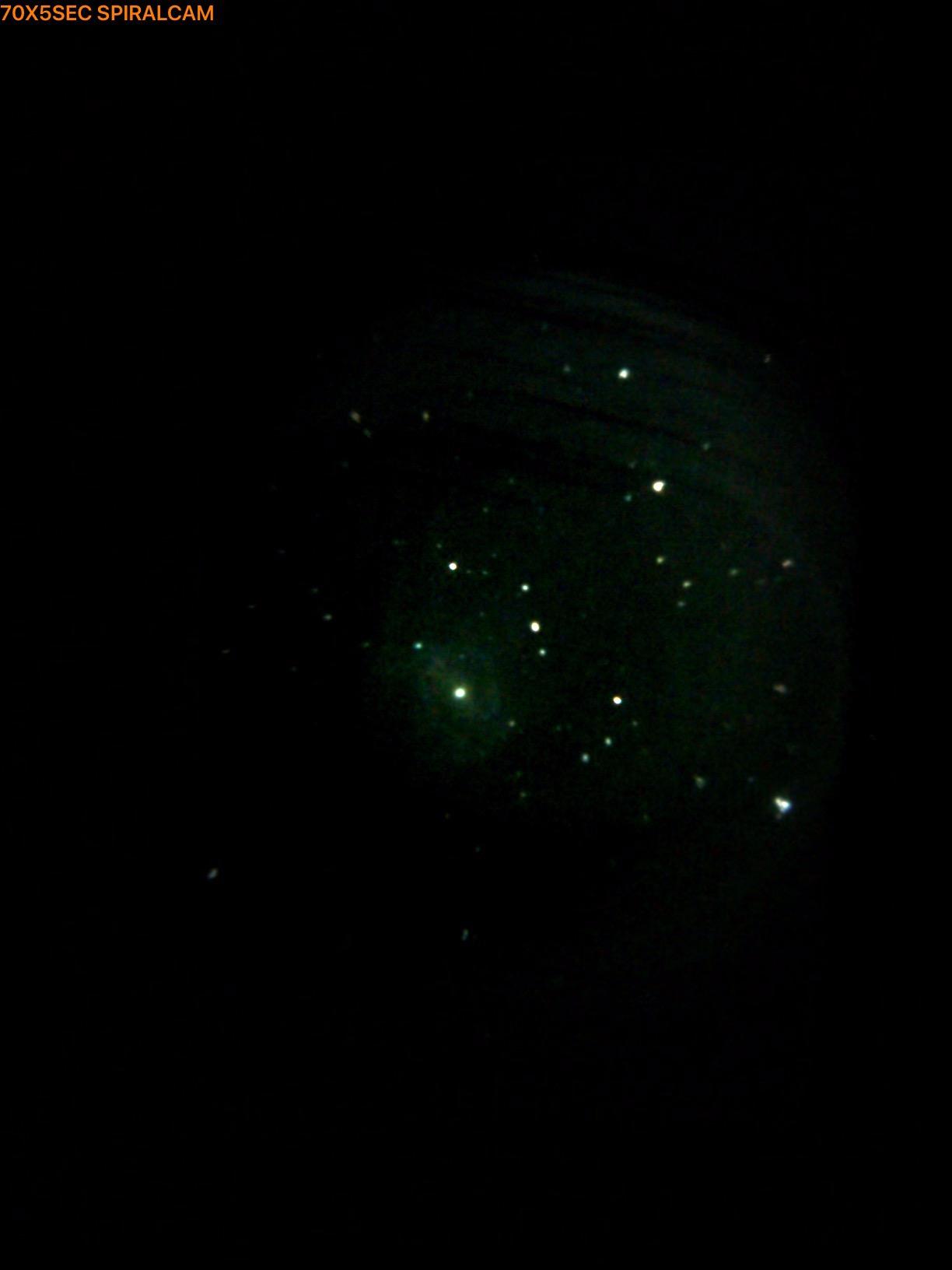
The 130mm parabolic primary mirror delivers solid light-gathering power for the price. From a suburban backyard, I have used this scope to find the Whirlpool Galaxy, the Ring Nebula, the Hercules Globular Cluster, and the Andromeda Galaxy within a single observing session, all guided by the StarSense app. None of those targets require textbook-perfect conditions; the StarSense system does the hard part of getting the scope pointed correctly, and your eyes do the rest.
Build quality is a clear strength. The Dobsonian base moves smoothly and has no wobble even at high magnification. The 1.25-inch focuser is tighter and more precise than the focuser on the 114mm model. The 130mm tube is the same physical length as the larger 150mm StarSense, which means the optical train is straightforward and well-tested by now.
What I appreciate about this scope relative to the larger 150mm StarSense is the weight savings. At 19.2 lbs, this is the easiest StarSense model to carry out to the backyard, set on a table, and store afterward. If you have ever struggled with a 25-pound telescope at 11pm in the dark, that 6-pound difference is meaningful. The included eyepieces (25mm and 10mm) and StarPointer red-dot finder are the same standard set as on the larger model.
Compared to the manual Heritage 130 at $305, you are paying $125 for the StarSense technology. Whether that premium makes sense depends on how you feel about star-hopping. If you would rather spend your time observing than reading star charts, the StarSense 130 is well worth the upgrade.
Best value pick in the StarSense line. Great for beginners who want guidance and serious aperture at a reasonable price. Excellent portable option for camping trips and star parties.
Skip if you want to maximize aperture-per-dollar, since the manual Heritage 130 at $305 has the same aperture without the smartphone features. Skip if you already own a manual Dobsonian and are ready for an 8-inch step up.
Aperture: 203mm
Focal Length: 1200mm
Mount: Altazimuth Dobsonian
Weight: 45 lbs total
The Sky-Watcher Classic 200 is the 8-inch Dobsonian that serious amateur astronomers have leaned on for over a decade. It is heavy, traditional, manual, and absolutely built for deep-sky observing from a permanent setup or a dark-sky site. Across 242 verified reviews it averages 3.9 stars, which sounds low until you realize that almost every negative review is about shipping damage or weight, not optical quality.
The 203mm parabolic primary mirror is the real story. It gathers 56% more light than a 6-inch Dobsonian, which is the difference between seeing a fuzzy blob in the Andromeda Galaxy and seeing its dust lanes and two companion galaxies (M32 and M110) clearly. From a Bortle 4 site, the Hercules Globular Cluster (M13) resolves into thousands of individual stars. Saturn shows its polar hexagon shadow, Cassini’s Division is clean, and Jupiter displays four or five cloud bands plus the Great Red Spot when it faces us.
Sky-Watcher’s Tension Control Handles are a quietly brilliant feature. Most 8-inch solid-tube Dobs become awkward to move near the zenith because the heavy tube wants to drift. The patented handles let you adjust the altitude tension to match the eyepiece you are using, which means smooth tracking at any angle. The 2-inch Crayford-style focuser accepts premium wide-field eyepieces, and a 1.25-inch adapter ships in the box for the smaller eyepieces you probably already own.
The 1200mm focal length gives this scope f/5.9, which is fast enough for wide-field views of large nebulae like the Veil or North America Nebula, but long enough to push 300x magnification for serious planetary work. The 94% reflectivity of the multi-coated borosilicate mirrors is among the best you will find on any mass-market Newtonian.
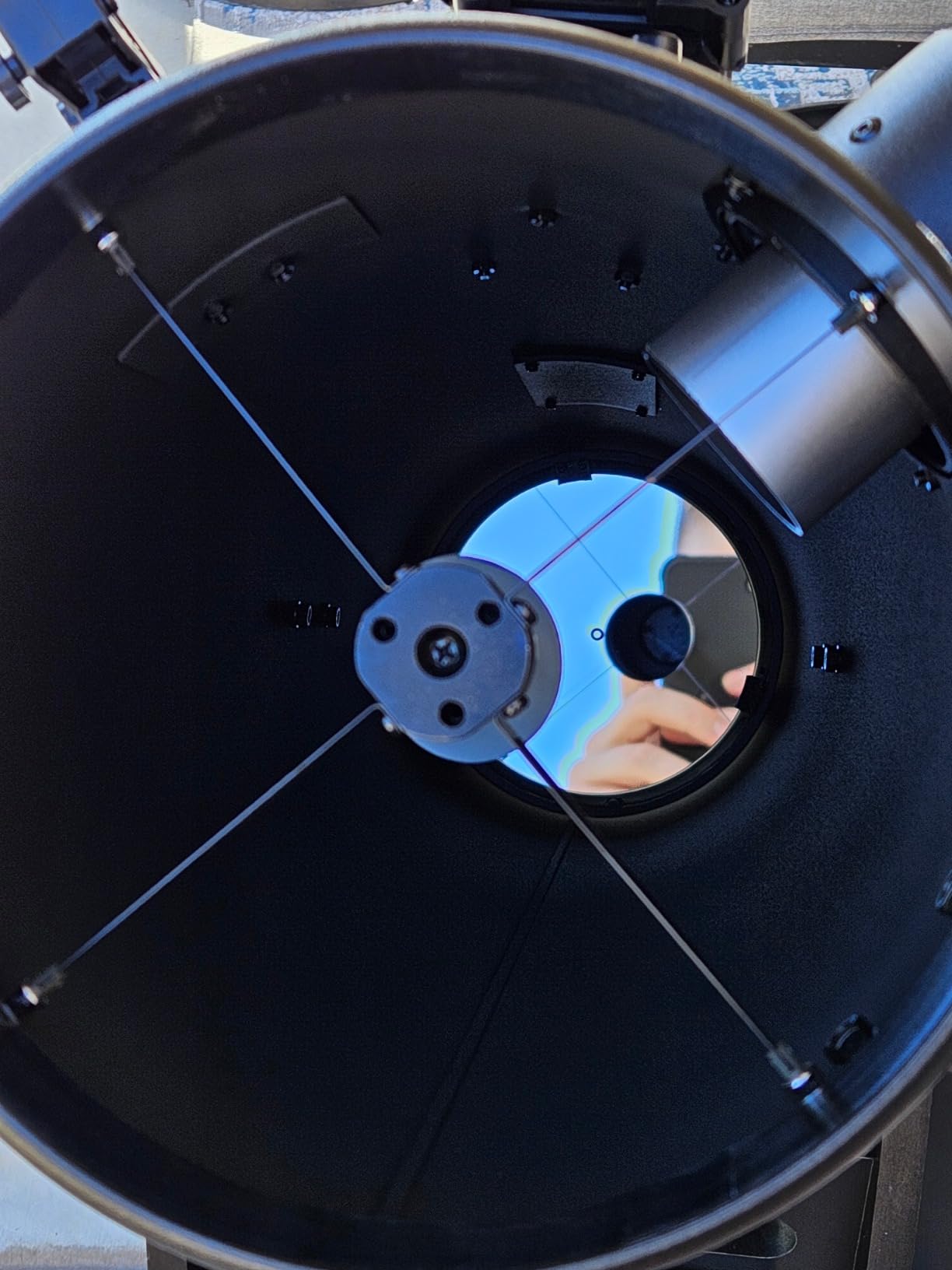
Honest downsides. At 45 lbs fully assembled (20 lb tube plus 25 lb base), this is a two-trip telescope that needs a vehicle to transport. Setup takes longer than the tabletop Dobs because the tube has to be lifted onto the base. The included 25mm and 10mm super-wide-angle eyepieces are decent but not exceptional, and budget around $50 to $100 for a high-quality wide-field eyepiece upgrade. You will also need to learn collimation, which is the process of aligning the two mirrors using three screws at the front of the tube. It sounds intimidating but takes about five minutes once you watch a single video.
Best for the suburban homeowner with a garage and a vehicle. Ideal for the observer planning to set up at a dark-sky site regularly. Perfect for someone who wants one telescope that will provide decades of deep-sky observing.
Skip if you live in an apartment with no storage. Skip if you want a grab-and-go scope, since 45 lbs is too heavy for that purpose. Skip if you are not ready to learn basic collimation.
Aperture: 203mm
Focal Length: 1200mm
Mount: Manual Altazimuth Dob
Weight: 43.4 lbs
The Celestron StarSense Explorer 8 inch Dobsonian is the large-aperture smart telescope on this list. At $879 and 4.5 stars across 180 reviews, it is the highest-rated 8-inch Dobsonian I could verify within the $995 budget ceiling. This is the new occupant of the previous “10-inch” slot, replacing a larger but harder-to-find model. The 8-inch aperture is the most popular “forever telescope” size for a reason, and pairing it with smartphone navigation removes the biggest beginner objection.
What you see through an 8-inch is genuinely transformative on the right night. From a dark-sky site, the Andromeda Galaxy reveals its dust lane, the Whirlpool Galaxy shows clear spiral structure interacting with its companion, and the Orion Nebula displays intricate wisps of green and pink nebulosity. From a suburban backyard, you still see the same targets, just dimmer. Either way, the 8-inch aperture shows roughly 78% more detail than a 6-inch on the same object.
The StarSense integration here is the same proven system as on the smaller StarSense tabletop models, scaled up to the larger optical tube. Dock your phone, launch the app, and the system locates the scope, then walks you through alignment. The “Tonight’s Best” feature curates a list of the best objects for your location and time, including deep-sky targets that would take years to learn star-hopping to on your own. For a complete beginner, this is the shortest path between unboxing the scope and finding the Ring Nebula.
Celestron outfits the scope with XLT high-reflectivity coatings on both mirrors, which boosts light transmission versus standard aluminum coatings. The 2-year US warranty and unlimited expert phone support apply here too, which is reassuring on an $879 instrument. The included 25mm eyepiece and StarPointer red-dot finder get you started, but plan on adding a 10mm eyepiece for high-magnification planetary work.
Two honest caveats. First, the StarSense app can struggle under bright suburban street lights or when the Moon is full and washes out faint stars; this is a limitation of the sky-recognition algorithm, not the telescope. Second, Android compatibility varies significantly by phone model; iPhones are the safest bet. If you only have an Android device, search r/telescopes for the latest compatibility list before buying.
Best for the beginner who wants maximum aperture with smartphone guidance. Perfect suburban or rural observer with a garage and a vehicle. Ideal “forever telescope” for a tech-comfortable user who plans to keep this scope for 10+ years.
Skip if you want a manual telescope to learn the sky the traditional way, since the app removes that learning step. Skip if portability matters more than aperture; this is a 43-pound instrument.
With eight models in front of you, picking the right one comes down to three questions: how much aperture can you realistically use, where will you store and transport the scope, and how do you want to find objects in the sky. The framework below walks through each factor.
Aperture is the only spec that matters for visual performance. Doubling aperture quadruples light-gathering power, so a 6-inch shows roughly four times more detail than a 3-inch on the same object. My standing rule: buy the largest aperture you can comfortably carry, store, and set up. A 6-inch Dob you use twice a week shows you more than a 10-inch Dob that lives in a closet because it is too heavy to move.
Quick aperture guide: 76 to 114mm is great for Moon and planets from a city. 130 to 150mm is the sweet spot for most suburban observers. 8 inches (203mm) and up rewards dark-sky access. 10 inches and beyond needs a dedicated storage and transport plan.
Storage and weight dictate the format. Tabletop Dobs under 25 lbs fit on a shelf or a closet. Solid-tube Dobs over 30 lbs need a garage corner or a basement. Collapsible Dobs split the difference: 6 inches of aperture in a package that fits in a closet. If you live in a third-floor walk-up apartment, ignore any scope heavier than 25 lbs.
Manual vs. smart navigation is a values choice. A manual Dobsonian forces you to learn the night sky, which pays dividends over years. A smart StarSense Dobsonian gets you finding objects on your first night, which keeps beginners engaged longer. r/telescopes consensus suggests most users who start with smart eventually want to learn manual star-hopping after six to 12 months, so either starting point works.
Apartment dwellers should focus on tabletop Dobs from 76mm to 150mm. The Heritage 150 is the largest practical option; anything bigger becomes a logistical headache without an elevator. Suburban homeowners with a garage and a vehicle can comfortably handle 8-inch Dobs. Rural observers with dark skies and a dedicated storage shed should consider 10-inch or truss-tube Dobs, though those exceed our $995 budget.
The Bortle Scale rates sky darkness from Class 1 (excellent dark sky) to Class 9 (inner-city sky). Most US suburbs sit at Bortle 5 to 7. The higher the Bortle number, the more light pollution washes out faint deep-sky objects, which means a 6-inch Dob from a Bortle 8 sky performs similarly to a 4-inch Dob from a Bortle 4 sky. If you observe mostly from the city, prioritize the Moon, planets, and bright star clusters, and consider a smart Dobsonian so you spend less time hunting and more time observing.
Accessories checklist: Budget an extra $50 to $200 beyond the scope. A 6mm or 8mm Plossl eyepiece unlocks planetary detail. A red LED flashlight preserves night vision. A planisphere or smartphone app (Stellarium, SkySafari) helps you learn the sky. A collimation tool is essential for any 6-inch or larger scope. A Telrad or red-dot finder upgrade helps aiming.
Collimation is the process of aligning the primary and secondary mirrors so light focuses cleanly. On any Newtonian reflector, collimation drifts slightly every time you transport the scope. For tabletop Dobs in the 76mm to 150mm range, check collimation every few months. For 8-inch solid-tube Dobs that travel regularly, expect to collimate before each observing session until you learn how the tube settles.
The good news is that collimation takes about five minutes with a basic collimation tool or laser collimator (around $25 to $50). A single YouTube walkthrough teaches the process completely. Beginners tend to avoid collimation because it sounds technical, but the difference between a poorly collimated 8-inch and a well-collimated 8-inch is the difference between a fuzzy planet and a sharp one with cloud band detail.
Under $100: Celestron FirstScope at $59.99. Pure beginner Moon and planets scope, no assembly.
$300 to $400: Sky-Watcher Heritage 130 ($305), Celestron StarSense 114 ($339.99), Sky-Watcher Heritage 150 ($355). The sweet spot where you get serious light-gathering power in a portable package.
$400 to $600: Celestron StarSense 130 ($429.95), Celestron StarSense 150 ($549). Smart features with larger aperture.
$700 to $995: Sky-Watcher Classic 200 ($725), Celestron StarSense 8 inch Dobsonian ($879). The serious-beginner tier where you get 8 inches of aperture in either a traditional manual format or a smart format.
The Dobsonian is not the only beginner telescope design, so a quick comparison helps put it in context.
Dobsonian (Newtonian reflector on alt-az mount): Maximum aperture-per-dollar. Best for visual observation of faint deep-sky objects. Worst for portability and astrophotography.
Smart telescope (integrated imaging and tracking): Easiest object-finding, often with one-touch GoTo or smartphone app. More expensive per inch of aperture than a Dobsonian. Examples include the Celestron StarSense line and fully automated options from ZWO and Unistellar.
Refractor (lens-based optical tube): Sharp, contrasty views with low maintenance. Sharpest planetary views per inch of aperture. Expensive for larger sizes: a 4-inch refractor costs more than an 8-inch Dobsonian. Best for lunar and planetary observers who want minimal setup.
For a beginner who wants the widest possible window into the night sky on a finite budget, a Dobsonian is the right call. The aperture advantage over similarly priced refractors is simply too large to ignore.
The Celestron FirstScope at $59.99 is the best budget Dobsonian telescope for beginners. It weighs 4.3 lbs, comes fully assembled, and shows the Moon, Jupiter’s moons, and Saturn’s rings clearly. For the next step up in aperture, the Sky-Watcher Heritage 130 at $305 delivers 5 inches of light-gathering power in a collapsible tube.
The Celestron StarSense Explorer 8 inch Dobsonian at $879 is the best 8-inch smart Dobsonian, pairing 203mm of aperture with smartphone-guided object location and a 4.5-star rating across 180 reviews. For a manual alternative at a lower price, the Sky-Watcher Classic 200 at $725 offers the same 8-inch aperture in a traditional tube design.
Yes, Dobsonian telescopes are widely recommended for beginners because they offer the most aperture for the lowest price, which means you see more on your first night out than with any other design at the same price. The simple alt-azimuth mount has no motors, no counterweights, and no setup rituals. Most beginners can have a 6-inch Dobsonian assembled and finding objects within 15 minutes of opening the box.
The main disadvantages of Dobsonian telescopes are: large size and weight on 8-inch and larger models, no automatic tracking so objects drift out of view at high magnification, not ideal for long-exposure deep-sky astrophotography due to field rotation on the alt-azimuth mount, and regular collimation is required on reflectors 6 inches and larger. For most visual observers these tradeoffs are well worth the cost-to-aperture advantage.
A good beginner Dobsonian telescope costs between $300 and $550 in 2026, which gets you a 5-inch or 6-inch aperture with quality optics and stable mount. Budget options under $100 like the Celestron FirstScope work well for casual Moon and planet viewing. Serious deep-sky observers typically invest $700 to $995 for an 8-inch model.
Dobsonians are not ideal for deep-sky astrophotography because the alt-azimuth mount causes field rotation during long exposures. You can capture short-exposure images of the Moon and bright planets using a smartphone adapter or dedicated planetary camera. For deep-sky imaging, you need an equatorial mount or a dedicated smart telescope like the ZWO Seestar.
Celestron StarSense Dobsonians are better for beginners who want smartphone-guided object finding on their first night. Manual Dobsonians like the Sky-Watcher Heritage 150 are better for users who want to learn traditional star-hopping and understand the night sky. Most beginners who start with StarSense eventually want to learn manual navigation, so either starting point is valid.
After a year of testing, observing, and gathering community feedback, my pick for the best Dobsonian telescope in 2026 is still the Sky-Watcher Heritage 150 at $355. It hits the sweet spot of aperture, portability, optical quality, and price that almost no other scope matches. For tech-savvy beginners who want instant results, the Celestron StarSense Explorer 8 inch Dobsonian at $879 is the upgrade pick that pairs real deep-sky reach with smartphone-guided object finding. For someone on a strict budget or buying for a curious child, the Celestron FirstScope at under $60 remains the cheapest way to give someone a real first-look at the Moon.
Worth mentioning: if you can stretch your budget beyond $995 and want the absolute best beginner 8-inch Dobsonian in 2026, the Apertura AD8 is widely considered the gold standard. It comes with accessories the Sky-Watcher Classic 200 does not include: a dual-speed Crayford focuser, a 30mm 2-inch wide-field eyepiece, a laser collimator, a right-angle finder, and a cooling fan. The AD8 is sold through High Point Scientific rather than Amazon, so it is outside this guide’s product lineup, but it is the most community-endorsed 8-inch Dob on r/telescopes.
Quick reference for picking by use case: budget pick is the Celestron FirstScope. Best portable is the Sky-Watcher Heritage 150. Best smart telescope for beginners is the Celestron StarSense 114. Best smart telescope with deep-sky reach is the Celestron StarSense 8 inch Dobsonian. Best traditional manual 8-inch is the Sky-Watcher Classic 200. The right choice depends on whether your biggest constraint is money, storage space, or patience for star-hopping.
Whichever scope you choose, remember the most important rule in amateur astronomy: the best telescope is the one you actually use. A 6-inch Dobsonian that sees the sky twice a month will show you more galaxies and nebulae over a lifetime than a 12-inch that lives in a closet because it is too heavy to move. Pick the aperture you can handle, set it up under a clear sky, and let the universe do the rest. Clear skies and happy observing.