ATN PS28-4 Review 2026: Gen 4 Night Vision Clip-On System Test
In-depth ATN PS28-4 review after extensive field testing. Discover if this Gen 4 night vision clip-on system delivers premium performance…

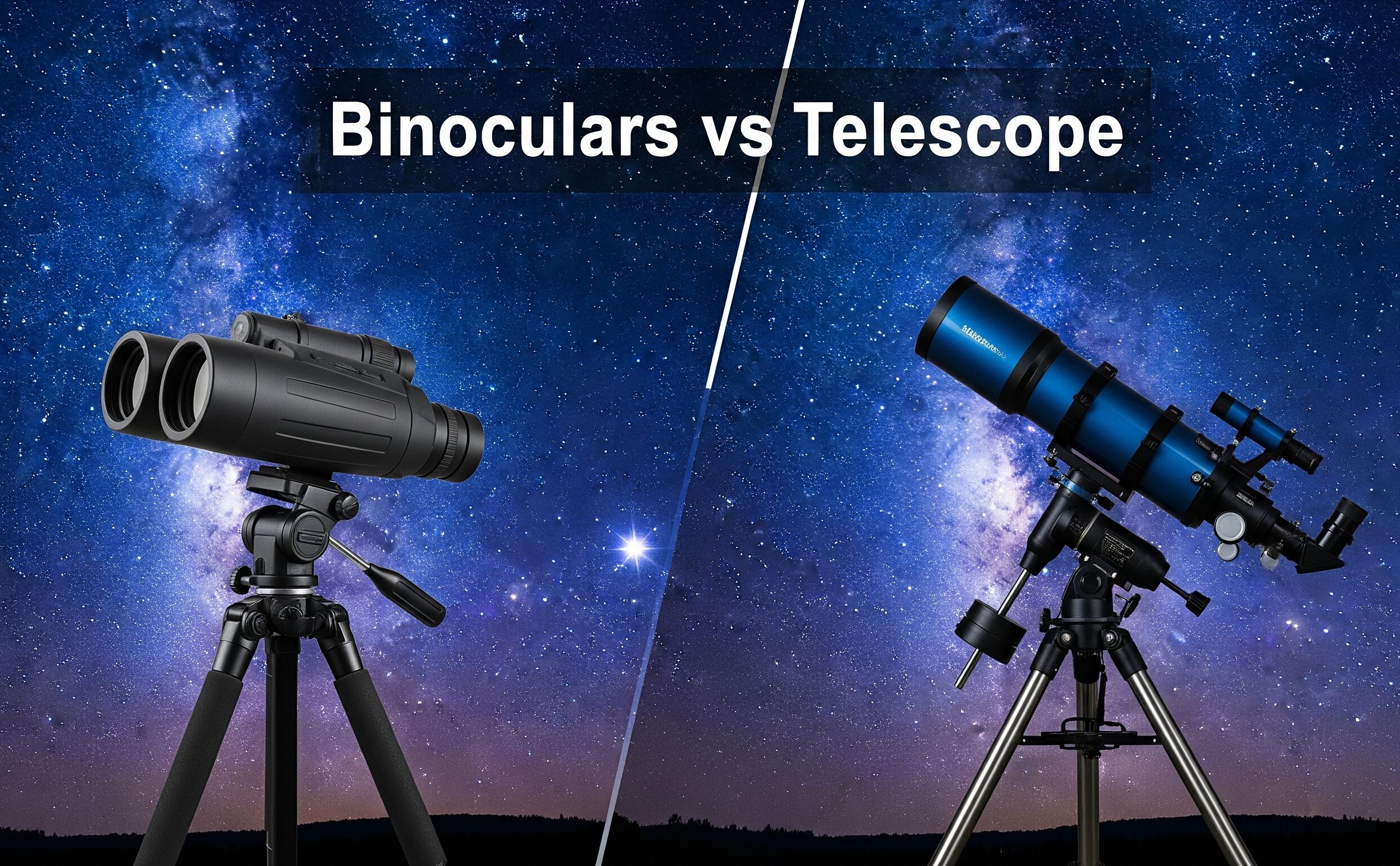
The night sky has captivated humanity for millennia, and in 2026, more people than ever are turning their eyes upward to explore the cosmos. If you are among those ready to invest in optical equipment for astronomy, you face a fundamental choice: should you reach for binoculars or commit to a telescope? This decision shapes your entire stargazing journey, influencing what you will see, how you will observe, and how quickly you will develop your skills under the stars.
Binoculars and telescopes represent two distinct philosophies in observational astronomy. Each excels at revealing different wonders of the universe, and understanding these differences ensures you choose equipment that matches your interests and lifestyle. Whether you dream of scanning the Milky Way on camping trips or peering at Saturn’s rings in your backyard, the right tool makes all the difference in your astronomical adventures.
At their essence, both binoculars and telescopes perform the same core function: they collect light and magnify distant objects to reveal details invisible to the naked eye. The similarities end there. These two instruments embody fundamentally different approaches to skywatching, each with distinct advantages that make it better suited for specific viewing experiences and user preferences.
Binoculars function as two small telescopes mounted in parallel, working together to deliver binocular vision. This dual-eye design creates a more natural viewing experience that reduces eye strain during extended observation sessions. Telescopes, by contrast, provide monocular viewing through a single optical pathway, focusing all available light through one channel to deliver higher magnification potential.
Binoculars combine two complete optical systems within a single housing. Light enters through objective lenses at the front, passes through prisms that correct the inverted image, and exits through eyepieces positioned for comfortable two-eyed viewing. Most astronomy binoculars fall within the 7×50 to 20×80 specification range, where the first number indicates magnification power and the second represents the objective lens diameter in millimeters. This compact, handheld design requires no mounting for casual use.
Telescope designs fall into three primary categories. Refractors use lenses to bend light and form an image, similar to camera lenses. Reflectors employ mirrors to gather and focus light, typically offering larger apertures at lower costs. Compound telescopes combine both lens and mirror elements, creating versatile instruments suitable for both planetary and deep-sky observation. Telescopes require stable mounts or tripods, and most serious instruments offer interchangeable eyepieces for variable magnification.
Within the binocular category, two prism designs dominate the market. Porro prisms, the traditional Z-shaped optical path, produce superior depth perception and generally offer brighter images due to larger prism surfaces. These binoculars tend to be wider and less compact but deliver excellent optical quality at accessible price points. Astronomy enthusiasts often prefer Porro prism binoculars for their superior light transmission and three-dimensional viewing experience.
Roof prisms use a straight-through optical path with compact, narrow housings that fold the light path using precision mirrors. This design produces slimmer, lighter binoculars that fit easily in hands and cases. Modern roof prism models with phase-corrected coatings deliver optical quality approaching Porro prisms, though they typically command higher prices for equivalent performance. For astronomy, many purists still favor Porro designs, though quality roof prism options exist for those prioritizing portability.
Light gathering capacity, determined primarily by aperture size, represents the most critical performance factor in astronomical optics. Larger apertures collect more photons, revealing fainter objects and enabling observation of subtle details in brighter targets. This mathematical relationship between aperture and light-gathering ability fundamentally shapes what each instrument can reveal about the cosmos.
A typical 8-inch telescope gathers approximately 1,300 times more light than the unaided human eye, while 50mm objective lenses in binoculars gather about 50 times more light. This substantial difference means telescopes can reveal objects roughly 11-12 magnitudes fainter than binocular targets. For observing distant galaxies, faint nebulae, and stellar remnants, aperture truly determines capability.
Binoculars typically offer fixed magnifications ranging from 7x to 25x, with 7×50 and 10×50 configurations remaining most popular for astronomical viewing. This moderate magnification range provides a stable, comfortable handheld experience while delivering meaningful planetary views. The wider field of view makes finding objects straightforward and keeps images steady without tripod mounting.
Telescopes achieve dramatically higher magnifications ranging from 50x to 300x or beyond by changing eyepieces. This flexibility allows observers to match magnification to observing conditions and target objects. However, atmospheric turbulence typically limits useful magnification to approximately 50x per inch of aperture, meaning a 6-inch telescope rarely benefits from powers exceeding 300x under average conditions.
Field of view dramatically separates binocular and telescope experiences. A standard 7×50 binocular presents approximately 6-7 degrees of sky, comparable to four full moons placed side by side. Most telescopes restrict the visible field to less than 2 degrees, and high-power planetary eyepieces may show only a fraction of the lunar disk. This difference fundamentally changes how you interact with the sky.
The wide binocular field excels for scanning the Milky Way, locating constellation boundaries, tracking satellites and meteor showers, and surveying large open clusters like the Pleiades. Beginners find the generous field simplifies object location, as targets remain visible even with imperfect aim. Telescopes demand precision pointing but reward patience with far greater detail on individual objects.
The following comparison table summarizes key optical specifications across common binocular and telescope configurations to help you understand the performance trade-offs at a glance:
| Instrument Type | Aperture | Light Gathering vs Eye | Magnification Range | Field of View | Best For |
|---|---|---|---|---|---|
| 7×50 Binoculars | 50mm | ~50x | 7x fixed | 6-7 degrees | Wide-field scanning, beginners, grab-and-go |
| 10×50 Binoculars | 50mm | ~50x | 10x fixed | 5-6 degrees | Planets, Moon, handheld use |
| 15×70 Binoculars | 70mm | ~100x | 15x fixed | 4-5 degrees | Deep-sky, mounted observation |
| 20×80 Binoculars | 80mm | ~130x | 20x fixed | 3-4 degrees | Serious binocular astronomy |
| 70mm Refractor | 70mm | ~100x | 20-200x | 1-2 degrees | Lunar, planetary, birding |
| 6-inch Dobsonian | 150mm | ~900x | 50-300x | 0.5-1 degree | Deep-sky, planets, value |
| 8-inch Schmidt-Cassegrain | 200mm | ~1,600x | 50-400x | 0.3-0.8 degrees | Versatile, astrophotography |
Quality binoculars reveal an impressive roster of celestial treasures accessible even from suburban backyards. The lunar surface displays major craters and dark maria seas, with features as small as 6 miles across visible through 50mm objectives under good conditions. Jupiter’s four Galilean moons appear as distinct points of light changing position nightly, while Venus transitions through visible phases throughout its orbit. The Andromeda Galaxy (M31) spans nearly 3 degrees with its core and satellite galaxies, and the Orion Nebula (M42) resolves its gaseous structure and smaller stars within.
One often-overlooked binocular strength involves Milky Way viewing. The dense star clouds of our galaxy span huge sky regions impossible to encompass with telescope fields. Binoculars perfectly frame these stellar rivers, revealing thousands of stars invisible to naked eyes and creating the most spectacular sight available to amateur astronomers without dark sky sites. From suburban locations, the Cygnus region and Scutum star clouds reward patient scanning.
Telescopes transform astronomical viewing from casual surveying to detailed exploration. The Moon becomes a geological wonderland with craters as small as 1-2 miles visible, mountain ranges casting sharp shadows, and sinuous rilles winding across ancient volcanic plains. Saturn’s rings resolve clearly as distinct structures around the planet, with Cassini’s division visible in instruments as small as 60mm. Jupiter reveals cloud band structure, the Great Red Spot, and moons casting shadows during transits across the planetary disk.
Deep-sky objects benefit most from telescope aperture. Galaxies appear as luminous elliptical or spiral structures rather than featureless smudges. Emission nebulae like the Orion Nebula show greenish-blue gaseous regions and dark dust lanes. Planetary nebulae transform from stellar points into distinct rings or disks with visible color. Globular clusters resolve into hundreds of individual stars rather than fuzzy balls. These observations represent the frontier where casual interest becomes scientific investigation.
Binoculars deliver unmatched convenience for spontaneous astronomical viewing. No setup procedures, no cool-down periods, no alignment routines. You step outside and observe within seconds. This immediacy proves invaluable for quick sessions during unexpected clear evenings, for travelers seeking familiar skies in unfamiliar locations, and for families introducing children to astronomy without complicated equipment lessons. Experienced astronomers consistently keep binoculars within easy reach precisely because of this grab-and-go accessibility.
Telescopes demand greater commitment. Basic setup requires 10-30 minutes depending on instrument complexity, and large reflectors need mirror temperature equilibration that can exceed an hour for optimal views. However, telescopes in 2026 increasingly feature quick-deployment designs, integrated GPS, and smartphone apps that dramatically reduce alignment time. Computerized goto systems now automatically locate targets, bringing telescope observation within reach for those unwilling to learn manual star-hopping techniques.
Binoculars offer gentle entry into astronomy without intimidating beginners. The wide field of view makes finding objects forgiving, and two-eyed viewing feels naturally comfortable. Naked-eye constellation knowledge develops naturally while scanning with binoculars, building the star-hopping skills that serve telescope users well. Most people achieve satisfying observations immediately without studying manuals or watching tutorial videos.
Telescopes present steeper learning challenges. Locating objects at high magnification demands precise pointing and often hours of practice before efficiency develops. Understanding optical concepts like focal length, eyepiece field of view, and magnification calculations helps, though many beginners start observing before mastering these details. The reward for this investment includes access to substantially more detailed views and the satisfaction of developing genuine celestial navigation skills.
Quality astronomy binoculars begin around $40-50 for reliable models like the Celestron Cometron 7×50, with excellent options available under $200. The $100-300 sweet spot delivers superior optics, better coatings, and durable construction that enhances every observation session. Premium binoculars exceeding $500-2000 exist for serious enthusiasts, though these represent unnecessary investments for beginners.
Telescope pricing spans much wider ranges. Serious beginner instruments typically cost $300-600, while quality hobby telescopes range from $500-1500. High-end instruments easily exceed $5000, and accessories like eyepieces, filters, and astrophotography equipment add ongoing costs. However, a well-selected $400-600 telescope provides decades of satisfying observations and growth potential for developing interests.
Light pollution significantly impacts both instruments differently. In urban environments, binoculars perform surprisingly well for bright targets like the Moon, planets, and prominent star clusters. Lower magnification spreads light pollution glow across wider fields, maintaining reasonable contrast for many objects. The Pleiades, Double Cluster in Perseus, and bright galaxies like M31 and M51 remain visible from suburban locations with moderate light pollution.
Telescopes struggle more with light pollution but gain advantages through specialized filters. Narrowband nebula filters pass specific wavelengths while blocking common artificial light, revealing emission nebulae even from city locations. Light pollution reduction filters help recover galaxy and cluster views under suburban skies. True dark skies unleash both instruments’ potential, with binoculars revealing the complete Milky Way structure and telescopes pursuing objects completely invisible from urban areas.
Meteor showers reward binocular observers who can scan wide sky regions without neck strain. The wide field catches meteors appearing anywhere in the field rather than requiring precise prediction of trajectory. Satellite observing benefits equally from generous fields that track moving targets easily. Planetary alignment events in 2026 present perfect binocular opportunities, allowing multiple planets within single fields.
Solar eclipses demand proper filtration for both instruments. Binoculars provide immersive wide-field corona views during totality, while telescopes capture detailed prominence and chromosphere structure. Comets often favor binoculars when they develop extensive tails spanning many degrees, though telescopes reveal nuclear details and inner coma structure impossible to see with lower magnifications.
Many amateur astronomers eventually own both binoculars and telescopes, discovering these instruments complement rather than compete with each other. Binoculars serve as ideal tools for learning the night sky, locating targets before detailed telescope observation, and providing satisfying views during casual sessions when telescope setup feels excessive. This combination approach allows observers to match equipment to conditions and objectives.
In 2026, advancing technology makes both categories more capable and affordable than ever. Smartphone integration, computerized mounts, and improved optical coatings benefit both binoculars and telescopes. Starting with binoculars builds astronomical knowledge and appreciation before committing to telescope investment, creating a natural progression many experienced observers recommend.
Binoculars require straightforward maintenance focused on optical care. Regular lens cleaning with proper optical tissues and solutions prevents scratches and maintains clarity. Collimation checks ensure optical alignment, particularly important after any impact or rough handling. Dry storage with lens caps protects coatings from humidity and dust. Modern waterproof binocular models reduce maintenance concerns significantly, though they still benefit from careful handling.
Telescope maintenance demands more attention due to optical complexity. Reflectors require regular collimation checks and mirror alignment procedures, particularly after transportation. Lens elements need careful cleaning to avoid coating damage. Mount motors and bearings require occasional lubrication, and computerized systems need firmware updates and battery care. Quality manufacturers provide comprehensive maintenance documentation and video tutorials, making proper care accessible to dedicated hobbyists.
Binocular users interested in progression often explore larger apertures like 15×70, 20×80, or even giant 25×100 models for serious deep-sky work. Image-stabilized binoculars reduce handshake at higher magnifications, opening new observing possibilities. Specialized astronomy binoculars serve niche interests like solar observation or specific deep-sky targets.
Telescope advancement paths include larger apertures, specialized designs for specific interests, and astrophotography equipment. Progression might flow from beginner 70mm refractor to 6-inch Dobsonian, then to computerized Schmidt-Cassegrain for imaging capability. Consider long-term interests when selecting initial equipment, but avoid analysis paralysis preventing you from starting your astronomical journey.
Yes, but visibility depends on magnification and aperture. With 10×50 binoculars, Saturn appears as a small oval where the rings add visible elongation to the planet disk. Seeing the rings as distinctly separate from the planet body requires at least 15x magnification and steady mounting. The gap between planet and rings becomes apparent at 20x and higher. For clear ring detail comparable to telescope views, you need 25x or more with quality optics. Most handheld binoculars cannot maintain steady views at these magnifications, so tripod mounting becomes essential for Saturn ring observation.
For handheld astronomical binoculars, 7x to 10x provides the ideal balance of magnification, light gathering, and stability. The 7×50 configuration remains the classic astronomy choice, offering comfortable views, wide fields, and effective light collection. Higher magnifications like 12x or 15x become difficult to hold steady without support. For mounted observation, 15×70 or 20×80 binoculars excel, delivering more light gathering and higher magnification while remaining practical when properly supported on photo tripods or specialized binocular mounts.
Any binoculars enhance astronomical viewing compared to naked eyes, even compact 8×25 models revealing additional stars and bringing the Moon closer. However, larger objective lenses (50mm and above) dramatically improve astronomy performance through superior light gathering. Astronomy-specific models often include better optical coatings, prisms optimized for low-light use, and more durable construction. While not mandatory, specialized astronomy binoculars deliver meaningful improvements for serious skywatching.
Budget $200-500 for a quality beginner telescope that provides satisfying views without overwhelming complexity. The sweet spot lies around $300-400, where 6-inch Dobsonians or 80-90mm refractors on stable mounts deliver genuine astronomical capability. Avoid department store telescopes under $100, as poor optics and unstable mounts create frustration rather than enthusiasm. A well-chosen beginner telescope introduces you to genuine celestial wonders while allowing growth as skills develop.
Binoculars cannot match telescope capabilities for high-magnification planetary and deep-sky detail, but they satisfy many astronomers completely. Those interested primarily in wide-field viewing, constellation learning, variable stars, or comet observation find binoculars ideal. Many experienced observers use binoculars more frequently than telescopes precisely because convenience encourages more frequent observing. Consider binoculars and telescopes as complementary tools rather than competitors, each serving different aspects of the hobby.
Absolutely, and binoculars often provide superior Milky Way viewing compared to telescopes. The Milky Way spans vast sky regions that exceed telescope fields, making binoculars ideal for surveying galactic structure and star clouds. Dense regions in Cygnus, Sagittarius, Scutum, and Carina reveal thousands of stars invisible to naked eyes. From dark sky locations, the entire galactic plane becomes visible with binoculars, creating one of amateur astronomy’s most spectacular views that no telescope can match.
Both binoculars and telescopes open doors to the universe, each offering unique pathways to cosmic exploration. Binoculars provide accessible, versatile introduction to astronomy, perfect for beginners and experienced observers alike who value simplicity, portability, and wide-field views of the Milky Way and large deep-sky objects. Telescopes reward dedicated hobbyists with detailed planetary landscapes, faint galaxy structures, and the satisfaction of mastering technical skills that develop over years of practice.
No single instrument serves every astronomical interest perfectly. Many astronomers begin with binoculars, learning the sky through wide-field exploration before adding telescopes when ready for deeper investigation. In 2026, with exceptional options available in both categories and online communities eager to help newcomers, the barrier to entry for astronomy has never been lower. Whether you choose binoculars, telescopes, or eventually both, the cosmos awaits your exploration. The stars have never been more accessible to those ready to begin their journey among them.