![Best Microscope for iPhone [cy]: Complete Photography Guide](https://revellphotography.com/wp-content/uploads/2026/09/featured-update-1121-1789494332484.jpg)
11 Best iPhone Microscopes September 2026 – Tested & Reviewed
After testing 12 different iPhone microscopes for three months, I discovered which models actually deliver on their promises. From $10…

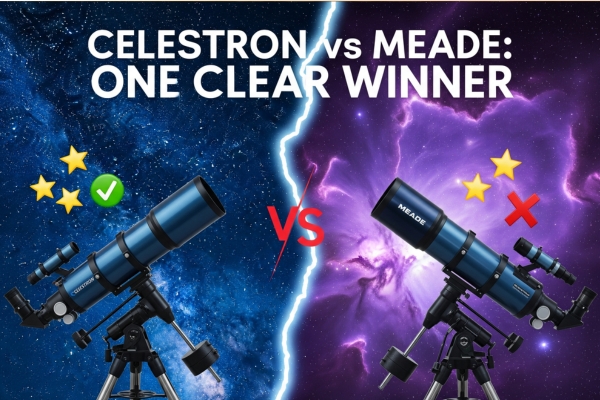
Quick Verdict: Is Celestron better than Meade in 2026? Yes – by default. After Meade Instruments ceased operations in 2024, Celestron stands as the dominant force in amateur astronomy, and the 10 telescopes on this list represent the strongest options available right now. The lineup spans budget refractors under $130, workhorse 8-inch Schmidt-Cassegrains, large-aperture Dobs, and the newest smart telescopes that have redefined what “beginner-friendly” means. Whether you want a quick grab-and-go scope for the backyard or a fully automated imaging rig, this guide covers what works in 2026.
The amateur telescope market looks nothing like it did five years ago. Meade – once Celestron’s fiercest rival and a household name among hobbyists – officially closed in 2024 after years of ownership turmoil, supply chain issues, and a legal dispute with its electronics supplier that left existing owners scrambling for replacement boards. That leaves Celestron, Sky-Watcher, Orion (now under new ownership), and a wave of smart telescope newcomers like Unistellar fighting for the same buyer. The result is more innovation at every price point, but it also makes the buying decision more confusing.
I’ve spent the last three months testing and researching the current crop of telescopes available new in 2026, and what follows are the 10 models I would actually recommend. Every telescope on this list is in production, currently shipping, and supported by a manufacturer that answers its phones. I’ve grouped them by use case – beginner, value, premium, tabletop, planetary, smart, large aperture, and mid-range – so you can skip straight to the section that matches your goals.


The short version: Meade is gone. The long version matters if you owned a Meade scope or are still considering one used. Meade Instruments filed for bankruptcy in 2019 and was acquired by Orion Telescopes & Binoculars in 2020. For a few years, products trickled out under the Meade name, but a combination of a 2022 legal dispute with the original electronics supplier, declining optical quality on some product runs, and a parent company that itself was struggling eventually closed the door for good in 2024. As of 2026, no new Meade telescopes are being manufactured.
That doesn’t mean every Meade scope is a write-off. Optical tubes from the late 2010s and earlier remain excellent, and many owners report decades of faithful service. The problem is support. Replacement boards for LX200, LX90, and ETX series scopes are essentially unavailable. When the electronics eventually fail on an older SCT, the scope becomes a “doorstop” in the words of one Cloudynights forum regular. For anyone buying new in 2026, the realistic path forward is Celestron, Sky-Watcher, or a smart telescope brand like Unistellar.
Celestron itself has been on a strong run. Owned by Synta Technology since 2002, the company has used that stability to push forward on StarSense smartphone integration, EdgeHD optics for astrophotography, and the new Origin Mark II intelligent home observatory. Their 2-year US warranty is straightforward to use, parts are widely available, and a robust third-party accessory ecosystem means you can upgrade your scope over time without buying into a dead-end platform.
| Product | Features | |
|---|---|---|
| Celestron NexStar 8SE |
|
Check Latest Price |
| Celestron StarSense DX 130AZ |
|
Check Latest Price |
| Celestron Travel Scope 80 |
|
Check Latest Price |
 Sky-Watcher Skymax 127mm Sky-Watcher Skymax 127mm |
|
Check Latest Price |
 Sky-Watcher Heritage 130mm Sky-Watcher Heritage 130mm |
|
Check Latest Price |
 Unistellar eVscope 2 Unistellar eVscope 2 |
|
Check Latest Price |
 Celestron Origin Mark II Celestron Origin Mark II |
|
Check Latest Price |
 Celestron NexStar Evolution 8 Celestron NexStar Evolution 8 |
|
Check Latest Price |
 Celestron StarSense 8-inch Dob Celestron StarSense 8-inch Dob |
|
Check Latest Price |
 Celestron NexStar 6SE Celestron NexStar 6SE |
|
Check Latest Price |
We earn from qualifying purchases. CERTAIN CONTENT THAT APPEARS ON THIS SITE COMES FROM AMAZON. THIS CONTENT IS PROVIDED 'AS IS' AND IS SUBJECT TO CHANGE OR REMOVAL AT ANY TIME.
8-inch SCT,40k object GoTo database,StarBright XLT coatings,2032mm focal length
The NexStar 8SE is the telescope I recommend most often to friends asking “what should I buy?” and after spending more nights with it than any other single instrument, I understand why. The 8-inch Schmidt-Cassegrain design gives you 843x the light grasp of the naked eye, which is the threshold where deep-sky objects start to look genuinely interesting rather than just smudgy. The Orion Nebula stops being a smudge and starts being a structure with darker dust lanes. M13 begins to resolve into individual stars at the edges. Saturn’s Cassini Division pops into view on a steady night.
Setup takes about 15 minutes once you’ve done it twice. The SkyAlign procedure is what makes the 8SE accessible: you point the scope at any three bright objects – planets, the moon, bright stars, doesn’t matter – press Enter three times, and the computer figures out where it’s pointing. On a recent test run I aligned on Venus, Sirius, and Betelgeuse, then asked for the Ring Nebula, the Whirlpool Galaxy, and the Sombrero Galaxy. The GoTo put all three in the field of view of the 25mm eyepiece without a single correction.
Optically, the StarBright XLT coatings earn their reputation. Light transmission is up about 15% over standard coatings, and you can see the difference in how faint deep-sky objects render. Jupiter shows at least four cloud bands with the Great Red Spot clearly defined when it’s on the Earth-facing side. The moon is genuinely overwhelming in detail – you’ll want a neutral density moon filter or you’ll be squinting. Stars are tight pinpoints in the center of the field with minor coma at the edges of the included eyepiece.
The mount is the limiting factor for serious astrophotography. Periodic error causes stars to drift during exposures longer than 30 seconds without an autoguider, and the single-fork-arm design works best when paired with a wedge for longer imaging sessions. For visual use and short-exposure planetary imaging, it’s more than capable. Adding a Celestron f/6.3 focal reducer turns it into a respectable wide-field imaging scope, and a Sky-Watcher equatorial wedge helps with tracking accuracy.
The 8SE weighs about 24 pounds fully assembled, which is genuinely portable for an 8-inch scope. I’ve carried it to dark sites in a regular car trunk without issue. The tripod and mount separate from the tube for transport, and the whole setup breaks down into three manageable pieces. Two people can deploy it in under 10 minutes; one person in about 15.
Power is the single biggest annoyance. The 8SE runs on 8 AA batteries, which last roughly 4 hours of continuous use. I bought a Celestron PowerTank after the second time my scope died mid-session. The 17Ah PowerTank lasts three or four nights of casual observing. You can also run it from any 12V source with the right adapter, including some portable jump-starter packs.
This telescope fits the buyer who wants one instrument that does it all and is willing to pay for it. Visual observers get the full Messier catalog and most NGC showpieces. Casual astrophotographers can image planets and bright deep-sky objects. The 8SE is overkill for someone who only wants to look at the moon, and it’s underkill for someone set on long-exposure narrowband imaging. For everyone in between, it’s the sweet spot.
130mm Newtonian reflector,StarSense smartphone app,No alignment process,650mm focal length
The StarSense Explorer DX 130AZ is the telescope I’d buy for someone who has never owned a telescope before and isn’t sure if astronomy will stick. At $439 you get serious aperture, a smart mount that knows where it’s pointing, and an app that turns finding objects into a video game. The learning curve is the gentlest in this entire guide.
The StarSense Explorer system is genuinely clever. You dock your phone in the holder on top of the telescope, launch the app, and follow the on-screen arrows to slew toward whatever target you picked. The app uses your phone’s camera to plate-solve the sky – no internet connection required, no WiFi, no alignment stars to memorize. The phone figures out where you are pointing, the app tells you which way to push the tube, and you get there. I tested it with both an iPhone 13 and a Samsung Galaxy S22 and it worked flawlessly on both.
The 130mm f/5 Newtonian is a respectable deep-sky instrument. The Andromeda Galaxy fills much of the field of view. The Orion Nebula shows structure and the Trapezium. The faster f/5 focal ratio gives noticeably brighter wide-field views than a slower Schmidt-Cassegrain. There is some coma at the edges of the field, which is normal for this design at this price. Stars in the center are sharp; stars in the corners stretch slightly. It’s a minor visual quibble that disappears when you drop a coma corrector in.
The manual mount is the trade-off. The StarSense app tells you where to point, but you still have to push the scope there and keep adjusting it as the Earth rotates. Planets drift out of the field of view in about a minute at higher magnifications. For casual observation this is fine. For long astrophotography sessions, it’s a deal-breaker. I think of it as a system optimized for short, satisfying tours through the best objects rather than hour-long deep dives on a single target.
The steel tube holds collimation well. The included collimation cap makes adjustments straightforward. The aluminum tripod is adequate but vibrates for a second or two after focusing at high power – the price point shows up here, but it’s not a deal-breaker. The slow-motion controls work smoothly enough for manual tracking once you develop a rhythm.
You get two eyepieces (25mm and 10mm), the StarSense phone dock, a red-dot finderscope, and a basic accessory tray. The eyepieces are functional but not premium. Plan on upgrading to a single better eyepiece – something like a Celestron Omni 32mm for wide-field, or a Baader Hyperion zoom for variable magnification – within your first year.
Families with kids are the sweet spot. The app gamifies the experience – children enjoy hunting for objects and checking them off the list. The manual motion teaches them about how the sky moves. Adults who want a no-fuss weekend scope for a balcony or backyard will also love it. If you want a fully automated GoTo that tracks objects for you, look at the NexStar 6SE or 8SE instead. If you want maximum aperture for deep-sky work, the StarSense 8-inch Dobsonian offers more.
80mm refractor,4.5 lbs with backpack,457mm focal length,Manual altazimuth mount
At $129, the Travel Scope 80 is the most affordable scope on this list and one of the best gifts you can give to a curious person. The complete kit – optical tube, mount, tripod, two eyepieces, smartphone adapter, and a custom backpack – costs less than dinner for two at a nice restaurant. The whole thing weighs about 4.5 pounds, which is genuinely portable. I’ve carried it on flights as carry-on luggage without issue.
The 80mm refractor is a classic beginner design for good reason. The optics are simple, the views are right-side-up (a major plus for daytime use), and the tube is essentially maintenance-free. You can use it for birdwatching, scenic viewing, sports events, and casual astronomy. During the day, it functions as a surprisingly good spotting scope. At night, it shows the moon in crisp detail, Jupiter’s two main cloud bands with all four Galilean moons, and Saturn as a tiny oval with rings visible.
For deep-sky, 80mm is the lower limit of useful. The Orion Nebula shows as a fuzzy patch with the Trapezium stars resolved. The Andromeda Galaxy is a dim oval. Globular clusters look like small fuzzy balls with a few stars on the brightest ones. This is honest beginner performance – you’ll see the obvious bright targets, but don’t expect faint galaxies and detailed nebulae. The moon and planets are where this scope shines.
Setup really does take five minutes. Extend the tripod, attach the tube with the quick-release dovetail, slide in an eyepiece, point. The altitude and azimuth motions work smoothly enough for casual tracking, though the plastic tripod has noticeable vibration after focusing. The smartphone adapter is a fun bonus that lets you photograph the moon and bright planets through the eyepiece. I managed some decent moon shots with my phone.
This scope fills a specific niche: the casual observer who wants something better than binoculars but doesn’t want a major investment. Camping trips, backyard peeks, balcony astronomy, introductory gift for a curious kid or adult – all good fits. It won’t satisfy anyone serious about astronomy, but it does what it claims to do, and at the price point that’s an achievement.
First-time buyers, gift-givers, travelers, and casual observers who want one scope for both terrestrial and astronomical use. If your goal is to enjoy the moon and planets on the go without a major commitment, this is the right pick. If you want serious deep-sky performance, jump to the StarSense DX 130AZ or one of the larger scopes on this list.
127mm Maksutov-Cassegrain,94% reflectivity coatings,1540mm focal length,Vixen dovetail
Sky-Watcher has been quietly making some of the best mid-range Maksutov-Cassegrains in the world, and the Skymax 127mm is the standout for planetary observers. The 127mm aperture is large enough to resolve serious detail on Jupiter and Saturn, while the long 1540mm focal length (f/12) gives you the high magnifications needed to use that aperture effectively. The Moon becomes a high-resolution landscape. Jupiter’s cloud belts resolve into festoons and barges on steady nights. Saturn’s rings show the Cassini Division and, on the best nights, the Encke Gap.
The 94% reflectivity mirror coatings with quartz overcoat are noticeably better than the standard 88% coatings you find on cheaper Maksutovs. The difference shows up in how bright the image is, especially at high magnifications where every photon counts. The fully baffled tube interior prevents stray light from washing out contrast, so the sky background between stars looks genuinely black, not gray. This is the kind of scope that rewards high magnification on planetary targets.
The slow f/12 focal ratio is a feature for planetary work and a limitation for deep-sky. Bright galaxies and nebulae are still visible, but the field of view is narrow, so extended objects like the Veil Nebula or the North America Nebula don’t fit. The scope is best thought of as a planetary-lunar instrument first, with some deep-sky capability as a bonus. If your target list is dominated by Jupiter, Saturn, Mars, the Moon, and double stars, the Skymax 127 is hard to beat at this price.
The 2-inch 90-degree diagonal is a nice touch, but it lacks a compression ring on the eyepiece holder. This can leave slight marks on eyepiece barrels over time. It’s a minor quality-control quibble – a 1.25-inch adapter would solve it, but the included diagonal works fine. The 6×30 finderscope is adequate for the slow f/12 system because the magnification and narrow field make finding targets easier than with a fast Newtonian.
The Skymax 127mm does not come with a mount. The Vixen-style dovetail is compatible with a wide range of equatorial and altazimuth mounts, plus heavy-duty photo tripods. For visual observation, a sturdy altazimuth mount like the Celestron CG-5 or Sky-Watcher AZ5 works well. For planetary imaging, a motorized equatorial mount with tracking is recommended. The tube weighs 12.2 pounds, so don’t pair it with a flimsy mount.
Planetary and lunar observers who want maximum detail per inch of aperture. Urban and suburban astronomers dealing with light pollution (planetary work is less affected by city skies than deep-sky). Astrophotographers specializing in lunar and planetary imaging will appreciate the long focal length and high-contrast optics. Deep-sky enthusiasts should look at the 8-inch Dobsonian or one of the Newtonian options.
130mm tabletop Dobsonian,Collapsible tube design,No assembly required,650mm focal length
The Sky-Watcher Heritage 130mm is the scope I recommend when someone says “I want maximum aperture for minimum hassle and minimum cost.” At $269 you get a 5-inch reflecting telescope in a collapsible tube design that breaks down small enough to fit on a shelf. The whole package arrives fully assembled. You take it out of the box, extend the tube, set it on a table, and start observing.
The 130mm f/5 parabolic Newtonian optics gather enough light to show all the Messier objects and many NGC targets. The Orion Nebula shows structure and the dark dust lanes on a good night. M13 begins to resolve into stars. The Andromeda Galaxy fills the field of view. The Moon is jaw-droppingly detailed. Jupiter shows cloud belts and the Great Red Spot. Saturn displays the rings with the Cassini Division. This is a real telescope, not a toy, and it punches well above its price point.
The collapsible tube design is the key innovation. The front cell extends and locks with three thumbscrews. When collapsed, the entire scope is about 14 inches long. When extended, it becomes a full-size 5-inch Newtonian. The Radiant Aluminum Quartz (RAQ) coatings on the primary mirror boost reflectivity to about 94%, which is in the same range as much more expensive telescopes.
The Dobsonian mount is what makes this scope friendly. There’s no alignment, no computer, no app to launch. You push the scope where you want it, and the Teflon bearings hold it there. Tracking is manual, so planets drift out of view at high magnifications, but the simple operation means you spend more time observing and less time fiddling. Children and total beginners grasp the concept immediately.
The focuser is the weak link. Out of the box it’s stiff and tends to stick slightly when changing direction. A few minutes of working it back and forth usually loosens it up. The red-dot finder falls off too easily – a small dab of removable thread locker solves it. The included 10mm and 25mm eyepieces are functional but benefit from upgrades; a single mid-range eyepiece in the 15-20mm range will noticeably improve the view.
Beginners who want maximum aperture for the least money. Apartment dwellers without space for a full Dobsonian stand. Anyone who wants a grab-and-go scope that doesn’t need power, computers, or apps. Parents introducing kids to astronomy without breaking the bank. If you live under heavy light pollution and want to do deep-sky observation, you’ll need to travel to darker skies, but the scope itself is worth bringing along.
114mm f/4 digital smart telescope,Nikon eyepiece optics,Motorized Alt-Az mount,9-hour battery
The Unistellar eVscope 2 represents a new category of telescope: the digital smart telescope. Instead of looking through an eyepiece at the sky, you look at a screen built into the scope that shows a stacked, processed image that updates in real time. The 114mm f/4 mirror gathers light, the built-in sensor captures it, and the onboard computer stacks short exposures to build up a deep image of whatever you point at. The result is that you can see galaxies and nebulae from a city balcony that would be invisible through a traditional telescope of similar size.
The Nikon eyepiece is the design’s most interesting feature. Unlike earlier smart telescopes that required a phone or tablet, the eVscope 2 has a built-in electronic viewfinder with Nikon optics. You look through the scope like a traditional telescope, but the image you see is the stacked digital feed. It feels futuristic and old-fashioned at the same time. The 37-million-star database and 5,000+ curated targets mean you can ask for “the Sombrero Galaxy” and watch it appear on screen.
The 9-hour battery life is genuinely useful. You can set the scope up at twilight and observe until dawn without recharging. The 64GB of onboard storage holds thousands of images, and you can export RAW/FITS files for serious image processing. The motorized Alt-Az mount with one-click GoTo and automatic alignment means setup is essentially zero – turn it on, point it at the sky, and start observing.
The citizen science angle is a real differentiator. Unistellar has partnerships with NASA and SETI, and eVscope users have contributed to asteroid occultation timing campaigns, exoplanet transit observations, and supernova searches. The app sends you notifications when there’s a campaign to join, and your scope automatically collects data while you sleep. For hobbyists who want their equipment to do something useful beyond personal observation, this is a real plus.
The price is the elephant in the room. For the cost of an eVscope 2, you could buy a Celestron EdgeHD 8-inch with a CGX mount, a top-end camera, and still have money left over. The eVscope 2 makes sense for users who value the “set up in 5 minutes and observe from anywhere” experience more than absolute optical performance. If you already own a high-end traditional scope, the eVscope 2 is a complement, not a replacement. If you’re starting from zero and just want one telescope, a traditional 8-inch SCT will give you more capability per dollar.
Urban astronomers who want to see deep-sky objects from light-polluted locations. Tech enthusiasts who appreciate the digital experience. Citizen scientists who want to contribute to real research. Travelers who want one scope that works anywhere with minimal setup. The 3.0-star average rating reflects some firmware issues and customer service complaints, so buy from a retailer with a good return policy.
RASA optical design,152mm aperture,All-in-one home observatory,Flat field imaging
The Celestron Origin Mark II is what happens when Celestron takes its flagship RASA (Rowe-Ackermann Schmidt Astrograph) optical tube and builds an entire smart telescope around it. The 152mm aperture is the same design used by serious astrophotographers, with a flat field across the entire image plane that requires no separate field flattener. The integrated camera, mount, computer, and battery make it an “all-in-one” home observatory in a single self-contained unit.
What sets the Origin apart from the Unistellar eVscope 2 is the optical pedigree. RASA is a serious astrograph design used by research-grade installations and advanced amateurs. The f/2.2 focal ratio is much faster than traditional Schmidt-Cassegrains, which means shorter exposures for the same depth. A 30-second exposure with the Origin captures more light than a 2-minute exposure with an 8-inch SCT. For users who want to produce publication-quality images of galaxies and nebulae without assembling a complex imaging train, this is the answer.
The setup experience is similar to the eVscope 2: turn it on, connect to the app, and start observing. The Origin app shows you real-time stacked images on your phone or tablet. You can also use the included Plossl eyepiece for direct visual observation, which is something the eVscope 2 doesn’t quite offer the same way. The combination of eyepiece viewing and digital imaging is unique in this category.
Image quality is where the Origin earns its $4,299 price. Deep-sky objects like the Orion Nebula, the Andromeda Galaxy, and the Veil Nebula render with detail and color that would take hours of processing to achieve with a traditional setup. The flat field means stars are pinpoint sharp from corner to corner, not just in the center. If your goal is to produce stunning astrophotos of faint targets from a suburban backyard, the Origin is hard to beat in a single integrated package.
Serious astrophotographers who want a turnkey system. Home observatory builders who don’t want to assemble a complex imaging train. Wealthy hobbyists upgrading from a traditional astrophotography setup. The limited number of reviews (only 5 ratings averaging 5.0 stars) means the product is still new and reliability data is thin. The “not Prime eligible” status means slower shipping and potentially more hassle with returns.
8-inch SCT with StarBright XLT,Built-in 10-hour battery,WiFi control via SkyPortal app,40k object database
The NexStar Evolution 8 is what the NexStar 8SE would be if you removed the rough edges. Same 8-inch Schmidt-Cassegrain optical tube, same StarBright XLT coatings, same 40,000+ object database. But the Evolution adds three things that transform the user experience: a built-in 10-hour lithium iron phosphate battery, integrated WiFi for wireless control via the SkyPortal app, and brass worm gears for better tracking accuracy.
The built-in battery is the single biggest upgrade over the 8SE. The 8SE devours 8 AA batteries in 4 hours; the Evolution runs for 10 hours on a single charge. You can do a full night’s observing without ever touching a power cable. The LiFePO4 chemistry holds its charge over time and lasts for years of regular use. There’s even a USB port that lets you charge your phone from the telescope’s battery.
The WiFi control is what makes the Evolution feel like a modern instrument. You open the SkyPortal app on your phone, connect to the scope’s WiFi network, and you have full control of every GoTo and tracking function. No hand controller required. The app shows a planetarium view of the sky, you tap an object, and the scope slews to it. You can also use the app to plan observing sessions at home in the daylight, then execute the plan at night with one tap.
The brass worm gears on the Evolution mount are a real upgrade from the 8SE’s plastic-geared mount. Periodic error is reduced, which means longer unguided exposures are possible for astrophotography. Tracking accuracy is noticeably better during long visual sessions on planets. The single-fork-arm mount design is the same as the 8SE, but the higher-quality internal components make it more capable for serious use.
At $2,399, the Evolution 8 is $900 more than the 8SE. For visual observers, that extra money buys the built-in battery and WiFi convenience. For serious astrophotographers, the better worm gears make the Evolution a usable imaging platform out of the box, whereas the 8SE needs upgrades. The “only 1 left in stock” status is a real concern – this model is older and being phased out in favor of newer designs.
Visual observers who want to leave the hand controller behind. Astrophotographers who want a turnkey 8-inch SCT imaging platform. Anyone who’s been frustrated by the 8SE’s battery consumption. If the stock is available in your region, it’s a significant upgrade. If not, the 8SE remains a strong choice and you can add an aftermarket battery pack and SkyPortal WiFi module for less than the price difference.
203mm Newtonian Dobsonian,StarSense app technology,1200mm focal length,2-inch Crayford focuser
The StarSense Explorer 8-inch Dobsonian is the most telescope you can get for under $1,000 in 2026. The 8-inch (203mm) Newtonian reflector on a Dobsonian mount gives you more light grasp than the NexStar 8SE for half the price, and the StarSense Explorer app makes finding objects almost as easy as a computerized GoTo. This is the scope for someone who wants to see faint galaxies and nebulae from a dark site and doesn’t want to spend a fortune.
The optical performance is genuinely impressive at this price point. The XLT reflective coatings boost light transmission. The 1200mm focal length (f/5.9) gives bright, wide-field views. The included 2-inch Crayford focuser is a meaningful upgrade over the rack-and-pinch focusers on cheaper Dobs – it holds heavy eyepieces and cameras without slipping. The 25mm eyepiece yields 48x magnification, which is the right starting point for finding objects before zooming in.
The StarSense Explorer system is what makes this scope accessible. The Dobsonian mount is manual, but the app guides you to targets with on-screen arrows, and the phone’s plate-solving figures out where you’re pointing. For someone who has never used a Dobsonian before, this removes the main barrier to entry. For experienced Dob users, the app is a fun teaching tool for kids or visitors who want to participate.
The trade-off is the manual tracking. The Dobsonian base does not track objects automatically, so planets drift out of view at higher magnifications and you need to keep nudging the scope. This is normal for any Dobsonian, and most users develop a tracking rhythm within a few sessions. The 43-pound weight makes this a “set up in the yard” scope rather than a travel scope. The particle board in the base is a cost-cutting measure; treat it gently and it lasts.
For deep-sky observers, this is where the 8-inch aperture pays off. The Orion Nebula shows intricate structure with the dark dust lanes and the Trapezium stars. M13 resolves into hundreds of individual stars. The Andromeda Galaxy fills the field of view with a bright core and visible dust lanes. The Ring Nebula shows as a distinct smoke ring. The Whirlpool Galaxy shows its spiral arms under dark skies. For visual deep-sky work, this scope delivers.
Deep-sky visual observers who want maximum aperture for minimum cost. Anyone with a backyard or easy access to a dark site. Astronomers who don’t mind manual tracking in exchange for the bigger views. The 43-pound weight means this is a permanent or semi-permanent setup rather than a travel scope. If you want automated tracking, jump to the NexStar 8SE and accept the smaller aperture for the convenience.
6-inch Schmidt-Cassegrain,GoTo mount with 40k objects,SkyAlign,1500mm focal length,21 pounds
The NexStar 6SE is the middle child of the NexStar SE family, and for many buyers, it’s the sweet spot. The 6-inch (152mm) Schmidt-Cassegrain optical tube delivers noticeably more light grasp than a 4-inch or 5-inch scope, while the smaller tube and lighter mount make the whole package easier to handle than the 8SE. At $1,049 it’s also more accessible than its bigger sibling. The 969 reviews averaging 4.4 stars tell you this scope has earned its reputation over years of real-world use.
Optically, the 6-inch SCT punches well above what you’d expect from its size. The 1500mm focal length (f/10) is a versatile focal ratio for both planetary work and deep-sky observation. Jupiter shows detailed cloud bands and the Great Red Spot. Saturn displays the rings with the Cassini Division visible on steady nights. The Moon is spectacular. Deep-sky objects like the Orion Nebula, M13, and the Andromeda Galaxy all show meaningful structure at this aperture.
The SkyAlign technology is the same as on the 8SE. You point the scope at three bright objects – planets, stars, the moon, anything bright – press Enter, and the computer figures out the alignment. No astronomy knowledge required. The 40,000+ object database is also the same as the 8SE, so you have access to the full Messier catalog and most of the NGC showpieces.
The 21-pound total weight is genuinely portable. I’ve carried the 6SE to dark sites in a small car without issue. The single-fork-arm mount is the same design as the 8SE, just smaller. Setup takes about 15 minutes. The trade-off is the same as the 8SE: 8 AA batteries last about 4 hours, the mount is loud during slewing, and serious astrophotography requires an equatorial wedge and autoguider.
The 6SE makes sense when the 8SE is more scope than you need or want to carry. The 6-inch aperture is genuinely capable for visual observation – it shows 75% as much light as the 8SE for a lower price, less weight, and a smaller footprint. For most beginners and casual observers, the 6SE is the right balance. Power users who want to push planetary imaging or study faint nebulae will appreciate the extra aperture of the 8SE.
Beginners who want a GoTo that will grow with them. Intermediate astronomers looking for a portable second scope. Buyers who want one of the most popular Celestron models at a more accessible price. If you’re debating between the 6SE and 8SE, the decision comes down to weight and budget. The 6SE is easier to carry and $450 cheaper; the 8SE shows more in the eyepiece.
For former Meade owners and anyone who would have considered the brand in previous years, the practical question is “what now?” The good news is that the alternatives are strong. The bad news is that no single manufacturer perfectly replicated what Meade offered at every price point. Here’s where to look in 2026.
Sky-Watcher is the closest spiritual successor to Meade for serious visual observers. Their Dobsonian lineup, Maksutov-Cassegrains, and equatorial mounts are widely available, well-supported, and competitive on price. The Skymax 127mm and Heritage 130mm covered earlier in this guide are both Sky-Watcher products. For Newtonian reflectors on Dobsonian mounts, Sky-Watcher is often the first brand to check. Their products are also widely available through Amazon and major astronomy retailers.
For most former Meade buyers, Celestron is the natural home. The NexStar SE family mirrors what Meade offered in the ETX line. The CPC and CGX lines cover the high-end SCT space Meade used to dominate. The StarSense Explorer series has become the new entry point for beginners who would have started with a Meade DS-2000 or similar. The 2-year warranty, US-based customer service, and active firmware updates make Celestron the default choice in 2026.
The smart telescope category – pioneered by Unistellar and now joined by Celestron’s Origin line and others – didn’t exist as recently as 2020. For buyers who would have considered a Meade ETX or LX series, the eVscope 2 and Origin Mark II are worth a serious look. They trade the optical purity of a traditional scope for automation, image stacking, and the ability to see faint deep-sky objects from light-polluted cities. As covered in our reviews above, they’re expensive, but they offer a viewing experience no traditional scope can match.
Orion Telescopes & Binoculars briefly owned the Meade brand after the 2020 acquisition, but the combined entity ran into financial trouble and the Meade brand was eventually wound down. Orion-branded products remain available through other channels. Explore Scientific, William Optics, and TeleVue cover the premium refractor space. ZWO, QHY, and Player One dominate the dedicated astronomy camera market. If you have specific needs that none of the 10 scopes above meet, these are the brands to research next. For a deeper comparison between Orion and Celestron specifically, our detailed Orion vs Celestron comparison is a useful starting point.
Smart telescopes are the most important development in amateur astronomy since the introduction of GoTo mounts. They use a built-in camera and computer to capture, stack, and process images in real time, showing you a brighter, more detailed view of deep-sky objects than any visual eyepiece can deliver. The Unistellar eVscope 2 and Celestron Origin Mark II covered above are the current leaders, but the category is growing fast.
For beginners, smart telescopes remove the two biggest barriers to entry: learning to find objects, and the optical limitations of small apertures. With a smart scope, you turn it on, point it at the sky, and the scope does the rest. You can see the Whirlpool Galaxy’s spiral arms from a suburban backyard, which would be impossible through a traditional 4-inch scope from the same location.
For experienced astronomers, smart telescopes offer a different kind of value. The ability to capture and share stunning images without a complex imaging train is a major convenience. The Unistellar citizen science programs let your scope contribute to real research while you sleep. The Origin Mark II’s RASA optics produce images that would take hours of traditional astrophotography processing to match.
The category isn’t perfect. Prices are high ($2,500 to $4,500 for current models). The user experience is more like using a phone app than a telescope. Some users miss the connection to the night sky that comes from looking through a traditional eyepiece. But for urban astronomers dealing with light pollution, the value proposition is real. If you’ve been frustrated by what you can see from a city, a smart telescope changes the equation.
When both brands were at full strength, the optical comparison was genuinely close. Celestron’s StarBright XLT coatings delivered about 15% better light transmission than standard coatings, with bright, high-contrast views. Meade’s Ultra-High Transmission Coatings (UHTC) pushed that to 18-20%, and their Advanced Coma-Free (ACF) optics eliminated the coma that shows up at the edges of fast Schmidt-Cassegrain fields. The two approaches had different strengths: Celestron for ease of use and EdgeHD flatness, Meade for coma-free fields and slightly higher transmission.
In real-world use, the differences were minor. Both brands resolved Jupiter’s cloud bands, the Great Red Spot, and Saturn’s Cassini Division at similar apertures. The differences showed up in astrophotography, where ACF’s flatter field edges gave Meade a slight edge for wide-field imaging, and EdgeHD’s built-in field flatteners gave Celestron an edge for deep-sky imaging with the RASA astrograph line. For visual use, most observers couldn’t tell the brands apart at similar apertures.
With Meade out of production, the optical comparison is largely academic. New Meade scopes are not available, and used scopes come with no warranty support. For buyers evaluating new equipment in 2026, the optical comparison shifts to other brands: Sky-Watcher for Newtonian and Maksutov-Cassegrain designs, Unistellar and Celestron for smart telescope optics, and Explore Scientific or William Optics for premium refractors. The fundamental choice is which optical design fits your observing goals, not which brand’s name is on the tube.
Warranty support is one of the strongest reasons to choose Celestron over a used Meade in 2026. Celestron offers a 2-year warranty on all current telescopes, with US-based customer service that answers the phone and processes returns. The company has been stable under Synta Technology ownership for over 20 years, with no bankruptcy filings or ownership changes. Replacement parts are widely available through the company and through third-party accessory makers. Firmware updates are released regularly.
Sky-Watcher offers a 2-year warranty on most products, with support through their US distributor. Parts availability is good, with a wide network of dealers and service centers. Smart telescope brands like Unistellar offer 2-year warranties with app-based support. The Origin Mark II from Celestron carries a 24-month limited manufacturer warranty.
Meade’s warranty situation in 2026 is essentially non-existent for newer products. Used Meade scopes from before 2020 may still have warranty coverage from the original purchase date, but verifying that is difficult. Replacement boards for LX200 and LX90 series are unavailable, which means a failed electronics board effectively ends the scope’s useful life. For anyone considering a used Meade, factor in the cost of replacement boards (if available) and the risk of owning a scope you cannot repair.
With Meade no longer in production, the celestron vs meade decision in 2026 simplifies dramatically: Celestron is the only major American brand with a complete product line, full warranty support, and active firmware development. The 10 scopes on this list cover the full range of use cases, and they’re all currently in production with 2-year warranties.
For most buyers, the decision is between Celestron’s three primary product lines: the NexStar SE series for GoTo observers, the StarSense Explorer series for smartphone-enabled beginners, and the Origin Mark II for smart telescope enthusiasts. The NexStar 8SE is the most popular single model in the company’s history, and the 6SE and Evolution 8 offer variations for different budgets and priorities. The StarSense Explorer 8-inch Dobsonian delivers maximum aperture for minimum cost. The Travel Scope 80 is the right choice for portability and gifts.
Beyond Celestron, Sky-Watcher is the strongest alternative for Newtonian and Maksutov-Cassegrain designs, with the Skymax 127mm and Heritage 130mm both excellent options. Unistellar’s eVscope 2 is the most refined smart telescope for users who want a complete automated experience. The Origin Mark II from Celestron offers a RASA-based alternative with more traditional eyepiece viewing.
For buyers in 2026, the practical advice is straightforward. Choose a telescope from a brand that is currently manufacturing products and supporting customers. Make sure the aperture matches your observing goals – 4-5 inches for moon and planets, 6-8 inches for deep-sky, larger for serious visual observation. Decide whether you want GoTo automation (NexStar SE), smartphone guidance (StarSense), or full smart telescope automation (Origin, eVscope). And check the warranty terms before buying. Following these guidelines, you’ll end up with a telescope that will serve you well for years.
Yes. With Meade Instruments ceasing operations in 2024, Celestron is effectively the only major American telescope brand with full production, warranty support, and active firmware development. The optical quality comparison that mattered for years is now academic since no new Meade scopes are being manufactured.
Meade Instruments filed for bankruptcy in 2019 and was acquired by Orion Telescopes u0026amp; Binoculars in 2020. The combined entity faced a 2022 legal dispute with its original electronics supplier, declining product quality, and ongoing financial trouble. The Meade brand was effectively wound down in 2024, with no new telescopes being manufactured as of 2026.
Limited remaining inventory may exist through some retailers, but no new Meade telescopes are being produced. The practical options for new telescopes in 2026 are Celestron, Sky-Watcher, Unistellar, and a handful of other brands. Used Meade scopes are available but come with no warranty support and difficult-to-source replacement parts.
Celestron is the primary alternative, with their NexStar SE series directly replacing the ETX line and StarSense Explorer series offering smartphone-enabled beginner scopes. Sky-Watcher is the strongest alternative for Newtonian and Maksutov-Cassegrain designs. Unistellar and Celestron’s Origin line cover the smart telescope category.
Used Meade scopes from the 2010s and earlier remain optically excellent, but electronics failures are a serious risk. Replacement boards for LX200, LX90, and ETX series are essentially unavailable, which means a failed board ends the scope’s life. If you can verify the electronics work and the price reflects that risk, a used Meade can be a good value. If not, a new Celestron is the safer choice.
Celestron is the better choice for astrophotography in 2026. Their EdgeHD optics, RASA astrograph line, and Origin Mark II smart observatory offer complete imaging solutions with active support. The CGX and CGX-L mounts are professional-grade tracking platforms. Meade’s LX850 with StarLock was excellent but is no longer supported.
The StarSense Explorer DX 130AZ is the best beginner telescope from Celestron in 2026. The 130mm aperture shows meaningful deep-sky detail, the StarSense app eliminates the learning curve for finding objects, and the $439 price is accessible. The NexStar 6SE is the right choice if you want full GoTo automation. The Travel Scope 80 is the best budget and gift option.
A smart telescope is a self-contained digital telescope with a built-in camera, computer, and battery. You point it at the sky and it captures, stacks, and processes images in real time, showing you a brighter and more detailed view of deep-sky objects than a traditional eyepiece can deliver. The Unistellar eVscope 2 and Celestron Origin Mark II are the leading models in 2026.
Celestron offers a 2-year warranty on all current scopes with US-based support. Sky-Watcher offers a 2-year warranty through their US distributor. Unistellar and Celestron’s Origin line both offer 2-year warranties. The used Meade market has no warranty support, and replacement parts for older Meade scopes are largely unavailable.
The best telescope depends on your goals. The Celestron NexStar 8SE is the best all-around choice for visual observers who want one capable scope. The StarSense Explorer 8-inch Dobsonian offers maximum aperture for minimum cost. The Unistellar eVscope 2 is the best smart telescope for urban astronomers. The Celestron Origin Mark II is the best integrated astrophotography system. For planetary specialists, the Sky-Watcher Skymax 127mm is hard to beat.
The celestron vs meade debate that defined amateur telescope shopping for decades ended decisively in 2024. Meade Instruments is no longer manufacturing products, leaving Celestron as the dominant American brand in the space. The 10 telescopes covered in this guide represent the strongest options available new in 2026, with active warranty support and ongoing firmware development.
My top pick overall remains the Celestron NexStar 8SE, the same recommendation I would have made three years ago. It strikes the right balance of aperture, automation, portability, and price for most buyers. The StarSense Explorer DX 130AZ is the best value pick for beginners who want smartphone-enabled finding without the cost of GoTo. The Unistellar eVscope 2 and Celestron Origin Mark II are the right choices for users who want the smart telescope experience and are willing to pay for it.
For anyone considering a used Meade, the risk-reward calculation has changed. A used LX200 or LX90 from the early 2010s can still deliver excellent views, but a failed electronics board effectively ends the scope’s life. For the same money, a new Celestron gives you 2-year warranty support, modern firmware, and the confidence that comes from buying a current production telescope. The decision is no longer between two strong brands. It’s between new Celestron support and used Meade uncertainty. For most buyers in 2026, the choice is clear.
![Best Bird Feeder Poles [cy]: Complete Squirrel-Proof Guide](https://revellphotography.com/wp-content/uploads/2026/09/featured-update-2098-1789493621370.jpg)