Digital Camera Sales Statistics: 2026 Data & Recovery
Comprehensive analysis of digital camera market statistics showing the dramatic 94% decline from 2010-2023 and emerging recovery signs in 2024.…

A flashlight is one of the simplest electrical devices you own, and that’s exactly why it’s worth understanding. Press the button, photons come out – but behind that click sits a complete circuit, a power source, and a tiny piece of semiconductor physics that turns electrons into usable light.
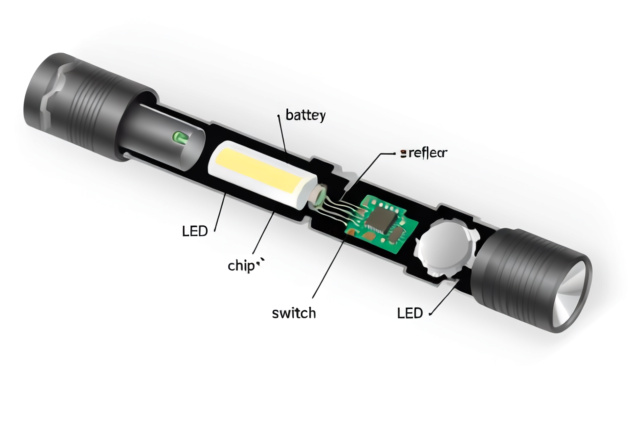
How does a flashlight work? When you flip the switch, you close an electrical circuit. Current travels from the battery through conductors to the light source (an LED in nearly every modern light), where electrical energy converts into photons. A reflector and lens then shape those photons into a focused beam you can aim.
Flashlights still matter in 2026 even as our phones flash brighter than ever. A quality dedicated light is more reliable in an emergency, throws farther, lasts longer on a charge, and frees your phone for navigation and communication. Recent events like the 2026 hurricane season and winter grid outages have reminded millions of households why a hand-held light with its own power supply belongs in every drawer, glovebox, and go-bag.
In this updated guide, I’ll walk through every part of a flashlight, the circuit that ties them together, how LEDs replaced tungsten filaments, and where the technology is heading next. You’ll also find a brief history, a series-vs-parallel circuit explanation, throw-vs-flood beam patterns, maintenance tips, and answers to the most common questions people ask about how flashlights work.
The flashlight dates back to 1899, when Russian immigrant Conrad Hubert founded the American Electrical Novelty and Manufacturing Company in New York and began producing battery-powered hand lights based on a patent by Joshua Lionel Cowen (better known for founding the Lionel model train company). Those first units were bulky, used carbon-filament bulbs, and flickered after only a few minutes of run time.
By the early 1900s, Eveready had commercialized the design with improved D-cell batteries and longer-lasting bulbs. Throughout the 20th century, flashlights shrank as batteries got denser and bulbs grew more efficient. The real turning point came in 1999, when Lumileds (a Philips-Agilent joint venture) released the Luxeon LED, the first white LED bright enough to replace an incandescent flashlight bulb. Within a decade, virtually every consumer flashlight had switched to LEDs.
The 2026 generation of flashlights now ships with USB-C charging, magnetic tail caps, programmable user interfaces, and high-CRI emitters that render color almost as well as sunlight. The basic principle, though, is over 125 years old: a portable power source, a switch, a light-producing element, and a circuit to tie them together.
Every flashlight, from a two-dollar plastic stick to a tactical 2026-model Olight or Fenix, contains the same seven functional parts. Recognizing each one makes it easier to diagnose problems, compare specs, and understand why some lights cost ten times more than others.
Parts of a flashlight at a glance:
1. Power source (batteries)
2. Switch
3. Contact strips / conductors
4. Light source (LED or bulb)
5. Reflector
6. Lens
7. Housing (body, bezel, tail cap)
Batteries are the heart of a conventional flashlight. Each cell stores chemical energy and releases it as a flow of electrons when the circuit is closed. Disposable alkaline AA and AAA cells still dominate the budget tier, but rechargeable lithium-ion chemistries have taken over the premium market.
Three formats show up most often in modern lights. AA and AAA alkalines (1.5 V nominal) are cheap, safe, and easy to find anywhere. CR123A lithium primaries (3 V) pack a lot of energy into a small package and shrug off cold weather. And 18650 or 21700 rechargeable Li-ion cells deliver 3.7 V and thousands of milliamp-hours, which is why serious EDC and tactical lights have largely standardized on them. The voltage and capacity you choose directly determine brightness, runtime, and how heavy the light feels in your pocket.
The switch is the gatekeeper of the circuit. In the off position it holds a gap in the conductive path so no current flows. Press it, and that gap closes, allowing electrons to stream from the battery toward the light source.
Modern flashlights use a few common switch designs. A tail-cap switch (the clicky button on the back) is favored by tactical users because it supports momentary-on for signaling. A side switch near the head is more ergonomic for everyday carry and typically drives a multi-mode UI. Rotary and twist switches appear in smaller penlights. Many premium lights now pair an electronic side switch with a mechanical tailswitch so you get both tactile control and access to modes like moonlight, turbo, and strobe.
Contact strips are the thin metal pathways – usually brass or copper – that carry current from the battery, through the switch, and up to the LED. They look insignificant, but they’re a top cause of flashlight failure in older lights.
Oxidation, battery leakage, or a stretched spring can interrupt the path. A flashlight that flickers or won’t turn on even with fresh batteries almost always has a contact problem, not a dead LED. Cleaning the strips with isopropyl alcohol and a cotton swab fixes most of these cases in seconds.
The light source is the component that actually converts electricity into photons. Today, that’s an LED (Light Emitting Diode) in nearly every flashlight made after about 2010. Older lights used incandescent bulbs with tungsten filaments, and a handful of specialty work lights still use high-CRI incandescent or COB panels.
The choice of emitter shapes everything else. A Cree XHP50.3 or Luminus SBT90.2 inside the same housing will deliver a very different beam, color temperature, and runtime than a budget 5mm LED. High-end flashlights now publish the exact LED model in their specs because enthusiasts care about the tint, CRI (Color Rendering Index), and maximum sustained output – not just the headline lumen number.
A parabolic or TIR reflector sits around the LED and gathers light radiating outward, redirecting it into a usable beam. Smooth reflectors throw a tight, long-distance spot. Orange-peel (textured) reflectors smooth out the beam and produce a wider flood with less of an obvious hotspot.
Throw distance and flood pattern are the result of reflector geometry, not raw brightness. A 500-lumen light with a deep smooth reflector can throw farther than a 2000-lumen light with a shallow flood reflector. Choosing between them comes down to whether you need to see 200 meters down a trail or light up an entire campsite.
The clear lens at the front of the flashlight does two jobs at once. It keeps dust, water, and impact off the reflector and LED, and it fine-tunes the beam. Most lenses are tempered glass with an anti-reflective coating to maximize light transmission.
Coated lenses can transmit 98-99% of the light that hits them, while uncoated plastic lenses can lose 5-10% to reflection alone. That difference is invisible indoors but matters when every lumen counts in a search-and-rescue context.
The housing holds everything together and protects the internals from drops, water, and heat. Budget lights use ABS plastic; mid-range lights use anodized aluminum; serious tactical and dive lights use type III hard-anodized aluminum or even titanium.
Look for an IP rating (IPX7 or IPX8 for water resistance) and a stated impact resistance in meters. Knurling, pocket clips, and magnetic tail caps are ergonomic touches that vary widely between models. The housing is also the heat sink for high-power LEDs, which is why compact tactical lights that output 1000+ lumens use thick aluminum bodies – the metal absorbs heat that would otherwise burn out the LED.
A flashlight is a textbook example of a simple series circuit. Follow the path of a single electron from the negative battery terminal, through the switch and the LED, and back to the positive terminal, and you understand how every light on earth works.
Circuit closes: Pressing the switch closes the gap in the conductive path so current can begin to flow.
Current leaves the battery: Electrons exit the negative terminal and travel through the contact strip toward the switch.
Switch routes power: The switch passes current along the path to the driver circuit and the LED.
Energy converts to light: At the LED, electrons drop across a semiconductor junction and release photons (incandescent bulbs do this instead by heating a tungsten filament until it glows).
Loop completes: Current returns to the positive battery terminal, and the cycle repeats until the switch opens.
The whole journey takes nanoseconds. Electrical signal propagation in a copper conductor is roughly two-thirds the speed of light, so the round trip inside a six-inch flashlight is effectively instantaneous.
Most flashlights use a series circuit, meaning batteries are stacked positive-to-negative so their voltages add together. Two 3.7 V 18650 cells in series deliver 7.4 V to the driver, which then steps the voltage down or up to whatever the LED needs.
Parallel configurations are rare in flashlights. In a parallel circuit, batteries are connected positive-to-positive and negative-to-negative, so the voltage stays the same but the available current (and therefore capacity) doubles. Parallel setups are common in battery packs for high-drain devices, but they introduce a balancing problem: a weaker cell can be reverse-charged by a stronger one, which is dangerous with lithium chemistries. That’s why flashlight engineers stick with series wiring and let the driver circuit handle voltage regulation.
Every component in a flashlight adds some resistance to the circuit. The LED itself has a forward voltage (typically around 3 V for a white LED), which acts as a kind of threshold: below that voltage, nothing happens. Above it, current flows in proportion to how much voltage is applied.
This is why you can’t safely drop a 3.7 V Li-ion cell into a flashlight designed for 1.5 V alkalines. The LED might survive briefly, but the extra voltage will quickly overheat and destroy it. Driver circuits exist specifically to regulate voltage and current so the LED always gets exactly what it needs, regardless of the battery’s state of charge.
Today’s LED flashlights contain a small driver board between the battery and the LED. This board regulates current, maintains constant brightness as the battery drains, and supports features like thermal step-down (reducing output when the light gets too hot), low-voltage protection, and mode memory.
Quality drivers can extract usable light from batteries that would register as “dead” in a voltmeter, which is one reason a modern LED flashlight keeps glowing long after an old incandescent would have quit. Some drivers also include PWM (pulse-width modulation) to dim the light by switching it on and off thousands of times per second. At low duty cycles this can produce visible flicker that bothers sensitive users; flicker-free drivers using constant-current regulation solve the problem at higher cost.
The way your flashlight produces light comes down to physics. LEDs and incandescent bulbs use entirely different mechanisms, and the difference shows up in efficiency, runtime, durability, and color quality.
Quick comparison:
LED: 100-200+ lumens per watt, 25,000-100,000 hour lifespan, cool to warm, virtually shockproof
Incandescent: 10-17 lumens per watt, 1,000-2,000 hour lifespan, warm yellow glow, fragile filament
LEDs generate light through electroluminescence. When current flows across a semiconductor junction, electrons fall from a higher energy band to a lower one, releasing the difference as photons. The wavelength (and therefore color) of the light depends on the semiconductor materials used.
Because almost no energy is wasted as heat, modern LEDs convert 40-60% of input power into visible light. Premium 2026 emitters from Cree, Luminus, Nichia, and Osram exceed 200 lumens per watt in real-world testing, a tenfold improvement over the tungsten bulbs they replaced. To see how that translates to runtime and brightness in real lights, browse our collection of rechargeable flashlight options.
Incandescent flashlights work on resistance heating. Current flows through a thin tungsten filament inside a vacuum or inert-gas-filled bulb, raising its temperature to roughly 2,500°C. At that temperature the filament glows white-hot and emits visible light.
The trade-off is brutal efficiency: roughly 90% of the input energy becomes heat rather than light. Incandescent flashlights drain batteries fast, get hot enough to burn skin, and break the moment they hit the floor. They’re rare now outside specialty work lights and a few enthusiasts who prefer the warmer color rendering of tungsten.
Between 1999 (the Luxeon LED launch) and the mid-2010s, LEDs went from a curiosity to the universal flashlight light source. Output per cell jumped by an order of magnitude, runtimes stretched from minutes to days, and durability improved because there are no fragile filaments or glass bulbs to shatter.
Today’s high-end flashlights also offer tunable color temperature and high CRI, meaning they render colors much more naturally than the bluish-white beams of early LEDs. A 95 CRI neutral-white emitter is now a common upgrade pick for photographers, inspectors, and anyone who needs accurate color recognition in low light.
Brightness alone doesn’t tell you how useful a flashlight will feel. Two lights with the same lumen rating can behave completely differently depending on how their reflector and lens shape the beam. Flashlight enthusiasts describe this as throw (distance) versus flood (width).
Throw is measured in meters of beam distance, the range at which the light still produces 0.25 lux of illumination (the ANSI/NEMA FL1 standard). A throw-focused beam has a tight hotspot and dim spill, perfect for spotting a trail marker 150 meters down a path. Flood beams spread light broadly with a soft hotspot, ideal for working under a sink, lighting a tent, or walking the dog.
Many modern flashlights split the difference with a TIR (Total Internal Reflection) optic or a dual-emitter setup that produces a defined hotspot surrounded by generous spill. Some lights also offer adjustable focus – twist the head to zoom in for throw or out for flood – though optical compromises mean a fixed-focus light usually outperforms a zoomie at either extreme.
Modern flashlights come in dozens of form factors, each tuned for a different use case. Knowing the main categories helps you match the right tool to the job.
EDC lights are compact, lightweight, and built to live in a pocket or on a keychain. Most measure 3-6 inches, run on a single 18650, CR123A, or AA cell, and produce 100-1000 lumens. They typically include a pocket clip, multiple brightness modes, and a tail switch for one-handed operation. Browse EDC flashlight buying guides for daily-use picks ranging from compact AAA lights to USB-C rechargeable models.
Built for military, law enforcement, and security use, tactical lights prioritize rugged construction, blinding output (often 1000-3000 lumens), weapon-mount compatibility, crenellated strike bezels, and momentary-on tail switches. They almost always run on rechargeable 18650 or 21700 Li-ion cells. For weapon-mountable and strike-bezel designs, see our tactical flashlight reviews.
Headlamps keep both hands free while directing light exactly where you look. Modern LED headlamps deliver 200-1500 lumens, run for hundreds of hours on low, and frequently include a red-light mode to preserve night vision. They’re the top choice for camping, hiking, running at night, caving, and any mechanical or electrical work in dark spaces.
Beyond standard batteries, several other power systems exist – mostly in emergency and off-grid lights:
Hand-crank dynamo: A small generator turns mechanical cranking into electricity. Slow to charge, but works indefinitely without batteries.
Solar: Built-in photovoltaic cells top off an internal battery during daylight. Useful as a backup, weak as a primary source.
Supercapacitor: Charges in seconds and tolerates millions of cycles, but stores far less energy than a Li-ion cell.
Thermoelectric: Generates power from a temperature difference (a hot cup of tea on one side, cool air on the other). Niche but genuinely useful in survival situations.
The flashlight category includes purpose-built tools you may not have considered:
UV flashlights: Reveal pet stains, authenticate currency, and identify certain minerals and fluids.
IR flashlights: Emit infrared light invisible to the naked eye but visible through night vision equipment.
Dive lights: Sealed to IPX8 standards with depth ratings often exceeding 100 meters.
Work lights: Broad, even flood beams with magnetic bases, hooks, and rechargeable batteries for jobsite use.
Flashlights serve far more purposes than just lighting up dark rooms. Their reliability and portability make them essential tools across home, outdoor, and professional settings.
During power outages, flashlights become lifelines. Keep at least one in the bedroom, kitchen, and near each exit, plus a backup in a go-bag. Modern LED lights can run for days on a single charge or set of cells.
Recent natural disasters have reinforced this lesson. During the 2026 hurricane season and the Texas winter storms, households with reliable USB-C rechargeable flashlights weathered extended blackouts far more comfortably than those depending on candles or dollar-store lights that failed after a few hours.
Campers, hikers, and hunters rely on flashlights for navigation, signaling, and campsite tasks. The shift from heavy D-cell lights to compact lithium-powered headlamps has reshaped backcountry gear lists. A 100-gram headlamp with a 1500 mAh Li-ion cell now outshines lights that used to weigh ten times as much.
For low-light photography techniques, flashlights double as tools for light painting and for illuminating foreground subjects in long exposures.
Electricians, mechanics, and inspectors rely on work lights with magnetic bases, flexible necks, and high-CRI beams that reveal wiring colors accurately. Search and rescue teams use 2000+ lumen throwers that can cut through fog and rain. Police and security officers carry tactical lights both for illumination and as a non-lethal defensive tool.
Some of the best flashlight use cases are the smallest. Finding a dropped earring behind a dresser, checking the breaker panel during a flicker, walking to the car after a late shift, or reading a menu in a dim restaurant – these tiny moments of light are why compact flashlights stay on keychains and nightstands decade after decade.
A quality flashlight can last decades, but only if you treat the battery and contacts well. Most flashlight “failures” are actually corrosion, leakage, or switch fouling rather than a dead LED.
The single most common flashlight problem is poor electrical contact. Old alkaline batteries sometimes leak a crystalline residue that coats the contact strips and blocks current. A quick scrub with a cotton swab dipped in white vinegar or isopropyl alcohol clears it up. Dry the contacts thoroughly before inserting fresh batteries.
Other flicker culprits worth ruling out in order: a loose battery (try a fresh cell), stretched tail-cap spring (compress or replace), oxidized threads at the head or tail (clean and re-grease lightly with silicone lubricant), and finally a failing switch (most tactical lights have user-replaceable switches).
Remove batteries if you plan to store a flashlight for months at a time. Alkaline cells self-discharge slowly, and a depleted alkaline that sits in a warm closet will eventually leak and corrode the contacts. Lithium primaries and Li-ion rechargeables hold their charge much better, but Li-ion cells stored at full charge degrade faster than those stored around 40-60%.
Store flashlights in a cool, dry place and check them every six months. A quick on-off cycle and a top-off charge for rechargeable models keeps the seals lubricated and the battery management system calibrated.
A flashlight works by completing an electrical circuit when you turn it on. Electricity flows from the batteries through the switch and contact strips to the light source, where it is converted into light. A reflector then focuses that light into a beam, and a clear lens shapes and protects the output.
Modern flashlights generate light using LEDs, which work through electroluminescence. When current crosses a semiconductor junction, electrons release energy as photons. Older incandescent flashlights generate light by heating a thin tungsten filament until it glows, the same way a household light bulb works.
Battery-free flashlights use alternative energy sources. Hand-crank dynamos generate electricity through mechanical motion, solar panels convert sunlight into current, supercapacitors store charge quickly, and thermoelectric generators turn temperature differences into power. These are most common in emergency and survival gear.
No. The law of conservation of energy means light cannot appear from nowhere. A flashlight must always get its energy from somewhere, whether that’s a battery, a spinning crank, sunlight, or another stored or generated electrical source. Devices that claim to produce light without any input violate basic physics.
EDC stands for Everyday Carry. An EDC flashlight is a compact, durable light designed to live in your pocket or on a keychain. Most measure 3-6 inches, run on AA, CR123A, or 18650 cells, and produce 100-1000 lumens with multiple brightness modes and a pocket clip.
The LED itself can last 25,000 to 100,000 hours of use, far longer than the 1,000-2,000 hours of an incandescent bulb. At normal use, an LED flashlight can run for decades before the emitter fails. Battery runtime per charge varies from about one hour on maximum output to several days on a low moonlight mode.
The flashlight was developed in 1899 by Conrad Hubert, who founded the American Electrical Novelty and Manufacturing Company. The design was based on a patent by Joshua Lionel Cowen. Hubert’s company eventually became Eveready, which popularized the flashlight across the United States in the early 1900s.
Most flashlights use a simple series circuit, where batteries are stacked positive-to-negative so their voltages add together. The current then flows through the switch and LED in a single loop back to the battery. Parallel circuits are rare in flashlights because they introduce cell-balancing problems with lithium-ion chemistries.
Flashlight technology isn’t standing still. The most significant changes in the last few years aren’t about brighter LEDs – we’ve largely hit the point of diminishing returns there – but about smarter power, charging, and user interfaces.
USB-C rechargeable flashlights are now standard at every price point above $30, replacing the older micro-USB and proprietary magnetic charging systems. A single USB-C cable charges your light, phone, and headphones. Magnetic charging remains popular on brands like Olight for its snap-on convenience, but USB-C is winning on universality.
Programmable user interfaces are another leap forward. Brands like Anduril (open-source firmware used by Emisar, Noctigon, and Lumintop) let users configure brightness ramp curves, thermal limits, mode memory, and even special modes like candle flicker or lightning storm. What used to require a custom mod is now a few clicks away in the official UI.
Smart features are arriving in cautious steps. Bluetooth-connected flashlights can adjust brightness from a phone app, but most buyers still prefer a physical switch. More useful is the widespread adoption of the ANSI/NEMA FL1 standard, which guarantees that a “1000 lumen” rating from one brand means roughly the same thing as “1000 lumens” from another – a reliability benchmark that simply didn’t exist a decade ago.
Looking ahead, expect higher-capacity 21700 and 46800 Li-ion cells to push runtimes even further, better high-CRI emitters to make color recognition easier, and tighter integration with solar and power-bank ecosystems for off-grid use. OLED panel lights remain a curiosity rather than a flashlight replacement, but they may eventually find a niche in flexible work lights.
Through all of it, the underlying principle stays the same: a portable power source, a switch, a circuit, and a light-emitting element. That elegant simplicity – the same idea Conrad Hubert commercialized in 1899 – is still what makes a flashlight work 2026.