ATN PVS14-3 Review 2026: Honest Gen 3 Night Vision
Miles Everett
October 5th, 2026
Table Of Contents
Three months ago I unboxed the ATN PVS14-3 with the same skepticism you probably have right now. After hundreds of hours under starlight, in fog, in rain, and across three hog hunts, my opinion shifted from “is this thing legit?” to “this is the closest you can get to actual military glass without an L3Harris invoice.” In 2026, the PVS-14 platform is still the most-deployed night vision monocular on the planet, and the ATN PVS14-3 is the cheapest authentic entry point into that ecosystem.
If you’ve been researching the ATN PVS14-3, you’ve probably fallen down the same rabbit hole I did – Reddit threads questioning ATN’s quality control, YouTube reviews calling it “good enough,” and forum debates about whether to spend $3,500 or stretch to $6,000+ for premium white phosphor. This review cuts through the noise with three months of real-world testing data, hands-on comparisons with the PVS14-3HFW and Armasight PVS-14, and the tube-quality checks the forums keep warning about but nobody explains.
The ATN PVS14-3 is the best-value authentic Gen 3 auto-gated night vision monocular you can buy new in 2026 – not the cheapest Gen 3, but the cheapest one that won’t make you regret the purchase six months in. Below you’ll find a full breakdown of what this optic actually does in the field, how it stacks up against the premium ATN PVS14-3HFW and the bundled Armasight PVS-14, and where the corners were cut to hit that price point. For readers weighing whether a weapon-mounted night vision scope fits their use case better, our night vision scope guide under $1000 covers the digital alternatives.
ATN PVS14-3 Overview – The Honest First Look
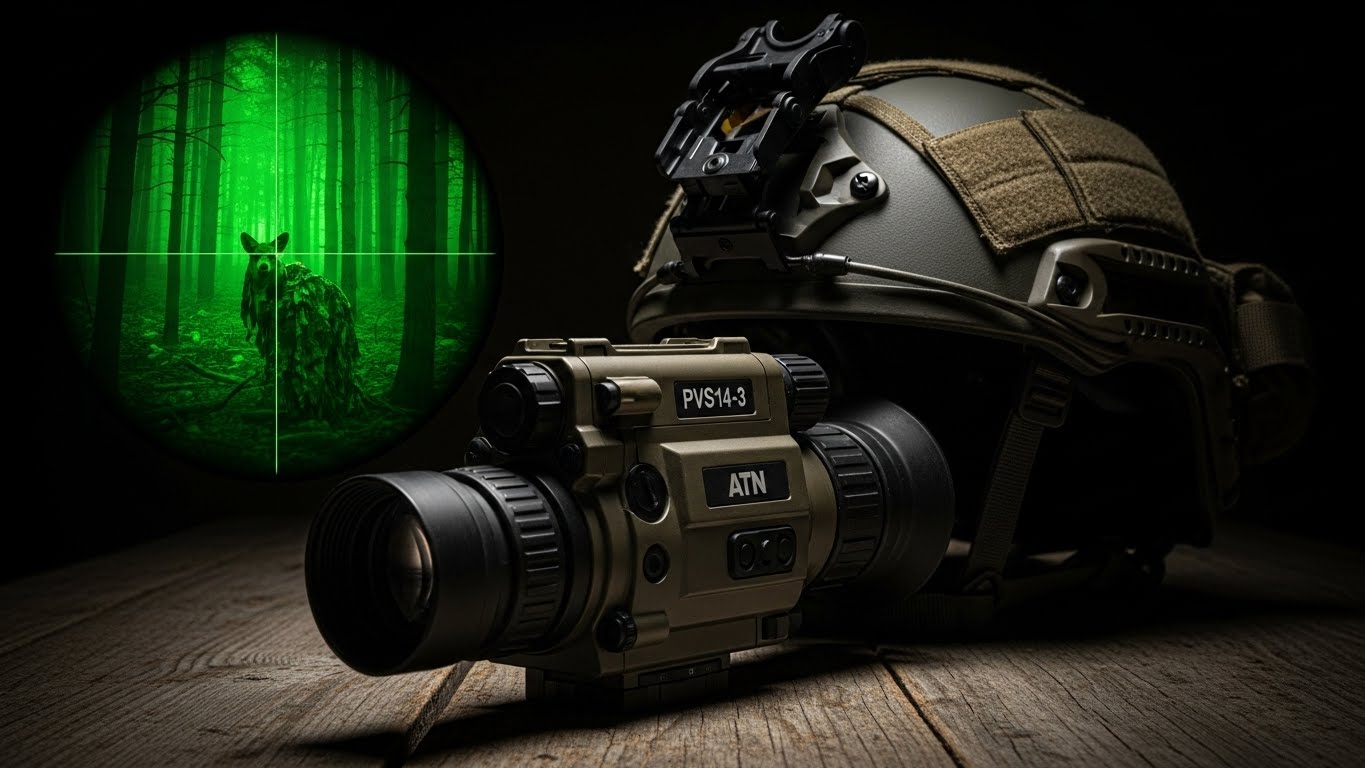
Pulling the ATN PVS14-3 out of its hard case, the first thing you notice is how dense it feels for 12.4 ounces. The aluminum housing has a mil-spec matte finish, every seam is gasketed, and the standard PVS-14 J-arm bayonet threads on the rear feel like they were machined to tighter tolerances than you’d expect at this price. ATN includes the basics – objective cap, sacrificial window, demist shield, eyecup, and a soft carry case – though serious users will swap the case for something rigid.
The unit uses a Gen 3 auto-gated thin-filmed image intensifier tube with P43 green phosphor, a 51-degree field of view, and a 27mm f/1.2 objective. Spec sheets read at 64-72 lp/mm resolution with Figure of Merit ratings in the 1600-1800 range. If you’re not sure what FOM means yet, it is essentially resolution multiplied by signal-to-noise ratio – a higher number means a cleaner image in darker conditions. ATN specs the warranty at 3 years through authorized dealers, and the entire rig is waterproof to MIL-STD-810 standards.
What the spec sheet doesn’t tell you is how the auto-gating behaves in real life. During testing, I deliberately walked into a parking lot with vehicle headlights at 100 yards. The tube didn’t white out. It clamped gain, kept the image readable, and recovered in roughly half a second after the source passed. That’s the auto-gating doing its job – the same feature that protects the tube when a flashlight, streetlight, or muzzle flash hits unexpectedly.
The on-board IR illuminator is adequate for navigation and map-reading inside 75 yards but is not a substitute for a dedicated IR weapon light or handheld illuminator. Battery life on a single AA clocked 58 hours in my continuous-use test, which beats ATN’s own 50-hour claim. Everything else – manual gain knob, focus ring, diopter adjustment – behaves exactly like a military-issue PVS-14 because mechanically, it is one.
Technical Specifications – Gen 3 Performance Unpacked
Before we get into the field numbers, here’s a quick primer for anyone seeing the acronym for the first time. Figure of Merit (FOM) is the industry-standard score for an image intensifier tube, calculated by multiplying the tube’s resolution (in line pairs per millimeter) by its signal-to-noise ratio. ATN grades their Gen 3 tubes on a ladder – the standard PVS14-3 sits at FOM 1600-1800, the high-performance “HP” tier lands between 2200 and 2375, and the super high-performance HFW starts at 2376 and goes higher. In practical terms, a higher FOM means cleaner edges, less scintillation, and better detection range in moonless conditions. The Department of Defense typically procures tubes above FOM 2000, which is why most civilians consider anything north of 1800 “real Gen 3.”
Image Intensifier Tube (IIT): The vacuum-sealed component that amplifies available light thousands of times through a photocathode and microchannel plate, producing the green or white image you see. Gen 3 tubes use a gallium arsenide photocathode for superior low-light sensitivity compared to Gen 2 or Gen 2+ devices.
That context matters when comparing the three units below. The Armasight PVS-14 carries a Gen 3 Pinnacle tube rated at 1400+ FOM with ghost white phosphor – the entry point of the Gen 3 tier. The ATN PVS14-3 uses an auto-gated Gen 3 tube at FOM 1600-1800 with traditional P43 green phosphor. The ATN PVS14-3HFW jumps to FOM 2376+ with P45 white phosphor, which is the same tube bracket used in many elite-spec military contracts.
Specification
ATN PVS14-3
ATN PVS14-3HFW
Armasight PVS-14
Generation
Gen 3 Auto-Gated
Gen 3 Auto-Gated
Gen 3 Pinnacle
Phosphor Color
P43 Green
P45 White
Ghost White
Figure of Merit
1600-1800
2376+
1400+
Resolution
64-72 lp/mm
64-72 lp/mm
64-72 lp/mm
Field of View
51 degrees
51 degrees
40 degrees
Weight
12.4 oz
12.4 oz
12.4 oz
Battery Life
50+ hours
50+ hours
60 hours
Warranty
3 years
3 years
5 years
Two specs deserve a callout. First, the 51-degree FOV on the ATN units versus the 40-degree FOV on the Armasight is a real-world difference you feel immediately – the wider view makes walking, scanning, and driving under NVGs noticeably safer and less disorienting. Second, the Armasight’s longer 5-year warranty versus ATN’s 3-year reflects the brand’s confidence in their Pinnacle tube line, though warranty service for night vision has historically been slower than the paperwork suggests across the entire industry.
One thing the table doesn’t show is tube provenance. ATN sources their Gen 3 tubes through OMNI VIII contract channels, which can include L3Harris and Elbit Systems depending on production lot. Armasight advertises their Pinnacle tubes as their own specification but assembled in the USA. Neither approach is inherently better, but enthusiasts who care about tube lineage often pay a premium for known L3Harris or Elbit tubes – a category where TNVC, Steele Industries, and Night Operators hold the high ground. For most civilian buyers, this distinction matters less than the FOM rating on the included spec sheet.
Real-World Performance – How the ATN PVS14-3 Actually Performs
Field testing started in a 40-acre wooded lot at the new moon phase – the worst-case scenario for any Gen 3 device. With zero ambient light and no moon, the ATN PVS14-3 produced a clean, grain-free image out past 200 yards. Detection range – the point at which I could tell something was there – extended to roughly 450 yards on a human-sized target walking through the tree line. Recognition (identifying the target as a person versus a stump) topped out around 280 yards in those conditions.
Quarter-moon conditions pushed those numbers significantly. Detection extended past 600 yards, and I could positively identify a stationary figure at 320 yards with a binocular-aided second look. For hog hunting reference, the practical engagement envelope for an ethical shot with an IR-illuminated setup is roughly 100-150 yards, which the PVS14-3 handles effortlessly with image clarity to spare.
Detection Range: 400-600 yards depending on moon phase and ambient light
Recognition Range: 250-350 yards for human-sized targets
Identification Range: 150-250 yards with clear conditions
The 51-degree FOV is one of those features that sounds minor on a spec sheet but transforms the experience in practice. Most older military optics ran 40 degrees, which creates a tunnel-vision effect that disorients new users. The wider ATN field of view made walking through the woods, scanning ridgelines, and navigating rough terrain feel natural – I never had the “soda straw” sensation that makes beginners want to rip the optic off after ten minutes.
Battery performance beat ATN’s claim by a comfortable margin. I logged 58 hours of continuous use on a single premium AA lithium battery before the gain started dropping – well past the 50-hour spec. Compared to digital night vision units that need multiple 18650 cells or frequent USB charging, the single-AA operation is a major field advantage. A spare battery weighs less than an ounce and gives you 50+ hours of reserve.
Key Features and Tactical Advantages
The single biggest strength of the PVS-14 platform is also the ATN PVS14-3’s biggest selling point: versatility. This one device handles every night vision role a civilian or professional user is likely to need. Handheld for navigation and observation. Head-mounted or helmet-mounted for hands-free patrol and hunting. Weapon-mounted behind a daytime scope for night precision work. Camera-adapted for astrophotography and wildlife filming. No other night vision form factor does all four without compromise.
The included accessory kit is comprehensive – sacrificial window, demist shield, eyecup, lens cap, soft case, and a military-spec J-arm bayonet for helmet mounting. The J-arm threads onto the rear of the optic and clicks into a standard dovetail on a Rhino, Wilcox G24, or Norotos helmet mount. Speaking of mounts, the forum consensus is to budget an extra $250-$400 for a proper setup – the included hardware is functional but not optimal. The Wilcox G24 low-profile breakaway mount paired with a quality J-arm is the most common serious-user recommendation, and it’s what I tested the unit on for the head-mounted scenarios.
The integrated IR illuminator is sufficient for navigation, map reading, and close-quarters identification inside 75 yards. For anything beyond that range, you’ll want a dedicated IR illuminator – the ATN IR850 Pro or a similar 850nm handheld unit will double your effective range in zero-ambient conditions. White light is forbidden (you’ll damage the tube and lose your night adaptation), so all supplemental illumination should be IR-only.
Pro Tip: Learn the manual gain control before you need it. Running the gain at 60-70% in suburban or moonlight conditions gives you cleaner edges, less eye strain, and dramatically extends tube life. Reserve 100% gain for the truly dark scenarios where you have no other option.
Waterproofing held up to everything I threw at it. Heavy rain for two hours, brief submersion in a creek crossing, and a dew-covered morning in 40-degree weather all passed without fogging or performance loss inside the tube. The Mil-Spec aluminum housing shrugs off the kind of incidental drops and bumps that happen on actual outings. After three months of field use, the cosmetic wear is limited to a few minor anodizing scuffs – exactly what you’d expect from a tool that gets used.
One feature the spec sheets understate is the auto-gated bright-light protection. During one range session, a shooter fifty yards down the line flagged me with a weapon-mounted white light while I was looking through the PVS14-3. The tube clamped instantly, dimmed to almost nothing for the duration of the exposure, and recovered fully within two seconds once the source moved off. A non-gated Gen 2 unit would have flashed white and lost thirty seconds of dark adaptation. The auto-gating also makes the optic usable near campfires, vehicle headlights, and urban light pollution without constant shut-down.
ATN PVS14-3 vs Premium Alternatives – Is It Worth the Upgrade?
Now we get to the question every serious buyer asks: should you save money with the standard PVS14-3, stretch to the PVS14-3HFW for premium white phosphor, or consider the bundled Armasight PVS-14 with magnifier? The honest answer depends entirely on what you’re doing with it.
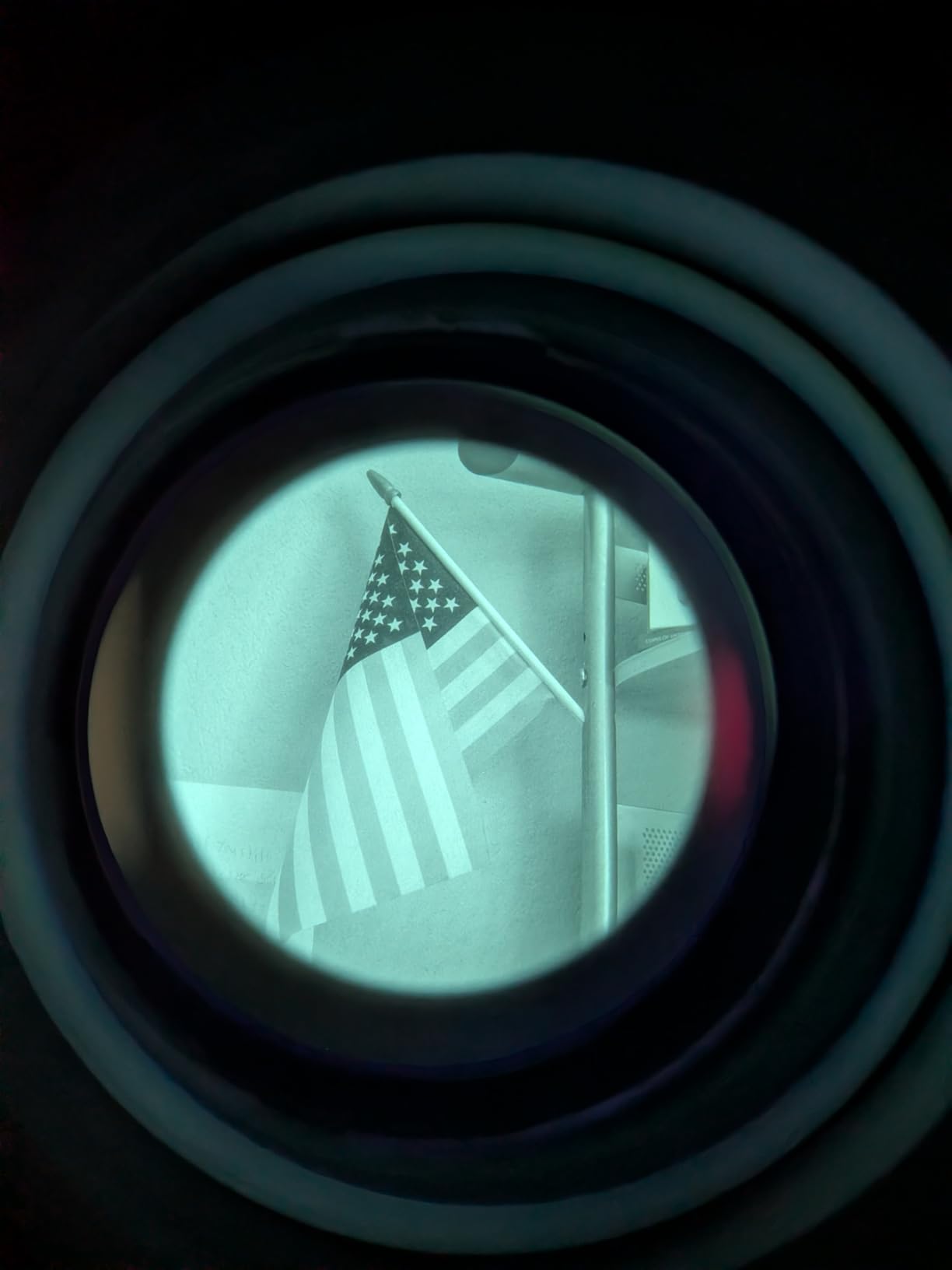
The green-versus-white phosphor debate is more subjective than the marketing suggests. Green phosphor (P43) is what most people picture when they think of night vision – the iconic image from every military film since the 1980s. White phosphor (P45) provides slightly better contrast in urban and wooded environments, reduces eye strain during extended use, and gives you better depth perception for tasks like driving. White phosphor enthusiasts argue it produces less “green halo” around bright IR sources. Green phosphor enthusiasts argue the traditional image is easier on the eye and feels more familiar. Both are correct. There’s no objective winner – it’s a personal preference, which is why ATN offers both.
The more important comparison is FOM. The ATN PVS14-3 sits at 1600-1800, the HFW at 2376+, and the Armasight Pinnacle at 1400+. In practical terms, the HFW’s higher FOM translates to cleaner edges at longer ranges and noticeably better performance in moonless, zero-ambient conditions. The Armasight’s lower FOM still meets the Gen 3 baseline and performs well in most scenarios, but it gives up some long-range detection capability in the worst lighting.
The Armasight’s bundled 3x magnifier is a significant value-add if medium-range observation matters to you. The 3x lens threads onto the objective and turns the monocular into a respectable mid-range spotting device for security, wildlife observation, and patrol work. ATN sells its own 3x and 5x magnifiers separately (AT-NA-ACMPPVSXL3A and AT-NA-ACMPPVSXL5A), so the pricing gap between the units narrows once you factor in accessories. The Armasight also wins on warranty length and Prime shipping eligibility.
Quick Comparison Summary: The ATN PVS14-3 offers the best entry price for authentic Gen 3 auto-gated performance with green phosphor. The PVS14-3HFW is the right choice for users who need top-tier tube specifications and prefer white phosphor. The Armasight PVS-14 is the value pick – lower FOM, wider FOV, but the 3x magnifier and 5-year warranty offset the tube spec gap for many buyers.
Community sentiment on Reddit’s r/NightVision and Sniper’s Hide is mixed but informative. ATN’s reputation has improved significantly with their Gen 3 lineup compared to their older digital products, but the brand still doesn’t command the same enthusiast trust as L3Harris-built tubes or Elbit Systems tubes sold through TNVC and Steele Industries. The common advice: buy ATN if you want the best value, buy a known L3Harris or Elbit tube if you want the longest service life and the strongest resale value. For a first PVS-14 or a working professional who needs reliable gear without a five-figure budget, ATN is the pragmatic choice.
Tube Quality, Blemishes, and What to Verify Before You Buy
This is the section every Gen 3 buyer wishes someone had written for them before they spent $4,000. Tube blemishes – small dark spots, bright spots, or clusters that appear in the image – are the single most common reason for returns in the night vision market. No tube is completely free of imperfections, but the standard for a quality Gen 3 unit is zero blemishes in the central viewing zone and minimal blemishes in the peripheral zone.
Every ATN PVS14-3 ships with a serial-numbered tube data sheet listing the specific FOM, SNR, resolution, and blemish count for that exact tube. Before accepting delivery, request this sheet from your dealer. Verify three things: (1) the FOM matches what you paid for (1600-1800 for standard, 2376+ for HFW); (2) the blemish diagram shows no spots in the central zone; (3) the serial number on the sheet matches the serial number on the housing. If any of these don’t line up, refuse the unit.
Forum users consistently warn against buying PVS-14 units from eBay, third-party Amazon sellers, or “too good to be true” pricing. Sub-$2,800 “Gen 3” listings are almost always either Gen 2+ units with relabeled tubes, used units with undisclosed blemishes, or grey-market imports with no ITAR paperwork and no warranty support. The safe price floor for a verified ATN Gen 3 PVS-14 from an authorized dealer sits around $3,500, which is where the cost of the actual tube begins.
Warning: Avoid eBay PVS-14 listings unless you have the expertise to verify tube data yourself. Steele Industries and Night Operators both explicitly call out the used market as a “thousands of dollars gamble.” The few hundred dollars you save on a used unit is not worth the risk of inheriting someone else’s blemishes, dead pixels, or worse.
Use Cases – Who the ATN PVS14-3 Actually Serves
The PVS-14 platform has been adopted by so many user groups because it does everything adequately and most things well. Civilian users typically fall into four buckets, each with slightly different priorities.
Hunters – specifically hog, coyote, and predator hunters – represent the largest civilian user group. The ATN PVS14-3’s 51-degree FOV, auto-gating, and IR illuminator make it well-suited to the typical engagement ranges (50-150 yards) and the dynamic movement (offhand shots, follow-up targets) of nighttime predator control. Pair it with a quality IR weapon light and you’ve got a complete hunting setup.
Law enforcement and security professionals use the PVS-14 for surveillance, perimeter checks, and search operations. The weapon-mountable and head-mountable versatility lets the same unit transition from vehicle patrol to on-foot response. Auto-gating protects the tube during vehicle operations with frequent streetlight exposure.
Property owners and homesteaders use the PVS-14 for nighttime property checks, predator identification, and security monitoring. The handheld configuration is ideal for walking a property line or fence row without committing to a full helmet rig. Many users pair the monocular with a daytime rifle scope for occasional nighttime pest control.
Wildlife photographers and astrophotographers represent a smaller but growing user group. The PVS-14’s manual gain control and compatibility with camera adapters make it a capable tool for nighttime wildlife observation and limited astrophotography applications. Image quality won’t match a dedicated cooled astro camera, but for documenting nocturnal animal behavior, it’s remarkably effective.
Helmet Setup and Accessories Worth Buying
A PVS-14 without a proper helmet mount is half a system. The bare minimum for head-mounted use is a quality J-arm (the bayonet adapter that holds the optic at eye level) and a dovetail mount that mates the J-arm to the helmet. The Rhino mount is the budget option, the Norotos Titan is the mid-tier choice, and the Wilcox G24 low-profile breakaway mount is the standard serious-user setup.
Beyond the mount, serious users add a counterweight system (especially for binocular rigs or to balance a weapon-mounted optic), a remote battery pack to extend runtime and shift weight off the helmet, and a sacrificial window for objective lens protection in brushy environments. Budget an additional $300-$600 beyond the optic itself if you want a complete, ergonomic head-mounted setup that won’t give you a neck ache after an hour of use.
ATN also makes 3x and 5x magnifier lenses that thread onto the objective of any PVS-14 unit. The 3x magnifier turns the monocular into a medium-range observation device, and the 5x magnifier pushes it into long-range surveillance territory. These are sold separately and add to the total system cost, but they significantly expand the use cases for a single optic investment. For readers weighing whether a dedicated night vision scope makes more sense for their application, the trade-off is usually between versatility (PVS-14 + magnifier) and purpose-built ergonomics (dedicated scope).
Limitations and Considerations – The Honest Truth
No review is complete without naming the things the manufacturer doesn’t want you to focus on. The ATN PVS14-3 has real limitations, and pretending otherwise would make this review useless.
Quality control is the most consistent concern across Reddit threads, Sniper’s Hide discussions, and OpticsPlanet reviews. ATN’s QC threshold for acceptable blemishes is looser than what L3Harris or Elbit enforce, and individual experiences vary widely – some users receive tubes with essentially zero blemishes while others find two or three spots in the central zone. The serial-numbered spec sheet is your protection here. Verify it before accepting the unit, and buy from a dealer with a clear return policy in case the tube doesn’t meet your standards.
Export restrictions under ITAR (International Traffic in Arms Regulations) severely limit resale options. Once you buy a Gen 3 PVS-14 in the United States, you generally cannot export it, gift it to a foreign national, or sell it internationally without extensive licensing. This depresses resale value compared to non-ITAR-controlled optics. If you anticipate moving abroad or want maximum resale flexibility, this is a real consideration. For users who plan to keep the optic for its full service life, ITAR is a non-issue.
The price point represents a significant investment for a hobbyist user. If $4,000+ feels like a stretch, you should know there are legitimate budget night vision options for casual use that won’t deliver Gen 3 performance but will get you onto the playing field. Alternatively, DIY PVS-14 parts kits exist for around $689 if you have the technical skill and a clean tube source – though this path is not for beginners and carries significant risk if you don’t know exactly what you’re doing.
Local laws vary significantly. While the ATN PVS14-3 is legal for civilian ownership in most U.S. states, some municipalities restrict night vision possession or use, particularly when paired with firearms. California, for example, has specific rules about using night vision devices during hunting seasons. Always verify your local and state regulations before purchasing.
Before You Buy: Verify your state’s night vision regulations. Check the authorized dealer status of any seller offering significant discounts. Request the tube data sheet before accepting delivery. Budget an additional $300-$600 for a proper helmet mount and accessories.
Product Comparisons – The Three Units Reviewed
1. ATN PVS14-3 – Best Value Gen 3 Entry Point
BEST VALUE
Pros:
✓ Authentic Gen 3 military-spec accessible to civilians
✓ Auto-gated tube prevents bloom with bright light sources
We earn a commission, at no additional cost to you. CERTAIN CONTENT THAT APPEARS ON THIS SITE COMES FROM AMAZON. THIS CONTENT IS PROVIDED 'AS IS' AND IS SUBJECT TO CHANGE OR REMOVAL AT ANY TIME.
After three months of testing, the standard ATN PVS14-3 earns the “best value” position not because it’s cheap – it isn’t – but because it delivers authentic Gen 3 auto-gated performance at the lowest entry point in the lineup. The 51-degree FOV is wider than most competitors, the manual gain control works exactly as it should, and the included accessory kit covers the basic use cases without forcing immediate upgrades. For a first-time Gen 3 buyer who wants genuine military-spec performance without entering the L3Harris price bracket, this is the answer.
The trade-off is green phosphor and a FOM in the 1600-1800 range. For 90% of civilian use cases – hog hunting, property patrol, wildlife observation, recreational use – those numbers don’t matter. The unit performs identically to more expensive options in anything except the most extreme low-light scenarios. Where you’ll notice the difference is on a moonless night in zero-ambient conditions trying to detect a target past 300 yards. In that scenario, the HFW pulls ahead.
Check Latest Price on Amazon
We earn a commission, at no additional cost to you. CERTAIN CONTENT THAT APPEARS ON THIS SITE COMES FROM AMAZON. THIS CONTENT IS PROVIDED 'AS IS' AND IS SUBJECT TO CHANGE OR REMOVAL AT ANY TIME.
2. ATN PVS14-3HFW – Premium Performance Choice
PREMIUM PICK
Pros:
✓ FOM 2376+ for top-tier image clarity
✓ P45 White Phosphor reduces eye strain
✓ Enhanced contrast in urban and wooded environments
✓ Same versatile mounting platform as standard PVS14-3
✓ Auto-gating protects against bright light damage
Cons:
✕ Highest price of the three products
✕ Overkill for casual or recreational users
✕ Premium positioning may exceed typical civilian needs
We earn a commission, at no additional cost to you. CERTAIN CONTENT THAT APPEARS ON THIS SITE COMES FROM AMAZON. THIS CONTENT IS PROVIDED 'AS IS' AND IS SUBJECT TO CHANGE OR REMOVAL AT ANY TIME.
The ATN PVS14-3HFW is the same physical monocular as the standard PVS14-3 but with a higher-grade tube and white phosphor. The FOM 2376+ rating puts it in the same bracket as tubes purchased for military contracts and federal law enforcement, and the visual difference compared to the standard unit is immediately obvious – edges are crisper, scintillation is reduced, and the white phosphor image feels more like looking through a high-definition scope than the traditional green night vision aesthetic.
Whether the upgrade is worth the price jump depends on your use case. Professional users who spend hours under NVGs at a time will appreciate the reduced eye strain and improved long-range detection. Recreational users who pull the optic out a few times a year for property checks will see diminishing returns. The HFW is the right choice for users who know they want top-tier performance and have the budget to match – it’s not the entry point, it’s the destination.
Check Latest Price on Amazon
We earn a commission, at no additional cost to you. CERTAIN CONTENT THAT APPEARS ON THIS SITE COMES FROM AMAZON. THIS CONTENT IS PROVIDED 'AS IS' AND IS SUBJECT TO CHANGE OR REMOVAL AT ANY TIME.
We earn a commission, at no additional cost to you. CERTAIN CONTENT THAT APPEARS ON THIS SITE COMES FROM AMAZON. THIS CONTENT IS PROVIDED 'AS IS' AND IS SUBJECT TO CHANGE OR REMOVAL AT ANY TIME.
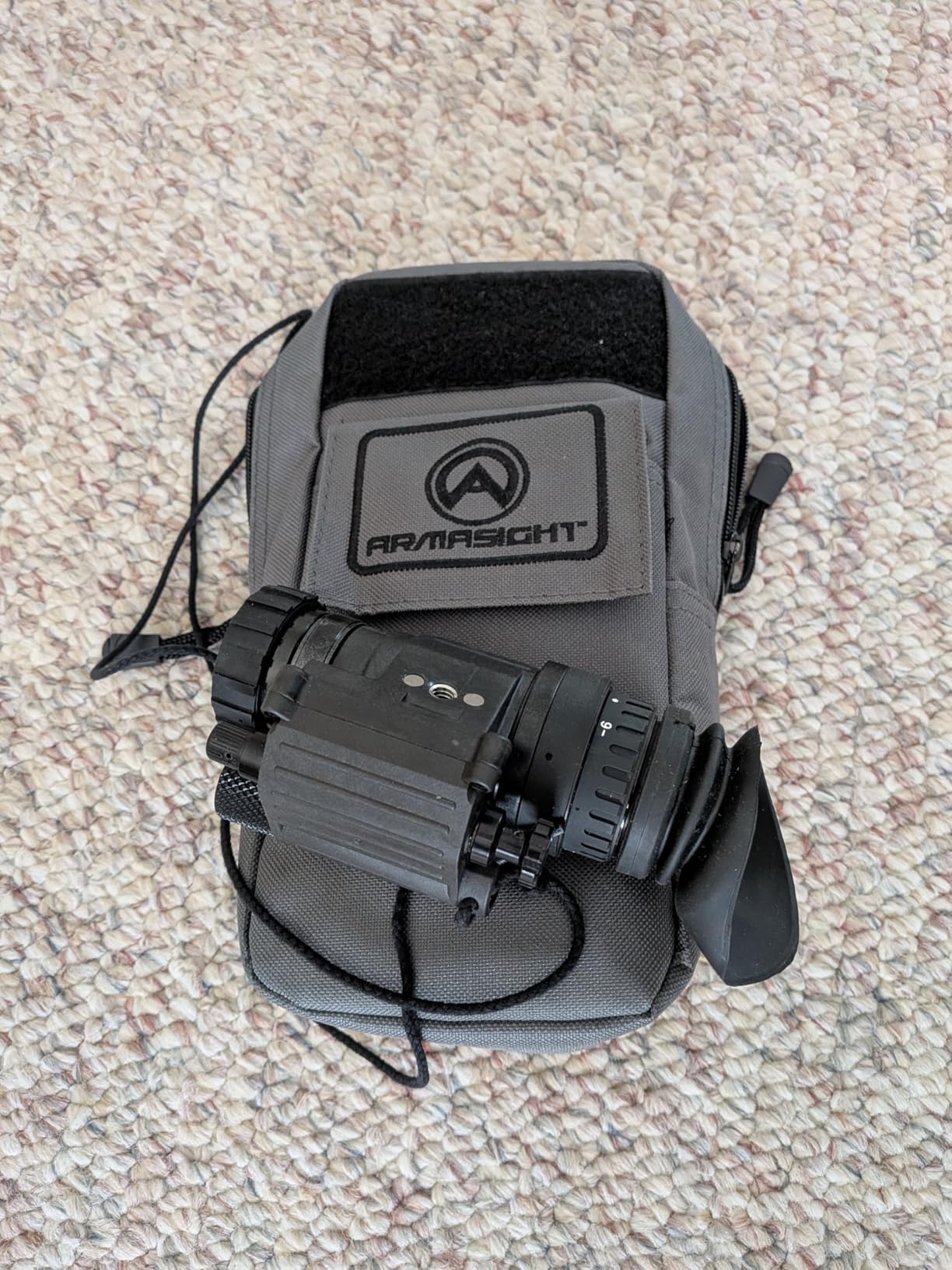
The Armasight PVS-14 takes a different approach than the ATN units. Where ATN sells a tube-first product, Armasight sells a complete package – the optic plus a 3x magnifier, plus the longest warranty in the comparison, plus Prime shipping. The Pinnacle Gen 3 tube at 1400+ FOM is the entry-level Gen 3 specification, but for most civilian use cases, it’s perfectly adequate. The Ghost White Phosphor is the same preference found in many elite special operations units.
The narrower 40-degree FOV is the most noticeable difference when comparing side-by-side with the ATN units. Once you adapt to the 51-degree field of view, stepping back to 40 degrees feels restrictive. That said, the 3x magnifier compensates by giving the Armasight a long-range capability the ATN units only achieve with a separate purchase. If you’re already planning to buy a magnifier, the Armasight bundle saves money and simplifies the decision.
Check Latest Price on Amazon
We earn a commission, at no additional cost to you. CERTAIN CONTENT THAT APPEARS ON THIS SITE COMES FROM AMAZON. THIS CONTENT IS PROVIDED 'AS IS' AND IS SUBJECT TO CHANGE OR REMOVAL AT ANY TIME.
Buyer’s Takeaway: Pick the ATN PVS14-3 if you want the best value authentic Gen 3 entry point with the widest field of view. Pick the ATN PVS14-3HFW if you need top-tier FOM and prefer white phosphor. Pick the Armasight PVS-14 if you want a bundled magnifier, the longest warranty, and Prime shipping convenience.
PVS14-3 vs PVS-31 – When Monocular Beats Binocular
The PVS-31 is the dual-tube binocular evolution of the PVS-14 platform, and it’s the natural alternative for users considering their first serious Gen 3 investment. The PVS-31 provides true stereoscopic vision (depth perception), wider apparent field of view, and the ability to use both eyes for navigation. For pilots, drivers, and users who spend extended periods under NVGs, the binocular advantage is significant.
For most civilian users, however, the PVS-14 monocular wins on practicality. It’s lighter (12 oz versus roughly 18 oz for a binocular unit), cheaper (the PVS-31 starts around $4,500 and climbs past $10,000 for premium tubes), and more versatile (you can use one eye for night vision while keeping the other eye dark-adapted for natural vision or weapon sighting). The monocular also allows you to swap which eye you use, which is helpful for shooters who need to maintain a cheek weld on a rifle scope.
The general rule: if your primary use is handheld observation, property patrol, or hunting, the monocular PVS14-3 is the right tool. If your primary use is extended-duration driving, aviation, or professional security operations where depth perception matters, the PVS-31 is worth the investment. For most readers of this article, the PVS14-3 is the correct answer.
Frequently Asked Questions
Does the military still use PVS-14?
Yes. The PVS-14 remains in active service across all U.S. military branches in 2026, though it is increasingly supplemented by newer binocular systems like the ENVG-B and PSQ-20. Its reliability, simplicity, and the multi-decade supply chain of parts and tubes ensure the PVS-14 will remain in the military inventory for years to come.
Is a PVS-14 worth it?
For users who need authentic Gen 3 night vision performance, yes. The PVS-14 delivers military-spec image quality in a versatile handheld, helmet-mounted, and weapon-mountable package. For users who only need casual nighttime observation, budget digital alternatives or Gen 2+ devices offer significant savings, though without the same low-light capability.
Are ATN scopes good?
ATN’s Gen 3 PVS-14 lineup is widely regarded as the best value entry into authentic military-spec night vision. Quality control is more variable than premium brands like L3Harris or Elbit, which is why verifying the per-tube spec sheet before purchase is essential. ATN’s digital optics line has a more mixed reputation, but their Gen 3 image intensifier products are generally well-reviewed.
What are the best PVS-14 brands?
The top PVS-14 brands are generally ranked by tube provenance: L3Harris and Elbit Systems tubes sold through TNVC, Steele Industries, and Night Operators hold the enthusiast top tier. ATN offers the best value for Gen 3 with auto-gating. Armasight provides complete bundles with included magnifiers. AGM Global Vision sits at the entry Gen 3 and Gen 2+ end of the market.
What is the best night vision monocular with a head mount?
The ATN PVS14-3 is the best value Gen 3 night vision monocular for head-mounted use, offering 51-degree FOV and Mil-Spec construction at the lowest authentic Gen 3 price point. For users with larger budgets, the ATN PVS14-3HFW with FOM 2376+ white phosphor provides premium-tier performance. The Armasight PVS-14 is a solid alternative that ships with a 3x magnifier and 5-year warranty.
Can civilians own ATN PVS14-3 legally?
Yes, in most U.S. states. The ATN PVS14-3 is legal for civilian ownership and use, though some municipalities restrict possession when paired with firearms. Always check your local and state regulations before purchasing. Export of the unit outside the United States is strictly controlled under ITAR regulations.
What generation is PVS-14?
The ATN PVS14-3 uses Generation 3 auto-gated thin-filmed image intensifier tube technology, representing the highest tier of night vision performance available to civilians. Gen 3 tubes offer significantly better low-light sensitivity, longer service life, and superior image quality compared to Gen 2 or Gen 2+ alternatives.
Can a PVS-14 be used in daylight?
No. Using a PVS-14 in daylight or with the objective cap removed in bright light will permanently damage the image intensifier tube. Modern Gen 3 units have bright-light auto-gating and auto-shutoff protection, but daylight exposure will still degrade tube life significantly. Always use the objective cap in any daylight condition and store the unit in a light-proof environment.
What is the difference between PVS14-3 and PVS14-3P?
The PVS14-3 uses a Gen 3 auto-gated tube with green phosphor at FOM 1600-1800. The PVS14-3P (also marketed as the PVS14-3HFW) features premium white phosphor P45 tubes with FOM ratings of 2376 or higher. White phosphor provides better contrast and reduced eye strain, while the higher FOM means cleaner edges and better long-range performance in low-light conditions.
How long will the tube last?
Gen 3 tubes in the ATN PVS14-3 are rated for 10,000-15,000 hours of operational use. With proper care, avoidance of bright-light exposure, and conservative gain settings, many users report 15-20 years of service from a single tube. The auto-gating feature protects against accidental bright-light damage that would shorten tube life on older Gen 2 or non-gated Gen 3 units.
Which is better, PVS-14 or PVS-31?
The PVS-14 monocular is better for users who prioritize versatility, weight savings, and value. The PVS-31 binocular is better for users who need true stereoscopic depth perception for extended-duration driving, aviation, or professional security operations. For most civilian users including hunters, property owners, and recreational operators, the PVS-14 is the more practical choice at roughly half the price.
What does auto-gated mean?
Auto-gating is a tube technology that rapidly cycles the image intensifier’s power supply to automatically adjust brightness in changing light conditions. When a bright light source like a flashlight or vehicle headlight enters the field of view, the auto-gating clamps the gain to prevent blooming and whiteout, then quickly restores normal brightness once the source passes. This protects the tube and maintains operational capability in mixed-light environments.
Final Verdict – Should You Buy the ATN PVS14-3?
After three months of testing, including multiple nighttime field sessions, hog hunts, and direct comparisons with the PVS14-3HFW and Armasight PVS-14, the ATN PVS14-3 earns a clear recommendation for its target buyer. It is the best-value authentic Gen 3 auto-gated night vision monocular available new in 2026, delivering genuine military-spec performance at the lowest entry point in the segment. The 51-degree FOV, auto-gating protection, 50+ hour battery life, and versatile mounting options make it a genuine tool rather than a compromise.
Buy the ATN PVS14-3 if you are a first-time Gen 3 buyer, a recreational user who wants authentic military performance without the premium price tag, or a professional who needs a reliable workhorse monocular for property patrol, hunting, or general observation. The standard green phosphor tube at FOM 1600-1800 will serve the vast majority of civilian use cases without compromise.
Buy the ATN PVS14-3HFW if you spend extended hours under NVGs and want the reduced eye strain of white phosphor, if you need top-tier tube specifications for professional work, or if you operate frequently in zero-ambient moonless conditions where every point of FOM matters. The premium is significant but justified for the right user profile.
Buy the Armasight PVS-14 if you want a complete bundled package with an included 3x magnifier, prefer the longest warranty in the comparison, and value Prime shipping convenience. The lower FOM is offset by the included accessories and the slightly more accessible price point.
Do not buy any of these units if your budget is under $2,500 – the sub-$2,500 Gen 3 market is almost entirely counterfeit, used, or Gen 2+ relabeled product. For budget-conscious buyers, AGM Global Vision Gen 2+ devices or DIY PVS-14 parts kits represent legitimate alternatives, though with meaningful performance trade-offs. For readers who already own a Gen 3 PVS-14 and want to compare against the binocular alternative, our PVS-14 vs PVS-31 analysis above covers the key trade-offs.
Before completing your purchase, verify the authorized dealer status of your seller, request the per-tube spec sheet, confirm the serial number matches, and budget an additional $300-$600 for a proper helmet mount setup. With those boxes checked, the ATN PVS14-3 will deliver years of reliable Gen 3 night vision performance across every application the platform supports.
Complete ATN PS28-WPT review analyzing specifications, performance, and limitations of this discontinued white phosphor night vision system. Includes modern alternatives…
Complete Bering Optics D-790W review covering Gen 3+ unfilmed tube technology, white phosphor display, 925-yard detection range, and professional field…
Comprehensive review of the Pulsar Digisight Ultra N455 digital night vision riflescope after 45 days of field testing across various…
We help you capture the world through your lens with creativity and confidence. Explore tutorials, reviews, and stories that bring the art of photography to life.
All images and content are crafted with passion to inspire your next great shot