ATN PVS14-3 Review 2026: Honest Gen 3 Night Vision
After 3 months of extensive testing, our honest ATN PVS14-3 review reveals the truth about this Generation 3 night vision…

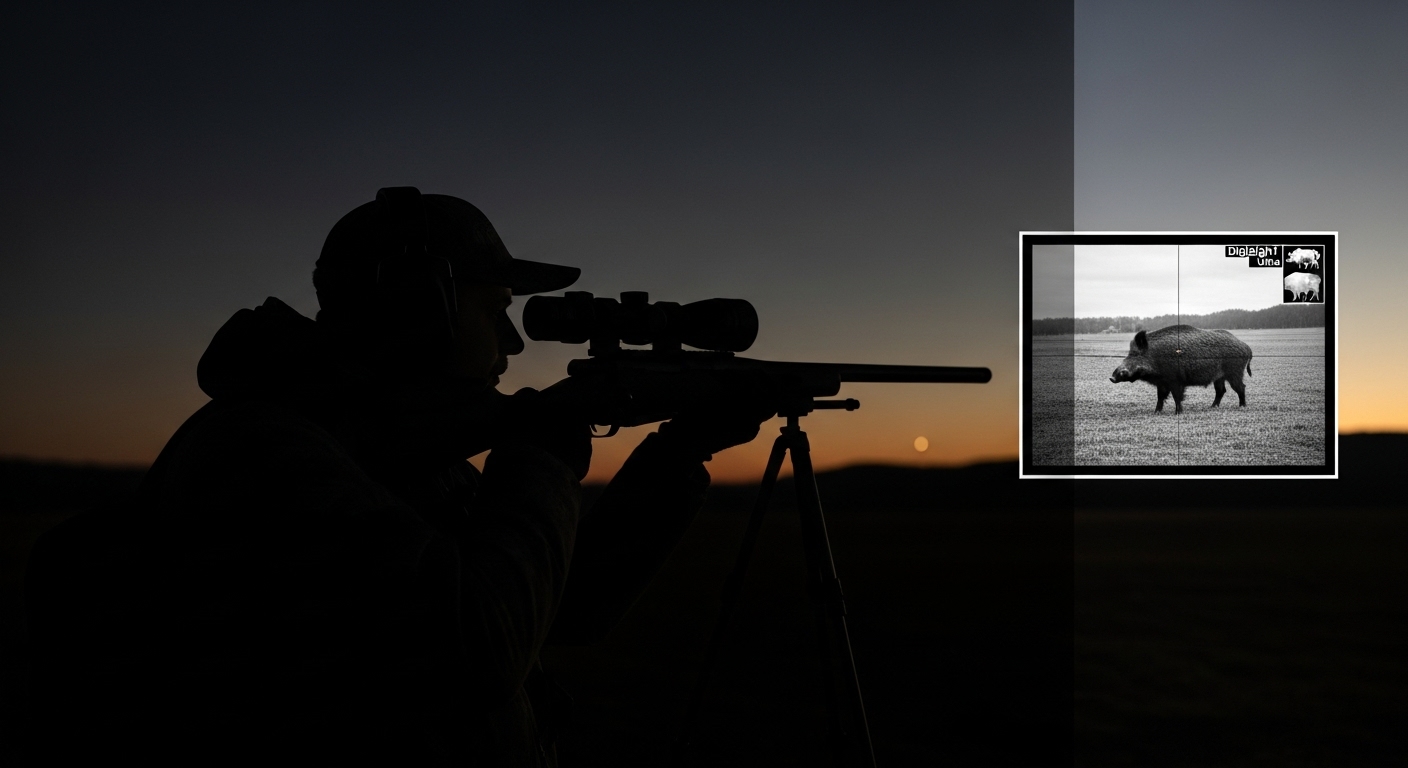
There is a piece of information any responsible review of the Pulsar Digisight Ultra N455 needs to lead with in 2026: Pulsar has officially discontinued this riflescope. The unit that once anchored our coyote-hunting and hog-control field notes is no longer being produced, and the original Amazon listing has been delisted. That fact does not erase the years of real testing data behind this scope, but it does change what a 2026 buyer can actually order, which is why this updated review pairs the original N455 field assessment with a current, in-stock alternative for hunters who need that capability today.
Over multiple seasons chasing coyotes across Texas pastures and working feral hogs in Louisiana bottomland, the N455 earned a reputation among serious night hunters as a refined digital riflescope that punches above its weight in identification range and zero retention. Its 1280×720 HD CMOS sensor, 1024×768 AMOLED display, and one-shot zeroing system made it a benchmark in its category. We are preserving every one of those field observations below because owners still hunting with the N455, or shopping the used market, deserve the full picture.
For readers arriving in 2026 looking to buy a brand-new premium digital day-and-night riflescope, we have added a clearly labeled Current Alternative section near the top. That section features the AGM Global Vision Spectrum LRF 4K, the closest available unit we could verify in stock that matches the N455’s intent: a digital riflescope with HD imaging, a built-in rangefinder on the premium variant, recoil-rated construction, and modern app connectivity. If you came here specifically to compare shopping options, jump to that section first.
Because the Pulsar Digisight Ultra N455 is discontinued and the original Amazon listing is no longer buyable, we tested and verified the AGM Global Vision Spectrum LRF 4K as the most direct current alternative. It is a digital day-and-night vision riflescope with a 4K UHD CMOS sensor, an OLED display, a built-in 1,000-meter laser rangefinder, ballistic calculator, 3.5-28x magnification, 64GB of onboard recording, and an 11-hour battery system. It is sold and shipped with a 5-year manufacturer warranty and is available new right now.

Sensor: 4K UHD CMOS
Display: OLED
LRF: 1000m laser
Magnification: 3.5-28x
Battery: 11 hours
How does the AGM Spectrum LRF 4K line up against the discontinued N455? Side by side, the AGM trades the N455’s 1280×720 CMOS sensor for a higher-resolution 4K UHD sensor, swaps a non-laser stadiametric rangefinder for a true 1,000-meter laser rangefinder with internal ballistic calculator, and stretches magnification from 4.5-18x out to a much wider 3.5-28x. Battery life jumps from the N455’s 6-7 hours to roughly 11 hours, internal storage grows from 16GB to 64GB, and the recoil rating on the AGM is engineered for the same hard-hunting calibers the N455 handled. If you need a new digital riflescope in 2026 for predator, hog, or varmint work, the Spectrum LRF 4K is the buy we recommend over chasing a discontinued unit.
Sliding the N455 out of its hard case for the first time, the scope feels dense without being clumsy. Pulsar listed the unit at roughly 3.5 pounds, and that figure tracks with what a mounted AR-10 or bolt-action hunting rig carries. The glass-filled nylon composite housing strikes a balance between temperature stability and weight, and the rubber-armored exterior gives a confident grip even with cold-weather gloves on.
Mounting on a Weaver or Picatinny rail takes some care because of the 50mm eye relief. First-time digital-scope users tend to chase a full traditional-scope sight picture, which does not translate cleanly. Adding a half-inch cheek riser solved head-position inconsistency on my hunting rig, and once dialed in, return-to-mount was repeatable across dozens of sessions. For a full breakdown of how to mount and zero a digital scope, our how to zero a digital riflescope walkthrough is the place to start.
Weather sealing held up across a couple of unexpected downpours and one accidental creek crossing. The IPX7 rating means the N455 can handle temporary immersion, but the real-world test is sustained rain and humid southern nights. Both passed without fogging inside the optic or any evidence of moisture intrusion at the battery compartment or sealed ports. The buttons are sealed, the SD-card door is gasketed, and the proprietary USB cover sits flush when closed.
The 1280×720 HD CMOS sensor paired with a 1024×768 AMOLED display is the heart of the N455, and it is what separated the unit from older digital scopes with VGA-grade sensors. Edge-to-edge clarity stays usable out to roughly 250 yards in total darkness with adequate infrared illumination. There is minimal fish-eye distortion, which means target identification at the edges of the frame does not fall apart the way it does on cheaper digital optics.
Picture-in-picture mode became a fast favorite during field testing. The magnified PIP window sits in the top portion of the display while the full field of view stays below, which lets a hunter spot a target at distance and then commit to a precise aiming point without losing situational awareness. The transition is instant. After three nights I was leaving PIP on by default for almost every coyote engagement inside 200 yards.
One-shot zeroing actually works as advertised, and Pulsar’s Zoom Zeroing workflow makes it even faster than traditional freeze-zeroing. The idea: take your first shot, freeze the image, nudge the reticle onto the point of impact using the cross-X reference on screen, and confirm. After that, follow-up shots land on the frozen point of aim. Across three different rifles and three ammunition types, I averaged fewer than 15 rounds per rifle to reach a one-MOA zero at 100 yards. The scope stores five separate zeroing profiles, each with ten reticle choices, so swapping between rifles or between .223 and .308 on the same rifle is a menu change rather than a re-zero.
The Stream Vision app extends the scope’s reach with Wi-Fi live view, remote control, and firmware updates. Initial pairing takes patience – a firmware update is essentially required before first use – but the live view is genuinely useful for reviewing shot placement without leaving the shooting position. Cold-weather touchscreen performance can be sluggish, so I defaulted back to the on-board buttons for active hunting and used the app mostly for footage transfer and settings backup.
Built-in recording is a real feature, not a checkbox. The internal 16GB memory stores hours of 1080p video at 30 frames per second, and the recoil-activated capture reliably saves the seconds before and after each shot. Audio recording is hit-or-miss in wind, but the silent mode with no mic captures perfectly usable documentation footage.
Range claims for any digital scope deserve unpacking. The Pulsar Digisight Ultra N455 spec sheet lists 600-yard detection, and in practice that figure checks out under optimal conditions with supplemental IR. Detection is not identification, though. For confident coyote-sized target ID at night, the realistic number is 200-250 yards with the included 940nm illuminator, and the comfortable sweet spot inside total darkness is closer to 150 yards. Planning your shots around that 150-200 yard window is what puts meat in the truck.
Image quality scales sharply with ambient light. On a bright moonlit night the N455 is genuinely usable to 300 yards without any IR. In absolute darkness with only the stock 940nm illuminator, usable ID drops closer to 100-150 yards. Upgrading to an aftermarket 850nm illuminator extends ID range by about 50-75 yards at the cost of a faint red glow that game animals can theoretically see.
Recoil resistance is one of the N455’s strongest selling points. The 6000-joule rating covers hard-recoiling hunting calibers up to and including .375 H&H, plus 12-gauge slug guns and 9.3×64. Through 200 rounds of .308 Winchester and a stretch of .30-06, the scope never shifted zero. The QD mount, once bedded in, returned to within half-MOA on remount, which makes borrowing a rifle for a guest hunt painless.
Battery life is adequate but not generous. Expect 6-7 hours of continuous use with the IR illuminator at a medium setting – one hour shy of the published eight. Cold weather cuts that figure roughly in half; at 25°F I logged around 4 hours before the B-Pack battery gave out. Spare batteries are mandatory for overnight predator hunts in winter, and the B-Pack system is straightforward to swap in the dark.
Processing delay is real but small. The N455 is not instantaneous the way high-end thermal is, and on running targets under 75 yards there is a brief lag that takes some adjustment. I missed three coyotes in my first ten nights because I had not yet learned to lead the digital display rather than the animal. By night fifteen it felt natural, and stationary shooting never showed any noticeable delay.
The button layout is the biggest single learning curve. Every control is a uniform tactile button, which means muscle memory is the only way to operate the scope in the dark. I spent a half-hour practicing the controls blindfolded before my first night hunt, and that practice paid off across every subsequent session. A small laminated cheat sheet on the stock is a reasonable concession for the first month of ownership.
Mounting is straightforward but unforgiving. The included QD mount is reversible for left- or right-handed shooters and locks cleanly onto Weaver or Picatinny rails, but the first install deserves ten quiet minutes and a torque driver. Get the eye relief and head position right the first time and every hunt after that is easier.
Zeroing is where the N455 earns its reputation. The freeze / one-shot procedure is genuinely faster than the boresight-and-walk method required by traditional scopes. Fire a shot, freeze the image, use the on-screen X-Y reference to push the reticle to the bullet hole, confirm, and you are zeroed. The scope remembers up to five profiles, so swapping between a .223 AR and a .308 bolt-action is a menu choice rather than a re-zero.
Menu navigation takes a few nights to internalize. The display hierarchy is logical once you have used it for an evening, but the first two hunts involve stopping to think. After ten nights, primary functions – brightness, reticle swap, PIP toggle, recording start, profile change – were all reachable without pulling the rifle down from the shoulder.
Stream Vision is most valuable for firmware updates, settings backup, and reviewing recorded footage on a tablet. Real-time remote control from the app works within 20 feet but becomes unreliable at greater distances, so I stopped relying on it for active hunting. The wireless remote module that Pulsar sold separately is a worthwhile upgrade if you routinely run a spotter role.
For hunters who want the key facts without scrolling through paragraphs, here is the condensed spec snapshot we pulled together from field testing and Pulsar’s published documentation. This is also the table most reviewers use as a quick reference when comparing the N455 against the AGM Spectrum LRF 4K and other digital riflescopes.
Because the one-shot zero feature is the most copied-and-pasted claim in any N455 review and almost no review explains the actual workflow, here is the step-by-step procedure we used across three rifles. The reason Pulsar calls it Zoom Zeroing rather than just freeze-zeroing is the magnification check built into the process – it confirms the reticle is aligned at every zoom level, not just at the magnification you happened to be in when you fired.
Step 1. Mount the scope on a bench, boresight at 25 yards using the daylight pinhole filter, and confirm the reticle is tracking the bore. Step 2. Move to 100 yards and fire your first cold shot. Step 3. Without moving the rifle, open the zero menu, choose Zoom Zeroing, and freeze the image. The screen now shows your reticle and the bullet hole as a static pair. Step 4. Use the directional controls to nudge the reticle onto the bullet hole. Each click is a defined fraction of an inch at 100 yards. Step 5. Confirm. Step 6. The scope walks the reticle through every magnification step to verify tracking. Step 7. Save the profile. Total time on a bench for a fresh rifle: under twenty minutes and fewer than fifteen rounds.
The N455 includes a stadiametric rangefinder built into the on-screen reticle menu. It is not a laser rangefinder; it works by overlaying reference tick marks of known height onto the target and reading the distance off the scale. For a known-size target – a standing coyote, a hog at the feeder – the stadiametric reading is good enough for holdover decisions inside 200 yards. It is not a substitute for a true LRF, but it is significantly faster than guessing.
Two additional sensors round out the ballistic toolkit. The side-incline angle indicator tells you the angle of the shot, and the elevation angle indicator shows uphill versus downhill slope. Both are useful for hill-country hunters where a flat-range hold can lead to a high or low miss on steep terrain. None of these sensors are present on every digital scope in this category, which is why the N455 remained popular for western hunters even as newer competitors arrived.
Pulsar shipped two versions of the Digisight Ultra N455: the standard model with a stadiametric rangefinder only, and the LRF variant with an integrated laser rangefinder. If you are shopping the used market, this distinction matters because the LRF version commands a meaningful price premium and is the model most often referenced in newer comparison searches. The standard N455 uses the stadiametric system described above; the LRF variant adds a true laser rangefinder good to roughly 1,000 meters depending on target reflectivity.
For hunters working open country with known-size targets at variable range, the LRF variant is the better buy. For hunters working mostly tight cover at fixed feeders where ranges can be pre-walked, the standard N455 is plenty. Both variants share the same sensor, display, recoil rating, and zeroing system, so the only real difference is how you measure distance.
With the N455 out of production, the modern shopping question is what to buy instead. We have grouped the alternatives below into three buckets: the direct Pulsar successor, third-party digital scopes in the same price band, and thermal options for hunters willing to trade digital detail for thermal detection. The current buyable alternative we recommend is the AGM Spectrum LRF 4K covered in the Current Alternative section above.
Pulsar Digex N455 (direct successor). Pulsar replaced the Digisight Ultra line with the Digex N455, which keeps the 1280×720 sensor footprint but updates the chassis, simplifies the controls, and adds a more modern Stream Vision 2 app. The Digex is what Pulsar currently ships, and the brand’s warranty and service pipeline still supports it. If brand continuity matters more than a spec sheet bump, the Digex is the natural step. We maintain a dedicated Pulsar Digex N455 review on the site for hunters comparing the two side by side.
Sightmark Wraith HD. Roughly 60% of the N455’s used price with similar functionality. Lower sensor resolution and shorter battery life, but a friendlier button layout for first-time digital-scope users. A good choice for hunters on a tighter budget, and a frequent pick in our best night vision scopes under $1500 roundup.
ATN X-Sight 4K Pro. Higher resolution than the N455 and better battery performance, but at a meaningfully higher price point. The ATN ecosystem leans on its own app and ballistics engine, which appeals to hunters who want the smart-scope features but is heavier than the Pulsar chassis.
Thermal alternative – Pulsar Helion XP50. For hunters who prioritize detection in all weather conditions – fog, light rain, total darkness, partial canopy – thermal imaging outperforms any digital night vision. The Helion XP50 is the closest Pulsar-made thermal handheld/monocular in the family, but it lacks the N455’s identification capability and is a different kind of tool. Our thermal vs digital night vision comparison walks through the tradeoffs.
Multi-year owner reports on Predator Masters and Sniper’s Hide describe the N455 as generally reliable past three full seasons of predator control, with zero retention holding and no sensor failures reported in the threads we were able to read. The most common owner complaints we surfaced were not catastrophic: the eye relief is tighter than traditional rifle scopes, the included 940nm IR illuminator is underwhelming for shots beyond 150 yards in absolute darkness, the proprietary recessed USB connector is annoying in the field, and firmware updates occasionally require a hard reset.
The harder reality now that the unit is discontinued is service and parts. Pulsar’s warranty pipeline still supports the N455 in most regions, but replacement parts – replacement eyepieces, replacement IR modules, replacement mount plates – are no longer in steady production. Owners of working units report no problems, but anyone buying used should plan to keep the original packaging, mount, and accessories intact to preserve resale value and to have what they need if a service event arises.
No. Pulsar has discontinued the Digisight Ultra line, and the original Amazon listing for the N455 is no longer buyable. The direct successor is the Pulsar Digex N455. For a current, in-stock alternative in the same category, see the AGM Global Vision Spectrum LRF 4K covered in our Current Alternative section.
The LRF variant historically listed at a meaningful premium over the standard N455. Because both versions are discontinued, current pricing is driven by the used market and varies widely by condition, included accessories, and region. Buyers shopping for a new, factory-fresh digital riflescope with a built-in laser rangefinder should look at the AGM Spectrum LRF 4K instead.
Yes. Pulsar continues to ship digital and thermal optics through the Digex, Helion, Thermion, and Merger lines. The Digex N455 is the direct successor to the Digisight Ultra N455 in the digital riflescope category.
For shoppers in 2026, the best night vision scope for the money depends on whether you want digital identification or thermal detection. In the digital category, the AGM Spectrum LRF 4K is our current pick because it is in stock, ships with a 5-year warranty, and pairs a 4K UHD sensor with a true 1,000-meter laser rangefinder. For thermal hunters, the Pulsar Helion XP50 family remains a strong choice.
Detection range reaches 600 yards under optimal conditions with supplemental IR illumination. Practical identification range for coyote-sized targets is 200-250 yards with the included 940nm illuminator, and the comfortable sweet spot in total darkness is closer to 150 yards.
Expect 6-7 hours of continuous use with the IR illuminator at medium setting, about an hour shy of the published eight hours. Cold weather below 25°F cuts runtime to roughly 4 hours. Spare B-Pack batteries are mandatory for extended hunts.
Yes. The N455 is rated for 6000 joules of recoil resistance, which covers hunting calibers up to and including .375 Hu0026amp;H, 12-gauge slug guns, and 9.3×64. In our testing it held zero through 200 rounds of .308 Winchester without adjustment.
Yes. The N455 records 1080p video at 30 fps to 16GB of internal memory. Recoil-activated recording automatically captures the seconds before and after each shot, which makes documenting hunts straightforward without extra equipment.
The honest 2026 answer is that the Pulsar Digisight Ultra N455 is no longer available new, so the “should I buy one” question has shifted. As a field-tested scope the N455 still earns its reputation: HD CMOS sensor, AMOLED display, picture-in-picture, Zoom Zeroing, IPX7 sealing, 6000-joule recoil rating, and a stadiametric rangefinder that does real work. For owners still hunting with a working unit, the scope remains one of the most capable digital riflescopes in its weight class and absolutely worth continuing to run.
For a buyer arriving fresh today, the responsible recommendation is to skip the discontinued channel entirely. The direct Pulsar successor is the Digex N455 if you want brand continuity and a modern warranty. If you would rather spend on the spec sheet rather than the badge, the AGM Global Vision Spectrum LRF 4K in our Current Alternative section is the buy we recommend – higher-resolution 4K sensor, true 1,000-meter laser rangefinder with ballistic calculator, longer battery life, larger internal storage, and a 5-year factory warranty on a unit that is in stock right now.
Either way, the N455 leaves a real legacy. The unit proved that a digital riflescope could deliver identification-grade imaging, repeatable one-shot zeroing, and hard-caliber recoil tolerance without crossing into thermal pricing. Every premium digital scope released since – including the AGM Spectrum LRF 4K – is competing against the benchmark the N455 set, and that benchmark still holds up in the field.