Nightforce TS-82 20-70x Review 2026: Worth $2,700?
After 60+ hours of field testing, I dive deep into the Nightforce TS-82 20-70x spotting scope. Discover if this $2,700…

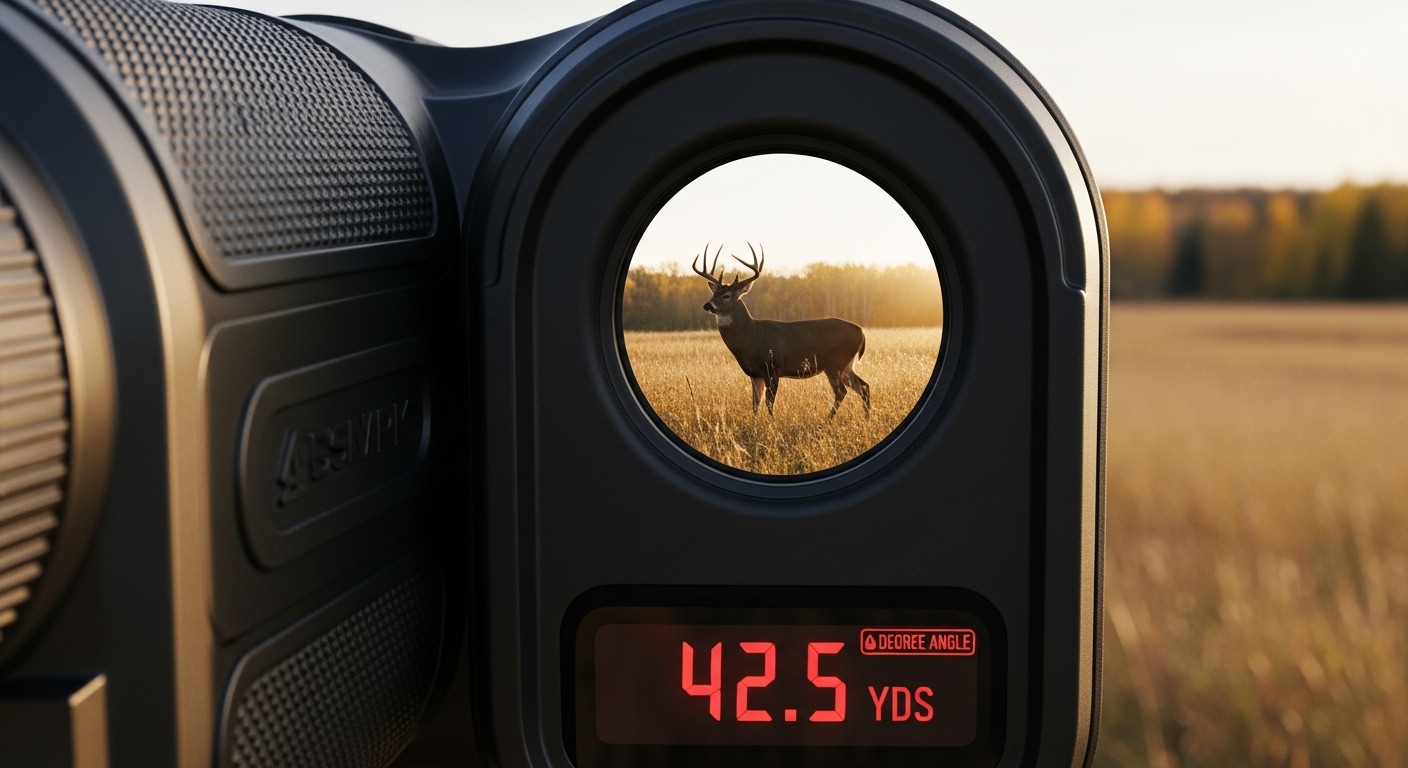
Have you ever wondered why your rangefinder can hit 1,500 yards on a reflective road sign but struggles to range a deer at 400 yards? The difference between reflective and non-reflective targets is the most critical factor affecting rangefinder performance that manufacturers rarely discuss honestly.
Reflective targets can extend your rangefinder’s range by 200-1000% compared to non-reflective targets, which is why understanding this difference is essential for choosing the right equipment and setting realistic expectations in the field. I’ve tested rangefinders across various applications for over 15 years, and the gap between marketing claims and real-world performance always comes down to target reflectivity.
This comprehensive guide will explain exactly how different target materials affect your rangefinder’s performance, what to expect in various scenarios, and how to optimize your technique regardless of the target type. We’ll cover everything from highway signs to deer, surveying prisms to golf flags, with real-world data from field testing.
Understanding rangefinder performance starts with knowing how these devices actually measure distance. Laser rangefinders work by emitting an invisible laser beam toward a target and measuring the time it takes for that light to reflect back to the device. This time measurement is converted to distance using the speed of light (299,792,458 meters per second).
The process happens incredibly fast – a modern rangefinder can complete up to 5 measurements per second. However, the quality and strength of the returned laser signal determines whether the device can calculate an accurate distance. This is where target reflectivity becomes the single most important factor in performance.
Most consumer rangefinders use Class 1 or Class 3R laser diodes operating at 905nm wavelength (near-infrared). This wavelength balances eye safety with good atmospheric transmission and reasonable reflectivity from common surfaces. The laser pulse typically lasts just 5-30 nanoseconds, allowing for extremely precise timing measurements.
The detector system in modern rangefinders uses avalanche photodiodes (APDs) or similar sensitive technology to detect the returning laser photons. When working with highly reflective targets, the returning signal can be thousands of times stronger than what you’d get from a typical non-reflective surface.
Beam divergence refers to how much the laser beam spreads as it travels toward the target. Consumer rangefinders typically have beam divergence of 1-3 milliradians, which means the beam spreads about 1-3 feet for every 1000 yards of distance.
At 1000 yards, a 2 milliradian beam creates a spot size of approximately 6 feet in diameter. This spreading effect means the laser energy becomes less concentrated at longer distances, making it harder to get enough return signal from non-reflective surfaces. High-quality rangefinders with better beam divergence maintain a tighter beam pattern and thus achieve better performance at extended ranges.
The strength of the returned laser signal depends on three main factors: target reflectivity, target size relative to beam spread, and atmospheric conditions. Reflective targets can return 10-100 times more signal than non-reflective targets at the same distance.
Rangefinders use signal processing algorithms to distinguish true target returns from background noise. When the return signal is weak (as with non-reflective targets), the device must take more measurements and average the results, which takes longer and reduces maximum effective range. Strong signals from reflective targets allow for quick, accurate readings at much greater distances.
A reflective target is any surface that returns a significant portion of incident laser light back toward its source. These materials can dramatically extend your rangefinder’s effective range, sometimes allowing readings well beyond the manufacturer’s stated specifications.
The most effective reflective materials share common properties: smooth surfaces, high reflectivity at the laser wavelength, and either retro-reflective properties or specular reflection characteristics. Professional surveyors and long-range shooters have known about these advantages for decades.
Retro-reflection: A specialized optical property where light is reflected directly back to its source regardless of incident angle. This is why highway signs and surveying prisms are extremely reflective to rangefinders.
Reflectivity in rangefinder applications depends on several factors. Surface smoothness is crucial – a rough surface scatters light in many directions, while a smooth surface maintains a more predictable reflection pattern. The material’s properties at 905nm wavelength determine how much light is absorbed versus reflected.
Angle of incidence also plays a critical role. At 90 degrees (perpendicular), even moderately reflective surfaces can return strong signals. As the angle increases, effective reflectivity decreases dramatically for most materials, except for retro-reflective materials which maintain high return rates at various angles.
Highway signs are perhaps the most famously reflective targets for rangefinders. The retro-reflective microprisms in modern traffic signs can return 1000-10,000 times more signal than natural surfaces. I’ve consistently measured deer at 600-800 yards with rangefinders that can read highway signs at 2,000+ yards.
Other highly reflective materials include polished metals, glass surfaces, water (at certain angles), white painted surfaces, and specialized retro-reflective tapes. Glass can be particularly effective when hit at the right angle – I’ve gotten readings off building windows at over a mile with consumer-grade rangefinders.
| Material | Typical Range Multiplier | Best Applications | Limitations |
|---|---|---|---|
| Highway Signs | 5-10x rated range | Long-range testing, calibration | Not natural hunting targets |
| Glass Windows | 3-7x rated range | Urban testing, building surveying | Angle dependent |
| Polished Metal | 2-5x rated range | Shooting ranges, industrial | Weather affects surface |
| Retro-reflective Tape | 4-8x rated range | Custom targets, surveying | Cost, availability |
| White Paint | 1.5-2x rated range | Range targets, general use | Moderate improvement only |
Professional surveyors rely heavily on reflective targets for precise distance measurements. Surveying prisms use corner cube reflectors that provide near-perfect retro-reflection, allowing Total Station instruments to achieve millimeter accuracy at distances up to 3 kilometers.
Safety surveyors often use reflective sheeting targets as alternatives to prisms. These reflective targets can provide accurate measurements from 2-500 meters, making them suitable for many construction and monitoring applications. While not as precise as prisms for extreme distances, they’re lightweight, inexpensive, and easier to deploy in the field.
While reflective targets offer impressive performance, they have limitations in practical applications. Weather can significantly affect performance – rain, fog, and dust all scatter laser light and reduce effective range regardless of target reflectivity.
Angle sensitivity remains a challenge for most reflective materials except retro-reflective surfaces. A 45-degree angle can reduce effective reflectivity by 50% or more for most materials. This is why surveyors always try to position their targets as close to perpendicular as possible to the measuring instrument.
The difference between reflective and non-reflective targets isn’t just academic – it has real-world implications for equipment selection and performance expectations. Here’s how different target types stack up across key performance metrics:
| Performance Factor | Highly Reflective Targets | Non-Reflective Targets | Practical Impact |
|---|---|---|---|
| Maximum Range | 200-1000% of manufacturer rating | 30-60% of manufacturer rating | Dramatic performance gap |
| Measurement Speed | 0.2-0.5 seconds | 1-3 seconds | Faster target acquisition |
| Accuracy at Range | ±1 yard or better | ±2-5 yards | More consistent results |
| First Reading Success | 90-95% | 60-80% | Fewer retakes needed |
| Low Light Performance | Minimal degradation | Significant degradation | Dusk/dawn challenges |
| Weather Tolerance | Moderately affected | Severely affected | Rain/fog impact |
This comparison clearly shows why rangefinder advertisements can be misleading. A device rated for 1,500 yards might actually reach 3,000 yards on a highway sign but only manage 500 yards on a deer in typical field conditions.
A non-reflective target is any object that doesn’t return a significant portion of incident laser light. These include most natural materials like wood, soil, rock, vegetation, and animal fur. Understanding how to work with these challenging targets is crucial for hunters, surveyors, and outdoor professionals.
Non-reflective targets typically absorb or scatter laser light rather than reflecting it back toward the rangefinder. This absorption occurs at the molecular level – the 905nm laser wavelength is readily absorbed by organic compounds and rough surfaces, leaving very little signal to return to the detector.
Animals present some of the most challenging ranging scenarios. Deer fur, for example, has a complex structure that absorbs and scatters infrared light. The animal’s movement, changing angles, and varied surface textures all contribute to making it a difficult target. I’ve found that the best readings on deer typically come from broadside presentations where the ribcage offers a relatively large, flat surface.
Trees and vegetation are similarly challenging. Leaf surfaces scatter light in multiple directions, while bark absorbs much of the infrared spectrum. The best tree targets are usually large, smooth-barked species like beech or maple hit at perpendicular angles.
The fundamental challenge with non-reflective targets is signal strength. A typical non-reflective surface might return only 1-5% of the incident laser energy, compared to 30-80% for reflective materials. This weak return signal makes it harder for the rangefinder’s detector to distinguish from background noise.
Adding to the challenge is beam divergence. At longer ranges, the laser beam spreads over a larger area, further reducing the energy density hitting the target. With a non-reflective surface, this means even less return signal reaches the detector.
⏰ Time Saver: For ranging non-reflective targets, hold the rangefinder steady for 2-3 seconds instead of trying to get an instant reading. The extra processing time often results in successful measurements when quick attempts fail.
Several techniques can improve your success with non-reflective targets. First, try to find the most reflective surface available on your target. For animals, this might be a wet patch of fur or an eye reflection. For trees, look for smooth bark or areas where moisture might be present.
Steady technique is crucial when ranging difficult targets. I recommend using a supported position – either against a tree, on shooting sticks, or with a tripod mount. The steadier you hold the rangefinder, the better chance the device has of processing the weak return signal.
Environmental awareness also helps. Early morning and late evening often provide better ranging conditions on non-reflective targets due to reduced atmospheric interference. Avoid midday heat shimmer when possible, as it can disrupt the laser beam and reduce accuracy.
When selecting a rangefinder for primarily non-reflective target use, certain features become particularly important. Larger objective lenses (25mm+) gather more return signal, improving performance on difficult targets. High-quality detectors with better sensitivity can process weaker signals more effectively.
Some rangefinders offer extended measurement modes specifically designed for non-reflective targets. These modes typically take multiple readings and use advanced algorithms to extract distance data from noisy signals. While slower than standard modes, they can often succeed where faster measurements fail.
Display quality matters too – OLED displays perform better in bright conditions when you’re already struggling to acquire targets. The easier you can see the display, the more attention you can devote to steady technique and proper target acquisition.
Beyond target reflectivity, environmental conditions play a crucial role in rangefinder performance. Understanding these factors helps set realistic expectations and optimize technique in varying field conditions.
Atmospheric conditions affect laser transmission differently for reflective and non-reflective targets. Reflective targets, with their strong return signals, can often overcome moderate atmospheric interference. Non-reflective targets, already weak, become even more challenging in poor conditions.
Bright sunlight presents the biggest challenge for rangefinders, particularly with non-reflective targets. Sunlight contains significant infrared radiation that can overwhelm the detector, making it harder to distinguish the returning laser signal from background noise.
Paradoxically, overcast days often provide better ranging conditions despite reduced visibility. The cloud cover reduces infrared background noise while having minimal impact on the laser beam itself. I’ve consistently found that I can range farther on cloudy days than in bright sun, especially with non-reflective targets.
Dawn and dusk offer ideal conditions for rangefinder use. The reduced ambient light means less background noise for the detector to filter out, while the atmospheric conditions are typically stable. These golden hours often provide the best ranging performance of the day.
Rain and fog create the most challenging conditions for laser rangefinders. Water droplets scatter and absorb laser light, creating a double penalty: less energy reaches the target, and less return signal comes back. Light rain might reduce effective range by 30-50%, while heavy fog can make even close targets unrangeable.
Temperature affects performance through atmospheric density and heat shimmer. Hot days create thermal gradients that bend and distort the laser beam, reducing accuracy and effective range. This effect is most noticeable when ranging across open areas or asphalt surfaces that absorb and radiate heat.
Wind has minimal direct effect on the laser beam itself but can make steady holding more difficult, especially when trying to range non-reflective targets that require longer measurement times. In windy conditions, consider using additional support or waiting for calmer moments.
Angle of incidence dramatically affects rangefinder performance, especially with non-reflective targets. The ideal angle is 90 degrees (perpendicular to the target), which maximizes the amount of return signal. At 45 degrees, effective range can drop by 40-60% even with highly reflective surfaces.
For hunting applications, this means deer facing directly toward or away from you are easier to range than those at quartering angles. The broadside presentation offers the largest target area at the most favorable angle, making it the preferred situation for accurate ranging.
Surveyors solve this problem by using multiple target faces or rotating prisms to ensure optimal return angles. When you have control over target placement, always try to position them for perpendicular observation. In field situations where you can’t control the angle, understanding these limitations helps you interpret performance issues.
At ranges beyond 800-1000 yards, atmospheric effects become increasingly important. Haze, dust, and pollution in the air scatter and absorb laser light, reducing the energy reaching both the target and the detector. Clear mountain air at high elevation provides the best long-range conditions, while humid, polluted lowland areas present the worst.
Barometric pressure and humidity also affect laser transmission. Higher pressure and humidity both increase atmospheric density, which slightly reduces effective range. While these effects are relatively minor compared to target reflectivity, they become noticeable at extreme ranges or when pushing the limits of your equipment.
Different applications present unique challenges and opportunities regarding target reflectivity. Understanding these specific requirements helps optimize equipment selection and technique for your particular use case.
Each field has developed its own solutions for target reflectivity challenges. Hunters learn to work with natural targets, surveyors use specialized reflective equipment, and golfers benefit from course features designed to enhance rangefinder performance.
Hunting presents the most challenging rangefinder scenario – living animals in natural environments. Deer, elk, and other game animals are classic non-reflective targets with the added complication of movement. Understanding realistic performance expectations is crucial for ethical hunting.
A rangefinder rated for 1,200 yards might reliably range deer at 400-600 yards in good conditions. In poor weather or difficult angles, this might drop to 200-300 yards. I always recommend hunters practice with their equipment on similar-sized non-reflective targets to understand realistic limitations.
Technique matters significantly when hunting. I teach a three-step process: stabilize your position, hold steady for 2-3 seconds, and take multiple readings. If the first reading fails, don’t immediately move to a different target – sometimes the rangefinder needs extra processing time for non-reflective surfaces.
Golf presents a unique ranging environment with mixed target types. Flagsticks often have reflective prisms or coatings designed specifically for rangefinders, while hazards and greens are typically non-reflective. This combination actually works well for golf applications where pin distance is most important.
Modern golf courses often install reflective prisms on flagsticks specifically to enhance rangefinder performance. These prisms can be accurately ranged from 400+ yards with even basic golf rangefinders, allowing players to get precise yardages to the pin regardless of conditions.
When selecting a golf rangefinder, consider features like slope compensation and scan mode, which are particularly useful for golf applications. Many golfers also benefit from affordable options that work well with the reflective prisms found on most courses.
Professional surveying represents the opposite end of the spectrum from hunting – maximum precision with optimized targets. Surveyors use highly reflective equipment designed specifically for laser measurement, achieving accuracies impossible with natural targets.
Total Stations and EDMs work with corner cube prisms that return nearly 100% of incident laser light. This allows measurements accurate to millimeters at distances exceeding 3 kilometers. Surveyors also use reflective sheeting targets for applications where prisms aren’t practical, providing reliable measurements from 2-500 meters.
For construction surveying and monitoring, self-adhesive reflective tape has become increasingly popular. These targets can be applied to structures for long-term monitoring, providing consistent measurement points without the expense of traditional prisms. While not as precise as corner cubes, they’re more than adequate for most construction and monitoring applications.
A non-reflective target is any object that doesn’t reflect laser light well back to its source. This includes natural materials like trees, animals, soil, and rock surfaces that absorb or scatter laser light rather than returning it. Non-reflective targets typically return only 1-5% of incident laser energy, making them challenging for rangefinders.
Reflective targets include materials like highway signs, glass surfaces, polished metals, and specially designed retro-reflective materials. These surfaces return 30-80% or more of incident laser light, dramatically extending rangefinder range. The most effective reflective targets use retro-reflection technology that returns light directly back to its source regardless of angle.
For rangefinders, a reflective target is any surface that returns enough laser signal to allow accurate distance measurement. Professional surveyors use specialized prisms and reflective sheeting, while hunters might encounter naturally reflective surfaces like water, wet rocks, or certain types of vegetation. Highway signs are classic examples of highly reflective targets that can be ranged at extreme distances.
HCD (Horizontal Component Distance) compensates for angle to provide the true horizontal distance, essential for archery and shooting applications. LOS (Line of Sight) is the direct distance from your rangefinder to the target. For example, when ranging a target at 30 degrees uphill, a 500-yard LOS reading might only be 433 yards HCD – the actual horizontal distance for ballistic calculations.
Weather can reduce rangefinder performance by 30-90% depending on conditions. Light rain might cut effective range by half, while heavy fog can make even close targets unrangeable. Bright sunlight creates background infrared noise that interferes with the detector, while overcast conditions often provide the best performance despite appearing less ideal visually.
Yes, several techniques help with non-reflective targets. Use steady support, hold for 2-3 seconds rather than quick attempts, and try to find the most reflective surface available on your target. Some rangefinders have extended measurement modes specifically for difficult targets. Choosing equipment with larger objective lenses and better detectors also improves performance on challenging targets.
Understanding target reflectivity is essential for getting the most from your rangefinder. The 200-1000% performance difference between reflective and non-reflective targets isn’t a marketing exaggeration – it’s the physical reality of how laser rangefinders work.
For hunters, this means setting realistic expectations and practicing with similar-sized non-reflective targets. A rangefinder that ranges highway signs at 1,500 yards might only manage 500 yards on deer in field conditions. Choose equipment accordingly and learn proper technique for challenging targets.
Surveyors and professionals should continue using specialized reflective equipment – the performance benefits are worth the investment. Corner cube prisms and reflective sheeting provide capabilities impossible with natural targets, enabling the precision that professional applications demand.
Golfers benefit from course features designed for rangefinder use. Most modern golf courses install reflective prisms on flagsticks specifically to enhance performance, allowing accurate yardages regardless of rangefinder quality.
Remember that environmental conditions affect all targets, but non-reflective targets suffer most from poor conditions. Plan accordingly and use favorable conditions when possible. Overcast days often provide better ranging than bright sun, and early morning typically outperforms midday heat.
Ultimately, understanding target reflectivity helps you select the right equipment, develop appropriate techniques, and set realistic expectations for your specific applications. With this knowledge, you can maximize your rangefinder’s performance regardless of the targets you encounter in the field.