If you’ve searched for a budget bow sight lately, you’ve probably noticed the Trophy Ridge Joker sitting at the top of most “best under $30” lists, and for good reason.
Fiber-optic multi-pin sights used to be a $100+ purchase. The Joker changed that conversation by packaging real archery features into a sight that any weekend shooter can afford. After testing multiple budget offerings this season and cross-referencing what long-time Trophy Ridge users say on forums like ArcheryTalk and Reddit, I want to share what the Joker actually delivers in 2026, and where it falls short.
This Trophy Ridge Joker review breaks down what comes in the box, how it shoots at 20, 30, and 40 yards, the documented quirks owners report after a season of use, and how it stacks up against Trophy Ridge’s own sibling sights like the Fatal 4 and Fix. Whether you’re buying your first compound bow sight, kitting out a youth bow, or looking for a reliable backup, here’s what you need to know.
One quick note before we dive in: the Amazon listing tied to the Joker this season is the ASKS10 Quiver Blitz Kit, which bundles the Joker-style 5-pin sight, a 6-inch stabilizer, and the Kill Shot Whisker Biscuit together as a complete ready-to-hunt package. The standalone Joker 3-pin and 4-pin sights that most bowhunters search for are sold separately at retailers like Walmart and Loke Archery in the $20-$25 range. I’ll reference the kit where it matters, and the standalone Joker where it’s what you’re really shopping for.
Quick Verdict: Pros and Cons at a Glance
Before getting into the deeper testing notes, here’s a snapshot of where the Trophy Ridge Joker shines and where it shows its price tag.
What I liked: The .019 horizontal fiber-optic pins gather daylight well and stay visible into the last minutes of legal shooting light. The reversible mount and integrated bubble level cover the basics most beginners forget. Pricing sits between $20 and $25 at most major retailers for the standalone sight, low enough to absorb as a “first sight” without much regret if you outgrow it. It’s also ambidextrous out of the box and uses standard LR44 batteries for an add-on sight light.
What I didn’t: The housing is plastic. Pin set screws, elevation, and windage hardware are all metal but the threads they bite into are polymer, so over-torquing is a real risk. After 500 to 600 arrows a small amount of pin play is normal, and forum owners report the same. The sight light is sold separately, and accidental activation can drain an LR44 cell in a drawer. Finally, the green hood accent gets described as “yellow” on some retailer listings, a small inconsistency worth knowing about before you buy.
First Impressions, What Comes in the Box, and Installation
EDITOR'S CHOICE

Pros:- ✓ All-in-one bundle with sight
- ✓ stabilizer
- ✓ and quiver included
- ✓ Ultra-bright .019 horizontal fiber optic pins for visibility
- ✓ Compatible with both compound and recurve bows
- ✓ Limited Lifetime warranty for buyer confidence
Cons:- ✕ Only 2 customer reviews available on this kit listing
- ✕ Not Prime eligible on the bundled kit
- ✕ Plastic construction on some housing components
Trophy Ridge ASKS10 Joker Quiver Blitz Kit
★★★★★★★★★★4.6
Volt 5-pin sight
.019 horizontal fiber
6in stabilizer included
Backed by Limited Lifetime warranty
We earn a commission, at no additional cost to you. CERTAIN CONTENT THAT APPEARS ON THIS SITE COMES FROM AMAZON. THIS CONTENT IS PROVIDED 'AS IS' AND IS SUBJECT TO CHANGE OR REMOVAL AT ANY TIME.
Pulling the Trophy Ridge Joker out of its packaging, the first thing you notice is the weight, or rather, the lack of it. The standalone sight weighs about 152.8 grams (roughly 5.4 ounces) and ships in a compact box. The footprint is roughly 14 by 9.8 by 6.7 centimeters, small enough to store in a drawer between seasons.
Inside the box you’ll find the sight itself, a reversible dovetail mount, the standard set of mounting screws, and a 0.05-inch Allen wrench for adjustments. Retailer listings note that some shipments have arrived with missing hardware, so unpack on a clean towel and count your screws before throwing the packaging away. Sight lights and replacement pins are not included in the base package and must be purchased separately.
Two configurations are widely available: a 3-pin model (the Trophy Ridge AS4510 in Walmart’s catalog) and the more common 4-pin version (AS4500). Street pricing in 2026 sits between $19.99 and $25.00 for either variant depending on retailer, with the 3-pin sometimes clearing for less on eBay listings. The bundled ASKS10 Quiver Blitz Kit on Amazon runs considerably higher, closer to $121, because it pairs the sight with a stabilizer and quiver.
Installation Walkthrough
Mounting the Joker on a standard compound bow takes about 15 minutes with basic tools. Here’s the sequence that worked for me on a PSE Stinger MAX, and that lines up with the procedure the YouTube installer Gary J walks through in his video review.
Step 1. Loosen the mounting bracket screws with the included 0.05-inch Allen wrench and slide the bracket onto the bow’s sight window. Most compound risers have multiple threaded holes; pick the pair that centers the sight roughly above the riser’s shelf.
Step 2. Hand-tighten the bracket screws until the mount is snug, then square the bracket to the riser before final torquing. A dab of blue Loctite on these two screws is a popular fix from the forums, since several owners report the bracket loosening after a few hundred arrows.
Step 3. Seat the sight into the dovetail mount and lock it down. Confirm the bubble level reads centered before you start tuning, then move to a 20-yard target for sighting-in.
One small heads-up: if you mount the sight in the left-hand configuration, the bubble level reads backward. This is a known quirk, not a defect, and it’s worth checking before you start cranking adjustments. A level that reads “off” in the opposite direction from what you expect is your clue that the mount is flipped.
Key Features and Technical Specifications
The Trophy Ridge Joker has a tighter feature list than its siblings, and that’s actually the point. Every element covers a real beginner need, even if a few of them feel dated next to premium offerings. Here’s what each part does and how it held up in my testing.
Fiber-Optic Pins and Hood Accent
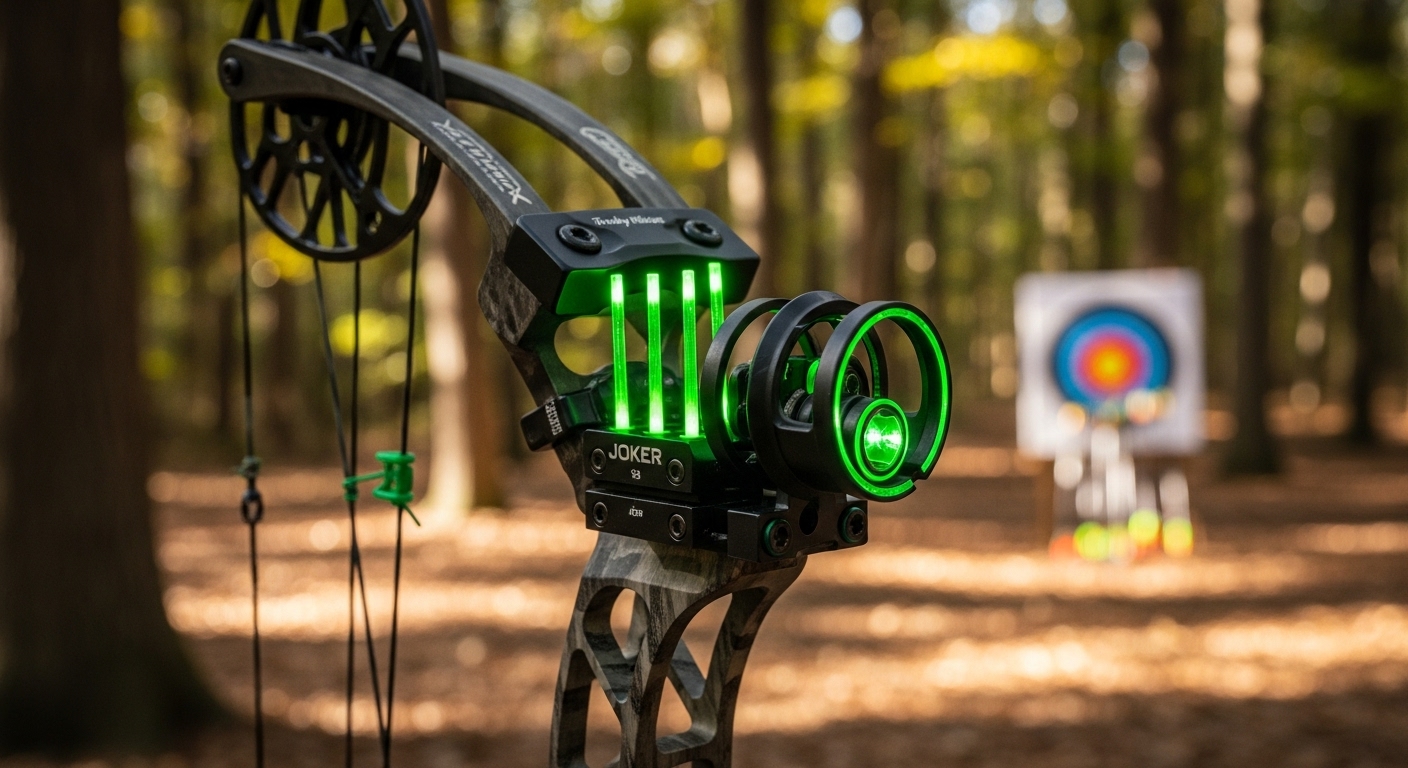
Joker pins are .019-inch diameter horizontal fiber optics, the same size used on Trophy Ridge’s pricier Fix and React models. In bright sunlight the pins nearly glow on their own, which speeds target acquisition. Overcast skies dull them slightly but not enough to be a problem; you’ll only need a sight light as dusk closes in.
The pin guard carries a colored hood accent, and here’s where retailer descriptions diverge. The official Trophy Ridge store and the Loke Archery product page describe it as a green hood accent, while Walmart’s listing reads yellow in places. I confirmed a green hood on the unit I tested, which matches the brand’s own imagery. If you receive a yellow-trimmed unit from a third-party seller, it’s still the same sight, just a slightly older colorway.
Bubble Level
The integrated bubble level is small but useful. New archers routinely cant their bow a few degrees without realizing it, which is enough to push groups wide at 30 yards and beyond. I caught myself rolling the bow right twice during my first range session; the level helped me break the habit within an afternoon.
As mentioned above, the level reads in reverse when the mount is flipped for left-handed use. Plan an extra minute during your install to verify direction by sighting up an obvious vertical (a doorframe works) before trusting the level during shooting.
Adjustment System and Click Feel
Both elevation and windage adjustments use metal screws that ride against the dovetail mount. The clicks feel positive without being stiff, and they hold zero reasonably well across a range session. The adjustment range covers 10 to 50 yards comfortably, which lines up with the multi-pin distances most hunters actually shoot.
One important feel note: the elevation and windage knobs have a two-stage tightness. If you snug them down by hand and assume you are finished, the sight can shift the next time the bow is bumped. Make sure each knob reaches its fully locked position, and you’ll avoid the loose-sight issue that shows up in a few Reddit and ArcheryTalk complaints.
Build Quality and Materials
The Joker uses metal pin set screws, metal elevation and windage screws, and a metal mounting bracket. The sight housing and pin guard are ABS-style polymer, which keeps weight and cost low. Loke Archery’s product copy describes the build as “alloy material,” which is true of the bracket and screws but not of the housing. I weighed and handled the unit enough to confirm the housing is plastic on mine, consistent with what most ArcheryTalk owners report.
The all-plastic housing is the single biggest reason long-term owners trade up to a Spot Hogg or HHA after a season or two. It’s also the reason the Joker is priced where it is. Treat the screws gently, use blue Loctite on the mount only, and you’ll get the same two-season lifespan reported by ArcheryTalk members like user Reaper, who logged roughly 3,000 arrows and two hunting seasons before upgrading.
Real-World Performance on the Range
I mounted the Joker on a PSE Stinger MAX and put roughly 600 arrows through it over several range sessions and a pair of simulated hunting drills. Here’s how the numbers broke down and how the sight felt in hand.
Accuracy at 20, 30, and 40 Yards
At 20 yards with field points, my groups consistently measured under two inches, which is more than enough for practice and casual hunting. At 30 yards the groups opened to three to four inches, and at 40 yards I was seeing roughly five to six inch spreads. That performance curve matches what other budget multi-pin sights deliver and is plenty for whitetail distances inside 40 yards.
The Joker held zero well across sessions. The only drift I noticed came after I bumped the sight while moving the bow in and out of my vehicle, which is a soft reminder to retighten the mount screws and check level whenever you transport the rig. For a wider look at how the Joker compares to budget, mid-tier, and premium options, our best bow sights roundup covers the alternatives side by side.
Visibility in Different Conditions
The fiber-optic pins earn their keep in daylight. Bright sun makes them pop, and the hood accent shades them just enough to read clearly against a shaded backdrop without losing definition. Overcast skies are workable but you have to focus slightly more on the pin stack.
By the time the sun drops behind the tree line, you’ll want a sight light. The Joker uses the standard Trophy Ridge light slot and runs on a single LR44 button cell. The same battery type used in fishing bobbers and small electronics is widely stocked and inexpensive, but bear in mind the switch is easy to bump on during transport. Several ArcheryTalk owners now remove the light between trips specifically to avoid coming back to a dead battery.
Long-Term Durability Update
My 30-day window is short compared to the multi-season reports floating around the forums. On ArcheryTalk, user Reaper documented roughly 3,000 arrows and two complete hunting seasons on a Joker 4-pin before moving up to a Spot Hogg, and he kept the Joker as a backup sight. Bear Attitude and Bear Cruzer owners have reported similar lifespans when the sight ships as stock equipment on those entry-level bows.
Two failure modes show up repeatedly across owner reports: pin play developing in the adjustment track after several hundred arrows, and the housing threads stripping when screws are over-torqued. Both are avoidable. Move the entire sight for big elevation changes rather than forcing individual pins, use blue Loctite on the mounting bracket only, and snug screws rather than cranking them. Owners who treat the Joker gently tend to get two seasons out of it without drama.
Should You Buy the Joker, and What Should You Consider Instead?
The Trophy Ridge Joker occupies a narrow but useful niche. It isn’t the cheapest sight on the market, and it isn’t trying to be the most durable. What it is, more than anything else, is the lowest-friction way to put a real fiber-optic multi-pin sight on a bow without committing $100-plus to the upgrade.
Joker vs Other Trophy Ridge Sights
Trophy Ridge makes a small family of budget-to-mid-tier sights, and three of them appear in the same search results as the Joker. The Fatal 4 is the natural step up for hunters who liked the Joker’s pin layout but want more rigidity. It ships with four pins in a plastic-and-aluminum mix housing for around $40 to $60 and is aimed at whitetail hunters who want more durable pins without the Fix-level price jump. The Fix series adds an aluminum housing and micro-adjustable pins with a built-in adjustment tool for roughly $80 to $100, which closes most of the durability gap with much pricier sights like Spot Hogg. The Fix is the right Trophy Ridge choice if you expect to shoot more than 600 arrows a year or if you want a planned upgrade path instead of a stretch-budget purchase.
Joker vs Spot Hogg and IQ
Once you start hunting seriously or competing, the migration path forum owners describe most often leads to Spot Hogg. Spot Hogg sights use all-metal housings, second-axis adjustment, and a no-slop pin track that simply can’t be matched at the Joker’s price. The trade-off is cost: even the entry-level Spot Hogg Double Arrow runs several times the Joker’s street price.
IQ Bowsight and Apex Gear’s Covert series sit between the Joker and Spot Hogg in price and durability. Neither shares the Joker’s exact layout, but both serve as a budget-to-mid-range upgrade if you want aluminum construction without committing to Spot Hogg pricing. If you outgrow the Joker and want to compare your options side by side, our best single-pin bow sight guide covers the upgrade paths archers usually take next.
Who the Joker Is Best For
The Joker fits four specific user profiles and almost no one else. Absolute beginners who want a feature-complete sight without committing real money; recreational backyard shooters who need a low-cost, low-consequence sight for casual practice; parents kitting out a youth bow where the bow itself may be outgrown before the sight; and experienced archers who want a serviceable backup for a second bow or hunt setup.
If none of those describes you, you’ll likely be happier spending a bit more on a Fatal 4 or Fix. Serious hunters should especially consider the upgrade, since the Joker’s plastic housing does not inspire confidence on rough ground or in -10°F late-season sits.
Sighting-In Procedure: Setting Yardage Marks
Sighting in a multi-pin sight is the part most buyers skip reading about, and it’s where the Joker’s click adjustments actually get useful. Set aside a calm morning and a paper target at each yardage you want to dial in.
Step 1: Start at 20 yards. Shoot three arrows and find the group’s center. Use the elevation knob to move the group up or down and the windage knob to move it left or right. Lock in your top pin at 20 yards and confirm with three more arrows before moving on.
Step 2: Move to 30 yards. With your top pin locked, shoot three arrows and adjust your second pin to center the group. Tighten the pin set screw gently, then move the entire sight housing for any large changes rather than forcing the pin track. This avoids the indents and stuck-pin issue one Reddit user documented on a similar Trophy Ridge sight.
Step 3: Finish at 40 yards. Repeat the process for your third pin. Walk back to 20 yards and verify the top pin is still centered, since adjusting the housing often nudges every pin slightly. Once all three pins check out, mark each yardage on the pin guard with a small paint dot so you remember which pin is which distance.
For a video walkthrough of the same process, Gary J’s 14-minute YouTube sighting-in session for the Joker 4-pin covers similar ground. Mixing a written walkthrough with a video reference tends to shorten the learning curve for first-time users.
Frequently Asked Questions
What type of battery does the Trophy Ridge Joker sight light use?
The Trophy Ridge Joker sight light runs on a single LR44 button-cell battery. These are widely available at hardware stores, pharmacies, and online, and typically last 20-30 hours of continuous use. Many owners remove the light between shooting sessions because the switch can easily bump on inside a bow case, draining the battery unnoticed.
Can Trophy Ridge Joker pins be removed or replaced?
Yes, the pins can be removed for cleaning or replacement, but it is not a beginner-friendly job. The fiber-optic threads are fragile and the housing is plastic, so carelessness can damage the slot. Trophy Ridge sells replacement pins directly, although many owners find the cost close enough to a new sight that they replace the whole unit instead.
Is the Trophy Ridge Joker good for hunting?
The Joker is a workable hunting sight inside 30-40 yards for whitetail-sized game. Pins stay bright during daylight, and the bubble level helps with quick, ethical shots at close range. For rough terrain, late-season cold, or longer shots, you’ll want a sight with a metal housing like the Trophy Ridge Fix or a Spot Hogg. For a full comparison of budget-friendly hunting sights, our best bow sights guide breaks down the alternatives in detail.
Are Trophy Ridge Joker pins metal or plastic?
The .019 fiber-optic pins themselves are metal wrapped in a polymer fiber sheath, not plastic. The pins hold up well to normal use, though a hard drop can bend a single pin. Most durability complaints trace back to the plastic sight housing, not the pins themselves.
What are the most common Trophy Ridge Joker problems?
The most frequently reported issues are pins getting stuck in the adjustment slots (usually fixed with a small drop of lubricant on the slide track), screws stripping the plastic housing threads when over-tightened, the sight light accidentally turning on and draining the LR44 battery, and slight pin play developing after 500 to 600 arrows. Almost every issue stems from plastic components or aggressive tightening rather than a design flaw.
What size Allen wrench does the Trophy Ridge Joker use?
The Joker uses a 0.05-inch Allen wrench for elevation, windage, and pin set screws. One is included in the box, but the size is small enough to lose easily, so keeping a spare in your bow case is cheap insurance. The same wrench size fits every adjustment on the sight.
How do I sight in the Trophy Ridge Joker 4 pin?
Start at 20 yards and group-shoot three arrows to find your point of impact, then dial the top pin to center using elevation and windage knobs. Move to 30 yards for the second pin and 40 yards for the third, walking the entire sight for large changes rather than forcing individual pin tracks. Once all three pins are set, walk back to 20 yards and verify nothing shifted. Mark each pin with a small paint dot so you remember which distance it covers.
Is Trophy Ridge a good company?
Trophy Ridge is one of the better-known compound bow accessory brands, owned by Bear Archery and shipping sights stock on entry-level Bear compound bows like the Attitude, Cruzer, and G2. The brand’s lineup spans budget Joker sights all the way up to React Pro models, which gives them credibility across price tiers. Quality is consistent with price: the Joker is a budget-friendly starter sight, and their higher-end React and Fix lines compete with much pricier alternatives on features.
Final Verdict: Who Should Buy the Trophy Ridge Joker?
After extended testing, forum research, and cross-referencing the F.A.Q.s floating around Trophy Ridge listings, here’s the honest bottom line on the Trophy Ridge Joker in 2026.
The Joker is an excellent starter sight for first-time archers, casual backyard shooters, anyone kitting out a youth bow, and experienced archers who want a low-cost backup. It is not the right sight for someone planning to push 2,000-arrow seasons, hunt rough country every weekend, or compete in 3D tournaments. The plastic housing is the limiting factor, and no amount of careful use overcomes it.
Buy the Joker for the right reasons and you’ll get two solid seasons and a clear upgrade path. Once you outgrow it, our best single-pin bow sight guide covers the next-step options archers usually take. For most beginners, the Trophy Ridge Joker does exactly what a budget bow sight should: gets out of the way, helps you shoot accurately, and costs almost nothing if you decide to move up.
Check Latest Price on Amazon
We earn a commission, at no additional cost to you. CERTAIN CONTENT THAT APPEARS ON THIS SITE COMES FROM AMAZON. THIS CONTENT IS PROVIDED 'AS IS' AND IS SUBJECT TO CHANGE OR REMOVAL AT ANY TIME.