How To Lap Scope Rings: Complete Guide for Precision Mounting 2026
Complete step-by-step guide to lapping scope rings for precision mounting. Learn when lapping is necessary, what tools you need, and…

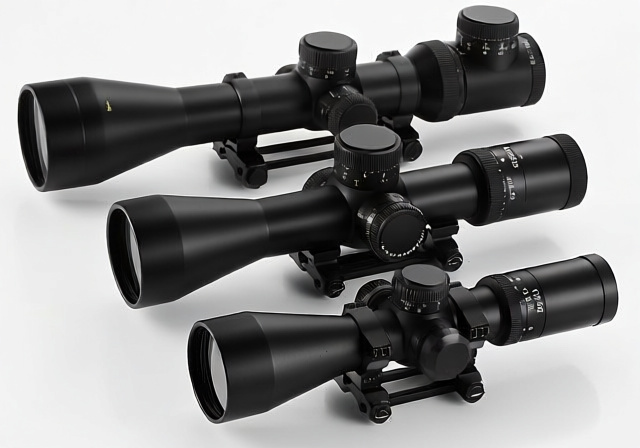
The numbers on a rifle scope tell you exactly two things: the magnification (before the x) and the objective lens diameter in millimeters (after the x). A scope labeled 3-9×40 magnifies your target from 3x to 9x its normal size and uses a 40mm front lens to gather light. That single string of characters is the foundation for understanding every rifle scope specification you will encounter.
If you have ever stood in a sporting goods aisle staring at boxes covered in baffling strings like 6-24×50, 1-6×24, or 4-16×44, you are not alone. Scope specs look like a coded language until you learn the system – and once you do, choosing the right optic for hunting, target shooting, or tactical use becomes dramatically easier.
This guide breaks down every number you will see printed on a scope body, the adjustments printed on the turrets, and the letters that tag along as suffixes. We will cover magnification ranges, objective lens diameter, exit pupil, field of view, eye relief, MOA and MIL click values, parallax, tube diameter, focal planes, and what those shorthand letters (BDC, SF, IR, FFP, SFP) actually mean.
By the end, you will read scope numbers the way experienced shooters do – quickly, confidently, and with a clear sense of which configuration fits your rifle and your shooting style. Whether you are mounting your first optic or shopping for a long-range precision scope, the same decoding rules apply.
Quick Answer Box – Scope Numbers at a Glance:
Every rifle scope printed with two numbers follows the same simple formula. The first group of numbers represents the magnification, and the second number represents the objective lens diameter in millimeters. The lowercase x between them simply separates the two values, like a divider that says “this part, then that part.”
Magnification is the multiplier that determines how much larger your target appears compared to viewing it with the naked eye. A scope with 4x magnification makes distant objects appear four times closer than they really are. A scope with 9x magnification makes them appear nine times closer.
The objective lens is the large front lens you can see from the muzzle end of your rifle. Its diameter, measured in millimeters, determines how much light the scope can collect. More light means a brighter, clearer image – especially during the low-light windows at dawn and dusk when most big game animals move.
Worked Example – Reading 3-9×40: The first number (3-9) means the scope magnifies from 3x to 9x depending on where you set the power ring. The second number (40) means the front lens is 40mm across. Read the whole thing as: “This scope zooms from 3 to 9 times, with a 40mm objective lens.”
Magnification is the most familiar specification on a scope, and the easiest to understand. When you see “3x” it means the target looks three times larger than it does with your naked eye. When you see “9x” the target looks nine times larger. A simple way to internalize this: if a deer appears about 1 inch tall at 100 yards to the unaided eye, it would look 3 inches tall through a 3x scope and 9 inches tall through a 9x scope.
Magnification comes in two flavors. Fixed power scopes have a single, unchanging magnification – a 4x scope is always 4x. Variable power scopes offer a range, like 3-9x or 4-16x, that you adjust by rotating a power ring or zoom lever near the eyepiece. The variable range allows you to dial down for a wider field of view when scanning, then crank up for precise shot placement.
Pro Tip: Always start at lower magnification when glassing for targets. Higher power narrows your field of view, making it harder to find and track movement. Once you spot your target, dial up for the shot.
Variable magnification is so dominant in today’s market that most modern hunting and tactical scopes are variables. Fixed power scopes still exist, mostly in specialized roles – red dot style low-power scopes, scout scopes, and some traditional hunting scopes where simplicity and ruggedness are prized. For most modern rifle applications, a variable scope gives you more shooting options with one optic.
Variable scopes shine when you need versatility. One day you might be shooting paper at 50 yards, the next you are stretching a shot out to 400. A 3-9x or 4-12x variable handles both scenarios without swapping optics. They are perfect for hunters who might see game at varying distances, or shooters who use one rifle for multiple roles.
The downsides are real. Variables cost more, weigh slightly more, and have more internal moving parts that could potentially fail in harsh conditions. They also force you to think about which magnification you need – which can cost precious seconds when a buck appears unexpectedly at close range.
Fixed power scopes win on simplicity and reliability. A 4x or 6x fixed scope is always ready, with no adjustment to make. Fixed scopes are often lighter, more durable, and frequently provide better optical quality per dollar because manufacturers are not paying for the extra internal zoom mechanism. For beginners learning about different types of rifle scopes, fixed power can be an excellent entry point.
A newer category worth knowing about is the LPVO – Low Power Variable Optic. An LPVO typically runs from 1x to 6x or 1x to 8x, giving you a true 1x (essentially a red dot) at the low end and useful magnification at the top. LPVOs have exploded in popularity for AR-15 style rifles, 3-gun competition, and close-to-medium range hunting. The number 1-6×24 means 1x to 6x magnification with a 24mm objective – small, fast, and versatile.
The number after the x is the objective lens diameter in millimeters. This is the front lens of the scope, and its job is to gather light. A larger objective lens collects more light, which translates to a brighter image – especially important during low-light conditions like the half hour after sunrise and before sunset when deer, elk, and predators are most active.
Think of the objective lens as a bucket collecting rain. A 50mm objective is a bigger bucket than a 40mm, and gathers more light in the same amount of time. That extra light produces a brighter, more detailed sight picture when ambient light is limited. The practical difference is most noticeable when you compare scopes side by side at dawn or dusk.
Most hunting scopes have objective lenses between 32mm and 56mm. Target and long-range scopes sometimes go larger – 60mm, 70mm, or even more – because the controlled environment of a range lets you use bigger optics without the practical downsides.
Watch Out: Bigger objective lenses require higher scope mounts to clear the barrel. A 56mm objective can force you into rings that push your scope an inch or more above the bore, which affects your cheek weld and can make the rifle feel awkward to shoot.
Exit pupil is the circle of light that exits the eyepiece of the scope toward your eye. You can calculate it by dividing the objective lens diameter by the magnification. For a 4×32 scope: 32 divided by 4 equals 8mm exit pupil. For a 3-9×40 at 9x: 40 divided by 9 equals roughly 4.4mm exit pupil.
Why does exit pupil matter? The human pupil dilates to about 5 to 7mm in young adults, and shrinks with age. If the exit pupil is larger than your dilated eye pupil, some of that gathered light is wasted because your eye physically cannot take it all in. An exit pupil between 4mm and 7mm is generally ideal for hunting applications.
This is why experienced hunters often prefer 40-50mm objective lenses. They produce exit pupils in the 5-7mm range at common magnifications – a sweet spot that matches the human eye’s natural dilation in low light. Going much larger than 50mm adds weight and mounting headaches without delivering more usable light to your eye.
Now that you understand the two-number formula, here is a quick reference table of the most common scope configurations and what they are best suited for. Bookmark this section – you will reference it every time you shop for a new optic.
Scope Configurations Quick Reference:
The 3-9×40 is the workhorse of the hunting world. It provides enough magnification for the vast majority of deer and elk hunting scenarios while keeping the field of view wide enough at 3x to find game quickly. The 40mm objective offers solid dawn and dusk performance without forcing you to use high mounts. If you only buy one scope for general hunting, this is the configuration most guides – including ours – will recommend.
For thick cover and brush hunting where shots come fast and close, drop down to a 1-6×24 LPVO or a 2-7×32. These give you a wide field of view and lightning-fast target acquisition, which matters far more than magnification when a whitetail appears at 30 yards through the trees.
For long-range target shooting or varmint hunting past 500 yards, the 6-24×50 is the standard. The high magnification range lets you see distant targets clearly and use the mil-dot or hash-mark reticle for holdovers. Keep in mind that high magnification amplifies your own tremor and movement, so a steady position and a solid rest become critical.
Beyond the magnification and objective numbers printed on the scope body, there is a second set of numbers printed on the turrets – the knobs you turn to adjust your point of aim. These numbers refer to MOA (Minute of Angle) or MIL (milliradian) click values, and they tell you how much your bullet impact moves on the target with each click of the turret.
MOA stands for Minute of Angle. One MOA equals roughly 1 inch at 100 yards, 2 inches at 200 yards, and 10 inches at 1000 yards. Most American-made hunting scopes use 1/4 MOA per click, meaning each click of the turret moves your bullet impact 1/4 inch at 100 yards. To move your bullet 1 inch at 100 yards, you turn the turret 4 clicks.
MIL (or MRAD for milliradian) is the metric system equivalent used by most European-made scopes and the U.S. military. One MIL equals 10 centimeters at 100 meters, or about 3.6 inches at 100 yards. Most MIL scopes click in 0.1 MIL increments, meaning each click moves your bullet 0.36 inches at 100 yards.
Pro Tip: Pick one system and stick with it. Mixing MOA scopes with MIL reticles (or vice versa) leads to bad math and missed shots. American shooters usually prefer MOA, while tactical and competition shooters often prefer MIL.
Reading the elevation and windage turret numbers is straightforward once you know the system. Each number on the dial represents one full unit (1 MOA or 1 MIL) of adjustment. The smaller tick marks between numbers represent individual clicks. On a 1/4 MOA scope, the numbers typically run 0, 1, 2, 3, 4, etc., and each click is 1/4 MOA – so 4 clicks equal 1 MOA.
For long-range shooting, knowing your scope’s click value is essential. If your bullet hits 6 inches high at 300 yards, and your scope clicks in 1/4 MOA, you need to dial 24 clicks down (6 inches divided by 0.25 inches per click at 100 yards, times 3 for the 300-yard distance). This is where learning to sight in your rifle scope properly comes in.
Parallax is the apparent movement of the reticle against the target when you shift your eye position behind the scope. It is not a defect – it is a fundamental optical issue that becomes noticeable at longer distances. Most hunting scopes are factory-set to be parallax-free at a specific distance, often 100 yards, so the issue is invisible during normal hunting.
Long-range and target scopes frequently include a parallax adjustment, often called a side focus or adjustable objective (AO). The number printed near the parallax knob tells you the distance the scope is currently set for – usually in yards, ranging from 50 to infinity. You rotate the knob to match the distance to your target, which eliminates the parallax error and ensures the reticle and target image are on the same optical plane.
If your reticle appears to “swim” or shift against the target as you move your head, you are seeing parallax. Dial the side focus until the swimming stops. On scopes without an adjustable objective, factory-set parallax is typically optimized for 100 to 150 yards, and you may notice minor parallax at very close or very long ranges.
Some scope descriptions include a third number or letter that refers to the main tube diameter. The two most common tube sizes are 1 inch (25.4mm) and 30mm. This measurement describes the diameter of the central body tube of the scope, not the objective lens.
1-inch tubes have been the American standard for decades. They are lighter, less expensive, and work with the widest variety of mounting rings. Most hunting scopes from Leupold, Burris, and Bushnell use 1-inch tubes.
30mm tubes have become the standard for long-range, tactical, and many modern hunting scopes. A larger tube allows for larger internal lenses, which can produce a brighter image and a wider field of view. It also provides more physical room for adjustment turrets, which is why long-range scopes with heavy MOA or MIL adjustments often use 30mm tubes. The downside is that 30mm scope rings cost a bit more and add a touch of weight.
Field of view is the width of the area you can see through the scope at a given distance, usually expressed in feet at 100 yards. A scope set at 3x might show 30 feet at 100 yards, while the same scope at 9x might show only 10 feet. This matters when you are scanning for game or tracking moving targets – a wide field of view at lower magnification makes both easier.
Eye relief is the distance your eye can sit behind the eyepiece while still seeing the full image. Most scopes offer 3 to 4 inches of eye relief. This matters for two reasons: comfort and safety. On a hard-kicking magnum rifle, insufficient eye relief can cause “scope bite” – the scope recoils back and smacks your eyebrow or forehead. It only takes one time to teach you to check this number.
Eye relief also shortens at higher magnifications on most scopes. If you are buying a scope for a high-recoil rifle, look for one that maintains at least 3.5 inches of eye relief at maximum magnification. Some scopes advertise “extended eye relief” or “long eye relief” specifically for this purpose.
The reticle is the aiming point you see inside the scope. While not strictly a “number,” reticle choice is deeply intertwined with how you read and use a scope. Modern scopes come with a bewildering array of reticle options and suffix letters on the model name. Here is what the most common ones mean.
Duplex reticle: The classic crosshair with thicker outer posts and a fine center. The most popular hunting reticle because it is easy to see in low light and does not obscure the target. No suffix letter is usually required – this is the default.
BDC (Bullet Drop Compensator) reticle: Has additional aiming points below center, calibrated for holdover at specific distances. BDC reticles let you compensate for bullet drop without dialing the turret – useful for hunters who need to make quick shots at varying ranges.
MOA or MIL reticle: Uses the same unit of measurement as your turrets, with hash marks or dots spaced at MOA or MIL intervals. These allow precise holdovers and windage corrections directly on the reticle. They are most useful in first focal plane reticle scopes where the spacing remains constant at any magnification.
Common Scope Suffix Letters Decoded:
First focal plane (FFP) scopes have the reticle mounted in front of the magnification lens, which means the reticle itself grows and shrinks as you change magnification. The key advantage: the reticle’s holdover marks and hash spacing always represent the same angular measurement, regardless of the power setting. A 1 MIL hash is 1 MIL at 3x and still 1 MIL at 12x.
Second focal plane (SFP) scopes have the reticle mounted behind the magnification lens, so the reticle stays the same size as you zoom. SFP reticles are typically calibrated to be correct at one specific magnification – often the highest power. At other magnifications, the holdover points represent different actual distances. SFP scopes are generally less expensive and are the standard for hunting applications.
For long-range precision work, FFP scopes are popular because you can use the reticle at any magnification and trust that the math works. For hunting, SFP scopes are often preferred because the reticle stays visually consistent and the thinner reticle at lower power covers less of the target. The “right” choice depends on what you are doing with the scope.
After helping dozens of new shooters pick optics, I have seen the same handful of mistakes repeated again and again. Avoiding these will save you money and frustration.
The most common error is buying too much magnification. New shooters often think bigger is better and end up with 6-24x scopes for deer hunting at ranges where they will never use past 12x. High magnification narrows your field of view, makes finding targets harder, and amplifies your own body movement. For most hunting scenarios, 9x or 10x maximum is plenty.
Larger objective lenses require higher rings to clear the barrel. I have seen shooters buy 56mm objective scopes only to discover they need expensive high mounts that throw off their cheek weld. Before buying, verify the scope will mount correctly on your rifle with readily available rings.
It is tempting to buy the most powerful scope you can afford, but optical quality matters more than magnification. A well-built 3-9×40 from a trusted brand will outperform a budget 6-24×50 in brightness, clarity, durability, and repeatable adjustments. Spend your money on glass quality, not maximum numbers.
On a hard-kicking rifle, insufficient eye relief creates a real safety issue. Always check the eye relief specification and consider your rifle’s recoil before purchasing. Magnums and large-bore rifles need more eye relief than low-recoil rimfires or standard .223s.
3-9×40 means the scope can magnify your target from 3 to 9 times its normal size, with a 40mm objective lens that gathers light. This is the most popular hunting scope configuration, offering versatility for various distances while maintaining good low-light performance.
6-24×50 indicates a variable scope with 6x to 24x magnification range and a 50mm objective lens. This high-magnification setup is designed primarily for long-range target shooting or varmint hunting at extended distances, typically 200+ yards.
4-16×50 offers 4x to 16x magnification with a 50mm objective lens. This provides excellent versatility for hunters who might encounter game at close range but need precision for longer shots up to 400-500 yards.
2-7×32 is a low-magnification scope with 2x to 7x zoom and a 32mm objective lens. It is ideal for close-range hunting in thick cover, quick target acquisition, and situations where shots typically occur under 150 yards.
1-6×24 is an LPVO (Low Power Variable Optic) that runs from 1x magnification – essentially a red dot – up to 6x magnification, with a compact 24mm objective. It is the most popular configuration for AR-15 rifles, 3-gun competition, and close-quarters hunting.
No. While larger objective lenses gather more light for better low-light performance, they require higher mounts, add weight, and affect rifle balance. For most hunting, 40-50mm provides the best balance of light gathering and practical use.
For most 100-yard applications, 4x to 9x magnification is ideal. 4-6x works well for quick shots at moving targets, while 9x provides precision for stationary targets. Even 1-4x scopes can be effective at 100 yards for close-quarters hunting.
MOA stands for Minute of Angle. One MOA equals roughly 1 inch at 100 yards. Most American hunting scopes click in 1/4 MOA increments, meaning each click moves your bullet impact 1/4 inch at 100 yards.
MIL (or MRAD) is a metric unit of angular measurement. One MIL equals 10 centimeters at 100 meters, or roughly 3.6 inches at 100 yards. Most MIL scopes click in 0.1 MIL increments per click.
Parallax is the apparent shift of the reticle against the target as you move your eye. Most hunting scopes are parallax-free at 100 yards. Long-range scopes often include a side focus or adjustable objective (AO) to dial out parallax at specific distances.
Understanding the numbers on a rifle scope removes the mystery from choosing the right optic. Once you know that the first number is magnification, the second is objective lens diameter, and the suffix letters describe reticle type and adjustment features, you can decode any scope on the shelf in seconds.
For most hunters in 2026, a quality 3-9×40 or 4-12×40 will handle virtually every big game scenario in North America. If you run an AR-15 or want maximum versatility, a 1-6×24 LPVO is hard to beat for close and medium range work. Long-range shooters and varmint hunters should step up to a 4-16×50 or 6-24×50 with a mil or MOA reticle and a 30mm tube.
Remember the simple decision rule: match the magnification to your typical shooting distance, match the objective lens to your low-light needs, and spend the rest of your budget on optical quality. A mid-tier scope from a reputable manufacturer will outperform a budget scope with bigger numbers every single time.
Now that you know what do the numbers on a rifle scope mean, you are ready to choose an optic with confidence. For a deeper dive into specific scope recommendations, see our complete guide to choosing a rifle scope and our picks for the best hunting and tactical optics available this year.
![What Is A Prism Scope: Complete Guide [cy]](https://revellphotography.com/wp-content/uploads/2026/09/featured-update-4794-1789230406771.jpg)