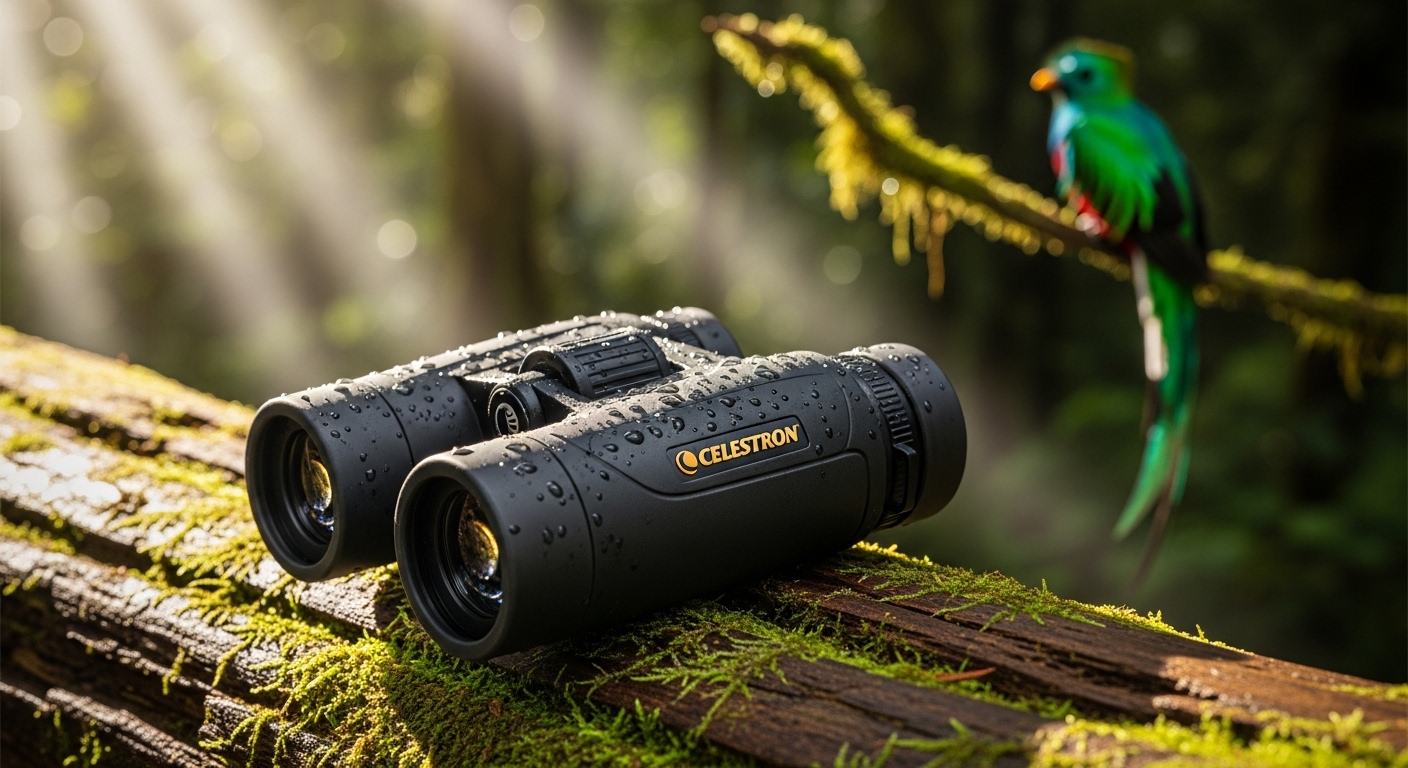
Celestron TrailSeeker 8×42 Review 2026: Honest Testing Results
After 6 months of testing Celestron TrailSeeker 8x42 binoculars in various conditions, discover the honest truth about optical quality, durability,…


Hawaii’s state bird is the Nēnē (pronounced “nay-nay”), the Hawaiian Goose (Branta sandvicensis). This medium-sized goose is endemic to the Hawaiian Islands and holds the distinction of being the rarest goose species on Earth. Designated Hawaii’s official state bird in 1957, the Nēnē represents a story of evolutionary adaptation, near-extinction, and one of the most celebrated conservation recoveries in modern wildlife history.
What makes the Nēnē especially compelling for wildlife photographers is its combination of accessibility and uniqueness. Unlike waterfowl that retreat at the first sign of a person, Nēnē often graze on golf courses, in national parks, and along roadways across the islands. They evolved from Canada goose ancestors that arrived roughly 500,000 years ago, and their shortened wings, partially webbed feet, and long legs tell a clear visual story of adaptation to volcanic terrain. Photographing the Nēnē means documenting a bird that exists nowhere else on the planet.
Quick Answer: Hawaii’s state bird is the Nēnē (Hawaiian Goose), scientific name Branta sandvicensis. Pronounced “nay-nay,” it was designated the state bird in 1957 and is the rarest goose species in the world, with a population of approximately 3,862 birds as of 2022.
How do you pronounce Nēnē? The correct pronunciation is “nay-nay”, with both syllables receiving equal emphasis. The name comes from the Hawaiian word that mimics the bird’s soft, low call. You may also see the spelling “Nene” without the diacritical marks in older texts, but modern Hawaiian-language standards use the macron over the first “e” (Nēnē) to indicate a longer vowel sound.
The species name sandvicensis derives from the “Sandwich Islands,” the name given to Hawaii by British explorer Captain James Cook in 1778. The genus Branta places the Nēnē within the group of black geese that includes the Canada goose and cackling goose. The Nēnē was first formally described by Irish zoologist Nicholas Aylward Vigors in 1834, based on specimens collected during Cook’s voyages.
The name “Nēnē” reflects an interesting linguistic pattern in Hawaiian, where bird names often echo the sounds the birds make. The soft, mooing vocalization of the Nēnē is unmistakable once you hear it. Hawaiian birders have noted for generations that the bird’s call is far gentler than the honking of mainland geese, making it sound almost like a small cow or dove. You can hear field recordings of the Nēnē call on resources like the Cornell Lab’s Macaulay Library or xeno-canto.org to train your ear before a trip.
Hawaii has a small but meaningful collection of official state symbols. The Nēnē shares the distinction with the Yellow Hibiscus (Ma’o hau hele) as the state’s most recognized emblems, but several other symbols round out the full picture of Hawaiian natural and cultural identity.
| Symbol | Official Name | Notes |
|---|---|---|
| State Bird | Nēnē (Hawaiian Goose) | Branta sandvicensis; designated 1957 |
| State Flower | Yellow Hibiscus (Ma’o hau hele) | Hibiscus brackenridgei; designated 1988 |
| State Tree | Kukui (Candlenut) | Aleurites moluccanus; designated 1959 |
| State Motto | Ua Mau ke Ea o ka Aina i ka Pono | “The life of the land is perpetuated in righteousness” |
| State Marine Mammal | Humpback Whale | Megaptera novaeangliae; designated 1979 |
| State Fish | Humuhumunukunukuapua’a | Reef triggerfish; designated 1985 |
The Nēnē stands apart from other geese with several distinctive features that make identification straightforward, even for novice bird photographers. Adult Nēnē typically measure 24-27 inches in length with a wingspan of 32-38 inches. The Cornell Lab’s Birds of the World describes them as smaller than their Canada goose ancestors, but sturdily built for life on rugged volcanic terrain. Their plumage combines warm brown, cream, and black tones in a pattern that provides excellent camouflage against Hawaii’s lava fields and vegetation.
For photographers, the most striking features to capture are the diagnostic markings that set the Nēnē apart from every other goose species. Their face displays a striking contrast: a black crown and bill transitioning to creamy buff-colored cheeks that catch light beautifully during golden hour photography sessions. The neck features distinctive white grooves or furrows, giving it a rippled appearance that creates interesting texture in close-up portraits. These white markings continue diagonally onto the sides of the neck, forming a pattern unique among geese worldwide.
The Nēnē’s feet show perhaps the most remarkable adaptation to island life. While their Canada goose relatives have fully webbed feet ideal for swimming, Nēnē evolved longer legs with significantly reduced webbing, making them better suited for walking on rough lava flows and through mountain vegetation. This adaptation means you’ll often find them in locations where other geese would never venture, providing photography opportunities against dramatic volcanic backdrops. Their feet have a blackish coloration that can add visual contrast to wide shots showing their natural habitat.
One common question is how to tell male Nēnē from female Nēnē in the field. The species shows mild sexual dimorphism: males are typically 11% larger than females, weighing between 1.7-3.05 kg compared to the female range of 1.5-2.56 kg. Males also tend to have a slightly larger, more robust head and bill. In the field, the most reliable size cue is overall bulk, though experienced observers often rely on behavioral cues during breeding season, when males perform elaborate courtship displays. Without a size reference, distinguishing the sexes can be challenging, and many photographers simply photograph pairs without attempting to label the gender.
Scientific Classification: Kingdom Animalia, Phylum Chordata, Class Aves, Order Anseriformes, Family Anatidae, Genus Branta, Species Branta sandvicensis. The Nēnē belongs to the black geese genus (Branta), which includes other species like the Canada goose and cackling goose.
When photographing Nēnē in the field, look for behavioral cues that help with identification and storytelling. Unlike many geese that spend much time on water, Nēnē are primarily terrestrial and often seen walking on slopes, grazing on vegetation, or resting on elevated viewpoints. This terrestrial behavior, combined with their distinctive vocalizations – softer and more melodic than other geese – helps confirm you’ve found Hawaii’s unique state bird. Understanding these identification characteristics will help you not only find Nēnē but also capture images that highlight their unique evolutionary journey.
Many visitors to Hawaii ask whether the Nēnē is the same as a Canada goose. The short answer is no: the Nēnē evolved from Canada goose ancestors that arrived in Hawaii roughly 500,000 years ago, but it has since become a distinct species with several unmistakable differences. A side-by-side comparison helps photographers and birders tell them apart at a glance.
| Feature | Nēnē (Hawaiian Goose) | Canada Goose |
|---|---|---|
| Origin | Endemic to Hawaiian Islands | Native to North America |
| Size | Smaller (24-27 in length) | Larger (30-43 in length) |
| Cheeks | Buff/cream-colored | White chinstrap on black face |
| Neck | Furrowed with diagonal white grooves | Solid black, no furrows |
| Feet | Partially webbed, longer legs | Fully webbed, shorter legs |
| Wings | Shortened, weaker flight | Long, strong migratory flier |
| Vocalization | Soft, low moo or “nay-nay” | Loud, classic honk |
| Habitat | Volcanic slopes, lava fields, golf courses | Lakes, ponds, agricultural fields |
| Conservation | Near Threatened (IUCN); Endangered (ESA) | Least Concern |
One of the most cited facts in Google’s AI Overview is that the Nēnē “differs from the Canada goose; neck is not solid black.” That single sentence captures the most important field mark: a Canada goose has a uniformly black neck, while a Nēnē’s neck shows the distinctive cream-colored grooves. If you remember nothing else, look at the neck.
The Nēnē’s habitat preferences reflect its remarkable evolutionary journey from waterfowl to mountain specialist. Unlike their Canada goose ancestors that thrive on lakes and ponds, Nēnē have adapted to life across Hawaii’s diverse volcanic landscapes, occupying different elevation ranges on different islands. The National Park Service’s December 2025 update notes that on Maui, Nēnē inhabit Haleakalā’s subalpine shrubland between roughly 5,500 and 8,000 feet. On Kauai, by contrast, released birds have established populations at much lower elevations, often from sea level up to about 600 feet around Kīlauea Point and Hanalei. On the Big Island, the species ranges from sea level to nearly 7,900 feet around Mauna Kea. Forum birders on Reddit have noted this elevation split catches many visitors off guard, since the popular assumption that Nēnē live only at high elevation is wrong.
Volcanic terrain represents the quintessential Nēnē habitat. These birds are perfectly adapted to navigate the sharp, uneven surfaces of lava flows with their specialized feet and longer legs. When I photograph Nēnē in Hawaii Volcanoes National Park, I’m always amazed at how they move confidently across surfaces that would challenge most other waterfowl. They’ve developed the ability to drink without submerging their heads in water, instead consuming dew from vegetation – an adaptation that allows them to thrive far from traditional water sources.
Diet plays a crucial role in understanding Nēnē behavior and movement patterns. The species is primarily herbivorous, feeding on over 30 documented plant species including native grasses, herbs, leaves, and berries. In the wild, I’ve observed them spending significant time grazing on ohia leaves, pukiawe berries, and various grasses that grow in volcanic soils. According to the Hawaii Department of Land and Natural Resources, preferred native foods include the berries and leaves of pukiawe (Styphelia tameiameiae), ‘ohelo, and various sedges, while introduced grasses and clover supplement their diet in areas where native vegetation is sparse.
Breeding season, typically running from November through May, brings dramatic changes in Nēnē behavior that offer unique photography opportunities. According to NPS field data, females lay 2-5 eggs (most commonly three) in ground nests often concealed under vegetation or in lava rock cavities. Incubation lasts 29-32 days, and goslings fledge at 10-12 weeks. During this period, pairs become more territorial and engage in elaborate courtship displays. I’ve witnessed males performing impressive displays with wing flapping, honking, and head bobbing to attract mates. If you’re fortunate enough to photograph Nēnē during breeding season, remember that nesting birds are particularly sensitive to disturbance – maintain extra distance and limit your time in the area. Forum discussions from r/birding frequently warn that even well-meaning photographers can cause nest abandonment by lingering too long.
Social behavior varies throughout the year. Outside breeding season, Nēnē often gather in small flocks, particularly in areas with abundant food resources. These social gatherings provide opportunities to capture interaction shots – preening behavior, communication through various calls, and even playful moments. However, they can also be solitary, especially when foraging across large territories. The species is monogamous, and pairs often stay together for years, with both parents sharing in chick-rearing duties. Nēnē also have a troubling tendency to walk on roads and highways, which has made vehicle strikes one of the leading causes of mortality, second only to predation. Understanding these behavioral patterns helps photographers anticipate moments and position themselves for compelling natural history images.
Time Saver: Visit popular Nēnē viewing areas during early morning hours when birds are most active. Many Nēnē feed around golf courses and parks at dawn before moving to higher elevations as temperatures rise.
Weather significantly influences Nēnē behavior and photography conditions. These birds are most active during cooler, overcast days or the golden hours of morning and evening. Harsh midday sun often drives them to shade, while rainy weather may increase foraging activity as plants become more accessible. As a photographer, I’ve found that the best images often come during Hawaii’s characteristic passing showers, when soft, diffused light eliminates harsh shadows and creates a moody atmosphere that suits the Nēnē’s wild character.
Vocalizations deserve their own note, because the Nēnē’s call is genuinely unlike any other goose. Where Canada geese honk loudly and aggressively, Nēnē produce a low, rising “nay-nay” that gives them their name. They also have a softer alarm call used when they perceive a threat, typically a short, clipped “wow” or a hiss. Listening for these sounds in the field is a great way to locate birds in dense vegetation where visual spotting is difficult. The Cornell Lab’s Macaulay Library hosts dozens of field recordings that you can study before your trip to train your ear for the species’ distinctive voice.
Photographing Nēnē requires a thoughtful approach that balances technical skill with ethical wildlife photography practices. Based on my experience capturing these remarkable birds across Hawaii’s islands, I’ve found that success comes from understanding their behavior, respecting their space, and having the right equipment for the conditions you’ll encounter in the field.
The ideal camera setup for Nēnē photography begins with a versatile telephoto lens. While I’ve captured decent images with a 70-200mm lens when birds are particularly habituated, I recommend a 400mm or longer lens for most situations. Forum discussions on Reddit’s r/birding and r/BirdPhotography frequently highlight the Sony 200-600mm and Sony 400-800mm as popular choices for Hawaii birding, given the long working distances and the Nēnē’s tendency to keep at least 25 feet of separation from humans. A quality pair of 8×32 binoculars can help you spot Nēnē from afar before setting up your shot, preventing disturbance of their natural behavior.
Camera settings play a crucial role in Nēnē photography due to Hawaii’s challenging light conditions. The bright tropical sun creates high-contrast situations that can fool your camera’s meter. I typically shoot in manual mode with an ISO between 200-800 depending on the time of day, using a slightly higher ISO in morning and evening light to maintain faster shutter speeds. For static portraits, aim for shutter speeds of 1/500s or faster, increasing to 1/1000s or more when birds are moving or in flight. A polarizing filter helps manage glare and enhances the rich colors of their plumage against Hawaii’s vibrant landscapes.
Composition is where Nēnē photography truly shines. The birds’ natural habitat offers incredible opportunities for environmental portraits that tell a story about their adaptation to island life. I love positioning myself to include volcanic elements – lava rocks, silversword plants, or distant crater rims – to provide context and visual interest. The golden hours (typically 6:00-8:00 AM and 4:30-6:30 PM in Hawaii) provide the most flattering light, warming the yellow cheeks and creating beautiful rim lighting that separates the birds from their backgrounds. At higher elevations like Haleakalā’s summit, where the sun is intense, you may want to wait for passing clouds to soften the light rather than shooting in harsh midday conditions.
Pro Tip: Nēnē are most active during cooler parts of the day. Plan your photography sessions for early morning or late afternoon when birds are feeding and moving, rather than midday when they often rest in shade.
Ethical considerations must guide every Nēnē photography session. These birds are protected by law, and their recovery from near-extinction remains fragile. Never use bait or calls to attract Nēnē, and always maintain a minimum distance of 25 feet (8 meters). If birds show signs of stress – such as head bobbing, alarm calls, or attempting to move away – back off immediately. Remember that great wildlife photography prioritizes the welfare of subjects over any image. Consider using a spotting scope with a phone adapter for distant observation before approaching for closer shots. Tourists frequently make the mistake of approaching nesting birds to get a “better” shot, which is one of the leading causes of nest abandonment. Compare your 8×32 vs 8×42 binocular options before your trip to choose the right magnification for Hawaii’s bright conditions.
Weather in Hawaii can change dramatically, so come prepared for various conditions. I always pack a rain cover for my camera and lens, as sudden showers are common in mountain areas where Nēnē thrive. The humidity can cause lens fogging when moving between air-conditioned vehicles and humid outdoor areas – allow your equipment to acclimate for 10-15 minutes before shooting. These challenges, however, often create dramatic lighting conditions – post-rain clouds, rainbows, and misty landscapes that can elevate your Nēnē images from simple portraits to powerful storytelling moments.
Finding Nēnē in the wild requires knowing where to look across Hawaii’s islands. Each location offers unique photography opportunities and different challenges. Based on extensive field experience and crowd-sourced sighting reports from sites like eBird, I’ve compiled the most reliable spots for Nēnē photography, along with tips for making the most of each location.
Hawaii Volcanoes National Park on the Big Island stands as perhaps the premier destination for Nēnē photography. The park’s diverse habitats, from lush rainforests to stark lava fields, provide dramatic backdrops for your images. The best areas within the park include the Thurston Lava Tube area and the Devastation Trail, where Nēnē are commonly seen grazing near the parking areas. I’ve had particular success in the early morning hours along Chain of Craters Road, where birds often feed on vegetation amidst recent lava flows. The park’s high elevation (around 4,000 feet) means cooler temperatures that Nēnē prefer, but also variable weather – come prepared for rain and wind. Park entry is $30 per vehicle and the park is open 24 hours, so dawn shoots are accessible.
Haleakalā National Park on Maui offers another excellent Nēnē photography destination, especially within the summit district. The park’s subalpine ecosystem above 7,000 feet provides habitat for one of the healthiest Nēnē populations. I’ve found consistent opportunities along the Hosmer Grove Trail and near the visitor center, where birds have become accustomed to human presence while maintaining their wild behavior. The summit area provides breathtaking backgrounds with volcanic cinder cones and silversword plants that create unique compositions impossible elsewhere. Remember that the high elevation means strong sun – use early morning light or wait for passing clouds to soften harsh shadows. Park entry is $30 per vehicle, and sunrise reservations are required for the summit area, so plan ahead.
Kauai offers perhaps the most accessible Nēnē photography opportunities, particularly around the Kōke’e State Park and Waimea Canyon areas. The island’s golf courses, including those at Princeville and Kīlauea, have become unlikely Nēnē sanctuaries where birds can often be photographed against manicured landscapes. While less natural than national park settings, these locations offer close-up opportunities and predictable bird behavior. I’ve also found Nēnē along the coastline near Kīlauea Point National Wildlife Refuge, where ocean backgrounds add variety to your portfolio. Captive-bred birds have been released at Kīlauea Point NWR since 1991, and the population continues to grow.
For visitors on Oahu, the situation has changed dramatically in recent years. A small but growing Nēnē population exists at Turtle Bay Resort on the North Shore, established through a 2014 introduction program. James Campbell National Wildlife Refuge also occasionally hosts Nēnē, though sightings are less reliable than on the Big Island or Maui. If you only have time for one island, choose either the Big Island or Maui for the highest density of Nēnē sightings.
For the most reliable sightings with fewer crowds, consider visiting during shoulder months (April-May or September-October) when Hawaii sees fewer tourists but Nēnē remain active. I’ve found that weekday mornings offer the best combination of bird activity and minimal disturbance. Always check current conditions and Nēnē sighting reports with park rangers, as bird locations can vary based on food availability and weather patterns. The Hawaii Birding Trails website maintains an updated map of recent sightings across all islands, and eBird’s “explore” tool lets you filter for recent Nēnē observations in any specific park or refuge.
The Nēnē’s conservation story represents one of wildlife’s most remarkable comeback tales, offering photographers not just a subject but a powerful narrative of hope and persistence. When conservationists first counted fewer than 30 birds in the wild in the early 1950s, the species seemed destined for extinction. The U.S. Fish and Wildlife Service’s most recent comprehensive population estimate puts the global population at 3,862 birds as of 2022, while the IUCN’s 2021 Red List assessment estimated 2,600-3,300 mature individuals in the wild. The discrepancy reflects different counting methods (captive + wild vs. wild only), but both numbers represent a dramatic recovery from the bottleneck. In October 2026, the species is listed as Near Threatened on the IUCN Red List and Endangered under the U.S. Endangered Species Act, which reflects continued vulnerability even as numbers rise.
The decline of Nēnē populations began with human colonization of Hawaii. Introduced predators including mongooses, rats, feral cats, and dogs took a devastating toll on ground-nesting birds that had evolved without natural predators. Habitat loss as Hawaii’s landscapes changed for agriculture and development further reduced available territory. By the 1940s, the situation was critical – Nēnē survived only in remote areas of Hawaii Island and Maui, with fewer than 30 birds remaining in the wild. Historical estimates suggest around 25,000 Hawaiian geese may have existed in 1778 when Captain Cook arrived, though that figure carries significant uncertainty and is based on extrapolation rather than direct count.
The turning point came in 1949 when conservationists initiated a captive breeding program that would eventually save the species. Sir Peter Scott of the Wildfowl and Wetlands Trust in England played a crucial role, successfully breeding Nēnē in captivity at the WWT Slimbridge center. These programs, combined with intensive habitat protection and predator control in Hawaii, began the slow process of recovery. In 1957, recognizing the bird’s cultural importance and precarious status, Hawaii designated the Nēnē as its official state bird, bringing additional attention and resources to conservation efforts. The 2024 IUCN downlisting from Vulnerable to Near Threatened marked a major milestone, although the U.S. Endangered Species Act has kept the species classified as Endangered since 1967.
Photography has played an unexpected but vital role in Nēnē conservation. Images of these striking birds helped build public support for protection measures by making the species relatable to people who might never see them in person. Today, responsible wildlife photography continues to contribute to conservation through education – your images can help others understand the value of preserving Hawaii’s unique wildlife. Programs like the “Adopt-A-Nēnē” initiative allow photographers and visitors to contribute directly to conservation funding, and citizen-science platforms like eBird and iNaturalist let you share your sightings with researchers tracking population trends. I always consider this broader impact when sharing Nēnē photographs, including information about their conservation status and recovery story.
Important: Nēnē remain protected under the Endangered Species Act. Never feed, touch, or harass these birds. Report any disturbance to proper authorities to help protect this conservation success story.
Recent conservation milestones in 2024 and 2025 have included continued releases on Oahu, expanded predator control on Haleakalā, and a record-breaking breeding season on the Big Island. The IUCN downlisting to Near Threatened in 2024 marked the first time in decades that a major global body acknowledged the species’ recovery, even as the U.S. ESA Endangered classification remained in place. Climate change remains an emerging concern: rising temperatures and shifting rainfall patterns in Hawaii could affect the alpine shrubland ecosystems on which Haleakalā’s population depends, potentially forcing conservationists to consider assisted migration or habitat restoration at higher elevations.
For photographers, this conservation context adds depth to every image. When you capture a Nēnē portrait against Hawaii’s volcanic landscape, you’re documenting more than just a bird – you’re recording a symbol of resilience and a reminder of what dedicated conservation efforts can achieve. Consider sharing your images with conservation organizations, as they help tell the story of recovery and build support for continued protection of Hawaii’s unique wildlife heritage.
The Nēnē holds profound cultural significance in Hawaiian tradition that extends far beyond its designation as state bird. In Hawaiian mythology, the Nēnē appears in the Kumulipo, the sacred creation chant that traces the lineage of Hawaiian royalty and the origins of life itself. This ancient text identifies the Nēnē as a guardian spirit or ‘aumakua, a concept that elevates the bird beyond mere wildlife to a sacred protector and spiritual guide for Hawaiian families.
Traditional Hawaiian society viewed the Nēnē with reverence and respect. Birds were considered messengers between the earthly realm and the spirit world, and the Nēnē’s distinctive calls were interpreted as carrying important messages. The bird’s adaptation to Hawaii’s unique environment – evolving from Canada goose ancestors to become perfectly suited for volcanic terrain – was seen as a testament to the creative forces that shaped the islands. This evolutionary story mirrored Hawaiian narratives of adaptation and resilience in their island home.
The Nēnē’s cultural importance continues in modern Hawaii. The bird appears on official state emblems, currency, and signage, serving as a recognizable symbol of Hawaiian identity and environmental stewardship. For Native Hawaiians, the recovery of Nēnē populations represents not just conservation success but cultural restoration – the return of a being that holds spiritual significance and connects contemporary Hawaiians to their ancestral heritage.
As photographers documenting Nēnē, we participate in this cultural narrative by capturing images that honor both the natural beauty and cultural significance of these birds. When you photograph Nēnē in traditional landscapes or include cultural elements in your compositions, you’re helping preserve and share aspects of Hawaiian worldview. Consider that your images might be viewed by Native Hawaiians who see in the Nēnē not just a state bird but a relative, a spiritual guardian, and a symbol of Hawaiian resilience.
Kumulipo Connection: In Hawaiian creation mythology, the Kumulipo chant describes the Nēnē as one of the original life forms created by the gods, giving it status as a primordial being rather than just an ordinary bird.
The relationship between cultural preservation and wildlife conservation becomes particularly evident in Nēnē protection efforts. Many conservation initiatives now incorporate traditional Hawaiian knowledge and practices, recognizing that effective species protection requires cultural understanding as well as scientific management. This holistic approach honors the deep connection between Hawaiian people and their natural world, offering a model for conservation that respects both ecological and cultural values.
Essential Information:
Photography Equipment Checklist:
Field Photography Tips:
Seasonal Considerations:
Hawaii’s state bird is the Nēnē (Hawaiian Goose), scientifically known as Branta sandvicensis. The name is pronounced u0022nay-nayu0022 and the species was designated Hawaii’s official state bird in 1957.
Hawaii’s state bird is the Nēnē (Hawaiian Goose), and the state flower is the Yellow Hibiscus (Hibiscus brackenridgei), known in Hawaiian as Ma’o hau hele. Both symbols represent Hawaii’s unique natural heritage and commitment to conservation.
The Nēnē is pronounced u0022nay-nay,u0022 with equal emphasis on both syllables. The macron over the first u0022eu0022 indicates a longer vowel sound in Hawaiian. The name itself mimics the bird’s soft, low call.
The Nēnē produces a soft, low, mooing call that sounds like u0022nay-nay,u0022 which is the source of its name. This is very different from the loud honk of a Canada goose. The bird also has a shorter alarm call used when threatened. Field recordings are available on the Cornell Lab’s Macaulay Library and xeno-canto.org.
The best places to see Nēnē include Hawaii Volcanoes National Park (Big Island), Haleakalā National Park (Maui), Kōke’e State Park and Kīlauea Point NWR (Kauai), and increasingly on Oahu at Turtle Bay and James Campbell NWR. Golf courses across the islands also host habituated populations.
The Nēnē nearly went extinct due to introduced predators (mongooses, rats, cats, dogs), habitat loss from agriculture and development, and historical hunting. By the early 1950s, fewer than 30 birds remained. Captive breeding programs led by Sir Peter Scott at WWT Slimbridge starting in 1949, combined with predator control and habitat protection, helped populations recover to roughly 3,862 birds as of 2022.
In Hawaiian culture, the Nēnē symbolizes guardianship and appears in the Kumulipo creation chant as a spiritual protector (aumakua). The bird represents resilience, adaptation, and the unique wildlife heritage of Hawaii, holding sacred status for Native Hawaiians.
Responsible Nēnē photography requires maintaining a 25-foot (8 meter) minimum distance, never feeding or baiting birds, using telephoto lenses (400mm or longer) for close-up frames, avoiding nesting areas during the November-May breeding season, and following all park regulations. Never disturb birds for a photograph.
Essential equipment includes a DSLR or mirrorless camera, 400mm+ telephoto lens (600mm+ preferred), polarizing filter for managing glare, weather protection for tropical conditions, and a sturdy tripod. Quality 8×32 binoculars help spot birds before approaching. Allow your gear to acclimate between air-conditioned vehicles and humid outdoor air to prevent lens fogging.
The Nēnē evolved from Canada goose ancestors that arrived in Hawaii roughly 500,000 years ago, but it is now a distinct species. Key differences include: the Nēnē has buff-colored cheeks and a furrowed neck (not solid black like the Canada goose), partially webbed feet adapted for walking on lava, shortened wings with weaker flight, and a soft u0022nay-nayu0022 call instead of a honk.
Photographing Hawaii’s state bird offers more than just technical challenges and beautiful images – it provides an opportunity to document one of conservation’s greatest success stories while honoring a species of profound cultural importance. As you plan your Nēnē photography adventures in 2026, remember that ethical wildlife photography prioritizes the welfare of subjects above any image, and your responsible behavior helps ensure these remarkable birds continue thriving for generations to come. The smallest choices – parking legally, keeping your distance, sharing your sightings on eBird – all add up to meaningful conservation support.
The Nēnē’s journey from fewer than 30 birds to roughly 3,862 today stands as one of the most inspiring recovery stories in modern conservation. Each image you capture contributes to awareness and appreciation for Hawaii’s unique wildlife heritage. Whether you are a local photographer documenting the birds in your backyard or a visitor seeking to capture Hawaii’s natural beauty, the Nēnē offers endless opportunities for compelling storytelling through photography that transcends mere documentation to become meaningful conservation advocacy. Pick up your camera, study the pronunciation, plan for golden hour, and bring a long lens – the rarest goose in the world is waiting.