Paper Shoot Camera Review 2026: Honest 30-Day Test Results
After 30 days and 347 photos, discover if this eco-friendly paper-thin camera is worth your money. Real test results, honest…

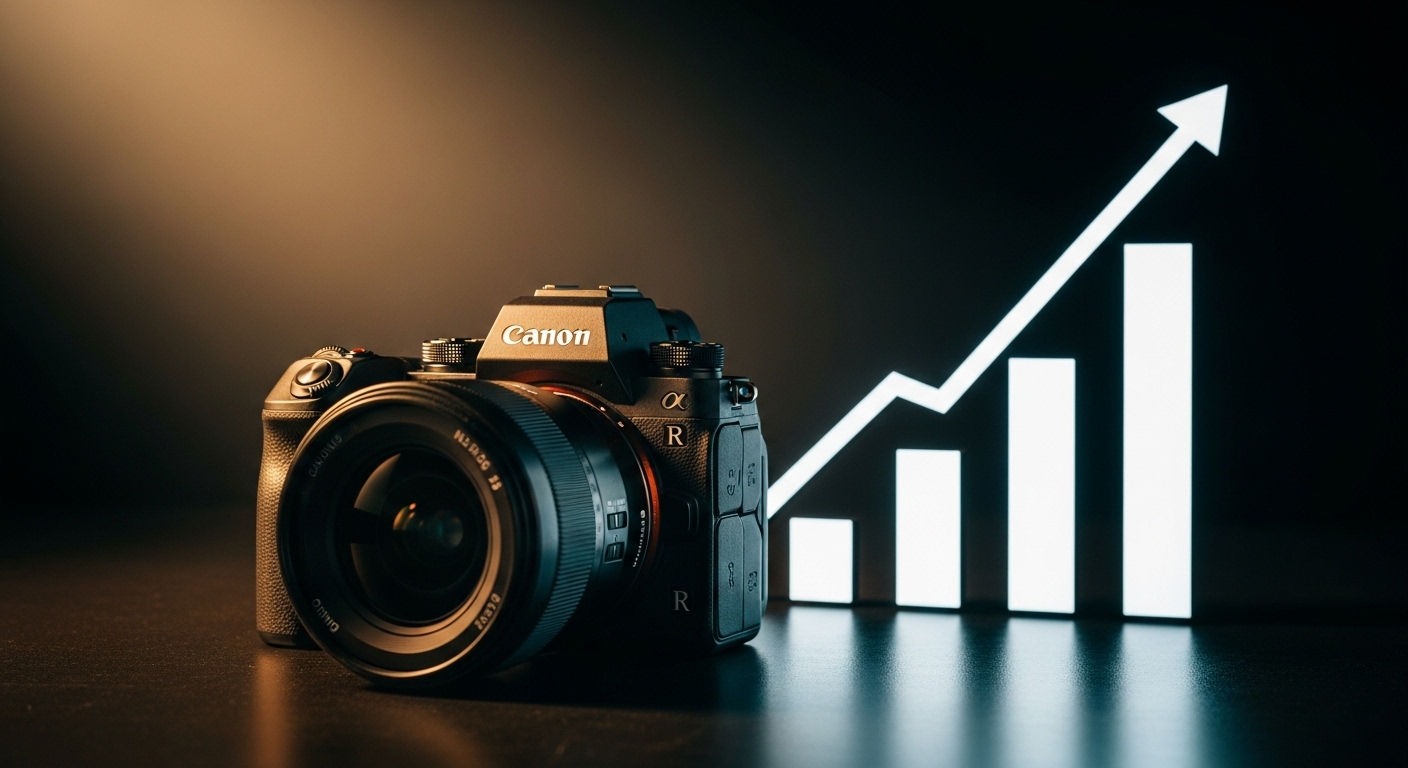
Digital camera sales fell roughly 94% from their 2010 peak before bottoming out in 2023, a collapse steeper than almost any other consumer-electronics category on record. The story that grabbed headlines in early 2026 is the bounce-back: CIPA members shipped 9.44 million digital cameras in 2025, up 11% year over year and marking the second consecutive year of growth, the first multi-year expansion since 2013.
What makes this recovery unusual is that unit volumes are still a fraction of the 2010 peak while market value has shrunk less dramatically. The gap between units and dollars tells the real story: today’s camera buyer is overwhelmingly a professional, an enthusiast, or a content creator willing to spend more per body. Average selling prices have climbed sharply, and the market is consolidating around fewer brands charging higher prices.
Based on finalized 2025 data from CIPA (Camera & Imaging Products Association) and Nikkei Inc shipment rankings, this analysis breaks down the new market structure. It covers the brand shake-up that pushed Fujifilm past Nikon, the compact camera revival driven by Gen Z and TikTok, and what 2026-2030 projections from TBRC, Mordor Intelligence, and Grand View Research say about where the industry is heading.
In this guide, you’ll see the full 2010-2025 shipment timeline, the corrected 2025 brand rankings, segment-level breakdowns for mirrorless, DSLR, and fixed-lens cameras, and a regional view of where the recovery is sticking. The aim is to give photographers, investors, and gear-curious readers a clear read on what the numbers actually say, with sources cited throughout.
The global digital camera market is back to growing for the second straight year, with very different mechanics than the last growth cycle. CIPA members shipped 9.44 million units in 2025, an 11% increase over 2024 and roughly 5.5x the 2023 low. Capture magazine pegged the 2025 market value at $5.8-6.2 billion, lower than the $8.5 billion cited for 2024 because earlier forecasts overstated the addressable base.
That apparent contradiction (more units, less value) is the single most important data point for understanding the post-2023 market. Unit growth is being driven by compact cameras with average selling prices around $300-500, while the high-margin mirrorless segment has seen stronger dollar growth than unit growth. The market is no longer a volume game; it is a value-per-unit game.
Forward projections show this value-led recovery continuing. The Business Research Company forecasts $7.51 billion in 2026 rising to $9.07 billion by 2030 at a 4.8% CAGR, while Mordor Intelligence estimates a larger $10.19 billion in 2026 reaching $12.78 billion by 2031 at 4.62% CAGR. Grand View Research is more conservative, projecting $8.8 billion in 2026 and $10.3 billion by 2030. The wide gap between forecasts reflects different assumptions about compact camera momentum and mirrorless ASP trajectories.
Market Insight: Recovery is being led by higher-value equipment, not higher volume. DPReview reports the average DSLR sold for roughly $282 in 2025 while the average mirrorless sold for $711, a 2.5x premium. The market has moved from a unit-volume model to a premium-first model.
For photographers and gear shoppers, this evolution matters. The number of new camera models released each year has fallen, but the average quality of what does ship has risen. If you are choosing your first dedicated camera in 2026, the best beginner cameras in 2026 are concentrated in a handful of strong product lines rather than spread across a sprawling catalog.
The camera industry’s historical trajectory is the steepest sustained decline in consumer electronics over the last 30 years. In 2010, manufacturers shipped 121.5 million cameras worldwide, of which roughly 109 million were fixed-lens models and 12.5 million were interchangeable lens systems. That peak represented decades of compounding growth as digital replaced film and point-and-shoots became a near-universal household item.
The slide began quietly in 2011 as smartphone cameras improved, then accelerated sharply from 2014 onward as iPhone and Galaxy handsets reached consumer-acceptable image quality. By 2019 shipments had collapsed to 15.2 million units, an 87% drop from peak in nine years. The pandemic produced a brief uptick to 8.9 million in 2020, then a fresh decline to 8.4 million in 2021 and a catastrophic trough of 1.7 million in 2023, a level not seen since the early 1980s.
| Year | Total Shipments (millions) | Key Context |
|---|---|---|
| 2010 | 121.5 | Industry peak; smartphones still maturing |
| 2012 | 98.1 | iPhone 5 era; compact erosion begins |
| 2015 | 35.4 | iPhone 6 Plus dual-camera launch |
| 2019 | 15.2 | Pre-pandemic floor |
| 2020 | 8.9 | Pandemic hobby surge (short-lived) |
| 2023 | 1.7 | Market bottom |
| 2024 | 8.5 | First growth year since 2017 |
| 2025 | 9.44 | Second consecutive year of growth |
The 2023 trough wiped out 98.6% of the 2010 volume and marked the worst single-year reading in the industry’s history. Fixed-lens cameras fell hardest, dropping to roughly 1.0 million units, a 99% decline from 2010. The 2024 rebound was the first growth year since 2017, and the 2025 print confirmed the recovery is structural rather than a one-off restocking effect.
CIPA: Camera & Imaging Products Association, a Japanese trade body founded in 1951 that publishes monthly and annual shipment data from its member manufacturers. CIPA is the de facto source for camera industry statistics, but it has known blind spots: JK Imaging (which sells Kodak and AgfaPhoto branded cameras), Viltrox, 7artisans, and Laowa are not members. Their sales, which have grown meaningfully in the manual-focus and budget-mirrorless segments, are absent from official figures.
The single biggest factual shift in the 2025 data is a brand-rank shake-up that previous forecasts did not predict. According to Nikkei Inc’s 2025 shipment rankings, Canon remains the clear leader at 45.7% share (4.5 million units), Sony sits in second at 24.6% (2.42 million units, down 3.9 points), and Fujifilm has leapfrogged Nikon into third place at 11.8% (1.16 million units, up 2.8 points). Nikon now sits fourth at 8.9% (880,000 units).
This is a significant correction to data circulating through 2024 and early 2025, which had Nikon in third and Fujifilm in fourth. Nikon’s slip from #3 to #4 is the headline change: the company has been reallocating engineering and capital toward cinema (the RED acquisition and Z cinema push) rather than competing on mirrorless body volume, and the rankings now reflect that pivot.
| Brand | 2023 Units (k) | 2024 Units (k) | 2025 Units (k) | 2025 Share | YoY Change |
|---|---|---|---|---|---|
| Canon | 2,840 | 3,340 | 4,500 | 45.7% | +2.5 pts |
| Sony | 1,810 | 2,000 | 2,420 | 24.6% | -3.9 pts |
| Fujifilm | 430 | 740 | 1,160 | 11.8% | +2.8 pts |
| Nikon | 760 | 810 | 880 | 8.9% | -1.4 pts |
| Panasonic | 320 | 370 | 430 | 4.4% | +0.2 pts |
| Ricoh Imaging | 140 | 170 | 210 | 2.1% | +0.3 pts |
| OM Digital | 110 | 130 | 150 | 1.5% | +0.1 pts |
Canon’s leadership is the most stable force in the entire market. Its mix of entry-level EOS R-series, mid-range R6/R8, and professional R5/R3 bodies covers every price band, and its RF lens catalog is now deep enough that switching costs are very high. Sony’s share drop is mostly a denominator effect: it grew units from 2.0 to 2.42 million but the overall market grew faster.
Fujifilm’s rise is the most interesting narrative. The company roughly tripled shipments from 430,000 in 2023 to 1.16 million in 2025, fueled by the X100VI viral hit, the X-E5 launch, and a retro-styled lineup that resonates with Gen Z buyers. TechRadar called out the same pattern in August 2026. Fujifilm is also one of the only major brands that never made a meaningful modern DSLR, so its mirrorless commitment is total.
Nikon is consciously repositioning itself. The RED acquisition in 2024 gave it a cinema camera platform, and the Z9, Z8, and Z cinema bodies are aimed at hybrid shooters and video professionals. The strategy is working on the high end, but Nikon is no longer fighting on volume, and the rankings show the cost of that choice. Panasonic, Ricoh Imaging, and OM Digital Solutions round out the rest of the meaningful market, each carving out defensible niches in Lumix S, GR street-photography, and Micro Four Thirds respectively.
For consumers, the practical takeaway is that the top four brands are safer long-term investments than they were three years ago, but the gap between #1 (Canon) and #4 (Nikon) is now wider than ever. Three manufacturers (Canon, Sony, and Fujifilm) account for over 82% of all 2025 shipments.
The segment-level picture in 2025 is dominated by two simultaneous revolutions: mirrorless has effectively ended the DSLR era, and compact fixed-lens cameras have come roaring back from near-extinction. According to Capture magazine’s breakdown of CIPA data, interchangeable lens cameras (ILCs) totaled 7.0 million units in 2025, of which mirrorless accounted for 6.31 million (90% of ILC units) and DSLRs just 691,000. Mirrorless also captured 82% of total ILC market value.
DSLR shipments fell 31% year over year in 2025, marking the sixth consecutive year of declines. The DSLR segment is now structurally a maintenance market: existing photographers replacing worn bodies, plus a residual base in regions where mirrorless infrastructure (lens lineups, service networks) is still thin. Sony has not shipped a new DSLR body since the Alpha 99 II in 2016, and Fujifilm’s last DSLR was the FinePix IS Pro in 2007. Both companies never looked back.
What makes 2025 different from prior recovery years is the fixed-lens segment. Compact camera shipments jumped 30% in 2025 to 2.44 million units, making fixed-lens cameras roughly 25.8% of total CIPA volumes. This is the segment’s strongest performance since 2017 and the first clear signal that the compact camera is no longer a dying category.
Why the compact camera is back: Three forces converged in 2024-2025. First, Gen Z buyers discovered “vintage digicams” through TikTok aesthetics, treating early-2000s point-and-shoots as fashion accessories. Second, premium fixed-lens models like the Fujifilm X100VI, Ricoh GR IV, and Canon G7X Mark III sold out for months. Third, even budget models like the Kodak PixPro FZ55 went viral. Capture magazine, DPReview, and TechRadar all led their 2026 coverage with this story.
The compact revival is not just nostalgia. Younger buyers are actively choosing fixed-lens cameras because they look and feel different from smartphones, offer optical zoom, and produce a deliberately imperfect aesthetic that stands out on social platforms. Canon’s PowerShot G7X shortage was so persistent through 2025 that stores imposed per-customer limits. Ricoh positioned the GR IV launch explicitly at street photographers and TikTok creators, and the camera sold through its entire production run within weeks.
For photographers thinking about a hybrid kit, the implication is that mirrorless is now the default choice for new system purchases. Full-frame mirrorless bodies pair with heavier lenses, so for enthusiasts carrying a 70-200mm or longer telephoto, properly fitted camera straps for heavy mirrorless lenses have become genuinely important gear rather than an afterthought. And for solo creators working from a tripod, the best monopods for serious photographers pair well with the heavier full-frame zoom lenses now standard in mirrorless kits.
The recovery is not uniform across regions. Asia-Pacific remains the largest single market for digital camera shipments, with Japan as the historic manufacturing center and China, South Korea, and Southeast Asia representing the bulk of unit demand. China’s domestic market has shifted decisively toward mirrorless, with DSLRs now accounting for just 1.2% of camera sales versus 14.9% in the Americas, the most extreme regional split in the world.
Japan’s household camera ownership has fallen from 48.6% in earlier surveys to roughly 30% today, reflecting smartphone saturation. Yet Japan remains the global hub for premium equipment sales, and the country is also where retro compact cameras like the Fujifilm X100 series and Ricoh GR continue to enjoy cult followings. Domestic demand in Japan is small in unit terms but disproportionately influential in setting global product trends.
North America shows the lowest household camera ownership among developed nations according to Statista Consumer Insights survey data, last among eight countries compared. Despite that, the U.S. has the highest per-capita spending on premium equipment because the buyers who remain are professionals, enthusiasts, and content creators. European markets (Germany, the UK, France, the Nordics) sit in between: lower volumes than Asia but stronger ASPs than the U.S. on average, reflecting a hobbyist culture that prioritizes optics quality over gear volume.
Emerging markets in Southeast Asia, India, and Latin America are skipping the DSLR generation entirely. New buyers in these regions move directly from a smartphone to an entry-level mirrorless body, often a Canon EOS R50, Sony ZV-E10, or Fujifilm X-T30 II. This leapfrogging dynamic is accelerating the global shift to mirrorless and compressing the timeline for DSLR phase-out in markets that historically held onto older systems the longest.
Smartphones caused the collapse of the compact camera market, but the relationship between phones and dedicated cameras has shifted. Capture magazine now frames smartphones as a “gateway drug” rather than a pure replacement: the phone gets people interested in photography, and a subset of those users eventually graduate to a dedicated camera. This reframing matters because it changes how analysts interpret unit declines.
For most consumers, the smartphone is now the primary camera. Multiple lens systems, computational night mode, AI scene recognition, and HDR processing produce images that exceed what compact cameras could deliver a decade ago. For casual social media use, smartphones have become the default and will remain so.
What smartphones cannot easily replicate is the combination of a large sensor, fast prime lens, optical zoom, manual control, and intentional craft. That combination is exactly what the Gen Z compact camera revival is buying, and it is also what drives the mirrorless upgrade cycle. The smartphone did not kill dedicated cameras; it killed the casual camera segment and clarified what the dedicated camera is actually for.
One practical bridge between the two worlds is the smartphone-as-camera ecosystem. Creators who want better video and photos but are not ready for a full mirrorless kit often start with smartphone accessories; the best iPhone tripods for smartphone photographers address exactly that use case. The accessories market has grown alongside the camera market recovery.
Industry forecasts for 2026 through 2030 cluster around modest but sustained growth, with a clear premium-first tilt. The Business Research Company projects $7.51 billion in 2026 rising to $9.07 billion by 2030 at 4.8% CAGR, while Mordor Intelligence is more bullish at $10.19 billion in 2026 reaching $12.78 billion by 2031 at 4.62% CAGR. Grand View Research sits in the middle at $8.8 billion in 2026 and $10.3 billion by 2030.
The gap between these forecasts hinges almost entirely on assumptions about the compact segment. If fixed-lens compacts continue their 2025 trajectory of 30% annual growth, the higher forecasts will prove correct. If compact momentum plateaus, the more conservative numbers will hold. Mirrorless ASP and unit trajectory are roughly consistent across the three.
The single biggest emerging driver for 2026 is AI integration in camera bodies. CIPA data and Capture magazine coverage both flag 2025 as the inflection point when computational photography moved meaningfully from smartphones into dedicated cameras. Subject-recognition autofocus now identifies specific animals, vehicles, and even aircraft in real time. On-device noise reduction and AI-assisted framing are appearing in flagship bodies. The next wave is expected to include AI-assisted editing and direct cloud upload with automated tagging.
The content creator economy remains the largest demand engine. Solo YouTubers, TikTok creators, and live streamers drive consistent upgrade cycles, and the vlogger/solo creator segment has become a recurring headline for 2026 coverage. Sony’s cinema push with the FX line, Canon’s V-series bodies, and Nikon’s RED acquisition all target this segment directly. The release calendar for early 2026 is unusually quiet for new body launches, which analysts read as manufacturers prioritizing firmware and AI updates over fresh hardware.
Niche markets continue to provide a stable floor. Industrial cameras for medical, scientific, and security use are growing independently of the consumer market. Astrophotography, underwater, and other specialized applications hold steady demand. Hobbyists interested in niche optical setups, including specialized astrophotography techniques like shooting through a telescope, represent a small but committed buyer base that the broader market cycle does not affect.
Outlook Takeaway: The camera market will not return to its 2010 mass-market peak, and the 2026-2030 consensus is for a smaller but healthier industry with higher average prices, fewer brands, and more value per unit sold. Companies that thrive will be those serving professionals, enthusiasts, and creators, rather than chasing the casual buyer who has permanently migrated to smartphones.
Nearly 100% of cameras sold today are digital. Film cameras represent less than 1% of the market, surviving only as niche products for photography enthusiasts and artists. The digital transition was effectively complete by 2010, and every major manufacturer now focuses exclusively on digital technology.
Camera sales are no longer declining after a 13-year downturn. 2024 marked the first year of growth since 2017, and 2025 was the second consecutive year of growth, the first multi-year expansion since 2013. CIPA members shipped 9.44 million units in 2025, up 11% year over year. While still far below the 2010 peak of 121 million units, the market has clearly found its bottom and is recovering.
Yes, and the buyer profile has changed significantly. Today’s purchasers are typically photography enthusiasts, professionals, or content creators who need capabilities beyond smartphones. Casual photographers have largely migrated to phones, creating a smaller but more dedicated market with higher average selling prices.
Yes, compact fixed-lens cameras posted 30% growth in 2025 to 2.44 million units, the segment’s strongest performance since 2017. The comeback is driven by Gen Z buyers rediscovering point-and-shoots through TikTok aesthetics, by viral hits like the Fujifilm X100VI and Ricoh GR IV, and by budget models like the Kodak PixPro FZ55 going viral on social platforms.
Gen Z has embraced dedicated cameras, especially compact fixed-lens models, for several reasons. They produce a deliberately retro, film-like aesthetic that stands out from phone-shot social media. Early-2000s point-and-shoots are now affordable on the used market. Premium compacts like the Fujifilm X100 series and Ricoh GR have cult followings on TikTok. And separating camera and phone use creates a more intentional creative practice.
Mass-market point-and-shoot digital cameras are essentially dead as a casual-use category, with shipments down more than 99% from the 2010 peak. However, premium compact cameras with larger sensors and manual controls (Sony RX100 series, Fujifilm X100VI, Ricoh GR IV, Canon G7X) are thriving, and 2025 fixed-lens growth of 30% shows the category is in active recovery for the right buyers.
DSLRs are functionally obsolete for new system purchases. DSLR shipments fell 31% in 2025 to 691,000 units, the sixth consecutive year of decline. Sony has not released a new DSLR since the Alpha 99 II in 2016 and Fujifilm since 2007. Canon and Nikon still produce DSLRs, but development has effectively shifted to mirrorless. Buyers purchasing new systems in 2026 should choose mirrorless.
Mirrorless cameras have already replaced DSLRs in market value terms, capturing 82% of ILC dollars in 2025 and roughly 90% of ILC units. The transition will be functionally complete within 2-3 years for new buyers; remaining DSLR demand will be confined to existing photographers replacing worn bodies in regions where mirrorless infrastructure is still thin.
Three forces are driving the recovery: content creator demand for high-quality video equipment, the Gen Z-driven compact camera revival, and professional or enthusiast users upgrading to newer mirrorless systems. AI features now appearing in flagship bodies are an emerging fourth driver. Together these have produced stable demand that appears sustainable even as smartphone cameras continue to improve.
Canon sells the most cameras by a wide margin. In 2025, Canon shipped 4.5 million units for 45.7% market share per Nikkei Inc data, more than the next two brands combined. Sony sits second at 24.6% (2.42 million units), Fujifilm third at 11.8% (1.16 million units), and Nikon fourth at 8.9% (880,000 units), with Fujifilm having leapfrogged Nikon in the latest rankings.
The digital camera market’s collapse and partial recovery offer useful lessons about how consumer technology categories evolve when smartphones absorb the casual tier. The 94% decline from 2010 to 2023 shows how fast a category can shrink when a new platform disrupts the mainstream use case. The 11% growth in 2025, the second consecutive year of expansion, shows that a smaller, premium-first market can be stable and profitable once it finds its niche.
For current and prospective camera buyers, the data points to a few practical takeaways. First, the top four brands (Canon, Sony, Fujifilm, Nikon) have consolidated their positions, so choosing among them is now safer than it has been in years. Second, mirrorless is the right choice for new system purchases, with 90% of ILC units and 82% of ILC dollars in 2025. Third, the compact camera segment is genuinely worth considering again, especially for buyers who want a distinct look or a pocketable camera with a larger sensor than a phone can offer.
Most importantly, the statistics show that photography remains vital and growing even if camera ownership has fallen. More photos are taken today than ever before; smartphones democratized casual photography while dedicated cameras serve specialized needs. For shoppers ready to buy, the best beginner cameras in 2026 are concentrated in a handful of strong product lines, and the market around them is healthier than the 2023 headlines suggested.
After working through the full 2010-2025 dataset, the picture that emerges is a smaller, more focused industry serving professionals, enthusiasts, and creators who want capabilities and aesthetics smartphones cannot deliver. The numbers will never return to 2010 levels, and that is the point. The camera market has matured into a sustainable form, and 2026 is a good year to be part of it.