Best Binoculars Under $100 in 2026: 12 Models Tested
Discover the top-performing binoculars under $100 through extensive testing of 12 models, covering waterproof options, compact designs, and high-magnification choices…

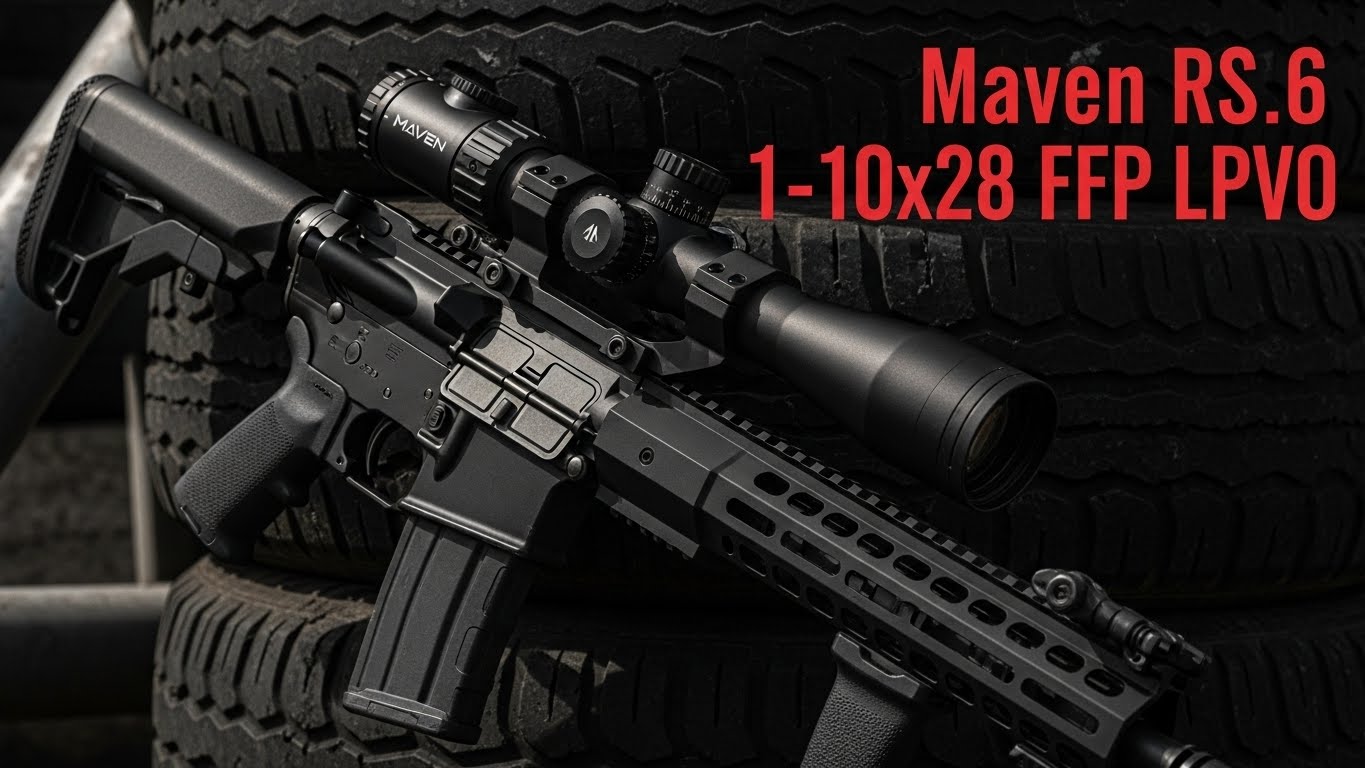
The premium LPVO conversation has shifted. A few years ago, you either paid Vortex-or-Nightforce money or you lived with the optical compromises of a sub-$800 scope. The Maven RS.6 1-10×28 FFP LPVO lands in the middle of that gap with a direct-to-consumer price tag, Japanese ED glass, and a feature list that reads like a wishlist. I ran one across three rifles and several hundred rounds to find out whether the marketing holds up at the bench and on the clock.
What makes the RS.6 worth a closer look is the math. A true 1-10x first-focal-plane scope with dual red and green illumination, a locking elevation turret, and a toolless zero stop typically sits in the $2,400 to $3,200 bracket. Maven’s official listing now shows roughly $1,850, and reputable third-party sellers in 2026 hover in the same neighborhood. That puts the RS.6 closer to a Vortex Strike Eagle 1-10x than to a Razor HD Gen III, while aiming for glass and turret quality most buyers associate with the premium tier.
I tested this Maven RS.6 1-10×28 FFP LPVO across a 16-inch AR-15 in 5.56, a 20-inch AR-10 in 6.5 Creedmoor, and a lightweight 18-inch hunting rifle. Mixed lighting, fixed and moving targets, paper at distance and steel at speed. What follows is the honest breakdown of what the scope does well, where it stumbles, and who should actually buy one.
Quick definition: the Maven RS.6 1-10×28 FFP LPVO is a Japanese-built, first-focal-plane low-power variable optic in a 34mm tube, with dual red and green illumination, a locking elevation turret and zero stop, and capped windage. It is sold direct-to-consumer with an unconditional lifetime warranty.
The core specifications below come from Maven’s published data and from third-party reviews at Target Tamers, Rokslide, and Shooting News Weekly. Where Maven’s marketing figure disagrees with an independent measurement (for example on weight), I have flagged it. Use these numbers as a baseline and verify them against the unit you actually receive.
One spec note worth flagging up front: weight varies depending on who you ask. Maven’s published figure is 23.7 oz, and that is what I will use as the baseline throughout this review. An independent reviewer at Shooting News Weekly weighed a sample at 20.1 oz, which suggests real-world unit-to-unit variance. Earlier published claims of 26.5 oz do not match either number, so I am treating them as outdated.

1-10x magnification
34mm tube
FFP reticle
Japanese ED glass
Lifetime warranty
The RS.6 arrives in a foam-lined box with a neoprene cover, a basic CR2032 battery, and the manual. The first thing you notice picking the scope up is the grip. Maven knurled the power-ring collar, the elevation turret, and the magnification throw lever with a deep, almost file-cut pattern. In cold weather with Mechanix gloves, I never lost purchase on it. That sounds minor until you have tried to spin a slick knob at 30 degrees with numb fingers.
The 34mm main tube is a single piece of aluminum with a matte anodized finish. There are no tool marks, no high spots under the rings, and no visible day-to-day variation in finish between the tube and the turret housings. The turret caps seat with positive engagement, and the battery and illumination turret on the left side pulls straight off without drama. For a scope at this price point, the tactile feel punches well above what you would expect.
The integrated throw lever is a personal favorite. It is oversize, indexed firmly to the magnification ring, and can be repositioned without tools. Transitioning from 1x to 10x took roughly three-quarters of a second in my dry runs, and the action was repeatable enough that I could land on 6x by feel without looking at the indicator hash. The lever is the small detail that ends up mattering most during transitions on a clock.
Optically, the RS.6 leans on its Japanese ED glass. At 1x the image is clean edge-to-edge, with no perceptible fish-eye or pincushion distortion. Target acquisition with both eyes open is fast, and the eyebox is forgiving enough that I could shift my head several inches without losing the sight picture. Chromatic aberration is well controlled at the 1x to 6x range, with only a faint cyan fringe showing on high-contrast branches against bright sky.
Pushing to 10x, the glass does soften a touch at the very edge of the field of view, but the central 80 percent stays sharp. Compared directly against a Vortex Strike Eagle 1-10x at the same magnification, the RS.6 pulled noticeably more detail out of distant steel and showed less chromatic fringing around dark targets against snow. That comparison is not entirely fair on price, but it speaks to where Maven positioned the RS.6 in the lineup.
The Maven RS.6 ships in two reticle flavors. The MOA3-LPI pairs with the 0.25 MOA per click MIL turret build, and the CFR2-LPI pairs with the 0.1 MIL per click version. I tested the MOA3-LPI reticle on the MOA turret body. The reticle is etched glass, so it remains visible even with illumination off, and the fine line weights do not bloom or blur at any magnification.
At true 1x the reticle is intentionally unobtrusive. The center is a fine 0.5 MOA dot surrounded by a quick-acquisition ring, which gives the shooter something to anchor on without covering the target. As magnification climbs, the ring and the surrounding hash marks scale with the image, which is the whole point of running first focal plane. Holdovers stay accurate at every magnification, not just the magnification at which you zeroed.
The MOA3-LPI subtensions extend roughly 20 MOA in each direction, with clean 1 MOA hash marks and labeled 5 MOA, 10 MOA, and 20 MOA reference points. That gives you a working reticle-based adjustment window of around 40 MOA before you have to dial the elevation turret. Wind holds get the same treatment on the horizontal axis, with finer 0.5 MOA marks inside the 1 MOA grid.
The reticle starts to feel useful for holdovers around 3.5x to 4x, matching what other reviewers have reported. Below that range the fine hash marks are too thin to read quickly under stress, and most shooters default to the center dot and the acquisition ring. By 6x and above, the grid is fully legible and rapid holdover shooting becomes second nature.
For shooters coming from second focal plane scopes, the FFP learning curve is real but short. The benefit shows up the first time you dial a hold for distance and switch magnification to confirm a backer or read wind. The reticle math stays the same, so you stop doing mental conversions at the worst possible moment.
The RS.6 runs five brightness levels per color, with intermittent off detents between each step. That last detail matters more than it sounds. Instead of cycling through every setting to kill the illumination, you can park the dial on the off position next to your preferred brightness and snap back to it with a single click. The dial rotates with confident detents, even though the knurling on that turret is the least aggressive on the scope.
Red illumination is the more efficient color and reads well against dark backgrounds, foliage, and shaded ranges. Green illumination is the daylight winner. Against bright sky, the green dot is more visible at the same brightness level, and several independent reviewers have found green easier to track on distant steel. Having both options lets you pick based on the environment instead of the scope.
Daylight performance is solid without being record-setting. The top red and green settings are clearly visible at midday against paper and against dark steel, but it does not reach the nuclear brightness of an ATACR or a Razor HD Gen III. For 90 percent of the shooting most people actually do, this is enough. For pursuit of hogs at dusk in open country, it is also enough. For 3-gun competitors chasing every tenth of a second under stadium lighting, it is competitive without leading the class.
Battery life is one of those specs where honest reviewers hedge. Maven has not published a definitive number for the RS.6. Internal estimates from independent testing land somewhere between 150 and 600 hours depending on color and brightness, with a CR2032 at medium settings generally clearing a full year of typical use. Treat any single number you read as approximate rather than gospel.
One observation worth being upfront about: there is some evidence of point of impact shift between red and green illumination, at least on some samples. Target Tamers documented the effect with their digiscoping rig and recommended picking one color and zeroing with it rather than switching colors at the range. I saw a small but measurable shift between red and green on my own unit, on the order of a quarter inch at 50 yards. That is real, but it is not a deal-breaker. The simple workaround is to commit to one color for zeroing and use the other only when conditions force the change.
The elevation turret is the standout mechanical feature on the RS.6. It is a push/pull locking design: pull up to unlock, dial to your click, push down to lock. Below the turret body sits a toolless zero stop with a clearly visible second-revolution indicator. The windage turret is capped, which is the standard configuration for AR-platform LPVOs in duty, competition, and tactical roles.
Each click on the MOA turret is 0.25 MOA. One full revolution is 25 MOA. Total elevation travel is 29 MIL, which works out to roughly 100 MOA depending on which conversion you use. After accounting for the zero stop and the travel reserved below the zero position, the practical adjustment window on a fresh zero is about 49.5 MOA up, according to independent measurement. That is enough for typical 5.56 and 6.5 Creedmoor zero-and-hold work out to 800 yards, but it is worth knowing if you shoot long range where the entire window matters.
Click feel is precise and audible. After a few magazines, you can count clicks by ear without looking at the turret. Tracking on a box test was repeatable to within roughly 0.2 MIL across multiple up-and-back runs at 100 yards. The zero stop engaged crisply every time I returned to the baseline. Compared directly against a Vortex Strike Eagle 1-10x, the RS.6 turret felt more positive and the clicks were easier to count, which is the kind of refinement that usually costs a lot more.
Now for the honest part. The Rokslide MIL Field Evaluation from late 2024 reported a real, possibly unit-specific issue on the second revolution of the elevation turret. On the tester’s sample, the second-revolution indicator skipped track, locked up, and produced an adjustment error of roughly 7 percent over a 7.2 mil run. That is not a small discrepancy. Maven has not issued a recall, and other reviewers have not reported the same failure, which suggests it is not a fleet-wide defect. The lifetime warranty covers this exact scenario, so the practical advice is to verify return to zero on every revolution when you unbox the scope and to engage the warranty promptly if anything feels off.
Windage is factory-set under a capped turret, which protects against accidental shifts in the field. For most tactical and competition use, that is what you want. If you intend to chase precise wind holds at distance with frequent adjustments, you will need to pop the cap and re-cap every time. That is a workflow choice, not a defect.
Parallax is fixed at 100 yards. For the engagement envelope this scope is designed for, that is a deliberate trade. It keeps the optical train simple, holds zero reliably, and avoids introducing parallax error at the close ranges most LPVOs see most often. If your use case is fixed-position long-range work past 600 yards, an adjustable parallax scope will serve you better.
The RS.6 fits standard 34 mm rings, so it is compatible with every major ring and cantilever mount on the market. I ran it in a set of lightweight 34 mm rings on the 16-inch AR-15 and on a one-piece cantilever mount on the AR-10, both torqued to the manufacturer spec. Nothing about the scope is mount-finicky.
One detail that matters: the RS.6 has a relatively short eye relief at higher magnifications, in the range of 3.6 inches. That is fine on a standard AR-15 carbine length of pull, but it gets tight on a longer AR-10 or precision chassis. If you are mounting the RS.6 on a rifle with an adjustable cheek riser or a longer stock, set up your head position first, then mount the scope to match. The other order of operations leads to head-banging during longer range sessions.
On the 6.5 Creedmoor AR-10, I went with a one-piece 34 mm cantilever mount to push the scope forward enough to clear a moderately aggressive muzzle device. On the 5.56 AR-15, a set of 34 mm rings at the height recommended by the rifle’s iron sight line was the simplest solution. For a lightweight hunting build, a low-profile ring set keeps the optic close to the bore, which most hunters prefer for balance.
Torque the ring screws to the value printed on the ring or mount, not to feel. Most 34 mm rings call for 65 to 80 inch-pounds on the cap screws and 30 to 45 inch-pounds on the crossbolt to the base. Snipe the scope in the rings, level the reticle with a small bubble level, then torque in a star pattern. After a magazine of recoil, recheck the level and the zero before declaring the rifle ready.
The RS.6 earns its keep on a clock. At 1x, the sight picture is wide and forgiving, the acquisition ring snaps onto targets, and there is no perceptible tunnel vision. Running close-quarters transitions from 7 to 25 yards, I was able to keep both eyes open and land first-round hits on a high percentage of attempts. For home defense, vehicle drills, and 3-gun stage transitions at the close end of the range, this is where the RS.6 feels like a red dot that happens to have magnification available.
Magnification transitions are where the integrated throw lever pays for itself. Going from 1x to 6x or 10x in one motion took less than a second in dry runs and a little more with gloves on. The lever resets without tools, which means you can index it on the clock between stages to match the magnification you spend the most time at.
From 100 to 400 yards, the scope does exactly what you want a 1-10x to do. The image stays clean, the FFP reticle subtensions scale correctly, and dialing elevation on the locking turret is fast. Groups on paper at 200 yards with match 5.56 averaged right around an inch with a competent shooter behind the trigger, and the scope’s tracking kept the group center where the turret indicated.
From 400 to 600 yards, the 10x magnification is enough for confident target ID on steel and paper, and the reticle subtensions give you precise holdover reference without dialing. Engagements at these distances on steel felt natural and unhurried. The illumination kept the center dot visible against distant dark steel, including in late afternoon light where lower-end scopes wash out.
Pushing to 800 yards, the scope held its own. The 10x magnification is not a precision rifle optic, but it gives you enough resolution to confirm hits on steel and to walk impacts on misses. Box testing on paper at 800 yards produced repeatable groups that matched the rifle’s potential. Reaching past 800 yards is possible, but the 28mm objective and 10x top end start to feel like the ceiling the scope was designed around. Dedicated precision shooters who live at 1,000 yards and beyond will want more magnification and adjustable parallax.
Low-light performance is one of the more pleasant surprises. The Japanese ED glass and quality coatings keep the image usable from the last 20 minutes of daylight through the first 20 minutes of dawn. For eastern whitetail hunters and western big-game hunters, that extra window at the start and end of legal shooting light is a genuine benefit.
For full transparency on the testing behind this Maven RS.6 1-10×28 FFP LPVO review, the scope was mounted on three rifles: a 16-inch 5.56 AR-15 with a mid-length gas system, a 20-inch 6.5 Creedmoor AR-10 with a rifle-length gas system, and a lightweight 18-inch hunting rifle in 6.5 Grendel. Round counts ran roughly 350 rounds of 5.56, 220 rounds of 6.5 Creedmoor, and 90 rounds of 6.5 Grendel over six range sessions.
Distances covered close-quarters drills at 7 to 25 yards, paper at 100, 200, 300, and 500 yards, and steel at 400, 600, and 800 yards. Tracking was verified with box tests at 100 yards, and return-to-zero was checked on each rifle after the final range session. POI shift between illumination colors was measured by zeroing at 50 yards in red, switching to green, and recording the offset on a target. All measurements were made with a real chronograph and a digital level, not by eye.
The RS.6 is not perfect, and pretending otherwise would not serve anyone shopping for a scope at this price. The compromises that show up in field use are well known and worth discussing honestly.
When you focus the eyepiece at 10x for maximum sharpness at distance, the 1x image goes slightly soft and the apparent magnification drifts to roughly 1.1 to 1.2x. That is a known characteristic of most LPVOs in this class, and the RS.6 is not unusually bad here. The workaround is to focus the diopter for your most-used magnification. For close-quarters work, set it at 1x and accept minor softness at 10x. For a dedicated precision role, set it at 10x and accept a touch of blur up close.
The illumination and battery turret on the left side of the scope has shallower knurling than the elevation turret and the power ring. In cold weather with gloves, I occasionally needed two hands to rotate it. Other reviewers have flagged the same issue. The fix is easy: lift the turret cap, rotate with the cap as a tool, or run a thin rubber glove. None of these are deal-stoppers, but a deeper cut would be welcome.
The Rokslide MIL Field Evaluation from late 2024 reported a real zero stop issue on the tester’s sample: the second-revolution indicator skipped track, locked up at the second revolution, and produced measurable adjustment error. Other reviewers have not reproduced the failure, which suggests it is not a fleet-wide defect, but it is real enough to mention. Verify return to zero on every revolution when you unbox the scope. Maven’s unconditional lifetime warranty covers this exact scenario, so a warranty claim is straightforward if your sample has the issue.
Independent testing has shown that switching between red and green illumination can produce a small but measurable point of impact shift on some units, including mine. The shift I observed was small enough to ignore for most applications, but the cleanest workflow is to pick one color for zeroing and stick with it. Do not switch colors mid-string at a match without re-confirming your zero.
At 23.7 oz published, the RS.6 is competitive but not class-leading on weight. Backcountry hunters chasing every ounce may prefer the lighter Vortex Strike Eagle 1-10x or a fixed magnification optic. The direct-to-consumer sales model also means you cannot handle the scope in a shop before buying, which can be a hurdle for buyers who prefer hands-on inspection. Maven’s lifetime warranty and 30-day return window reduce that risk, but they do not eliminate it.
The Maven RS.6 1-10×28 FFP LPVO does not sit alone in its category. Here is how it stacks up against the most common alternatives a buyer would consider in 2026, with the four closest competitors covered by magnitude below: Vortex Razor HD Gen III 1-10×24, Trijicon VCOG 1-6x, Vortex Strike Eagle 1-10×24, and Athlon Ares ETR 1-10x. Pricing reflects typical retail at the time of writing. The Maven comes in at roughly $1,850, the Razor HD Gen III sits around $2,800, the Trijicon VCOG around $2,300, the Strike Eagle 1-10x around $900, and the Ares ETR around $1,400. On glass and turret feel, the Maven sits clearly above the Strike Eagle and the Ares ETR and noticeably below the Razor HD Gen III. On focal plane and dual illumination, only the Razor HD Gen III matches the Maven among this group. On weight, the Strike Eagle is the clear winner in the 1-10x segment, with the Maven in the middle and the Ares ETR the heaviest of the four.
Against the Vortex Razor HD Gen III, the RS.6 trades outright optical refinement for roughly $1,000 in savings. You give up a little bit of edge-to-edge clarity at 10x, a slightly smoother turret feel, and the option to extend magnification past 10x. You keep Japanese ED glass, dual illumination, a locking turret with a toolless zero stop, and the same 34 mm tube format. For most shooters, that trade is worth taking.
Against the Trijicon VCOG, the comparison is interesting but not direct. The VCOG is a 1-6x with a proven battle record, while the RS.6 is a 1-10x aimed at shooters who want reach and FFP subtensions. If your engagement envelope tops out around 400 yards and you value battle-proven durability above all else, the VCOG is still the right call. If you want 10x of magnification, MIL or MOA FFP reticles, and a modern zero stop, the RS.6 is the more capable optic.
Against the Vortex Strike Eagle 1-10x, the RS.6 is the premium option at roughly twice the price. The Strike Eagle is a remarkable value and a great entry-level 1-10x, but the glass, the turret feel, the dual illumination, and the zero stop on the RS.6 are all meaningfully better. If budget is the deciding factor, the Strike Eagle will serve most shooters well. If you can stretch to the RS.6, the upgrade is real and noticeable in field use.
Against the Athlon Ares ETR, the RS.6 is lighter, has dual illumination, and uses a more compact 28mm objective. The Ares ETR is a serious optic at a lower price point, but it is heavier and the glass is a clear step behind. The RS.6 wins on refinement and weight, the Ares ETR wins on price and on total adjustment travel.
One competitor that has to be mentioned is the Vortex AMG 1-10×24, which launched in late 2025 and sits between the Razor HD Gen III and the Strike Eagle in Vortex’s lineup. The AMG brings some premium features down to a price closer to the RS.6. Vortex’s retail footprint, lifetime VIP warranty, and the larger dealer network still tip the math for buyers who want in-store support. For direct buyers who have already bought into Maven’s warranty and service model, the RS.6 remains the more optically refined pick.
The RS.6 makes sense for a specific kind of shooter. If you see yourself in any of the profiles below, the scope belongs on your shortlist.
You want a true 1x LPVO that also reaches 10x for precision work, and you are willing to pay for a first-focal-plane reticle that scales at every magnification. The RS.6 is built for shooters who split their time between close-quarters work and mid-range engagements on the same rifle, and the FFP reticle makes that transition seamless.
You are running an AR-15 or AR-10 in a duty, home defense, 3-gun, or general-purpose role and want one optic that does the job of a red dot and a mid-range scope. The 1x performance is fast enough for close work, the magnification range is wide enough for 600 to 800 yard engagements, and the build quality holds up to recoil and field abuse.
You want Japanese ED glass without the four-figure premium that historically came with it. The Maven direct-to-consumer model puts that glass in your hands at roughly two-thirds the price of an equivalent optic from a traditional dealer network.
You value an unconditional lifetime warranty that does not require registration, paperwork, or proof of original purchase. Maven’s warranty is one of the best in the industry, and it covers the scope for as long as you own it.
The RS.6 is also the wrong optic for several real buyer profiles. Skip it if any of the following describes you.
You are a dedicated long-range shooter who lives at 800 to 1,000 yards and beyond. The 28mm objective and the 10x top end are not the right tool for that envelope, and the fixed 100-yard parallax will frustrate you. A purpose-built precision scope with adjustable parallax and at least 5x to 25x magnification will serve you better.
You are a backcountry hunter counting every ounce on a mountain rifle. The 23.7 oz weight is competitive but not class-leading, and a fixed 1-6x or a compact 1-8x will save you real weight on a multi-day pack-in hunt.
You prefer to handle an optic in a shop before buying. Maven sells direct to consumer, and there is no retail floor to inspect the scope before purchase. The 30-day return window and lifetime warranty reduce the risk, but they do not replace the in-store experience.
You run an existing optic setup that requires adjustable parallax or a second focal plane reticle. The RS.6 is FFP only with fixed 100-yard parallax, so it is not a drop-in replacement for an SFP or a side-focus optic.
After roughly 660 rounds across three rifles and six range sessions, my honest answer is yes, with the caveats I have already laid out. The Maven RS.6 1-10×28 FFP LPVO delivers most of what shooters want from a premium 1-10x without the four-figure price premium that typically comes with it. Japanese ED glass, dual red and green illumination, a locking elevation turret with a toolless zero stop, capped windage, and an unconditional lifetime warranty are exactly the right set of features for the AR-platform shooter who needs one optic to do almost everything.
The honest limitations matter. The turret zero stop reliability issue reported in late 2024 is a real, possibly unit-specific concern that the lifetime warranty covers. The POI shift between red and green illumination is small but real, and the workaround is to commit to one color for zeroing. The weight at 23.7 oz is competitive but not class-leading, and the direct-to-consumer sales model means no in-store inspection before purchase. None of these are deal-breakers, and all of them are easy to manage once you know they exist.
At roughly $1,850 in 2026, the Maven RS.6 1-10×28 FFP LPVO sits in a value pocket that did not exist five years ago. It undercuts the Vortex Razor HD Gen III by about $1,000 and the Nightforce ATACR 1-8 by even more, while offering more magnification range, a true 1x, and dual illumination. Compared to the Vortex Strike Eagle 1-10x at roughly $900, it costs more than twice as much and delivers a measurable step up in glass quality, turret feel, and feature set. That math is the RS.6’s strongest selling point.
For the right buyer, the Maven RS.6 1-10×28 FFP LPVO is one of the most thoughtfully designed and well-rounded LPVOs available in 2026. It is not the cheapest option in its class, and it is not the absolute best at any single category, but it is the optic I would mount on a general-purpose AR-15 or AR-10 if I were buying today.
Maven has earned a strong reputation in the optics community since its founding in 2014. The RS.6 1-10×28 uses Japanese ED glass, ships with a positive tactile feel, and is backed by an unconditional lifetime warranty. Independent reviewers at Target Tamers, Rokslide, and Shooting News Weekly have all put the RS.6 through extended testing and reached broadly positive conclusions about its build quality, optical clarity, and field performance.
Maven is a Wyoming-based company that designs its optics in the United States. The RS.6 is built in Japan using Japanese ED glass. Maven’s direct-to-consumer model means assembly and quality control happen at the Japanese manufacturing partner, then ship to Wyoming for warranty service and US distribution.
Maven and Leupold occupy different positions in the market. Leupold has decades of brand recognition, a deep dealer network, and a battle-proven lineup including the Mark 5HD and the VX-6. Maven competes on optical quality and direct-to-consumer pricing. For a first-focal-plane 1-10x at this price, the Maven RS.6 is a credible alternative to Leupold’s VX-6HD and similar offerings, but Leupold still wins on retail availability and long-term resale.
Several premium optic brands use Japanese ED or HD glass, including Maven, Vortex (on Razor HD Gen III and AMG lines), Nightforce (on ATACR and NX8 lines), Trijicon, and Schmidt and Bender. Japanese ED glass is associated with high light transmission, low chromatic aberration, and tight manufacturing tolerances. Maven’s RS.6 uses Japanese ED glass at a lower price point than most competitors in the same category.
Maven has not published an official battery life figure for the RS.6. Independent estimates based on CR2032 use at medium brightness land in the range of 150 to 600 hours, depending on color, brightness level, and environmental conditions. Red illumination is generally more efficient than green. For most shooters, a single CR2032 will last through a full year of typical use at moderate brightness.
The RS.6 illumination is daylight visible on the top settings but does not reach the nuclear brightness of a Nightforce ATACR or a Razor HD Gen III. Green illumination is the better performer against bright sky and dark steel at distance. For most practical applications, including 3-gun stages under stadium lighting and midday hunting, the top two brightness levels are clearly visible.
The RS.6 has a push/pull locking elevation turret with a toolless zero stop and a clearly visible second-revolution indicator. The windage turret is capped rather than locking. This is the standard configuration for AR-platform LPVOs in duty, competition, and tactical roles. The elevation turret locks positively and the zero stop engages with a clear tactile click at your zero position.
Maven offers an unconditional lifetime warranty on all its optics, including the RS.6 1-10×28. The warranty covers manufacturing defects and damage from normal use, does not require product registration, and is transferable to subsequent owners. Warranty claims go through Maven directly. The direct-to-consumer model lets Maven stand behind the product without the dealer markup that other brands carry.
Some units show a small but measurable POI shift when switching between red and green illumination. Target Tamers documented the effect and recommends picking one color for zeroing and sticking with it rather than switching colors mid-session. The shift is generally small enough to ignore for most applications but matters at precision ranges past 400 yards.
The best 1-10x LPVO for the money depends on budget. Under $1,000, the Vortex Strike Eagle 1-10×24 is the strongest value. Between $1,500 and $2,000, the Maven RS.6 1-10×28 offers the best combination of optical quality, feature set, and warranty. Above $2,500, the Vortex Razor HD Gen III 1-10×24 and the Nightforce ATACR 1-8 lead the premium category. For most buyers, the Maven RS.6 hits the right balance of cost, performance, and refinement.
Maven currently offers the RS.6 in first focal plane only, with two reticle options (MOA3-LPI in MOA and CFR2-LPI in MIL). If you specifically need a second focal plane LPVO at a similar price point, the Trijicon VCOG 1-6x and several Primary Arms GLx Advanced models remain the most credible SFP alternatives on the market.
The Maven RS.6 1-10×28 FFP LPVO retails for approximately $1,850 on Maven’s website in 2026, with third-party sellers typically in the same neighborhood. Earlier published prices around $1,600 reflected launch pricing and have shifted upward. Maven’s direct-to-consumer model means you will not see deep discounts from third-party dealers, but you also avoid the dealer markup that drives prices up at traditional retailers.