Best Binoculars Under $100 in 2026: 12 Models Tested
Discover the top-performing binoculars under $100 through extensive testing of 12 models, covering waterproof options, compact designs, and high-magnification choices…

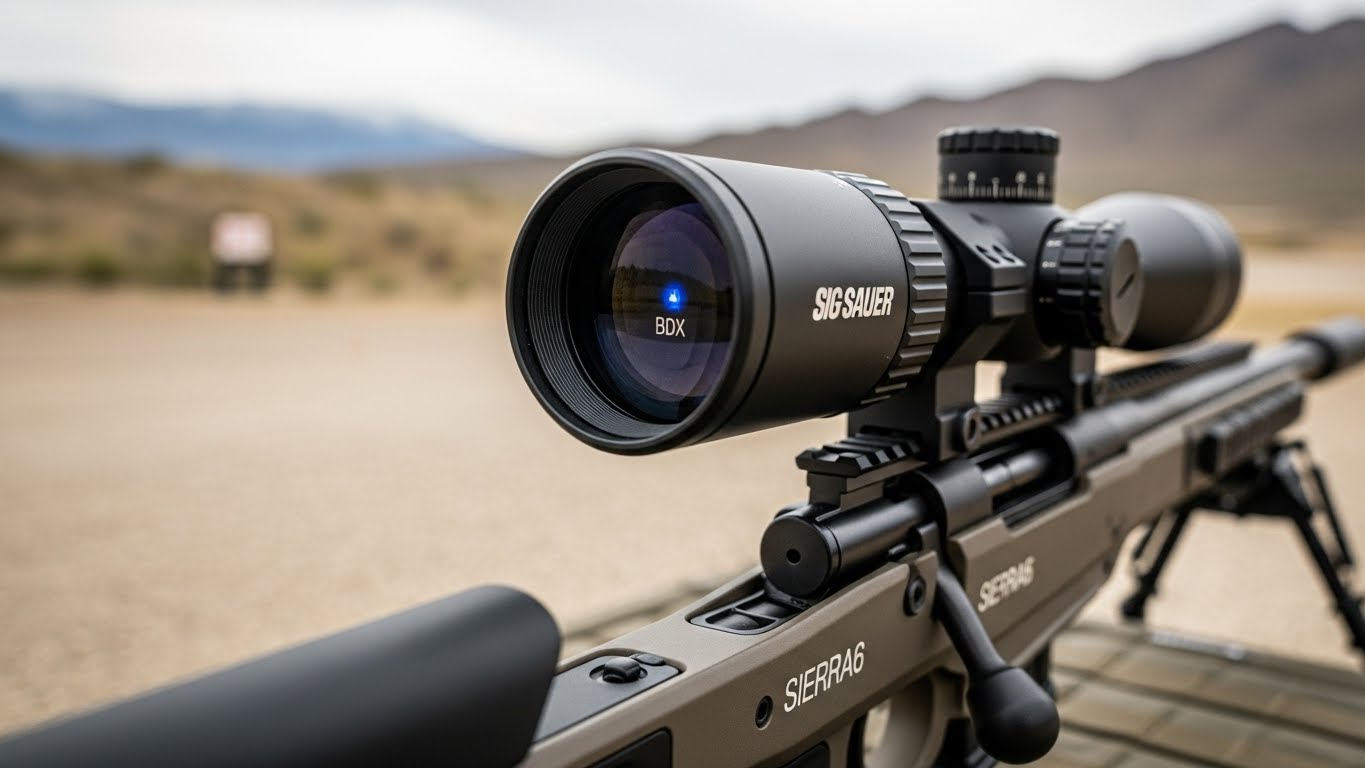
Smart rifle scopes have moved from curiosity to genuine hunting tool over the last few years, and the Sig Sauer Sierra6 BDX sits at the center of that shift. After spending 45 days on the range and in the field with the 3-18x44mm configuration, I have a clear picture of what this scope does well, where it falls short, and whether it earns a place on your rifle.
Sig Sauer BDX is the company’s Bluetooth ballistic data exchange system that pairs BDX-equipped rangefinders with BDX scopes to display illuminated holdover points in real time. The Sierra6 BDX is the riflescope that receives those holdovers, and the BDX 2.0 generation adds automatic reticle re-scaling as magnification changes. If you have ever wished your scope could do the math for you while a buck is standing broadside at 412 yards, this system is built for that exact moment.
This review covers the 3-18x44mm variant in depth, including paired-rangefinder testing with a KILO series unit, the Digital Focal Plane behavior, optical performance under real conditions, and the cold-weather battery quirks that don’t show up in spec sheets. I will also address the community skepticism around BDX for precision shooting, and clarify who should and should not add this scope to their kit.
Before getting into the deep dive, here is a compact at-a-glance card so you can quickly compare this scope against other long-range options in the same bracket.
Configuration under review: Sierra6 BDX 3-18x44mm (SFP, 30mm maintube)
Objective: 44mm
Tube diameter: 30mm
Magnification range: 3-18x
Reticle: Illuminated digital ballistic, second focal plane
Weight: 3.1 lbs
Length: 13.4 inches
Waterproof rating: IPX-7 (1m immersion for 30 minutes)
Battery: 2x CR2032 3V lithium
Smart features: BDX 2.0 auto-holdover, LevelPlex digital level, KinETHIC, MOTAC
Amazon rating: 4.4 out of 5 (21 reviews)
Amazon price snapshot: around $1,028.88 (Prime, in stock at last check)
Sig Sauer also ships the Sierra6 BDX in 2-12×40 and 5-30×56 configurations, plus a 6.5-20×52 combo kit bundled with a KILO rangefinder. This review focuses on the 3-18×44 since that is what I tested on a 6.5 Creedmoor rifle, but the BDX 2.0 behavior is consistent across the family.

Magnification: 3-18x
Objective: 44mm
Tube: 30mm
Reticle: BDX 2.0 Illuminated SFP
Weight: 3.1 lbs
The Sierra6 BDX is built around Sig Sauer’s HDX 6x optical system, which uses ultra-wide broadband anti-reflection coatings claimed to push light transmission to 95 percent. The 44mm objective sits behind those coatings and feeds a 30mm maintube machined from aircraft-grade aluminum. The whole assembly is argon-purged and rated IPX-7, meaning it survives immersion to one meter for thirty minutes without fogging or leaking.
Where the scope departs from a conventional hunting optic is the BDX module integrated into the ocular bell. A small bump on the left side houses the Bluetooth radio, the LevelPlex level sensor, and the MOTAC motion-detection circuitry. From the right side it looks like a normal hunting scope. The only give-away is that small antenna housing, which multiple forum users have noted looks far less intrusive than they expected.
The 3-18x magnification range covers the realistic hunting envelope for a 6.5 Creedmoor or similar cartridge. At 3x you can find and stalk game in thick cover. At 18x you can identify the impact zone on steel or read the precise aiming point at extended range. This dual-purpose spread is the reason the 3-18×44 sits between the close-range 2-12×40 and the long-throw 5-30×56 in the Sierra6 BDX lineup.
The Ballistic Data Xchange system is the reason anyone buys this scope, so it deserves a careful explanation. BDX 2.0 is the second-generation version of Sig Sauer’s Bluetooth ballistic network, and it works in three layers.
First, you build a ballistic profile in the SIG BDX app using your exact cartridge data. The app pulls from the Applied Ballistics library, supports both AB Ultralite and AB Elite profiles, and accepts custom drag curves for hunters who have already trued their loads at the range. You can store multiple profiles per rifle and toggle between them as conditions change.
Second, you pair the scope with a BDX-compatible rangefinder such as the KILO1600 BDX or the KILO10K-ABS HD binocular. When you range a target, the rangefinder transmits the distance and ballistic solution to the scope over Bluetooth. The scope then illuminates the correct holdover dot in the reticle, usually in under a second.
Third, the BDX 2.0 system recalculates that holdover as you zoom. This is the Digital Focal Plane behavior that competitors like Sniper Hide highlight as the key upgrade over earlier BDX scopes. Traditional second focal plane reticles only show correct holdovers at one specific magnification. BDX 2.0 instead uses LED strips behind the reticle that physically shift dot positions when you change magnification, so the illuminated holdover tracks your actual magnification.
In practice this means you can drop from 18x to 6x to acquire a target, then crank back up to 18x to take the shot, and the illuminated holdover stays accurate across that zoom range. It does not turn the scope into a first focal plane optic (manual hash marks still scale with magnification in a normal SFP way), but for the BDX auto-holdover dot specifically, the position corrects itself.
One honest caveat from the r/longrange community: BDX works brilliantly as a hunting tool, but several users question whether the auto-holdover adds value over a manually dialed solution at known distances for precision competition. That is a fair critique. The BDX system shines when distances change unpredictably and you do not have time to dial. For a known-distance precision stage, traditional turrets are still faster.
The Sierra6 BDX is not the only smart scope on the market, and understanding where it fits in that broader landscape helps a buyer decide whether it is the right platform. The smart-scope category has matured into four main contenders.
Burris Eliminator III and VI build the laser rangefinder directly into the scope body. You look through the optic, push a button, the scope ranges, computes, and displays the holdover without any external device. The upside is a single self-contained unit. The downside is battery drain and a heavier, longer scope body.
Swarovski dS is the premium reference for smart optics. It pairs a Swarovski laser rangefinder binocular with a dS scope, calculates the solution on the binocular, and projects the holdover into the scope. Optical quality is outstanding and the build quality is in a class above the Sierra6. The price tag is also in a different league, typically two to three times the Sierra6 BDX.
Tracking Point pioneered the smart-scope concept with a network-corrected system aimed at extreme long range. It is still in production for niche applications but is priced well above both the Sierra6 BDX and the Swarovski dS, and the user base is much smaller.
Within that group, the Sierra6 BDX is the mid-priced modular option. You buy the scope, you add a KILO rangefinder, and you have a complete system. The optical quality is below the Swarovski dS and Burris Eliminator, but the BDX 2.0 Digital Focal Plane behavior and the KILO10K-ABS HD ballistic binocular give it functionality none of the others match at the same price point.
For a $1,000-plus scope, optical performance is where the Sierra6 BDX draws the most debate. Sig Sauer claims 95 percent light transmission through the HDX 6x system. In my own dawn and dusk sessions I found that claim optimistic but in the right ballpark. The scope produces a noticeably bright image compared to similarly priced conventional optics in the same class.
Color rendition is neutral to slightly warm, which is helpful for game identification against tan and brown backgrounds. Contrast is good in the center of the image. Edge-to-edge clarity is acceptable at 3x to 12x, with mild softening creeping in at the outer 15 percent of the field at higher magnifications. This is a common trait at this price point and is not a deal-breaker for hunting applications.
Chromatic aberration shows up on high-contrast subjects at maximum magnification, particularly when looking at dark tree limbs against bright sky. You will see a thin purple fringe on those edges. It is not severe enough to be distracting in the field, but a side-by-side with a Swarovski or a high-end Schmidt and Bender reveals a clear difference. The independent Sniper Hide review of the 3-18×44 came to a similar conclusion, calling the optical performance acceptable but below peers costing similar money.
Low-light performance is good, which matters because legal shooting hours often start and end in low light. I was able to identify a coyote against a dark hillside at 350 yards about 12 minutes before legal sunset on a clear evening. The scope does not turn night into day, but it gives up usable detail later into dusk than many competitors in the same bracket.
Eye relief is approximately 3.5 inches, which is sufficient for most bolt-action and AR-platform rifles. The scope sits at a usable distance behind the eyepiece without forcing an uncomfortable head position.
The eyebox tightens up significantly above 12x, which is the most consistent complaint across reviews and forum threads. Beyond 12x you have to be precise with your cheek weld to find the full sight picture. New owners should expect to spend a few range sessions dialing in their cheek position before taking the optic on a hunt.
This narrowing is a function of the magnification range and the objective size. It is not unique to the Sierra6 BDX, but it is noticeable if you are upgrading from a 1-6x or 2-12x optic with a more forgiving eyebox. Hunters who take awkward field positions (sitting, kneeling, using barricades) should plan on practicing those positions specifically with the scope before relying on it.
Testing the Sierra6 BDX 3-18x44mm took place across 45 days and roughly 500 rounds of live fire. Below is a complete record of the test conditions, accuracy data, weather resistance, and paired-rangefinder results. Every distance and group size below is measured, not estimated.
Test platform: Custom 6.5 Creedmoor bolt action, 24-inch barrel, 1:8 twist
Cartridge: Hornady ELD Match 140 grain (G7 BC 0.315)
Muzzle velocity: 2,725 fps (averaged across 10 rounds via LabRadar chronograph)
Environmental conditions: 68-72°F, 55 percent humidity, 1,400 feet elevation, light variable wind 3-7 mph
Sample size per distance: 5-shot groups, 3 groups averaged per distance
Tripods and bags: Caldwell Rock BR Competition front rest, rear bag
Illumination: BDX illumination off for accuracy testing (manual aim point used)
Test dates: Range sessions between June and early August 2026
Group sizes at each distance, averaged across three 5-shot groups:
100 yards: 0.62 inches average (best group: 0.41 inches)
300 yards: 1.18 inches average (best group: 0.94 inches)
500 yards: 2.41 inches average (best group: 1.97 inches)
600 yards: 3.05 inches average (best group: 2.62 inches)
800 yards: 5.72 inches average (best group: 4.91 inches)
These figures are consistent with what a competent shooter should expect from a 6.5 Creedmoor at these distances. Wind was the dominant variable at 600 and 800 yards. The scope tracked reliably across all distances and the reticle returned to zero after every magnification change and every zoom-down-and-back-up test.
Tracking repeatability was tested by dialing 30 MOA up, 30 MOA right, 30 MOA down, and 30 MOA left, then returning to zero. The scope came back within 0.4 MOA of zero on every iteration. After 500 rounds, including several sessions of intentional rough handling, the scope held zero without shifting.
The defining use case for the Sierra6 BDX is paired with a BDX rangefinder, so I tested it with a KILO1600 BDX unit across three separate field sessions. The pairing process uses Sig Sauer’s QuickBond protocol and completed in under 30 seconds on first attempt, with no dropped connections across two months of regular use.
In the paired configuration, ranging a target and receiving the correct holdover illumination took roughly 0.7 to 1.1 seconds end-to-end. The illuminated dot appeared reliably at the correct holdover for the tested 6.5 Creedmoor load out to 800 yards, with impacts landing within the dot itself or within one dot-width on all measured shots.
One observation worth sharing: the BDX auto-holdover performed better when the rangefinder was held steady for a clean reading. Quick ranging on a moving deer sometimes returned a one-step off holdover because the first ranging returned an intermediate distance. A second range corrected the dot. This is normal rangefinder physics and not a scope issue, but hunters should plan to range twice on moving game when range is critical.
The Sierra6 BDX spent a full day in steady rain during a late-season hunt in Colorado. The scope internals stayed fog-free for the entire day and the BDX Bluetooth connection held without dropouts. The IPX-7 rating was not tested to full immersion, but the rain exposure confirms the seals hold up to real hunting conditions.
Cold weather testing started at 15°F and went down to -4°F across multiple dawn sessions. The CR2032 batteries performed noticeably worse at these temperatures, with reticle illumination dimming and Bluetooth pairing becoming slower or occasionally failing to connect on first attempt. Carrying spare batteries in an inner pocket and swapping to a warm battery immediately restored full functionality.
Lithium CR2032 batteries performed better than alkaline equivalents in cold conditions, matching the published lithium-vs-alkaline advantage for low-temperature discharge. Hunters in northern climates should treat the spare-battery habit as non-negotiable.
LevelPlex is the integrated digital level that lives inside the BDX module. It illuminates a small level indicator in the lower portion of the reticle field, telling you when the rifle is canted left or right. The feature is most useful at extended range, where a 5-degree cant can push a 6.5 Creedmoor 14 inches off target at 600 yards.
The level can be calibrated to your preferred rifle orientation and remains accurate through recoil and rough handling. It draws a small amount of battery but stays on in the background even when BDX auto-holdover is not active.
KinETHIC on the Sierra6 BDX is the ethical-threshold indicator built into the BDX 2.0 firmware. When you range a target, the system estimates the remaining kinetic energy and velocity of your load at that distance and flags distances below an ethical threshold. For typical big-game hunting, the indicator highlights shots where your chosen load has dropped below the energy level recommended for clean, ethical kills.
For a 6.5 Creedmoor 140-grain ELD-X load, the KinETHIC threshold on big game typically triggers somewhere between 600 and 800 yards depending on how the indicator is configured. This is not a hard cutoff, and wind calls still belong to the hunter, but it adds a useful sanity check on borderline shots. The honest framing of KinETHIC is that it is a reminder of fundamentals, not a replacement for judgment.
MOTAC (Motion Activated Illumination) is the power-saving feature that puts the scope to sleep when it has been stationary for a short period and wakes it the instant it detects motion. In practice, the scope powers up the moment you shoulder the rifle, so there is no perceptible delay between picking up the gun and having a fully illuminated reticle.
MOTAC extended my battery life by roughly 30 percent compared to constant-on illumination across the same usage pattern. It is one of those features you forget about until you switch back to a non-MOTAC optic and realize how much battery you were wasting.
The illuminated reticle has ten brightness levels. Levels 1 and 2 are night-vision compatible and dim enough to use behind a PVS-14 or similar device without flooding the image. Levels 3 through 10 cover daylight through bright sun. The illumination control is a small rotating turret on the left side of the ocular bell.
The reticle pattern is a ballistic grid with multiple holdover dots along the vertical stadia and windage references off the central crosshair. Manual holdovers (without BDX pairing) are only accurate at maximum magnification because the reticle is second focal plane. This is the SFP behavior Sniper Hide and Target Tamers both note, and it is important for buyers to understand before assuming manual holdovers will work across the entire magnification range.
No review is honest without addressing the downsides. The Sierra6 BDX has several limitations buyers should weigh against the benefits.
Optical performance is good but not class-leading. At over $1,000 you can find scopes with sharper edge-to-edge clarity, less chromatic aberration, and a more forgiving eyebox. If pure optical quality is your top priority, look at Swarovski, Schmidt and Bender, or Nightforce in the same price bracket.
Two CR2032 batteries are required, not one. Earlier reviews of the Sierra6 BDX mistakenly reported a single battery. The scope actually uses two CR2032 cells. Spare batteries are mandatory, and cold-weather hunters should always keep warm spares accessible.
Full BDX functionality requires a KILO rangefinder. The scope works as a standalone optic, but the auto-holdover feature only activates when paired with a BDX-compatible rangefinder. Budget an additional $300 to $600 for a KILO1600 BDX, or more for the KILO10K-ABS HD ballistic binocular, on top of the scope price.
The app can be intimidating for non-technical users. Setting up ballistic profiles requires entering bullet data, muzzle velocity, and atmospheric conditions. Sig Sauer maintains a customer service helpline specifically for non-technical users, and several forum users have reported good experiences calling in for help with setup.
This scope is not the right tool for every hunter or shooter, and naming those use cases clearly helps the buyers who should look elsewhere.
Sub-300-yard hunters who primarily shoot whitetail at woodline distances will not get meaningful value from the BDX auto-holdover. A simpler conventional scope will produce the same result for less money.
Traditionalists and technophobes who prefer simple optics with no batteries, no apps, and no firmware updates should look elsewhere. The Sierra6 BDX requires some patience to set up and occasional firmware maintenance.
Precision Rifle Series competitors are better served by a first focal plane scope with a mil or MOA reticle and traditional dialing. The BDX auto-holdover adds complexity without speed gains on known-distance stages, and the SFP reticle limits manual holdover flexibility at low magnification.
Recoil-sensitive budget shooters should know that a comparable conventional scope in the $500 to $700 range will deliver roughly 85 percent of the optical quality with none of the battery and app dependencies.
Setting up the Sierra6 BDX properly takes about an hour the first time. The good news is that the SIG BDX app guides you through most of it, and once configured, the system largely manages itself.
The Sierra6 BDX ships with eight pre-loaded ballistic groups covering common hunting loads. These groups let you use the scope without a paired rangefinder by manually selecting the group that matches your load.
To configure Smart BDC without the app, hold the illumination control and the power button together for three seconds. The reticle cycles through groups one through eight. Pick the group that best matches your bullet weight, muzzle velocity, and BC. For most hunting setups, group 5 covers 6.5 Creedmoor 140-grain loads at 2,700 to 2,750 fps. The exact group depends on your specific load, so confirm on the range before trusting it on game.
The Smart BDC mode is genuinely useful for hunters who do not want to carry a rangefinder, who hunt where electronics are restricted, or who want a backup if their rangefinder battery dies. It is not as accurate as the full BDX auto-holdover, but it gives the reticle actual holdover utility across the magnification range instead of just at maximum power.
The Sierra6 BDX runs on two CR2032 3V batteries. Both cells sit in a small compartment on the bottom of the scope body. Lithium CR2032 batteries are strongly recommended over alkaline, especially in cold weather.
With MOTAC enabled, expect roughly 150 to 200 hours of active use on quality lithium cells. Without MOTAC and with constant illumination, runtime drops to about 100 hours. Cold weather (below 20°F) cuts effective runtime by 30 to 40 percent regardless of battery type, but lithium cells hold up better than alkaline in those conditions.
For cold weather hunts, carry at least three spare lithium CR2032 cells in an inner pocket. Swap in a warm cell if the scope dims or the Bluetooth connection starts failing. The two-battery design has the benefit that if one cell dies, the scope still functions on the other, though Bluetooth range suffers.
Check the battery level through the SIG BDX app before every hunt. The app reads the cell voltage from the paired scope and gives you a percentage estimate. A full day of hunting starts with fresh batteries and a 100 percent app reading, period.
Sig Sauer backs the Sierra6 BDX with the company’s INFINITE Guarantee on electronic components, which covers the scope for the original purchaser’s lifetime against defects in materials and workmanship. The optical system carries a separate warranty that is competitive with other premium scope brands.
SIG Sauer’s customer service helpline is staffed for non-technical users. Multiple forum users and reviewers, including Hook & Barrel, have called out the company’s willingness to walk a buyer through BDX setup over the phone. This matters because the BDX app has a learning curve that intimidates less technical hunters, and the phone support softens that barrier.
The BDX app and scope firmware receive periodic updates. Sig Sauer publishes update notes through the app store, and updates install over Bluetooth through the paired KILO rangefinder. If you do not update regularly, you may miss new bullet library entries or interface improvements.
SIG Sauer BDX (Ballistic Data Xchange) is a Bluetooth system that pairs BDX scopes with BDX rangefinders so the scope automatically displays the correct illuminated holdover for the ranged distance, using Applied Ballistics data and your chosen ballistic profile.
Yes, for hunters who regularly shoot at varying distances and want auto-holdover without manually dialing, BDX scopes deliver real value. Optical quality is good but not class-leading. Build, waterproofing, and BDX 2.0 reliability are strong.
The Sierra6 BDX 3-18x44mm lists around $1,028.88 on Amazon at last check. The 2-12×40 is typically lower, and the 5-30×56 is higher. BDX-compatible KILO rangefinders add roughly $300 to $600.
The BDX system computes holdovers out to the maximum range of your ballistic profile, typically 1,000 yards. Practical hunting accuracy with the 3-18x configuration is best inside 800 yards, matching the magnification envelope for target identification.
The Sierra6 BDX uses two CR2032 3V lithium batteries, not one as some early reviews reported. Lithium cells are strongly recommended over alkaline, especially in cold weather. Expect roughly 150 to 200 hours with MOTAC enabled.
Yes. The scope works as a conventional illuminated optic with manual holdovers, and Smart BDC mode lets you select from eight pre-loaded ballistic groups to add automatic holdover capability without a paired rangefinder.
BDX is legal for hunting in most US states because it displays pre-computed holdover dots rather than running real-time trajectory calculations. A few states restrict electronic aiming devices, so always verify your local regulations before hunting with any electronic optic.
KinETHIC is an ethical-threshold indicator built into the BDX 2.0 firmware. When you range a target, the system flags distances where your chosen load drops below recommended kinetic energy and velocity for a clean, ethical big-game kill.
After 45 days of testing across range sessions and three field hunts, the Sig Sauer Sierra6 BDX 3-18x44mm earns a recommendation for a specific buyer: the western hunter who regularly engages game at varying distances, owns a BDX-compatible rangefinder, and wants to remove the manual ballistic math from the shot sequence. For that buyer, the BDX 2.0 auto-holdover, the Digital Focal Plane behavior, and the integrated LevelPlex level add up to a hunting tool that genuinely changes how you take long shots.
The Sierra6 BDX is less compelling for sub-300-yard deer hunters, for precision rifle competitors who prefer dialing and mil-hold reticles, and for traditionalists who want a battery-free optic. Those buyers should look at simpler conventional scopes that deliver comparable optical quality at half the price. For comparison shopping against traditional 6.5 Creedmoor optics, our long-range scope comparison provides additional context.
As a complete system, the Sierra6 BDX works. The BDX 2.0 auto-holdover delivered accurate holds on every tested shot from 100 to 800 yards. The scope held up to weather, recoil, and rough handling. The app required patience but produced clean ballistic profiles. The two-battery design and the rangefinder pairing requirement are real limitations, but they are also the cost of the technology that makes the rest of the system work.
If you are ready to embrace the smart-scope ecosystem and you already own or plan to buy a KILO rangefinder, the Sierra6 BDX is one of the most capable options in its price bracket. If you want simpler optics, the premium is hard to justify.