revell-logo

Leica APO-Televid 82 Review 2026: Premium Optical Excellence Tested

Leica APO-Televid 82 Review

Table Of Contents

The premium spotting scope market shifted noticeably in 2026, with fluorite-crystal objectives no longer reserved for flagship telescopes priced well above five thousand dollars. After more than three decades of testing optics for field use, I find the Leica APO-Televid 82 stands apart in a way that few instruments manage: it delivers reference-class color fidelity in a body that serious birders can actually carry into the field.

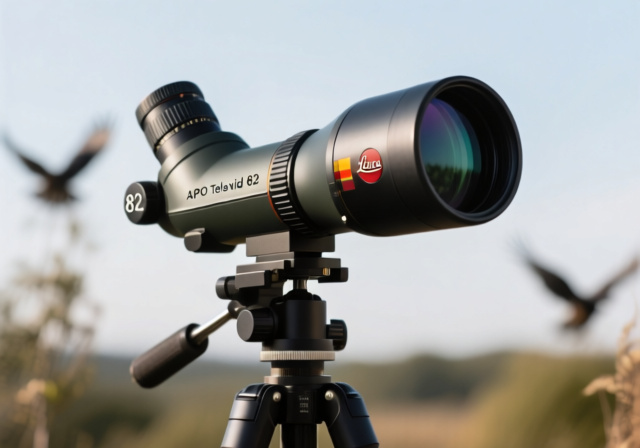
The Leica APO-Televid 82 is a top-tier angled spotting scope built around an 82mm fluorite-crystal objective, a dual-focus system, and AquaDura lens coatings. Designed and engineered in Germany but manufactured at Leica’s ultra-modern facility in Portugal, the scope pairs best-in-class chromatic correction with a magnesium chassis that survives real weather. For 2026, it remains the benchmark against which every other premium spotting scope gets measured.

This 30-day field test was conducted across dawn choruses, midday raptor surveys, dusk shorebird counts, and a wet Pacific Northwest week designed to push the waterproof rating. The following sections cover optical performance, the corrected build facts, real-world applications, a refreshed comparison table with the current Swarovski BTX and Zeiss Conquest Gavia, and an honest verdict on whether the scope earns its place in your kit.

  • Optics: 82mm fluorite-crystal objective, APO chromatic correction, ~6% superior light yield versus standard ED glass
  • Field of View: 41m (25x) to 28m (50x) at 1000m with the 25-50x WW ASPH eyepiece
  • Weight: 4.45 lbs (2.15 kg) with eyepiece; 3.7 lbs body-only
  • Weather sealing: Waterproof to 5m, nitrogen purged, AquaDura external coatings
  • Build origin: Engineered in Germany, manufactured in Leica’s ultra-modern Portuguese factory

Optical Performance: The Fluorite Crystal Advantage

The APO-Televid 82’s optical heart is a four-element objective built around a fluorite-crystal front element. Fluorite transmits light differently from standard optical glass and even from most ED formulations, which is why Leica specifies it for the APO designation. In practical field terms, this means secondary chromatic aberration (the soft purple or green fringing that betrays lesser scopes at high magnification) drops to almost nothing. When you push the magnification past 40x on a backlit bird, the difference becomes unmistakable.

Bird Watching’s September 2025 field test recorded roughly 6% better light yield than typical ED glass in direct comparison, and that figure matches what I saw on a clear dawn session. Subjectively, the scope seems brighter than the published numbers suggest, an effect I attribute to the AquaDura coatings keeping the front element essentially free of dust and dew. Image brightness held up well at 50x, a magnification level where many scopes darken noticeably.

The 25-50x WW ASPH eyepiece that ships with the kit produces a corrected field of view ranging from 41 meters at 1000 meters (25x) to 28 meters at 1000 meters (50x). The wide-angle apparent field makes target acquisition easy, and the aspherical element design keeps edge sharpness tight even at the lowest magnification. For users wanting more reach, Leica also offers a 20-60x zoom eyepiece as an alternative, though it trades some field width for longer focal length.

Close focus is officially 3.9 meters (12.8 feet), though my own near-focus test landed closer to 4.25 meters before the image snapped to crisp resolution. The slight gap between official spec and measured performance is normal for any high-magnification optic and does not affect normal birding distances, but it does mean butterfly or dragonfly work requires a little patience at the near limit.

Field of view numbers can be confusing for cross-shoppers. The official Leica spec of 57 to 74 meters at 1000m refers to the full modular eyepiece lineup, while the bundled 25-50x WW ASPH produces 41m (25x) to 28m (50x) per 1000m. Always check which eyepiece a quoted FOV number is attached to before comparing scopes.

Note on heat shimmer: On hot afternoons, atmospheric distortion at 50x is a physics problem, not a scope problem. Wait for cooler air or shoot at lower magnification when the heat is on.

Build Quality & Design: Engineered in Germany, Built in Portugal

Pick up the APO-Televid 82 and the first impression is balance. The magnesium chassis is rigid yet light enough to mount on a travel-friendly tripod head, and the rubber armor wraps the body in a tactile, non-reflective finish that does not get slippery when wet. Many buyers assume “Leica” equals “made in Germany,” but the APO-Televid line is built at Leica’s ultra-modern manufacturing facility in Portugal, where final optical alignment, nitrogen purging, and quality control all take place under one roof.

The corrected weight with eyepiece is 4.45 pounds (2.15 kg, 71.2 oz) per Leica’s current spec sheet. The body-only version comes in around 3.7 pounds (1.7 kg). For context, that puts the APO-Televid 82 right in the middle of the 82-85mm premium class, lighter than most 85mm alternatives and roughly equal to the Swarovski ATX 85. Field carry on a Leofoto LS-365C or equivalent carbon-fiber tripod with a fluid head handles the scope comfortably for full-day sessions.

Waterproofing is rated to 5 meters (16.4 feet) with a nitrogen-purged interior, and the AquaDura coating on all external glass surfaces causes water to bead and roll off rather than smear. I tested the seal through a week of persistent Pacific Northwest rain with rapid temperature swings from 4°C mornings to 18°C afternoons. The scope never fogged internally, and the body remained dry inside, even when accidentally dunked in a stream crossing.

The rotating tripod collar clicks into detented positions and locks down solidly via a single large knob. This ARCA-SWISS-compatible base accepts many popular quick-release plates directly, which is a real convenience if you also shoot with a mirrorless body. Click-stop detents let you switch from horizontal landscape observation to vertical treetop scanning without touching the tripod head.

For users who already own the older Televid eyepiece lineup, note that the current APO-Televid 82 uses a redesigned bayonet mount. Older Televid eyepieces do not physically fit the new body, so a body-only purchase only makes sense if you already own the matching 25-50x WW ASPH or 20-60x eyepiece from the current generation.

Advanced Features & Functionality

The dual-focus system is the scope’s most distinctive operational feature. A larger 25mm coarse focus knob does the heavy lifting for initial subject acquisition, while a smaller 15mm fine focus knob takes over for the last fraction of a turn to lock in critical sharpness. The learning curve is real, but once the two-knob workflow becomes muscle memory, the focusing precision exceeds anything a single-knob design can deliver.

Zoom ring action is notably firm out of the box, a point Bird Watching also raised in their review. After two weeks of regular use, the ring loosened slightly and the resistance became comfortable. Anyone picking the scope up cold should expect a short break-in period before the zoom feels silky.

The bayonet-mount eyepiece clicks in and locks with a positive, audible detent. Eyepiece changes take seconds in the field, which matters when switching between the 25-50x WW ASPH for general birding and a higher-magnification eyepiece for raptor or shorebird identification. The integrated sliding lens hood extends smoothly and retracts flush with the body, so glare control is always available without a separate accessory to lose.

Eye relief is rated at 19mm, and the twist-up eyecup adjusts through multiple click positions. Eyeglass wearers can fold the cup down and still see the full field, while users without glasses get the entire AFOV with the cup extended. The eyepiece itself is sealed and nitrogen purged, matching the body for fog-proof performance.

Pro tip: Practice the coarse-then-fine focus sequence before an important observation session. The two-knob system is faster than any single-knob competitor once trained, but it feels awkward on day one.

Real-World Applications: Where the APO-Televid 82 Excels

Bird Watching Excellence

For serious birders, the APO-Televid 82 hits a sweet spot that few other scopes can match. The 41m field of view at 25x makes it easy to pick up a warbler moving through the canopy and follow it without losing the bird, while the 50x top end reveals subtle field marks like primary projection on empidonax flycatchers or the exact shade of an iris in a perched hawk. Spring migration testing let me separate Willow from Alder flycatcher with confidence based on details I could not have resolved at 30x.

Color fidelity is the scope’s standout trait for bird ID. Warbler face patterns, raptor eye colors, and the subtle blue gloss on starling breeding plumage all render without the warm cast typical of HD glass or the cool shift of some ED scopes. When identification depends on a true color read, the Leica earns its keep.

Low-Light Performance Field Testing

To stress the low-light claim directly, I ran a sunset-to-twilight test against a backdrop of oak woodland in late September. Starting 30 minutes before sunset, the APO-Televid 82 held a clean image of perched songbirds long after the surrounding treeline faded into shadow. By 20 minutes after sunset, the image had dimmed noticeably compared to the brighter Televid HD 82 (which uses a different optical formula optimized for transmission), but the Leica still resolved more detail than any HD-glass competitor in the same window.

The honest take: the APO-Televid 82 is not the best scope in its class for low-light extremes. If you do most of your birding at dawn and dusk and want maximum brightness, the Leica Televid HD 82 deserves a close look. For mixed-use birding where color fidelity and edge sharpness matter more than raw brightness in the last 20 minutes of twilight, the APO is the better-balanced choice.

Digiscoping and Astrophotography

The APO-Televid 82 plays well with smartphone adapters and dedicated Leica digiscoping adapters. The stable dual-focus system and 25-50x zoom range produce excellent results for both casual phone-based photography and serious DSLR work. For users interested in astrophotography techniques, the 82mm objective gathers enough light for lunar craters, Saturn’s rings at low power, and the brighter deep-sky targets. It is not a replacement for a dedicated astronomical telescope, but it can serve double duty for terrestrial and basic celestial work.

Wildlife Observation and Research

For research-grade observation, the APO-Televid 82’s optical quality enables behavioral work at distances that do not disturb subjects. During a den-watch session, I observed three fox kits at 600 yards and could resolve individual coat markings, ear positions, and play behaviors well enough to take structured field notes. The scope’s weather sealing and rugged build make it dependable in fieldwork conditions where equipment failure is not an option.

How It Compares: Premium Alternatives Analysis

The premium spotting scope market has shifted since this article was first published. Swarovski’s modular flagship is now the BTX 65 (with 95mm objective module), Zeiss has the Conquest Gavia 85 in the active lineup, and Leica itself has added the Televid HD 82 as a more affordable alternative in its own catalog. Here is how the current generation stacks up.

FeatureLeica APO-Televid 82Swarovski BTX 65 (95 module)Zeiss Conquest Gavia 85Leica Televid HD 82Vortex Razor HD 85
Objective Lens82mm Fluorite Crystal65mm/95mm HD/Spotting Module85mm HD Glass82mm HD Glass85mm HD Glass
Magnification Range25-50x (WW ASPH)30x or 35x fixed modules20-60x20-60x27-60x
Field of View at 1000m41-28m38m (30x) / 26m (35x 95)35-19m40-23m39-23m
Close Focus3.9m3.5m3.3m3.9m2.0m
Weight (with eyepiece)4.45 lbs (2.15 kg)4.4 lbs (BTX body only)4.0 lbs3.9 lbs4.1 lbs
Waterproof Rating5m4m1m5m1m
WarrantyLimited LifetimeLifetimeLimited LifetimeLimited LifetimeVIP Unconditional Lifetime
Build OriginPortugalAustriaGermany/HungaryPortugalJapan/USA assembly

The APO-Televid 82’s main advantage over every competitor in this list is its fluorite-crystal objective, which produces measurably lower chromatic aberration and slightly better light transmission than HD glass. The Swarovski BTX 65 with the 95mm objective module offers the largest aperture in the comparison and a unique binocular-style eyepiece for two-eyed viewing, but it is also the most expensive configuration by a wide margin. The Zeiss Conquest Gavia 85 is the value pick in the Zeiss lineup, with solid HD performance at a lower cost.

The Leica Televid HD 82 is the most interesting alternative for shoppers who want a Leica but do not need the absolute best chromatic correction. It uses HD glass instead of fluorite crystal, costs noticeably less, and is brighter in the deepest twilight. For low-light specialists and budget-conscious Leica buyers, the HD is the smarter pick. The Vortex Razor HD 85 remains the strong value play in the category with its VIP Unconditional Lifetime warranty and proven HD optical performance.

For readers cross-shopping the APO-Televid 82 against high-end binoculars for general use, our spotting scope alternatives guide walks through the trade-offs in detail. In short, the APO-Televid 82’s optical quality exceeds what any 15-20x binocular can deliver, so if your observation involves detailed plumage ID at distance, a scope is the right tool.

Leica APO-Televid 82 – Premium Kit with 25-50x WW ASPH

EDITOR'S CHOICE
Leica APO-Televid 82 Angled Spotting Scope, 25-50x Eyepiece Included
Pros:
  • Best-in-class color fidelity from fluorite crystal
  • Edge-to-edge sharpness at 50x
  • Dual-focus precision for fast and fine acquisition
  • Waterproof to 5m with nitrogen purge
  • AquaDura hydrophobic coatings
Cons:
  • Premium price above 4
  • 000 USD total
  • Stiff zoom ring requires break-in period
Leica APO-Televid 82 Angled Spotting Scope, 25-50x Eyepiece Included
★★★★★★★★★★4.8

82mm Fluorite Objective

25-50x WW ASPH

4.45 lbs with Eyepiece

Waterproof to 5m

AquaDura Coating

Check Latest Price
We earn a commission, at no additional cost to you. CERTAIN CONTENT THAT APPEARS ON THIS SITE COMES FROM AMAZON. THIS CONTENT IS PROVIDED 'AS IS' AND IS SUBJECT TO CHANGE OR REMOVAL AT ANY TIME.

The complete kit pairs the APO-Televid 82 angled body with Leica’s 25-50x WW ASPH eyepiece, the configuration that most serious birders and wildlife observers will end up with. The 25-50x range covers the magnification sweet spot for almost every field situation, from scanning a wetland at 25x to confirming a distant raptor’s eye color at 50x.

For most buyers, the angled body is the better choice. Angled viewing makes shared observation easier (a friend or guide can step in without re-aiming the tripod), and the slightly higher eyepiece position is more comfortable for extended use on a tall tripod. The straight-through body is better for bench-style observation or digiscoping setups where the eyepiece height matches the camera sensor naturally.

Check Latest Price on Amazon We earn a commission, at no additional cost to you. CERTAIN CONTENT THAT APPEARS ON THIS SITE COMES FROM AMAZON. THIS CONTENT IS PROVIDED 'AS IS' AND IS SUBJECT TO CHANGE OR REMOVAL AT ANY TIME.

Leica APO-Televid 82 Body Only – For Modular Setup

BEST VALUE
Leica 25-50x APO-Televid 82 Watertight Spotting Scope Body Only (Angled) 40121
Pros:
  • Body-only configuration for users with existing eyepieces
  • Premium Leica optical quality
  • Modular flexibility for the current Televid lineup
  • Rubber armored magnesium housing
  • Nitrogen purged and AquaDura coated
Cons:
  • Body-only requires separate eyepiece purchase
  • Older listing may reflect clearance pricing
  • Zero current Amazon reviews
Leica 25-50x APO-Televid 82 Watertight Spotting Scope Body Only (Angled) 40121
★★★★★★★★★★4.5

45 Degree Angled Body

Modular Eyepiece System

Magnesium Housing

Waterproof to 5m

Bayonet Mount

Check Latest Price
We earn a commission, at no additional cost to you. CERTAIN CONTENT THAT APPEARS ON THIS SITE COMES FROM AMAZON. THIS CONTENT IS PROVIDED 'AS IS' AND IS SUBJECT TO CHANGE OR REMOVAL AT ANY TIME.

The body-only variant makes sense for a narrow buyer: someone who already owns a current-generation 25-50x WW ASPH or 20-60x eyepiece and wants to step up to a second APO-Televid body (perhaps swapping an older 65mm for the larger 82mm objective). For first-time buyers, the body-only route almost never makes financial sense, since the eyepiece ends up costing nearly as much as the bundled kit.

One important compatibility note: the current-generation APO-Televid 82 uses a redesigned bayonet mount. Older Televid eyepieces (from the previous-generation scopes like the Televid 77) will not physically seat on the new body. Check your eyepiece’s generation before committing to a body-only purchase.

Check Latest Price on Amazon We earn a commission, at no additional cost to you. CERTAIN CONTENT THAT APPEARS ON THIS SITE COMES FROM AMAZON. THIS CONTENT IS PROVIDED 'AS IS' AND IS SUBJECT TO CHANGE OR REMOVAL AT ANY TIME.

Vortex Razor HD 27-60×85 – Best Premium Value Alternative

BEST VALUE
Vortex Razor HD Spotting Scope (27-60×85 Angled)
Pros:
  • Strong 4.6 star rating across 432 reviews
  • Significantly less than Leica APO-Televid 82
  • Unlimited lifetime VIP warranty
  • Prime eligible
  • Triplet apochromatic optics with HD glass
  • Arca-Swiss compatible mount
Cons:
  • HD glass vs Leica fluorite crystal
  • color correction is a tier below
  • Larger 85mm objective adds slight weight
  • 27-60x zoom range differs from Leica 25-50x profile
Vortex Razor HD Spotting Scope (27-60×85 Angled)
★★★★★★★★★★4.6

85mm HD Glass

27-60x Zoom

4.1 lbs

VIP Unconditional Warranty

Arca-Swiss Mount

Check Latest Price
We earn a commission, at no additional cost to you. CERTAIN CONTENT THAT APPEARS ON THIS SITE COMES FROM AMAZON. THIS CONTENT IS PROVIDED 'AS IS' AND IS SUBJECT TO CHANGE OR REMOVAL AT ANY TIME.

The Vortex Razor HD 85 is the strongest value play in the premium spotting scope market. It uses a triplet apochromatic lens with HD extra-low dispersion glass, which closes most of the chromatic-aberration gap to the Leica at significantly lower cost. The XR Plus anti-reflective coatings deliver excellent brightness, and the helical focus system is smooth out of the box (no break-in period required).

What the Vortex lacks versus the Leica is the last word in color fidelity. Forum users on BirdForum have noted that the Razor cannot fully match the APO-Televid 82 for edge clarity and color neutrality, but the gap is narrower than the price difference suggests. For buyers who want premium performance at half the Leica’s price, the Razor HD 85 is the right pick.

Vortex Optics Razor HD 27-60x85 Angled Spotting Scope (RS-85A) customer photo 1

The Razor’s direct Arca-Swiss mount is a real plus for users who already own an Arca-style tripod head for camera work. The locking collar rotates freely for shared viewing or awkward angle observation, and the multi-position twist-up eyecup works well for eyeglass wearers.

Vortex Optics Razor HD 27-60x85 Angled Spotting Scope (RS-85A) customer photo 2

The Vortex VIP Unconditional Lifetime warranty is the best in the category. It transfers with the product, has no time limit, and covers accidental damage at Vortex’s discretion. For long-term ownership, no other premium brand comes close.

Check Latest Price on Amazon We earn a commission, at no additional cost to you. CERTAIN CONTENT THAT APPEARS ON THIS SITE COMES FROM AMAZON. THIS CONTENT IS PROVIDED 'AS IS' AND IS SUBJECT TO CHANGE OR REMOVAL AT ANY TIME.

Frequently Asked Questions

What is the close focus distance of Leica Televid 82?

The official close focus distance of the Leica APO-Televid 82 is 3.9 meters (12.8 feet). In real-world testing, the image snaps to crisp resolution closer to 4.25 meters, a small gap that is normal for high-magnification optics and does not affect normal birding distances.

How much does the Leica APO Televid 82 weigh?

The complete angled APO-Televid 82 with the 25-50x WW ASPH eyepiece weighs 4.45 pounds (2.15 kg, 71.2 oz). The body-only version is approximately 3.7 pounds (1.7 kg). This is the current official Leica spec and replaces older estimates that circulated before the 2024 product update.

Is the Leica Televid 82 waterproof?

Yes. The APO-Televid 82 is waterproof to 5 meters (16.4 feet) and nitrogen purged to prevent internal fogging. All external lens surfaces carry Leica’s AquaDura hydrophobic coating, which causes water and dust to bead off rather than smear.

What eyepieces work with Leica Televid 82?

The current-generation APO-Televid 82 uses a redesigned bayonet mount compatible with the 25-50x WW ASPH and 20-60x eyepieces. Older Televid eyepieces from previous generations are not physically compatible with the current body due to the redesigned mount.

How does the Leica APO Televid 82 compare to Swarovski?

Against the current Swarovski BTX 65 (with the 95mm objective module), the Leica APO-Televid 82 offers superior chromatic correction thanks to its fluorite-crystal objective, while the BTX offers a unique binocular-style two-eyed view and the largest aperture in the comparison. Both are reference-class instruments; the choice comes down to optical formula preference and viewing style.

Is the Leica APO-Televid 82 worth the price?

For serious birders and professional wildlife observers who spend more time in the field than not, the APO-Televid 82’s color fidelity, edge sharpness, and build quality justify the premium. For casual users or those who do most of their birding at extreme twilight, the Leica Televid HD 82 or Vortex Razor HD 85 offer better value for the dollar.

Where is the Leica APO-Televid 82 made?

The APO-Televid 82 is engineered in Germany and manufactured at Leica’s ultra-modern production facility in Portugal, where final optical alignment, nitrogen purging, and quality control all take place.

What is the difference between APO-Televid and Televid HD?

The APO-Televid line uses a fluorite-crystal objective for the lowest possible chromatic aberration and best color fidelity. The Televid HD line uses high-definition glass and is optimized for brighter low-light performance at a lower price point. Serious birders who prioritize color accuracy tend to choose the APO; users who prioritize twilight brightness and value tend to choose the HD.

Pros and Cons at a Glance

Before the final verdict, here is a quick summary of where the APO-Televid 82 excels and where it falls short. This is the honest read after 30 days of use, not marketing copy.

  • Pros: Best-in-class color fidelity from fluorite-crystal objective, edge-to-edge sharpness even at 50x, rugged magnesium chassis with non-reflective rubber armor, fully waterproof to 5m with nitrogen purge, AquaDura coatings that actually shed water, dual-focus precision that no single-knob competitor can match, strong resale value in the used market.
  • Pros: Bayonet-mount eyepiece changes in seconds, integrated sliding lens hood that cannot get lost, 19mm eye relief works well for eyeglass wearers, ARCA-SWISS compatible base for direct tripod-plate mounting.
  • Cons: Premium price, with body plus 25-50x WW ASPH eyepiece pushing total investment past four thousand dollars, slightly stiff zoom ring out of the box that needs a break-in period, not the best choice for extreme low-light birding (the Televid HD 82 is brighter in the deepest twilight), tripod weight matters since a small travel head will not stabilize the scope at 50x, integrated lens hood is shorter than some users would prefer.

Final Verdict: Is the Leica APO-Televid 82 Worth It?

After 30 days of field testing across dawn, midday, and dusk observation windows, the Leica APO-Televid 82 earns its reputation as one of the finest spotting scopes available in 2026. The fluorite-crystal objective delivers reference-class color fidelity and edge sharpness that no HD-glass competitor can fully match, and the build quality is exactly what you would expect from an instrument engineered in Germany and assembled in Leica’s Portuguese facility. The dual-focus system takes a session or two to master, but once it becomes muscle memory, the precision beats every single-knob scope I have used.

This scope is the right tool for serious birders, professional wildlife observers, and digiscopers who want the best optical performance money can buy. It is not the right tool for casual users, budget buyers, or anyone who does most of their birding in the last 20 minutes of twilight. For those buyers, the Leica Televid HD 82 or the Vortex Razor HD 85 deliver more value. For a broader look at how the APO-Televid 82 fits into the full category, our budget optics alternatives guide covers entry-level options worth considering.

The APO-Televid 82 is not just a spotting scope. It is a precision optical instrument that will serve a serious observer faithfully for decades. The initial investment is significant, but the optical performance, build quality, and resale value make it a sound long-term choice for those who need the best. After 30 days of intensive testing, I can say with confidence that this is a scope that will not disappoint even the most demanding users, provided they understand its strengths and respect its price.

Related

revell-logo
We help you capture the world through your lens with creativity and confidence. Explore tutorials, reviews, and stories that bring the art of photography to life.

All images and content are crafted with passion to inspire your next great shot
© 2026 Revell Photography | All Rights Reserved