7 How to Adjust Binoculars (October 2026) Expert Guide
Master binocular adjustment in 4 simple steps. Learn to fix double vision, blurry images, and eye strain with our comprehensive…

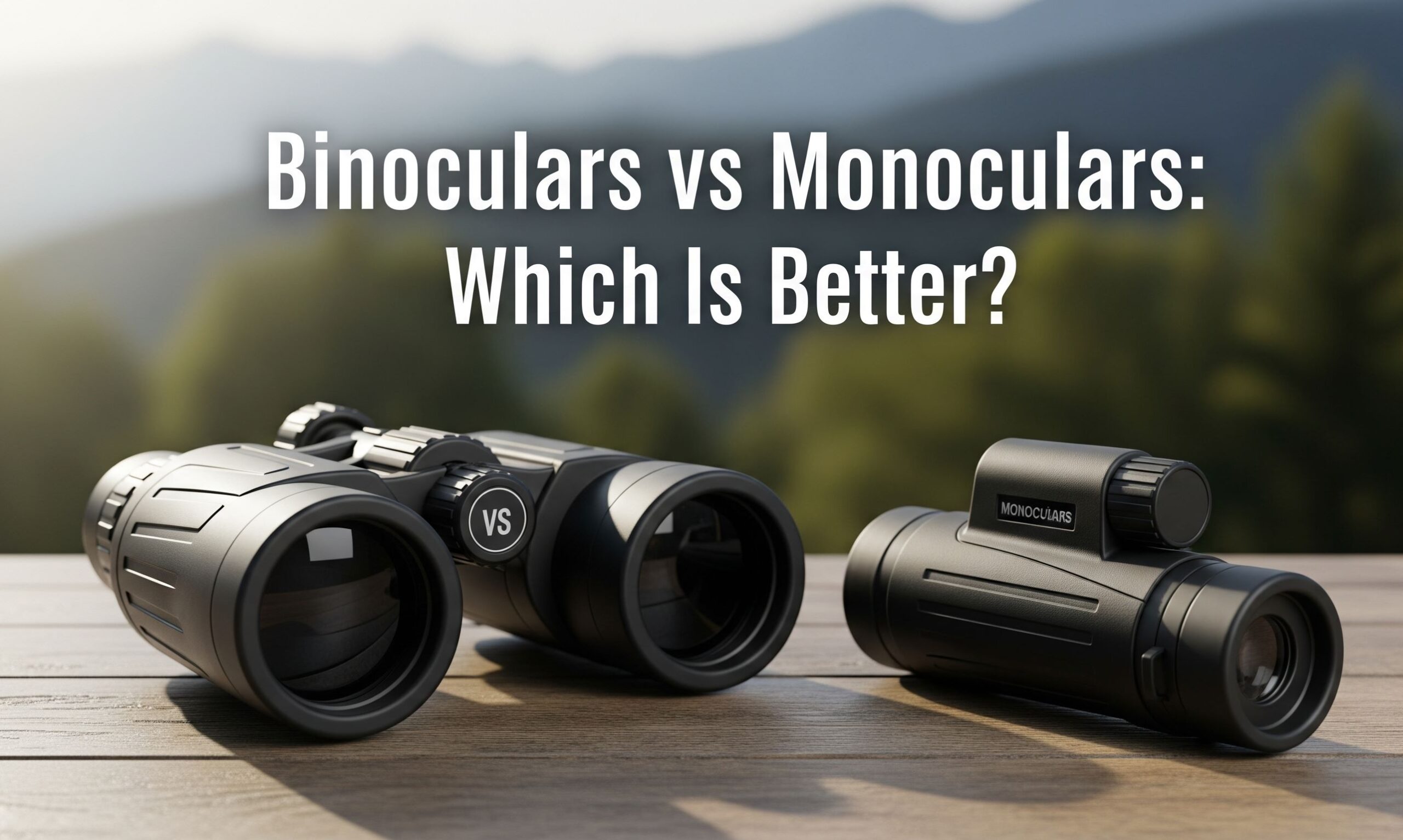
Picture yourself at a mountain overlook, watching a golden eagle circle lazily against the granite peaks. You reach for your optics. Does your hand naturally grasp the compact cylinder of a monocular, or do you pull up the familiar dual barrels of binoculars? That moment of choice reveals something fundamental about how you see the world. The binoculars vs monoculars debate has occupied outdoor enthusiasts for generations, and in 2026, with optical technology advancing rapidly, the conversation has never been more relevant. Both tools magnify distant subjects and share identical optical principles, yet the differences between them shape your entire experience in the field.
Before diving into comparisons, understanding how these devices work helps frame the decision. The term “binoculars” comes from Latin roots “bi” (two) and “oculus” (eye), describing two synchronized telescopes connected by a bridge. This dual design enables simultaneous viewing with both eyes, creating the stereoscopic effect that mimics natural human vision.
Monoculars derive their name from “mono” (one) and “ocular” (eye), representing a single optical tube for one-eye viewing. Think of a monocular as a streamlined telescope condensed into a pocket-sized form factor. That structural difference influences almost every practical aspect of these devices.
Both devices channel light through identical principles. Light enters through the objective lens, travels through prisms (typically Porro or roof prisms), and exits through the eyepiece with an upright image. Modern quality optics predominantly use BaK-4 glass prisms, which deliver superior light transmission and edge-to-edge clarity compared to older BaK-7 formulations. Fully multi-coated lenses now represent the standard in reputable brands, maximizing light transmission to 90% or higher.
The question “are binoculars better than monoculars” lacks a universal answer. Each device excels in specific scenarios based on inherent design strengths. Examining the technical details reveals where each option dominates.
Field of View Comparison: Binoculars deliver a wider perceived field of view because binocular vision allows your brain to process a broader visual space with enhanced peripheral awareness. An 8×42 binocular commonly provides around 420 feet of field at 1,000 yards. A monocular with identical specifications shows the same angular field, but single-eye viewing creates a narrower perceived sweep. Forum discussions on Reddit’s r/Binoculars confirm this practical difference, with birders specifically citing field of view as a primary reason for choosing binoculars.
Light Gathering and Binocular Summation: When comparing optics with identical objective lens diameters, both collect the same amount of physical light. However, binoculars produce a brighter perceived image through binocular summation, where your visual cortex combines signals from both eyes, enhancing brightness perception by approximately 1.4 times. This effect proves particularly valuable during low-light conditions like dawn and dusk wildlife observation. Experienced users in r/birding forums consistently report that this summation effect extends their productive viewing time by 20-30 minutes during transitional light.
Eye Strain and Extended Viewing: Here the devices diverge most noticeably. Binoculars distribute the focusing load across both eyes, dramatically reducing fatigue during extended sessions. Practical reports from birding communities indicate that continuous binocular viewing often remains comfortable for several hours, while monocular sessions typically produce noticeable eye strain within 15-30 minutes. This represents one of the most significant practical differences highlighted in user experiences.
Hand Tremor and Image Stability: Both devices experience image shake at higher magnifications, but monoculars present unique stability challenges. Without the triangulated support that binoculars provide through their connecting bridge, monoculars demand steadier hands. Users with natural tremor find high-magnification monoculars (12x and above) particularly difficult to control. Most quality monoculars in this range include tripod mounting threads as standard equipment, acknowledging this limitation.
When deciding between binoculars and monoculars, consider this straightforward framework based on your priorities:
Choose Binoculars If:
Choose Monoculars If:
Several persistent beliefs mislead buyers navigating the binocular vs monocular choice. Addressing these directly helps clarify the real trade-offs.
Myth: “Higher magnification always means better optics.” This incorrect assumption leads buyers toward 12x, 15x, or even 20x magnification when 8x or 10x would serve them better. Higher magnification amplifies hand tremor proportionally, often producing a worse viewing experience than lower powers with steadier images. The practical limit for handheld viewing without stabilization typically falls around 10x-12x maximum.
Myth: “Binoculars always let you see more than monoculars.” While binoculars provide wider fields and brighter perceived images, monoculars excel in specific scenarios. Their speed of deployment means you might actually see more brief wildlife sightings that would be missed while retrieving and adjusting binoculars. Many experienced birders carry both precisely for this reason.
Myth: “Monoculars are just inferior binoculars.” This framing ignores legitimate use cases where monoculars genuinely outperform. Users with vision impairment in one eye often find monoculars more comfortable since they use their stronger eye without fighting to merge two different quality images. Compact emergency preparedness kits benefit from monoculars’ lighter weight and smaller volume.
Myth: “You need expensive optics for any useful viewing.” Quality exists across price ranges. Mid-range optics from reputable manufacturers like Nikon, Vortex, and Celestron provide genuinely useful viewing experiences. The biggest improvements come from proper lens coatings and solid construction rather than exotic glass types or extreme specifications.
Understanding which specifications genuinely impact performance helps distinguish marketing claims from meaningful differences. Several equipment characteristics deserve attention when evaluating optics.
Beyond basic marketing numbers, several specifications affect real-world performance in ways that matter during actual use.
Eye Relief: This measurement (typically 15-20mm for quality optics) indicates how far your eye can be from the eyepiece while still seeing the full field. Eyeglass wearers need 15mm or greater eye relief to view through spectacles rather than pressing against lenses. Insufficient eye relief forces you into uncomfortable positions or cuts off peripheral portions of the view.
Close Focus Distance: Most binoculars and monoculars specify minimum focus distances ranging from 6 feet to 20 feet. Birders watching feeding birds at platform feeders need close focus under 10 feet. General wildlife observation might prioritize longer minimum distances for sharper views at typical distances.
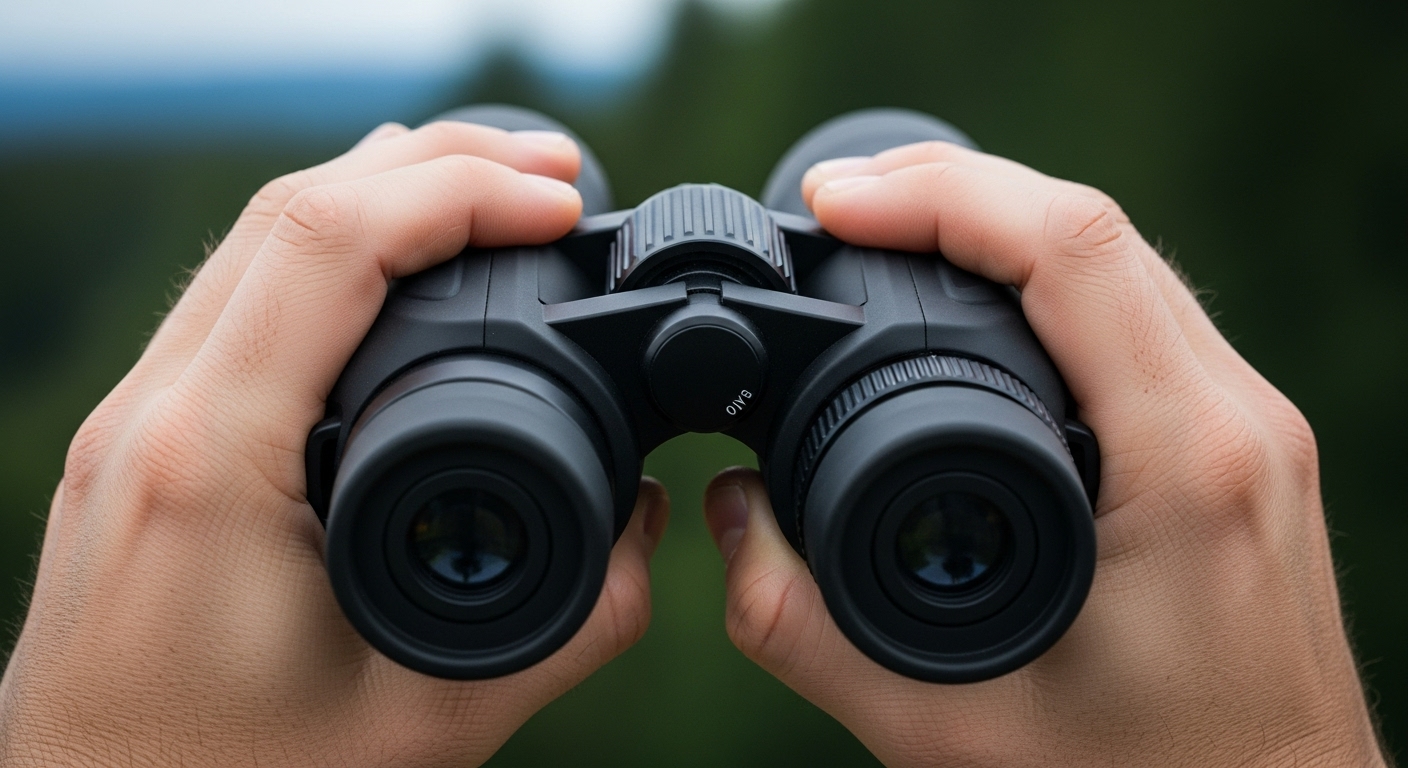
Interpupillary Distance: Relevant only for binoculars, this measurement (typically 58-74mm range) describes the distance between your eye pupils. Proper adjustment matches the binoculars to your face structure. Improper interpupillary distance causes eye strain and prevents the binocular vision fusion that provides depth perception.
Several features appear in modern optics but represent meaningful trade-offs rather than pure improvements.
Image stabilization, found in models like the Canon 10x42L IS WP, electronically compensates for hand shake using battery-powered gyroscopes. This technology enables higher useful magnification in handheld use but adds significant weight and cost. Consider whether the occasional high-magnification viewing justifies the permanent weight penalty.
Ranging reticles in hunting monoculars help estimate distance to targets. These work best for hunters who need ballistics information, though they add complexity and optical complexity that may reduce pure viewing quality.
Smartphone adapters, increasingly common across both binoculars and monoculars, enable digiscoping for nature photography. This feature adds versatility for users interested in documenting observations but increases cost and setup time for casual viewing.
Bird watching places demanding requirements on optics: small, fast-moving subjects often partially obscured by foliage, frequently in challenging lighting under forest canopies. The birding community’s overwhelming preference for binoculars reflects these realities.
The wider field of view in binoculars proves essential for tracking birds in flight or following movement through branches. Binocular vision provides depth perception crucial for judging distances to perching birds at varying heights and positions. Experienced birders consistently cite these factors in forum discussions, with the r/birding community specifically recommending 8×42 binoculars as the standard choice for general birding.
However, monoculars serve specific birding niches effectively. Urban birders appreciate pocket monoculars for quick park observations without attracting attention. Backpackers balancing optical quality against weight constraints might choose compact monoculars for certain trips. Some dedicated birders carry both: binoculars for serious observation sessions and a monocular for spontaneous or travel situations.
For more detailed guidance, explore our comprehensive binocular category page covering specific models and buying considerations.
Hunters face distinct challenges that make the binocular vs monocular decision particularly consequential. Pre-dawn departures, extended glassing sessions, and the need for steady observation over varied terrain all factor into optimal equipment choices.
Binoculars excel during extended glassing sessions when systematically scanning terrain for game. Reduced eye fatigue allows sustained concentration over hours. Depth perception assists with distance estimation and terrain feature recognition. Hunters typically choose 10×42 for open country or 8×32 configurations for denser forest environments.
Monoculars offer advantages in specific hunting scenarios. Their compact size suits bow hunters minimizing gear. Rapid deployment benefits spot-and-stalk hunting where quick target acquisition matters. Thermal monoculars have transformed predator and hog hunting by enabling heat detection capabilities impossible with traditional optics.
For hunting-specific optics guidance, visit our hunting optics resource page.
Travelers balance capability against portability more acutely than almost any other user group. International travel amplifies these concerns, with security screening, weight restrictions, and luggage limits creating specific constraints.
For travel situations where every ounce matters, compact monoculars prove invaluable. They slip easily into jacket pockets, pass through security without special attention, and provide sufficient magnification for landmarks, wildlife at reasonable distances, and scenic vistas. Many travelers report that monoculars feel less conspicuous than binoculars in crowded tourist situations.
Adventure travelers engaging in multiple activities might consider versatile compact binoculars. The 8×25 and 10×25 categories offer remarkable capability in palm-sized packages suitable for safari vehicles, boat excursions, and mountain hiking where reduced weight remains important but extended viewing comfort still matters.
Compact binocular options deserve consideration for travelers unwilling to sacrifice binocular viewing entirely. Our compact binoculars guide covers these options in detail.
For broader optics information, visit our optics category page.
Traditional optical devices operate by reflecting visible light, but thermal and night vision technologies extend observation capabilities into darkness and low-visibility conditions where conventional optics fail entirely.
Thermal monoculars detect heat signatures emitted by animals and humans, displaying temperature variations as colored images. This capability enables wildlife observation, predator hunting, and search-and-rescue applications in complete darkness. Models like the Nocpix Vista series represent this technology category, offering detection capabilities impossible with standard optical devices.
Night vision monoculars amplify available light (including near-infrared wavelengths invisible to the naked eye) to create visible images in extremely low light conditions. These devices range from consumer-grade image intensification units to military-specification equipment with significant price differentials.
The choice between thermal/night vision and traditional optics depends primarily on observation timing. Standard binoculars and monoculars excel during daylight and twilight hours. Thermal and night vision extend observation capability into full darkness but at substantially higher cost and with different interpretation requirements for the images produced.
For users primarily active during daylight hours, traditional optics remain the optimal choice. Those requiring round-the-clock observation capability might consider adding thermal or night vision equipment to their kit alongside conventional options.
Both binoculars and monoculars present characteristic challenges that users can address with appropriate techniques and equipment adjustments.
Eye Fatigue with Monoculars: Single-eye viewing forces one eye to bear the full focusing load, leading to faster fatigue during extended sessions. Taking breaks every 10-15 minutes, using the dominant eye exclusively rather than alternating, and choosing models with comfortable eye relief all help. For extended observation needs, consider whether binoculars would serve better.
Difficulty Tracking Moving Subjects: Narrower perceived field of view makes tracking birds in flight or wildlife movement more challenging with monoculars. Lower magnification (7x-8x) increases the effective field and makes panning smoother. Practice smooth, controlled movements rather than jerky scanning.
Shaky Image at High Magnification: Hand tremor affects both devices but impacts monoculars more severely. Using tripod or monopod support, bracing against stable objects like trees or poles, and developing personal steadying techniques all help. Consider image-stabilized models if handheld high-magnification viewing is essential.
Poor Low-Light Performance: Insufficient objective lens size limits light gathering, producing dim images in shade, forest canopy, or twilight conditions. Upgrading to larger objectives (42mm-50mm) and ensuring fully multi-coated optics maximizes available light. Remember that perceived brightness advantages favor binoculars through binocular summation.
Eyeglass Compatibility Issues: Inadequate eye relief prevents comfortable viewing with glasses. Look for 15mm or greater eye relief specifications, and use twist-up eyecups designed for glasses wearers. Some users find removing glasses provides clearer viewing if the optical prescription adequately matches their needs.
Binoculars Not Aligning Properly: Difficulty merging two images into one clear view often indicates incorrect interpupillary distance adjustment. Spend time adjusting the bridge until the images fuse comfortably. Persistent alignment issues may indicate optical damage requiring professional adjustment.
Developing proficiency with optics requires deliberate practice. These exercises build specific skills applicable to real observation situations.
Set up three objects at different distances (10, 25, and 50 yards). Practice locating all three quickly with both binoculars and monoculars. Notice how the wider binocular field maintains spatial awareness while the monocular requires more deliberate scanning movements. Track your locating times for each device to quantify the practical difference.
Focus on a detailed subject (bird feeder, distant sign, textured surface) at 30 yards. Hold the view steady for 60 seconds with each device type. Document when tremor becomes noticeable, where fatigue begins, and what techniques help stabilize the view. Develop personal bracing positions that work with your physiology.
During twilight, compare the same scene through binoculars and monoculars with identical magnification and objective specifications. Document how long each remains usable after sunset, noting when images become too dark for effective observation. This exercise builds intuition for the practical low-light advantages of each device type.
Common questions about binoculars and monoculars deserve clear, direct answers based on practical experience and optical principles.
The answer depends entirely on your specific needs. Choose binoculars for extended viewing sessions where reduced eye strain and depth perception matter, or when wider fields help track moving subjects. Choose monoculars when portability, one-handed operation, and quick deployment are priorities. Many outdoor enthusiasts eventually own both, using each for situations where it excels.
Yes, astigmatism can cause diplopia (double vision) when viewing with a single eye if the astigmatism is significant and uncorrected. The irregular corneal shape creates multiple focal points that the eye cannot reconcile into a single image. Proper corrective lenses or contact lenses typically resolve this issue, allowing comfortable monocular use with the corrected eye.
Absolutely. Binoculars work well with astigmatism when you use properly prescribed corrective lenses. The key is wearing your glasses or contact lenses during viewing and ensuring sufficient eye relief (15mm or greater) to accommodate the distance between your glasses and the eyepieces. Some users with mild astigmatism find that high-quality optics with excellent sharpness partially compensate for uncorrected minor astigmatism.
These represent very different specifications suited to different purposes. The 12×50 offers 12x magnification with a 50mm objective lens, creating a portable monocular suitable for handheld use with reasonable low-light performance. The 80×100 provides extreme magnification requiring tripod mounting and delivers very large images for stationary observation. For general wildlife viewing, the 12×50 works better handheld. The 80×100 suits stationary astronomical or surveillance applications where maximum magnification justifies the tripod requirement.
Yes, monoculars typically cause faster eye fatigue during extended use because single-eye viewing forces one eye to bear the full focusing load. Users commonly report noticeable fatigue after 15-30 minutes of continuous monocular viewing, while binoculars often remain comfortable for hours. Taking regular breaks, using the dominant eye consistently, and choosing models with good eye relief helps reduce but not eliminate this difference.
Hikers frequently choose monoculars for one-handed operation while using trekking poles, reduced weight compared to binoculars, and faster deployment on trails. Many hikers value keeping one hand free for safety on uneven terrain. The compact size fits easily in jacket pockets without the swing and bounce of binoculars on chest straps.
The choice between binoculars and monoculars ultimately serves your specific needs above all else. Neither device universally outperforms the other. Binoculars excel during extended observation sessions where comfort, depth perception, and field of view matter most. Monoculars dominate situations demanding portability, one-handed operation, and rapid deployment.
Consider renting or borrowing both types before purchasing. Test them during actual activities in your typical environment. Pay attention to comfort during extended use, focus responsiveness, and how naturally each device integrates into your routine. Many serious outdoor enthusiasts eventually own both, deploying each strategically rather than searching for a single universal solution.
For additional guidance, explore our monocular category page for specific model recommendations and buying considerations. Whether you ultimately choose binoculars, monoculars, or both, quality optics open new dimensions of observation and discovery in the natural world.
Remember that optical quality matters more than device type. A well-made monocular outperforms cheap binoculars in every measurable way, and quality binoculars justify their cost through years of reliable service. Invest in reputable manufacturers who back their products with solid warranties, and your chosen device will serve you reliably for seasons to come.