![Co-Witness Sights Explained: Complete Guide [cy]](https://revellphotography.com/wp-content/uploads/2026/08/featured-update-4760-1787154749578.jpg)
Co-Witness Sights Explained: Complete Guide 2026
Complete guide to co-witness sights: Learn the differences between absolute and lower 1/3 co-witness, proper setup procedures, and common misconceptions…

Anyone shopping for quality binoculars has probably asked the question: where are Vortex binoculars made? This American company has built a reputation for producing reliable optics, but the answer to that question involves a complicated global manufacturing network spanning multiple countries and facilities.
Understanding where your optics come from matters for several reasons. Country of origin can affect pricing, perceived quality, and even the specific optical technologies used in your binoculars. Vortex Optics, despite being headquartered in Wisconsin, manufactures its entire binocular lineup overseas in Asia. This strategy allows the company to offer professional-grade optical performance at price points accessible to hobbyists and professionals alike.
This guide provides a comprehensive look at Vortex binocular manufacturing locations, covering everything from premium Japanese-made models to the truth about current production in China and the Philippines. You’ll also learn about the technical innovations that make Vortex binoculars stand out, including Abbe-Koenig roof prisms, BaK-4 glass, and advanced phase correction coatings that enhance image clarity and color fidelity.
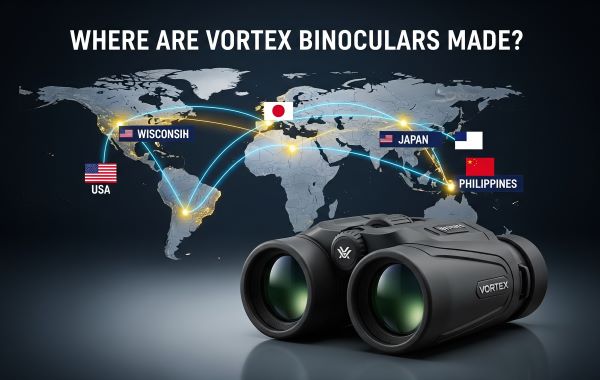
Vortex Optics operates a decentralized manufacturing model, producing binoculars across several Asian countries. Here’s the breakdown by country:
Japan – Premium Razor UHD series exclusively
Philippines – Viper HD series, Kaibab HD, Fury HD, Talon HD, Vulture HD, and some Razor HD models
China – Diamondback HD, Crossfire HD, Vanquish, Bantam HD, Raptor series
Taiwan and Korea – Component manufacturing for various optical elements
No Vortex binoculars are currently manufactured in the United States. The company’s Barneveld, Wisconsin headquarters handles design, engineering, marketing, and customer support, but all binocular production occurs at overseas facilities. This approach reflects industry-standard practice among major optics manufacturers.
The story of Vortex Optics began in 1986 when Dan and Margie Hamilton opened a small retail store called Wild Birds Unlimited in Middleton, Wisconsin. Selling bird feed and quality optics for nature observation, the couple developed firsthand understanding of what outdoor enthusiasts needed from their equipment.
In 2002, the Hamiltons transformed their retail business into Vortex Optics, a full-fledged manufacturer. The company grew rapidly, eventually acquiring Eagle Optics in 2017, which expanded their product portfolio and manufacturing expertise. Today, the Barneveld facility spans 280,000 square feet and employs 300-400 American workers handling design, engineering, quality assurance, marketing, and customer service.
The decision to manufacture overseas rather than domestically came down to economics and expertise. Japan had decades of optical manufacturing experience, particularly in precision optics for cameras and medical equipment. China and later the Philippines offered skilled labor forces and established supply chains for optical components. By leveraging these global capabilities, Vortex could offer competitive pricing while maintaining the quality standards their customers expected.
What sets Vortex apart is their approach to quality control. Japanese engineers supervise manufacturing at all facilities, ensuring consistent standards regardless of location. The famous VIP (Very Important Promise) warranty, which is fully transferable and lifetime, demonstrates the company’s confidence in their manufacturing process.
Understanding the manufacturing origin of specific Vortex models helps you make informed purchasing decisions. This section provides a detailed breakdown of where each product line is produced, based on the most current available information. Note that Vortex occasionally shifts production between facilities, so your specific model’s origin may vary depending on when it was manufactured.
Japan remains the gold standard for optical manufacturing, and Vortex reserves its Japanese facilities for the flagship Razor UHD series. These binoculars represent the pinnacle of Vortex’s optical engineering, featuring the company’s most advanced technologies.
The Razor UHD (Ultra High Definition) series incorporates Abbe-Koenig roof prisms, which provide superior light transmission compared to standard roof prism designs. These precision-engineered prisms minimize light loss and deliver brighter, more color-accurate images. Combined with extra-low dispersion (ED) glass elements, the Razor UHD achieves exceptional edge-to-edge clarity with minimal chromatic aberration.
Japanese manufacturing facilities utilize advanced lens coating technologies including XR (Extended Range) anti-reflective coatings and dielectric prism coatings. These treatments maximize light transmission through the optical path, resulting in brighter images even in low-light conditions such as dawn and dusk wildlife observation.
The premium pricing of Japanese-made models reflects several factors: tighter manufacturing tolerances, higher-quality glass elements, more sophisticated coatings, and the expertise of Japanese optical technicians who have decades of specialized experience. For birdwatchers and wildlife professionals who demand the absolute best optical performance, the Razor UHD justifies its higher price point.
The Philippines has become an increasingly important manufacturing location for Vortex, particularly for mid-range to premium models. Forum discussions and user reports from 2025 indicate that Vortex has shifted significant production to Philippine facilities, including certain Razor HD models that were previously made in Japan or China.
Currently, Philippine facilities produce:
Philippine manufacturing offers a balance between competitive labor costs and quality craftsmanship. The country has developed strong expertise in electronics and precision manufacturing over recent decades. Vortex maintains Japanese engineering oversight at these facilities, with regular visits and remote quality monitoring to ensure consistency with company standards.
The Viper HD series deserves special mention as one of Vortex’s most popular mid-range options. These binoculars feature BaK-4 roof prisms with dielectric coating, fully multi-coated optics using extra-low dispersion glass, and nitrogen-purged waterproof and fog-proof construction. The Philippine-made Viper HD models maintain the same optical performance characteristics as previous versions, just manufactured in a different location.
For the Kaibab HD, Fury HD, Talon HD, and Vulture HD models, buyers can expect similar optical quality to other Vortex products. These series utilize phase correction coatings on the roof prisms, which eliminate the image degradation that occurs when light reflects off parallel surfaces. This technology delivers sharper, higher-contrast images with better color reproduction.
China remains an important manufacturing location for Vortex, particularly for volume-production models that prioritize value over premium positioning. Chinese facilities produce several popular Vortex series including the Diamondback HD, Crossfire HD, Vanquish, Bantam HD, and Raptor lines.
The Diamondback HD series represents one of Vortex’s best-selling binocular lines. These binoculars feature a roof prism design with phase correction coating, fully multi-coated optics using BaK-4 glass, and the same waterproof and fog-proof construction found throughout the Vortex lineup. The value proposition of the Diamondback HD comes from efficient Chinese manufacturing combined with Vortex’s quality control protocols.
Chinese optical manufacturing has evolved significantly over the past two decades. Modern facilities serving brands like Vortex utilize computer-controlled polishing systems, advanced coating technologies, and rigorous inspection protocols. The quality gap between Chinese and Japanese manufacturing has narrowed considerably, particularly for mid-range optical products.
Vortex addresses quality concerns by stationing Japanese engineers at Chinese facilities and implementing comprehensive quality control procedures. Every binocular undergoes optical testing, waterproofing verification, and mechanical function checks before leaving the factory. The VIP warranty covers all products regardless of manufacturing location, demonstrating Vortex’s confidence in their global production standards.
The Crossfire HD series exemplifies Vortex’s approach to the entry-level market. These binoculars don’t sacrifice essential features for price. Users get fully multi-coated optics, waterproof construction, and the lifetime VIP warranty. Chinese manufacturing allows Vortex to offer these features at price points that make quality optics accessible to beginners and casual users.
While Taiwan and Korea don’t serve as final assembly locations for complete Vortex binoculars, both countries play important roles in the optical component supply chain. These nations have established precision manufacturing capabilities that supply specialized optical elements to assembly facilities in other countries.
Taiwanese manufacturers have built strong reputations for producing high-quality lens elements, particularly for consumer electronics and optical devices. Korean facilities contribute specialized components including certain prism designs and mechanical assemblies. This regional supply chain approach allows Vortex to source the best components from multiple specialized manufacturers.
Understanding this component-level manufacturing explains why “Made in” labels can sometimes be confusing. A binocular assembled in the Philippines might contain optical elements from Japan, glass components from Taiwan, and mechanical parts from Korea. This global supply chain is standard practice in the optics industry and reflects the specialized nature of precision optical manufacturing.
The decision to manufacture all binoculars overseas rather than in the United States stems from economic and practical realities that affect the entire optics industry. Understanding these factors helps explain why quality binoculars from any manufacturer typically come from Asian facilities.
Labor costs represent the most obvious factor. Optical manufacturing, particularly assembly and quality inspection, requires skilled workers with specialized training. The labor cost differential between the United States and Asian countries remains substantial, often representing 30-50% of total manufacturing cost for consumer optics.
Beyond labor costs, established expertise matters significantly. Japan has dominated precision optics manufacturing for over a century, starting with camera lenses and expanding into medical devices, scientific instruments, and sporting optics. This expertise created an ecosystem of skilled workers, specialized machinery suppliers, and component manufacturers that took decades to develop. No other region can match this concentrated knowledge base.
China and the Philippines have built their optical manufacturing capabilities more recently, but have invested heavily in automation and training. Modern Chinese facilities serving premium brands utilize the same computer-controlled equipment found in Japanese factories. The difference lies more in accumulated expertise than physical capabilities.
Supply chain logistics also favor overseas manufacturing. Most optical glass comes from a handful of specialized manufacturers, primarily in Japan, Germany, and the United States. Having manufacturing facilities in Asia reduces shipping costs and lead times for these critical materials. Component manufacturers tend to cluster in regions with established optical industries, making Asia the practical choice for final assembly.
Market dynamics also play a role. The binoculars market spans a wide price range from under $100 to over $3000. Vortex competes across multiple segments against established brands including Nikon, Bushnell, Leica, and Swarovski. Offering competitive pricing requires manufacturing efficiency that domestic production can’t achieve at scale.
For more guidance on choosing the right binoculars based on your specific needs and budget, see our comprehensive binocular buying guide.
Vortex’s quality control philosophy centers on a simple premise: manufacturing location shouldn’t determine product quality. The company’s approach combines Japanese engineering expertise, comprehensive testing protocols, and an industry-leading warranty to ensure customer satisfaction regardless of where their binoculars were made.
Japanese engineers play crucial roles at all Vortex manufacturing facilities. These technicians bring decades of accumulated expertise to Chinese and Philippine operations, training local workers and implementing quality control procedures refined over generations of precision optical manufacturing. Their presence ensures that manufacturing standards remain consistent across all locations.
Every Vortex binocular undergoes extensive testing before leaving the factory. Optical testing verifies proper alignment of lens elements, confirms coating performance, and measures light transmission through the entire optical path. Mechanical testing ensures smooth focusing action, reliable hinge performance, and durable eyecup function. Environmental testing verifies waterproofing and fog-proofing by pressurizing binoculars and checking for leaks.
The VIP (Very Important Promise) warranty backs every Vortex product equally, whether it costs $150 or $2500. This unconditional, transferable lifetime warranty covers everything from manufacturing defects to accidental damage. The warranty demonstrates Vortex’s confidence in their quality control processes and provides peace of mind for buyers concerned about manufacturing quality differences between locations.
Customer service and warranty support remain based in Wisconsin, maintaining the company’s American identity despite overseas manufacturing. Users on forums consistently praise Vortex’s responsive customer service and straightforward warranty claims process, which builds trust regardless of where products are manufactured.
Comparing Vortex’s manufacturing approach with competitors reveals industry-standard practices and helps contextualize the company’s global production strategy. The optics industry has become thoroughly globalized, with no major brand manufacturing binoculars entirely domestically.
Nikon – Premium Nikon Monarch HG and EDG models come from Japan, while mid-range products including Monarch and Prostaff series utilize Chinese and Philippine facilities. Nikon’s optical heritage in Japan ensures premium products maintain Japanese quality standards.
Bushnell – Premium Bushnell Elite and Legend series utilize Japanese and Korean manufacturing. Mid-range products come from Chinese facilities with some Philippine production. Bushnell has invested heavily in Chinese manufacturing capabilities over the past decade.
Leupold – American manufacturing for many products including riflescopes and certain binoculars. However, Leupold also utilizes Japanese and Philippine facilities for various product lines. The company maintains more domestic production than competitors, particularly for riflescopes.
Zeiss – Premium Zeiss Victory and Terra models come from Germany and Japan. Entry-level products utilize various Asian facilities. Zeiss maintains strict quality standards regardless of location, similar to Vortex’s approach.
Swarovski – Premium EL and NL series manufactured in Austria with characteristic Swiss precision. However, even Swarovski sources certain components from Asian suppliers. The company’s high-end positioning allows for more domestic production than volume-focused brands.
What emerges from this comparison is that manufacturing location alone doesn’t determine quality. All major brands utilize Asian manufacturing for various product lines while maintaining premium positioning for domestically or Japanese-made products. The key differentiator is how effectively each company implements quality control across their global supply chain.
Several persistent myths about Vortex manufacturing lead to confusion among buyers. Addressing these misconceptions directly helps potential customers make more informed purchasing decisions.
Despite being an American company headquartered in Wisconsin, Vortex currently manufactures zero binoculars domestically. The Barneveld facility handles design, engineering, customer service, and limited assembly of riflescopes and the UH-1 holographic sight, but no binocular production occurs in the United States.
This isn’t unique to Vortex. No major binocular manufacturer produces binoculars in the USA at scale. Even Leupold, which maintains significant American manufacturing, utilizes overseas facilities for many binocular models. The economics of precision optical manufacturing make domestic production challenging except for ultra-premium specialty products.
Vortex has expanded their Wisconsin facility over the years, which some interpreted as a sign of potential domestic binocular manufacturing. However, expansion has focused on engineering, customer service, and non-optical products rather than binocular production. Economic factors and established overseas supply chains make domestic binocular manufacturing unlikely in the foreseeable future.
The label “Assembled in Philippines” or “Made in Philippines” doesn’t indicate inferior quality. Philippine facilities operate under the same Vortex quality control protocols as other manufacturing locations, with Japanese engineering oversight ensuring consistent standards.
Assembly location differs from component origin. Premium optical elements like lenses and prisms might originate in Japan or Taiwan, while final assembly occurs in the Philippines. This approach combines quality components with efficient production, similar to how electronics manufacturers source parts globally before final assembly.
Users who have purchased Philippine-made Vortex products report satisfaction with quality, particularly for the Viper HD and Kaibab HD series. Forum discussions and user reviews indicate no systematic quality differences between Philippine-made products and those from other facilities. The VIP warranty covers all products equally, providing additional reassurance.
The Razor HD production shift generated significant discussion among optics enthusiasts when it occurred. Originally Japanese-made with premium pricing, the Razor HD transitioned to Chinese and subsequently Philippine manufacturing, allowing Vortex to reduce retail prices substantially while maintaining optical performance.
Original Japanese-made Razor HD binoculars retailed for $1,500-1,800. Current models manufactured in Asia retail for $900-1,300, representing significant savings for buyers. Vortex achieved these price reductions through more efficient manufacturing and labor costs while maintaining quality standards through enhanced oversight protocols.
Forum users who have owned both Japanese and Philippine-made Razor HD models report that optical performance remains comparable. The most noticeable differences tend to be in mechanical aspects like focus wheel smoothness rather than optical quality. This suggests that Chinese and Philippine manufacturing capabilities have reached levels sufficient for producing high-quality optics.
Determining your binoculars’ manufacturing origin requires checking specific locations on the product and packaging. Understanding how to read these labels helps verify what you’re purchasing.
Primary locations to check:
Understanding the labels:
“Made in [Country]” indicates complete manufacturing in that location, from components through final assembly. “Assembled in [Country]” means final assembly occurred there while components may have originated elsewhere. Products manufactured before 2024 might show different origins than current production due to Vortex’s shifting supply chain.
Production locations can vary within the same model line over time. A Razor HD purchased in 2023 might show different manufacturing origin than one purchased in 2026, even if purchased from the same retailer. Vortex has progressively shifted production among facilities based on capacity, cost, and quality considerations.
If the label is unclear or you’ve purchased a used binocular without original packaging, contact Vortex customer service with your serial number. They can verify the manufacturing origin and provide documentation if needed for warranty claims.
Several trends will shape Vortex’s manufacturing strategy in coming years, including supply chain diversification, automation advances, and potential reshoring of certain products.
Supply chain diversification has become a priority following global supply chain disruptions experienced in recent years. Vortex’s expansion of Philippine production alongside Chinese manufacturing reflects this strategy. Having multiple manufacturing locations reduces risk from regional disruptions whether caused by natural disasters, political factors, or economic changes.
Automation continues advancing in precision manufacturing, potentially reducing the labor cost advantage that currently favors Asian production. However, optical manufacturing requires significant skilled manual labor for quality inspection and certain assembly tasks that remain difficult to automate. The impact of automation on manufacturing location decisions will depend on how these technologies develop.
Market pressures for “Made in USA” products create potential reshoring opportunities, though economics currently don’t support domestic binocular manufacturing at scale. If labor costs continue converging between Asia and the United States, or if policy changes create incentives for domestic production, Vortex might consider limited domestic manufacturing for premium products.
The expanded Barneveld facility suggests Vortex is prepared to increase certain domestic operations. However, binocular manufacturing requires different equipment and expertise than riflescope assembly or other current domestic activities. Significant investment would be needed to establish domestic binocular production.
For now, Asian manufacturing will remain central to Vortex’s business model. The company’s focus will likely continue emphasizing quality control and engineering oversight rather than manufacturing location. As long as these standards are maintained, the specific origin of Vortex binoculars matters less than the final product quality.
These answers address the most common questions about Vortex binocular manufacturing based on PAA (People Also Ask) results and community discussions.
Vortex Optics designs all products in Wisconsin, with manufacturing partners in Japan, China, and the Philippines producing binoculars under Vortex specifications. The company maintains engineering oversight and quality control at all facilities, ensuring consistent standards regardless of manufacturing location.
Vortex Optics headquarters is located in Barneveld, Wisconsin, USA. The 280,000-square-foot facility houses design, engineering, customer service, marketing, and limited manufacturing operations for riflescopes and other products. All binocular production occurs overseas.
Yes, Chinese-made Vortex binoculars maintain excellent quality through Japanese engineering supervision, strict quality control protocols, and the VIP warranty. Modern Chinese facilities have developed strong optical manufacturing capabilities, and Vortex’s oversight ensures products meet the company’s standards. The optical performance of Chinese-made Vortex binoculars exceeds the requirements of most users.
Japanese-made models like the Razor UHD feature premium components including Abbe-Koenig roof prisms, higher-quality ED glass elements, and more sophisticated multi-layer coatings. Chinese-made models offer excellent value with optical performance sufficient for most users, but with slightly less refined components. The differences are most noticeable in challenging lighting conditions and at the edges of the field of view.
Current Vortex Diamondback HD binoculars are manufactured in China. The Diamondback line represents Vortex’s volume-production series, benefiting from efficient manufacturing capabilities in Chinese facilities. Despite the value positioning, Diamondback HD binoculars include premium features like fully multi-coated optics, BaK-4 prisms with phase correction coating, and waterproof construction.
Counterfeit Vortex optics do exist in the marketplace, though they’re relatively uncommon compared to some other brands. Fake products typically appear on unauthorized third-party marketplaces at prices significantly below retail. To avoid counterfeit products, purchase only from authorized Vortex dealers, check for the VIP warranty card and proper labeling, and verify serial numbers with Vortex customer service.
Premium binoculars from most manufacturers avoid Chinese production. Japanese-made options include Vortex Razor UHD, Nikon Monarch HG, Bushnell Elite, and Zeiss Victory models. European manufacturing, particularly Austrian (Swarovski, Steiner) and German (Zeiss) production, also maintains premium positioning. However, even these brands sometimes source components from Chinese suppliers before final assembly elsewhere.
Both Vortex and Leupold produce quality binoculars with strong warranty coverage. Leupold maintains more American manufacturing, which appeals to buyers prioritizing domestic production. Vortex typically offers more aggressive pricing for equivalent optical performance. The better choice depends on your specific needs, budget, and priorities regarding manufacturing location and warranty terms.
Vortex Optics designs all products in Wisconsin, USA. Manufacturing partners in Japan, China, and the Philippines produce binoculars under Vortex specifications and quality control supervision.
Vortex Optics headquarters is located in Barneveld, Wisconsin, USA. The 280,000-square-foot facility houses design, engineering, customer service, and limited manufacturing operations for select products.
Yes, Chinese-made Vortex binoculars maintain excellent quality through Japanese engineering supervision, strict quality control, and the VIP warranty. Modern Chinese facilities produce optics meeting international standards.
Japanese-made models feature premium components, tighter tolerances, and superior coatings. Chinese-made models offer excellent value with slightly less refined optics but still exceed requirements for most users.
All current Vortex Diamondback HD binoculars are manufactured in China. The popular Diamondback line represents Vortex’s volume production, benefiting from economies of scale in Chinese facilities.
Counterfeit Vortex optics do exist in the marketplace, though they’re relatively uncommon. To avoid counterfeit products, purchase only from authorized Vortex dealers and verify serial numbers with Vortex customer service.
Premium binoculars from most manufacturers avoid Chinese production. Japanese-made options include Vortex Razor UHD, Nikon Monarch HG, Bushnell Elite, and Zeiss Victory models.
Both Vortex and Leupold produce quality binoculars with strong warranty coverage. Leupold maintains more American manufacturing while Vortex typically offers more aggressive pricing for equivalent optical performance.
Understanding where Vortex binoculars are made reveals a sophisticated global manufacturing strategy designed to deliver quality optics at accessible price points. From Japanese precision manufacturing for the flagship Razor UHD series to efficient Philippine and Chinese production for popular lines like Viper HD and Diamondback HD, each facility serves a specific market segment.
The manufacturing location of your Vortex binoculars matters less than how the company manages quality across all facilities. Japanese engineering oversight, rigorous testing protocols, and the comprehensive VIP warranty ensure consistent customer satisfaction regardless of where products are made. Technical features like Abbe-Koenig roof prisms, phase correction coatings, and dielectric coatings represent the real differentiators between premium and value-oriented models.
Whether you choose a Japanese-made Razor UHD for the absolute best optical performance, a Philippine-made Viper HD for excellent mid-range value, or a Chinese-made Diamondback HD for budget-conscious quality, you receive the same warranty protection and customer support. Focus on matching optical features to your specific needs and budget rather than manufacturing location alone.
Vortex’s approach reflects broader industry trends toward globalized manufacturing while maintaining American brand identity and customer service. For more detailed comparisons between specific Vortex product lines, see our guide comparing the Vortex Razor UHD vs Viper HD. For in-depth performance analysis of the Diamondback HD series, read our comprehensive Vortex Diamondback HD review.