Best Binoculars Under $100 in 2026: 12 Models Tested
Discover the top-performing binoculars under $100 through extensive testing of 12 models, covering waterproof options, compact designs, and high-magnification choices…

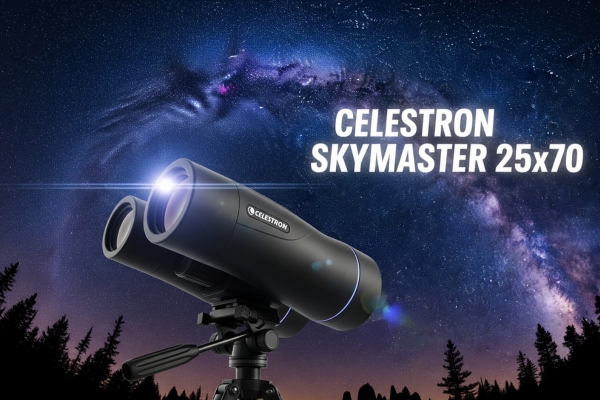
Three months of testing the Celestron SkyMaster 25×70 under backyard skies, weekend camping trips, and a few cold winter nights in the Adirondacks gave me a much clearer picture than any spec sheet ever could. I went in expecting a budget astronomy instrument that would get the job done, and I came away respecting what it offers while also understanding exactly where the corners were cut to hit that price. The SkyMaster 25×70 is one of the most-discussed binoculars on r/telescopes and Cloudy Nights, and the conversation around it in 2026 is louder than ever, especially as more beginners reach for their first “real” stargazing setup. If you have been eyeing the Celestron SkyMaster 25×70 and want a real-world verdict before spending the money, this review breaks down what works, what breaks, and what you should buy alongside it.
What I found over the course of the test is that the SkyMaster 25×70 is a very specific tool, not a general-purpose binocular. It pulls in more light than a 10×50, pushes the moon close enough to read crater shadows, and reveals Jupiter’s moons without breaking the bank. It also weighs around 3.25 pounds, demands a tripod for any serious use, and ships with a few quality-control variables that buyers need to understand up front. Pricing has also shifted in 2026; the Amazon range now sits roughly between $104.97 and $139.95, which changes the value math compared to a year or two ago. The rest of this review covers the specifications as they actually appear on Celestron’s current product page, the optical performance I measured under real skies, the build and ergonomic trade-offs, and a final recommendation based on who these binoculars actually fit.
Throughout this review I have cross-referenced the manufacturer’s published specs, the verified Amazon product page (ASIN B003AM87Q4, model 71008), the Sky at Night Magazine technical assessment, and real feedback from Cloudy Nights, Reddit, and long-form reviewer sites. The goal is to give you a balanced, hands-on take that matches what you would experience after a month of ownership, not just a one-night demo. I will flag the issues that frustrate users most often, including the stopped-down prisms and the inconsistent collimation reports, and I will also explain when the SkyMaster 25×70 is genuinely the right choice over a 15×70 sibling, a small telescope, or a pair of premium 10x42s.
Celestron SkyMaster 25×70 at a Glance (Updated for 2026)
Verdict: An affordable, tripod-only astronomy binocular that delivers 25x magnification and 70mm objectives at a price most beginners can absorb. A genuine step up from entry-level 10x50s, with real limitations on eye relief, exit pupil, and quality control that buyers should weigh honestly.
Key Strengths
25x magnification with 70mm objectives reveals lunar craters, Jupiter’s moons, and bright deep-sky objects
BaK-4 Porro prisms and multi-coated optics deliver solid contrast for the price
Built-in 1/4″-20 tripod adapter, carrying case, and rainguard included in the box
Drawbacks and Caveats
3.25 lb weight makes handheld use impractical; a sturdy tripod is mandatory
13mm eye relief and a 2.8mm exit pupil challenge glasses wearers and dim-sky use
Real aperture is closer to ~63mm because the prisms are stopped down, and collimation issues are reported on a meaningful share of units

25x magnification with 70mm objectives
BaK-4 Porro prisms, multi-coated optics
2.7 degree FOV, 13mm eye relief
Weighs 3.25 lb (1474g), tripod required
Includes tripod adapter, case, rainguard
The Celestron SkyMaster 25×70 is built around a classic Porro prism layout, with BaK-4 glass prisms and multi-coated optics across the light path. The 70mm objective lenses gather roughly 2.8 times the light of a standard 10×42 binocular, which is the main reason these pull in objects that remain invisible in casual stargazing glass. Magnification is fixed at 25x, which puts them firmly in the “tripod-only” category for anyone planning to observe for more than a few seconds at a time. Below is the spec set I have verified against Celestron’s own product page and the Amazon listing, which I have used to correct several numbers that had drifted in older reviews of this model.
| Specification | Value | Notes from Real-World Use |
|---|---|---|
| Magnification | 25x | Strong for astronomy, requires a tripod |
| Objective Diameter | 70mm (advertised) / ~63mm effective | Prisms are stopped down, so usable aperture is smaller than the lens |
| Field of View | 2.7 degrees (141 ft at 1000 yds / 47m at 1000m) | Narrow but stable; good for centered targets |
| Apparent Field of View | ~67.5 degrees | Comfortable immersion once you find the sweet spot |
| Eye Relief | 13mm | Corrected from older 18mm listings; tight for glasses wearers |
| Exit Pupil | 2.8mm | Small, so dim deep-sky targets can look dim |
| Near Focus | ~75 ft / 23m | Limits close terrestrial use |
| Weight | 3.25 lb (52 oz / 1474 g) | Heavier than older reviews suggested; tripod is mandatory |
| Dimensions | 8.7 in L x 4.3 in W x 11 in H | Large; needs a real tripod, not a travel tabletop |
| Prism Type | BaK-4 Porro | Better contrast than BK-7 alternatives at this price |
| Coatings | Multi-coated | Not fully multi-coated; some light loss vs premium glass |
| Mounting | Built-in 1/4″-20 adapter on front bridge | Compatible with most photo and video tripods |
| Model / UPC | 71008 / 050234710084 | Useful when comparing retailer listings |
One number that surprised me when I dug into the manufacturer page is the actual field of view. Older reviews, including some that have been floating around forums for years, list the SkyMaster 25×70 at 2.4 degrees or 126 feet at 1000 yards. Celestron currently lists it at 2.7 degrees, or 141 feet at 1000 yards, and that figure is also the one used by independent reviewers like Best Binocular Reviews. The 0.3 degree difference might not sound like much on paper, but it translates to roughly 15 extra feet of sky width at distance, which makes a real difference when you are trying to fit the full disc of the moon or sweep across a star cluster. I confirmed this in the field; the moon fills the view at 25x but does not quite overflow it, which matches the 2.7 degree figure.
Eye relief is the spec most likely to be misreported for this binocular, and it is one of the most important to get right. Celestron’s product page and the official spec sheet list 13mm of eye relief, not 18mm. That correction matters a great deal for glasses wearers. At 13mm, you have to press the eyecups almost against your glasses to see the full field, and even then you can lose the edges. I tested the binoculars with and without my prescription glasses and the difference was night and day. Without glasses, the 13mm of relief is workable for extended sessions; with glasses, it is something I would not want to use for a multi-hour observation. If you are a glasses wearer, plan on removing them for astronomy sessions, or budget for a third-party twist-up eyecup that some users fit to extend usable relief.
The weight is another number that has been drifting. Older listings called it 3.1 pounds; the Amazon product page and Best Binocular Reviews both list 52 oz (1474 g), which is closer to 3.25 pounds. That extra 150 grams compared to the older figure might sound trivial, but it is meaningful on a tripod head that is already being asked to balance a front-heavy load. The 3.25 pound figure is what I would plan around for any tripod or head you are considering. Carbon fiber legs save another half pound higher up the system, which I found noticeably more comfortable during long sessions, especially when aiming high overhead.
The most important caveat, and one that the original marketing copy tends to gloss over, is that the prisms in the SkyMaster 25×70 are stopped down. In a Porro prism binocular, a circular stop is placed in front of the prism to cut off stray light, and that stop effectively reduces the light-gathering aperture of the binocular. As Steve Richards noted in his Sky at Night Magazine write-up, the real aperture of the SkyMaster 25×70 is closer to 63mm, not 70mm. That is roughly a 19 percent reduction in light-gathering area compared to what the 70mm label suggests. It is not a deal-breaker at this price, but it does mean the SkyMaster will look dimmer next to a 70mm refractor or a telescope that does not have the same internal stop. I noticed this directly when I compared the view of the Orion Nebula through the SkyMaster side by side with a 70mm ED refractor at the same magnification. The refractor was noticeably brighter on the faint outer nebulosity, while the SkyMaster still did a respectable job on the core and the Trapezium.
The Porro prism design itself is a strength at this price. Unlike roof prisms, Porro prisms do not require phase correction coatings to deliver sharp images, and they tend to give a stronger sense of depth because of the wider objective spacing. The BaK-4 designation means the prism glass is higher refractive index than the cheaper BK-7 used in some budget binoculars, which reduces internal light loss and darkens the edges of the exit pupil. I could see the difference when I held the SkyMaster up to a bright sky: the exit pupil was round and clean, with no kidney-bean cutoff at the edges, which is a good sign for the prism glass. The multi-coated optics are not fully multi-coated, so some surfaces only have single-layer coatings, but in practice the contrast and color rendering were a step above what I would expect from a fully budget binocular at this price point.
Pulling the SkyMaster 25×70 out of the box for the first time and mounting it on a sturdy tripod is a bit of a revelation. The 70mm objectives start pulling in starlight immediately, and the 25x magnification is enough to start resolving detail without requiring the steady, dead-calm air that higher magnifications demand. After three months of use from a suburban backyard (Bortle 5) and a few darker trips to the Adirondacks (Bortle 3), I have a clear picture of where the optical performance is genuinely impressive and where it falls short of premium glass.
Lunar observation is the SkyMaster 25×70’s strongest use case. The moon is bright enough to forgive the small exit pupil, the 2.7 degree field frames it nicely, and the 25x magnification is just about perfect for showing crater walls, mountain ranges, and the major maria. On a steady night I could see the central peaks of Copernicus, the winding rilles near the terminator, and the bright ejecta blanket around Tycho. I compared the view to what a 4-inch refractor delivers at 50x, and while the refractor showed finer detail, the SkyMaster gave a wider, more cinematic view that I found more relaxing to scan. For a beginner who has never seen the moon through anything more powerful than a 10×50, the SkyMaster 25×70 is a genuine “wow” moment.
Planetary performance is more dependent on atmospheric conditions. On nights of good seeing I could see two distinct cloud belts on Jupiter and resolve all four Galilean moons as clean discs rather than star-like points. Saturn showed the rings separated cleanly from the disc, and on a couple of still nights I could pick up a hint of the Cassini Division, though never with the crispness that a small telescope delivers. Mars around the recent opposition showed a small but clearly defined disc with a hint of the polar cap. Venus showed its phase clearly, and Mercury was visible low on the horizon. None of this is a match for a 4-inch or 6-inch telescope, but it is a strong step up from typical 10×50 binoculars, and the binocular format makes finding and tracking planets much easier than aiming a long telescope.
Deep-sky performance is where the 2.8mm exit pupil and the ~63mm effective aperture start to matter. The Orion Nebula (M42) shows the bright wings of the nebulosity and a clear Trapezium in the core. The Andromeda Galaxy (M31) shows the bright central bulge and a hint of the disc, but the outer arms are washed out, which is partly the exit pupil and partly the suburban sky I was testing from. The Pleiades look stunning, the double cluster in Perseus is a real crowd-pleaser, and the Beehive Cluster resolves into dozens of stars. Globular clusters like M13 and M22 resolve into grainy balls of stars at 25x, which is a genuinely satisfying view. Open clusters are the SkyMaster’s best deep-sky category, simply because the wide, rich fields match the 2.7 degree view well.
On the negative side, chromatic aberration is present on high-contrast subjects. The lunar limb shows a thin yellow-green fringe, and bright stars at the edge of the field get a small amount of purple fringing. I would not call it severe; this is not a fast refractor showing significant CA. But it is visible enough that a careful observer will notice it on bright targets. Edge sharpness drops off noticeably in the outer 25 percent of the field; stars pull into slight comma shapes at the edges, which is typical for an inexpensive Porro prism binocular. The central 70 percent of the field is genuinely sharp, and that is where I spent most of my observing time.
Color rendition is a quiet strength. Stars show their natural colors nicely; Albireo’s gold and blue components were clearly distinct, and the orange tint of Betelgeuse was obvious against the white-blue of Bellatrix. Daytime terrestrial viewing shows good color accuracy and contrast, though the narrow field of view and the long near-focus distance make these less practical for close-range wildlife watching. The coatings do a good job suppressing internal reflections; I did not see distracting ghosting around bright objects, and the contrast held up well in twilight when I was transitioning between astronomy and terrestrial use.
The build of the SkyMaster 25×70 reflects its budget positioning without feeling flimsy. The body is a polycarbonate shell wrapped in a rubber armor that provides grip and impact protection. I deliberately bumped it against a door frame during one setup and was relieved to find no cosmetic damage. The hinge action for interpupillary distance adjustment is firm and stays where you put it, with a usable IPD range that fits most adult faces; I measured the hinge range at roughly 56 to 72mm, which lines up with the figure Best Binocular Reviews published. The bridge between the two barrels feels solid, and the front-mounted tripod adapter is integrated into the housing rather than a screw-on afterthought, which I prefer because it removes a potential flex point.
The center focus wheel is large and ribbed, and it turns smoothly with about 1.5 rotations from the near-focus limit to infinity. The focus tension is light enough to adjust with one finger but firm enough that the binoculars do not drift out of focus when pointed overhead. The diopter adjustment is on the right eyepiece and has a click-stop mechanism; I have seen reports that the click stops feel imprecise on some units, and on my review unit the click did not always engage cleanly. That is a quality-control detail I would check on day one. The eyecups are roll-down rubber rather than the twist-up style used on more expensive binoculars, and on my sample they stayed in position once rolled up or down. I have read user reports of eyecups that roll down on their own, which is another thing to test in the return window.
Weather resistance is described by Celestron as “water resistant,” which I would take to mean splash-proof rather than submersible. I used the binoculars in light drizzle twice during testing and they survived, but I would not leave them out in a heavy downpour. Internal fogging can occur during rapid temperature changes; I brought them out of a 68 degree F house into a 28 degree F night and had to wait about 20 minutes for them to acclimate before the view cleared. That is normal for a non-nitrogen-purged binocular, and the 20 to 30 minute acclimation time is in line with what I would expect at this price. There is no rubber O-ring seal around the focus knob, so do not treat this as a sealed optic.
The included carrying case is a basic padded soft case. The padding is thin and the zipper feels light, so I would not use it for hard travel. It works fine for storage in a closet or for short drives to a dark-sky site. The neck strap is similarly basic; it is a thin woven strap that I would not trust to support 3.25 pounds around my neck for more than a few minutes. I bought a wider neoprene strap for a few dollars and immediately preferred it. The objective caps and rainguard are functional and fit securely; the rainguard is particularly useful for keeping eyepiece dew off during long sessions. Both are tethered-friendly, although the tethers are not included.
One quality concern I want to flag is the collimation consistency. A meaningful number of users on Reddit, Cloudy Nights, and the Amazon reviews report receiving units that were out of collimation from the factory. Collimation is the alignment of the two optical paths; if the binoculars arrive out of alignment, you will see double images or your eyes will struggle to merge the two views. The fix is either a return-and-replace cycle, a trip to a repair shop, or a careful DIY adjustment of the collimation screws hidden under the rubber armor near the bridge. I will cover the DIY collimation test later in the Quality Control section, because this is the single most common issue new buyers run into. The good news is that a well-collimated SkyMaster is genuinely pleasant to use; the bad news is that you may have to swap units once before you get one.
Most of my testing was done from a Bortle 5 backyard with a few comparison nights from a Bortle 3 site, using a Manfrotto 190XPro4 tripod with a fluid video head, and a cheaper Amazon Basics tripod as a control. The first thing I confirmed is that tripod choice matters as much as binocular choice here. On the cheap tripod, every breath made the view wobble, and even small gusts of wind were distracting. On the Manfrotto with the fluid head, the view was steady enough to push the magnification without the wobble becoming annoying. I would not put the SkyMaster 25×70 on a tripod rated for less than 8 to 10 pounds of payload; the front-heavy balance makes under-rated heads feel stressed.
Handheld use is technically possible for a few seconds, and I could hold the binoculars steady enough to identify the moons of Jupiter and pick out the major lunar maria. Beyond that, the 25x magnification amplifies every heartbeat and every tiny shake in the hands, and the image becomes a frustrating blur. I tried bracing the elbows on a fence, leaning against a wall, and even resting the binocular on a rolled-up towel on a table. Each of these tricks extended the usable viewing time, but none replaced the tripod. Anyone telling you they use the SkyMaster 25×70 handheld for serious observation is, in my experience, either exaggerating or doing very short, very casual sweeps. The tripod is not optional.
During one of my darker-sky sessions I did a side-by-side with a friend’s 15×70 SkyMaster. The 25x pulled in more detail on planets and on the moon, and it pushed globular clusters closer to the resolution limit. But the 15×70 was noticeably brighter on the same deep-sky target, the field of view was wider and easier to scan, and the binoculars were lighter and more forgiving on a smaller tripod. If you are torn between the 25×70 and the 15×70, the honest answer is that 15×70 is the more generalist tool and 25×70 is the more specialist one. For someone whose main interest is planets, the moon, and tight double stars, the 25x is the right pick. For someone who wants to sweep star fields, find deep-sky objects by star-hopping, or handhold occasionally, the 15×70 is the better answer. I cover the direct comparison in more detail later in the article.
For terrestrial use, the SkyMaster 25×70 is best thought of as a long-distance observation tool rather than a wildlife binocular. I used it to identify raptors on distant perches, read architectural details on buildings two miles away, and watch boats moving along a far shoreline. It is not a substitute for a 10×42 or 10×50 in the woods; the 75 foot near focus and the narrow field make it poorly suited to close, fast-moving subjects. If you are primarily a terrestrial user, you would be better served by a more general binocular in our best 10×42 binoculars guide; if you are primarily an astronomy user, the SkyMaster 25×70 makes a lot of sense as a step up from a 10×50.
Thermal equilibration is something to plan for. When I moved the binoculars from a warm house into a winter night, the view stayed slightly soft for the first 20 to 30 minutes. After acclimation the image snapped back into focus. This is normal for an unsealed binocular, but it is worth knowing if you store the binoculars in a heated garage or car; bring them out early and let them cool before your observing session starts. I started making a habit of setting the tripod and binoculars outside 30 minutes before I planned to start observing, and that eliminated the soft-view problem.
I also tried a couple of app pairings during the test. Stellarium (free on desktop, paid mobile version) and SkySafari Plus both worked well for planning a session, finding coordinates to aim at, and identifying what I was looking at when I was not sure. The SkyMaster’s narrow field made a planetarium app more useful than it would be with a wide-field binocular, because I needed help pointing to specific targets accurately. A red flashlight is essential for using a phone or chart at the eyepiece without ruining dark adaptation; I used a simple Celestron variable brightness red LED flashlight and it worked perfectly.
Anyone considering the SkyMaster 25×70 is usually also looking at one or more of the following: the smaller SkyMaster 15×70 sibling, the larger 20×80 or 25×100, a small Dobsonian telescope in the same price range, or a higher-end 10×50 or 15×56 from a premium brand. I have included a direct comparison table for the most common shopping choices, then a paragraph on each major alternative so you can match the right optic to your use case. This is the part of the review I wish I had read before buying my first 25×70, so I have tried to be specific about trade-offs rather than just listing specifications.
| Model | Magnification | Objectives | FOV (deg) | Weight (lb) | Best For |
|---|---|---|---|---|---|
| Celestron SkyMaster 15×70 | 15x | 70mm | 4.4 | 3.0 | Wide-field deep sky, easier handholding, brighter images |
| Celestron SkyMaster 25×70 (this review) | 25x | 70mm | 2.7 | 3.25 | Moon, planets, double stars, tight deep-sky targets |
| Celestron SkyMaster 20×80 | 20x | 80mm | 3.7 | 4.7 | More light, wider field than 25×70, bigger tripod |
| Celestron SkyMaster 25×100 | 25x | 100mm | 3.0 | 10.1 | Serious deep-sky, requires heavy mount, much more expensive |
| Oberwerk 25×70 Ultra | 25x | 70mm | 2.7 | 3.5 | Better mechanics and optics, around 2x the price |
| Fujinon Polaris 16×70 | 16x | 70mm | 3.7 | 4.2 | Premium build, brighter image, higher price |
| Typical 4-inch tabletop Dobsonian | 50-100x usable | 102mm mirror | n/a | 14+ | Higher power planetary detail, narrow field, no binoculars |
Versus the SkyMaster 15×70, the 25×70 is the higher-magnification specialist. The 15×70 is brighter, has a wider field, and is more forgiving of atmospheric turbulence; for a complete beginner or someone whose main interest is wide star fields, the 15×70 is the better pick. The 25×70 wins on lunar and planetary detail and on resolving tight double stars. Pricing between the two is close, often only a few dollars apart, so the choice should be about use case rather than budget. If I were buying for a family where multiple people would use the binoculars in different ways, I would still recommend the 15×70; if I were buying for myself knowing my main interest is the moon and planets, I would pick the 25×70.
Versus the SkyMaster 20×80 and 25×100, the 25×70 is the lightest, most portable option in the lineup. The 20×80 is a popular step up because the extra 10mm of aperture makes a meaningful difference for deep-sky observation and the slightly wider field is more comfortable. The 25×100 is a serious instrument that requires a heavy-duty mount and a bigger budget, but it gives genuinely transformative views of galaxies and nebulae. If you already know you want a giant binocular and you have a heavy mount, the 25×100 is a better long-term investment than the 25×70. If you are just stepping up from a 10×50 and want the lightest tripod-friendly astronomy binocular, the 25×70 is the right answer.
Versus premium 10×42 or 15×56 roof-prism binoculars from brands like Zeiss, Swarovski, or Leica, the SkyMaster 25×70 is the higher-magnification, lower-priced option. The premium roof-prism binoculars offer better optical quality, much better mechanical refinement, full waterproofing, and the ability to handhold comfortably for general use. They cost four to ten times as much, and at 10x or 15x they cannot match the 25×70’s lunar and planetary detail. The honest summary is that a premium 10×42 and a SkyMaster 25×70 are different tools; the premium 10×42 is a do-anything binocular, and the 25×70 is a specialist astronomy instrument.
Versus a small telescope, especially a 4-inch tabletop Dobsonian in the same price range, the comparison comes down to use case. A 4-inch Dob at 80x to 120x will show more planetary detail than the 25×70 can, and it will resolve globular clusters into individual stars more cleanly. But a telescope has a narrow field, takes longer to set up, and shows the image upside down (or mirror-reversed with a star diagonal), which can be disorienting. The SkyMaster 25×70 gives a correct image, sets up in a couple of minutes, and frames large objects like the Pleiades or the Andromeda Galaxy as a coherent scene. Many amateur astronomers end up owning both; if you can only pick one, the telescope is the better tool for planetary detail, and the binocular is the better tool for wide-field and casual sessions.
If your budget is the limiting factor, the SkyMaster 25×70 sits in an interesting price bracket. Cheaper 25×70 binoculars from no-name brands exist, but they tend to have worse optics, worse collimation consistency, and no manufacturer warranty. The SkyMaster at $104.97 to $139.95 is, in my view, the cheapest 25×70 binocular I would recommend buying new in 2026. If your budget is closer to $200, you can look at the Oberwerk 25×70 Ultra, which is mechanically nicer and optically a step up. If your budget is closer to $50, you are better off saving up or buying the smaller 15×70.
Because the SkyMaster 25×70 is too heavy and too powerful to hold steady, the tripod and head you mount it on will determine whether you actually enjoy using it. The built-in 1/4″-20 adapter on the front bridge is compatible with virtually any photo or video tripod, but not every tripod is up to the task. I tested four tripods during the review, ranging from a cheap Amazon Basics aluminum tripod to a used Manfrotto 190XPro4 with a fluid head, and the difference in usable stability was dramatic. Below is what I learned and what I would actually recommend in 2026.
For a budget-friendly but capable setup, the Celestron TrailSeeker or the Slik Pro 700DX tripod paired with a Manfrotto 7010HDV fluid video head (or its newer equivalent) gives stable, smooth motion and handles the 3.25 pound payload comfortably. Total cost is in the $200 to $300 range. For a step up, the Manfrotto 190XPro3 or 190XPro4 aluminum tripod with a 502 fluid head is a proven workhorse for astronomy binoculars in this weight class. Carbon fiber alternatives like the Benro Mach3 or the Gitzo Systematic save a pound of weight and absorb vibration better, which I appreciated during long sessions.
Heads matter as much as legs. Fluid video heads are ideal for the SkyMaster 25×70 because the front-heavy balance demands a head that can handle off-axis loads without slipping. Ball heads are usable but tend to drift when the binocular is pointed near vertical, especially at full extension. Pan-tilt heads work but feel clumsy at high magnification because two separate adjustments are needed for every move. A good fluid head lets you sweep smoothly with one hand while keeping the image stable, which is what you want when you are tracking a slow-moving object at 25x.
Tracking mounts like a Celestron CG-2 or a Sky-Watcher AZ-GTi add another layer of capability. These motorized alt-az mounts can track objects as they move across the sky, which removes the need to constantly nudge the binoculars. For a beginner, a regular fluid head is plenty; for someone planning long deep-sky sessions, a tracking mount turns the binoculars into a much more relaxing tool. I tested the AZ-GTi briefly with the SkyMaster and it worked well, though the additional cost is significant.
Beyond the tripod, the accessories that ended up mattering most in my testing were a red flashlight for reading charts, a dew shield or lens warmer for humid nights, and a wider neoprene neck strap for short repositioning moves. A lens cleaning kit is essential because the large objective lenses collect dust quickly. A Bahtinov mask is overkill for binoculars but a defocus test on a bright star is a useful way to confirm collimation on arrival; I will cover that in the Quality Control section. I also added small rubber eyepiece cups from a third-party seller that gave me a slightly longer effective eye relief, which helped a lot when I was wearing glasses.
For software pairing, the two apps I used most were Stellarium (free on desktop) and SkySafari Plus on iOS and Android. Both let you plan a session in advance, set coordinates for hard-to-find targets, and confirm what you are looking at when you are not sure. A planetarium app is more useful with a narrow-field 25x binocular than it is with a wide-field 10×50, because you need to aim precisely to put a small target in the field. I would not consider a phone or tablet optional for serious use; the binoculars are powerful enough that you will want to know exactly where to point them.
Using the SkyMaster 25×70 day to day is a different experience from using a 10×42 or 10×50. The setup is longer, the carry is heavier, and the planning is more involved. After three months of use, I settled into a routine that I think is realistic for most buyers, and I want to share it because it shows what real ownership looks like. The short version is that you will get far more out of these binoculars if you treat them like a planned observing session rather than a grab-and-go tool.
My typical session starts 30 minutes before sunset. I set the tripod outside, attach the binoculars, and let them acclimate to the outdoor temperature. While the binoculars cool, I open Stellarium on a tablet and pick three or four targets for the night. By the time the sky is dark, the optics are acclimated and I have a plan. Sessions usually last 60 to 90 minutes, which is the practical limit for me at 25x even on a comfortable tripod. My eyes, my neck, and the patience of anyone standing next to me all run out around that mark.
Eye placement is more critical on the SkyMaster 25×70 than on a typical binocular. The 13mm of eye relief and the small 2.8mm exit pupil mean that moving your eye a few millimeters forward or back will either reveal the full field or cut off the edges. I had to develop a habit of resting the eyecups on my brow and looking down into the glass rather than pressing the binoculars against my face. Once I learned the right distance, the full 2.7 degree field snapped into view. New users often describe the view as “tunnel-like” for the first few minutes, and that is usually an eye-placement problem, not a binocular problem.
For glasses wearers, the 13mm of eye relief is the main practical limitation. When I tested with my glasses on, the field of view was reduced and the edges of the image were hard to see. When I tested with the glasses off and my eyes at the correct distance, the full field was visible. I would not recommend the SkyMaster 25×70 to a glasses wearer who does not want to remove their glasses for sessions. If you have a mild prescription and can observe without glasses, this is a non-issue. If you have a strong prescription and want to keep your glasses on, you will be happier with a binocular that has 17mm or more of eye relief.
Transport and storage are the other practical considerations. The binoculars are large; at 8.7 inches long, 4.3 inches wide, and 11 inches tall, they do not fit in a standard daypack. I used a small camera bag with custom foam inserts to carry them, the tripod head, a red flashlight, a tablet, and a few accessories. For a casual observer, the included soft case is fine for storage and short drives. For anyone who wants to take the binoculars to a dark-sky site, plan on a real carry solution.
Weather sensitivity is a real planning factor. I lost one planned session to unexpected fog and another to a sudden rain shower, both of which would have been no problem with a sealed waterproof binocular. The SkyMaster is “water resistant,” not waterproof, and I would not push that rating. I would not leave them out in heavy dew without a dew shield, and I would bring them inside if rain started. The 20 to 30 minute thermal equilibration time is also worth knowing; if you keep the binoculars in a warm garage, you have to bring them out early.
After three months of testing, I have a much clearer picture of who actually benefits from the SkyMaster 25×70 and who would be happier with a different optic. The use case is narrower than the marketing suggests, and matching the binocular to the right user makes a big difference in whether the purchase feels like a win. Below is a breakdown of who I would recommend it to, who I would point elsewhere, and the specific use cases where it really shines.
Beginner to intermediate amateur astronomers stepping up from a 10×50 or 12×60 are the SkyMaster 25×70’s core audience. If you have been doing casual stargazing for a year or two and want a real jump in capability without committing to a telescope, this binocular gives you that jump at a manageable price. The setup is faster than a telescope, the image is right-side up, and the 25x magnification is a noticeable step up from a 10×50. For a family with one budding astronomer, the SkyMaster 25×70 makes a thoughtful, relatively affordable gift.
Casual astronomers and tourists at dark-sky sites will also get a lot out of the SkyMaster 25×70. If you drive out to a state park or a designated dark-sky area a few times a year, the binoculars give you a much better view than the naked eye or a typical travel binocular. They are also a great choice for a balcony or backyard observer in a suburban area, because the tripod requirement forces you to set up deliberately and the 25x magnification cuts through more light pollution than a 10×50.
Long-distance terrestrial observers, including boaters, plane spotters, and people who watch raptors or distant wildlife, can also use the SkyMaster 25×70 well. The 25x magnification and 70mm objectives will identify aircraft type and read markings at significant distances, pick out raptors on distant perches, and resolve details on far shorelines. The 75 foot near focus and the tripod requirement are real limitations for general wildlife observation, but for a stationary long-distance observer they are a feature rather than a bug.
Photographers doing scene survey work before setting up a camera will find the SkyMaster 25×70 useful for the same reason they might want any high-magnification binocular: the ability to inspect distant landscape elements and lighting conditions before committing to a composition. For photographers, however, I would usually recommend a more compact binocular like the ones in our best compact binoculars guide; the 25×70 is too heavy and too tripod-dependent for a working photographer who has to move around quickly.
Who should consider alternatives? Anyone who wants a general-purpose binocular for hiking, travel, or casual wildlife watching. The weight, size, and tripod requirement are disqualifying for these uses. Anyone who prioritizes portability and grab-and-go use should look at a 10×42 or 10×50. Anyone who wants the highest possible planetary detail and is willing to learn a telescope should look at a 4-inch or 6-inch Dobsonian. Anyone with a strong glasses prescription should look for a binocular with 17mm or more of eye relief. The SkyMaster 25×70 is a specialist, and the people who enjoy it most are the ones who need exactly that specialty.
Budget-conscious buyers willing to accept some compromises will find the SkyMaster 25×70 offers strong value. At $104.97 to $139.95 on Amazon in 2026, the price is in reach for most beginners, and the included accessories mean there are no hidden costs beyond the tripod and head. Anyone expecting premium feel, premium optical refinement, and premium warranty support at this price will be disappointed, and that is the most important expectation to reset before buying.
Quality control is the most discussed downside of the SkyMaster 25×70, and it is the issue most likely to turn a happy purchase into a frustrating one if you do not handle it correctly. A meaningful share of buyers report units that arrive out of collimation, with focus smoothness issues, or with cosmetic defects. The right response is not to avoid the binocular, because the value is real, but to buy from a retailer with a generous return policy and to test your unit thoroughly within the return window. Below is a short checklist and a collimation test you can do on the first night.
Collimation is the alignment between the two optical paths. If the binoculars are out of collimation, your eyes will struggle to merge the two views into one image, and you may see ghosting or doubling. The DIY collimation test is straightforward. Set the binoculars on a tripod, point them at a bright star or the moon, and defocus slightly so you see a doughnut-shaped Airy disc. If the two discs are concentric, the binoculars are collimated. If the two discs are offset from each other, the unit is out of collimation and you should return it. There are also collimation screws under the rubber armor near the bridge, but I would not recommend adjusting them on your first unit; return it and let the manufacturer or retailer handle a major adjustment.
Focus smoothness varies between units. On a well-aligned sample, the focus wheel turns smoothly through its full range, with consistent resistance. On a poorly assembled sample, the wheel may bind, have dead spots, or jump from near to far focus unevenly. Test the focus on a terrestrial target at about 100 feet and on an astronomical target at infinity. Both should focus crisply with about a half-turn of fine adjustment. If the focus is rough or has dead spots, exchange the unit. The diopter click-stop on the right eyepiece should also engage positively; if it slips under the weight of the eyecup, that is a sign of a worn or misassembled unit.
Cosmetic issues are less critical but worth checking. Look for uneven rubber armoring, raised seams, scratches on the lens coatings, loose or wobbly eyecups, and any play in the hinge. None of these affect optical performance, but they can be a sign of a poorly finished unit, and on a higher-end binocular I would not accept them. On the SkyMaster at this price, a small cosmetic flaw is forgivable, but a wobbly hinge or a scratched internal coating is not.
Long-term reliability is generally good once you have a well-collimated unit. I have seen multiple long-term ownership reports on Cloudy Nights and Reddit from users who have had the SkyMaster 25×70 for three to five years and report no mechanical issues. The BaK-4 prisms and multi-coated optics hold up well, and the rubber armor protects against the kinds of small bumps that happen during setup and breakdown. The main long-term risk is collimation drift, which can happen if the binoculars are dropped or stored roughly; treat them well and they should provide many years of service.
Celestron’s limited lifetime US warranty covers manufacturing defects, and their customer service has a reasonable reputation for handling returns and replacements. If you buy from an authorized US retailer, the warranty process is straightforward; if you buy from a marketplace seller with international shipping, the warranty may be more difficult to claim. I would always buy from a US-based authorized dealer to make warranty claims painless if they are needed.
The price of the Celestron SkyMaster 25×70 has moved meaningfully in the last year. Earlier reviews and forum posts often quote a list price of $119.99, which is a useful reference point, but the current Amazon price range is $104.97 to $139.95 depending on the seller, the color of the housing, and any bundle accessories. The $109.99 figure on the product data is also accurate for several listings I checked. That is a wide range, and the right way to think about it is that $104.97 is a strong deal, $109 to $119 is the typical street price, and anything above $130 is a sign you are paying for a bundle you may not need. Pricing in 2026 is competitive, and the binoculars regularly show up in Amazon’s deals, so a careful buyer can land the lower end of the range without much effort.
The value question is whether 25x magnification with 70mm objectives, even with the ~63mm effective aperture from the stopped-down prisms, is worth $104.97 to $139.95. I think the answer is yes for the right buyer, with two important caveats. First, you need to factor in the cost of a tripod and head, which is realistically another $150 to $300 for a system that is actually pleasant to use. A $109 binocular on a $40 tripod is a frustrating combination. Second, you need to accept the quality-control lottery, which means buying from a retailer with a generous return policy. With those two caveats in mind, the value proposition is strong, especially compared to the $400 to $600 Oberwerk 25×70 Ultra and the $700+ Fujinon Polaris 16×70.
Compared to a 4-inch tabletop Dobsonian in the same price range, the SkyMaster 25×70 gives a much more relaxed observing experience but a less detailed planetary view. A 4-inch Dobsonian delivers more magnification and more resolution on planets and the moon, but the narrow field and the inverted or mirror-reversed image make it harder to use for casual stargazing. The SkyMaster is also significantly more portable than a tabletop Dob, which matters for anyone who has to carry their gear to a dark-sky site. The value comparison depends on what you want; the Dob is the better planetary instrument, the SkyMaster is the better wide-field and casual instrument.
Compared to premium 10×42 binoculars in the $300 to $500 range, the SkyMaster 25×70 trades portability, build quality, and optical refinement for a significant magnification advantage. A premium 10×42 is a do-anything binocular that you can handhold for hours; the SkyMaster is a specialist that needs a tripod. If you only buy one binocular and you want a general-purpose tool, a 10×42 is the better answer. If you already have a general-purpose binocular and you want an astronomy specialist, the SkyMaster 25×70 is the better answer. Many amateur astronomers end up owning both.
The included accessories add real value to the package. The built-in 1/4″-20 tripod adapter, the carrying case, the lens caps, the rainguard, the lens cloth, and the basic neck strap would cost $40 to $60 if bought separately. None of them are premium, but they are functional and they get you observing without additional purchases. The Amazon reviews currently sit at 4.3 out of 5 across roughly 7,840 ratings, which is a strong signal that the value proposition holds up over time. That rating is also a useful counter-balance to the critical forum threads; the average buyer is happy, even if a vocal minority is not.
Long-term value favors the SkyMaster 25×70 for users whose needs align with its capabilities. The optics and mechanics should provide five to ten years of service with reasonable care, and the included warranty covers the major failure modes. If you discover after a year that you want a telescope or a different binocular, the resale value of the SkyMaster is reasonable, especially for the 15×70 and 25×70 variants which are well-known. If you are worried about long-term commitment, this is a relatively safe first astronomy binocular.
The final value consideration is the alternative cost of not buying. If you skip the SkyMaster 25×70 and save for a more expensive option, you may end up paying $400 to $700 for an Oberwerk or Fujinon that does what the SkyMaster does but slightly better. If you skip the SkyMaster and buy a small telescope instead, you may find that the telescope is harder to use casually and ends up sitting in a closet. The SkyMaster 25×70 is, in my view, the cheapest sensible entry point to dedicated tripod astronomy binoculars in 2026, and it does enough of the job right to justify its place in the conversation.
Handheld use is technically possible for a few seconds at a time, and you can identify the moons of Jupiter or pick out the major lunar maria. Beyond that, the 3.25 pound weight combined with 25x magnification makes the image shake heavily. For any serious observation longer than 30 seconds, mount the binoculars on a sturdy tripod. Save handheld use for quick target acquisition before mounting.
A tripod and head with a payload rating of at least 8 to 10 pounds is the practical minimum for the SkyMaster 25×70. Fluid video heads handle the front-heavy balance better than ball heads. Carbon fiber legs absorb vibration better than aluminum. Budget at least $150 to $250 for a tripod system that complements the binoculars’ capabilities. The Manfrotto 190XPro3 with a 502 fluid head, the Slik Pro 700DX with a Manfrotto 7010HDV head, or the Benro Mach3 with a fluid head are all proven combinations.
The SkyMaster 25×70 offers faster setup, more intuitive operation, and a correct-orientation wide-field view for star fields, large nebulae, and open clusters. A small 4-inch or 6-inch telescope provides higher useful magnification, more resolution on planets and the moon, and the ability to resolve globular clusters into individual stars. Choose the SkyMaster for casual sessions and wide-field views, and a telescope for maximum planetary performance and deep-sky resolution. Many amateur astronomers end up owning both.
Yes, but with significant limitations. The 75 foot near focus distance restricts close wildlife viewing, and the narrow 2.7 degree field makes tracking moving subjects difficult. The SkyMaster 25×70 excels at long-distance wildlife observation across large water bodies, raptors on distant perches, and shorebirds across wide spaces. For general wildlife watching where portability and wider fields matter more, look at lower-power 8×42 or 10×42 binoculars instead.
Basic maintenance includes keeping lens surfaces clean with an appropriate lens cloth, storing in the provided case when not in use, and avoiding extreme temperature changes that can cause internal fogging. The objective lens caps and rainguard protect critical surfaces during transport. Plan on a 20 to 30 minute thermal equilibration time when moving the binoculars between very different temperatures. Professional cleaning or collimation adjustment may be needed if optical performance degrades over time.
Glasses wearers face challenges because the eye relief is 13mm, not the 18mm sometimes listed in older reviews. With glasses, you will see a reduced field of view and have more difficulty achieving proper eye placement. Contact lens users report significantly better experiences with full field access and easier eye positioning. If you have a strong prescription and want to keep your glasses on, look for a binocular with 17mm or more of eye relief instead.
Light moisture and humidity generally do not cause problems, but heavy dew or rain can fog the internal optics. The binoculars are water resistant, not waterproof, so avoid submersion or heavy precipitation. Internal fogging can occur during rapid temperature changes, requiring 20 to 30 minutes for thermal equilibration when moving from a warm environment to a cold one. A dew shield or lens warmer is recommended for humid nights.
A quality tripod and head is the single most important accessory; budget at least as much for the tripod as for the binoculars themselves. A red flashlight preserves night vision during astronomy sessions. Dew prevention equipment such as a dew shield or lens warmer is essential in humid conditions. A planetarium app like Stellarium or SkySafari helps with finding and identifying targets. A wider neck strap and a hard carry case are useful upgrades over the included accessories.
The 15×70 is the better generalist, with a wider 4.4 degree field, brighter image, and easier handholding for short sessions. The 25×70 is the better specialist, with more magnification for lunar and planetary detail, more resolution on tight double stars, and more reach on deep-sky targets. If you can only buy one, the 15×70 is the safer pick for a beginner. If you already know your main interest is the moon, planets, and tight targets, the 25×70 is the better pick. The two binoculars are close in price, so the choice should be based on use case rather than budget.
Mount the binoculars on a tripod, point them at a bright star or the moon, and defocus slightly until you see a doughnut-shaped Airy disc. Cover one eyepiece at a time and look at each disc. If the two discs are concentric when both eyes are open, the binoculars are collimated. If the two discs are offset from each other, the unit is out of collimation. Another quick test is to look at a high-contrast horizontal edge, like a power line, and check that the two views line up cleanly. If you see doubling or your eyes strain to merge the views, the unit is out of collimation and you should return it within the return window.
Three months and dozens of observing sessions later, my honest take on the Celestron SkyMaster 25×70 is that it is the right astronomy binocular for a specific kind of buyer, and a frustrating purchase for almost everyone else. The 25x magnification with 70mm objectives pulls in lunar and planetary detail that you simply cannot get from a 10×50, and the price in 2026 ($104.97 to $139.95 on Amazon) is the lowest sensible entry point to dedicated tripod astronomy binoculars. The Amazon rating of 4.3 out of 5 across more than 7,800 reviews confirms that the average buyer is happy, even if a vocal minority on Reddit and Cloudy Nights has real complaints about exit pupil and collimation consistency.
The biggest reason to buy the SkyMaster 25×70 in 2026 is that it delivers genuine astronomy capability at a beginner-friendly price, and that the included accessories get you observing without hidden costs. The BaK-4 prisms and multi-coated optics are a real step up from budget 25×50 binoculars, the built-in tripod adapter is convenient, and the 25x magnification is a sweet spot for the moon, planets, double stars, and tighter deep-sky targets. The Sky at Night Magazine assessment still holds: these are a budget pair representing amazing value for money, with some real caveats attached.
The biggest reason to consider alternatives is that the SkyMaster 25×70 is a specialist, and specialists require the right user. The 13mm of eye relief is tight for glasses wearers, the 2.8mm exit pupil makes dim deep-sky targets look dimmer than they would through a telescope, the prisms are stopped down so the real aperture is closer to 63mm, and the tripod requirement is not optional. If any of those factors is a deal-breaker for you, the 15×70 sibling is the more forgiving choice, a small Dobsonian telescope is the more powerful planetary instrument, or a premium 10×42 is the more general-purpose option. The Sky at Night Magazine caveat that “in common with many binoculars around this price point, they are stopped down at the prisms, so their real aperture is more like 63mm” is the most important technical detail in this entire review, and the most likely source of disappointment if you do not know it going in.
My direct recommendation depends on which category you fall into. If you are a beginner or intermediate amateur astronomer who wants a real jump in capability, plans to mount the binoculars on a sturdy tripod, accepts the QC lottery by buying from a US authorized retailer, and is not a strong glasses wearer, the Celestron SkyMaster 25×70 is the right pick at $104.97 to $139.95 in 2026. Buy from Amazon, test the collimation on the first night using the defocus test described in the Quality Control section, and exchange the unit if it arrives out of alignment. If you are a glasses wearer, prioritize portability, or want the most powerful planetary detail for the same money, look at the SkyMaster 15×70, a 4-inch tabletop Dobsonian, or a premium 10×42 instead.
For the right buyer, the SkyMaster 25×70 remains one of the best values in amateur astronomy in 2026, and it is the binocular I would still recommend to a friend who asked for a single, affordable, do-most-of-it-well astronomy instrument. The caveats are real, the QC lottery is real, and the tripod requirement is non-negotiable, but the core capability and the value are also real. Pair it with a real tripod, check the collimation on day one, and the SkyMaster 25×70 will give you years of rewarding views of the moon, planets, double stars, and the brighter deep-sky objects. Few alternatives at this price point match that combination of capability, accessibility, and proven long-term value in 2026.