![Mars Facts: Complete Guide to the Red Planet [cy]](https://revellphotography.com/wp-content/uploads/2026/09/featured-update-4302-1789317129635.jpg)
Mars Facts: Complete Guide to the Red Planet 2026
Comprehensive guide to Mars facts covering physical characteristics, surface features, moons, potential for life, and observation tips from Earth.

Last updated: June 2026 – All star coordinates, discovery years, and observation dates verified against current astronomical catalogs.
Aries is a zodiac constellation in the northern celestial hemisphere representing a ram. It ranks 39th in size covering 441 square degrees, contains the bright star Hamal, and is best viewed in December. From ancient Babylonian boundary stones to the James Webb Space Telescope’s search for habitable worlds around Teegarden’s Star, this modest patch of sky has shaped how humans measure time and where we look for life beyond Earth.
When I started learning the constellations as a teenager, Aries was the one I struggled with most. Its brightest stars hover around magnitude 2 to 4, dimmer than most of the zodiac neighbors, and the asterism is a crooked line rather than a vivid picture. Yet the more I read about it, the more I realized Aries punches well above its weight. It was the anchor of the Babylonian calendar, the herald of spring for the ancient Greeks, and it still hosts some of the closest exoplanet systems to Earth.
This guide covers the essential Aries constellation facts you need in 2026: the brightest stars with their right ascension and declination coordinates, the Greek and Babylonian mythology behind the golden ram, practical tips for finding and observing Aries from both urban and dark skies, the deep sky objects and meteor showers associated with this region, and the modern discoveries that make Aries relevant to current astronomy. Whether you are planning a December observing session or simply curious about why Aries kicks off the astrological year, the sections below will give you a complete picture.
Before diving into the details, here is a quick orientation. Aries sits in the northern celestial hemisphere between Pisces and Taurus, and although it is not a vivid pattern, it is rich in historical and astronomical importance. The following ten facts summarize what every stargazer should know.
Aries hosts a quietly fascinating collection of stars, even though the constellation itself never blazes across the sky like Orion or Scorpius. The five stars that trace the ram’s outline represent four distinct stellar classifications, a multiple-star system, and even a Mira-type variable. If you learn these stars, you are learning how a small constellation can teach big lessons about how stars live and evolve.
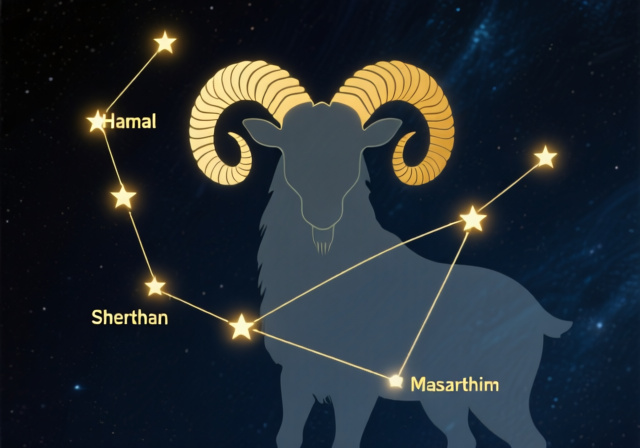
The principal stars of Aries are catalogued in the Bayer system with Greek-letter names: Hamal (Alpha Arietis), Sheratan (Beta Arietis), Mesarthim (Gamma Arietis), and Botein (Delta Arietis), joined by 41 Arietis (Bharani) as the fourth-brightest member. Each has a personality worth knowing. The table below summarizes their key data, including the right ascension and declination coordinates that astronomers use to point telescopes and identify objects in the sky.
| Star Name | Magnitude | Distance (light-years) | Spectral Type | Right Ascension | Declination | Notable Features |
|---|---|---|---|---|---|---|
| Hamal (Alpha Arietis) | 2.02 | 66 | K1.5 III orange giant | 02h 31m 49s | +23° 27′ | Former equinox star, about 15x Sun’s diameter |
| Sheratan (Beta Arietis) | 2.64 | 59 | A5 V + G0 V binary | 01h 54m 38s | +20° 48′ | Spectroscopic binary, 107-day orbit |
| Mesarthim (Gamma Arietis) | 3.86 | 164 | B9 V + A1 V binary | 01h 53m 32s | +19° 18′ | First double star identified telescopically, 1664 |
| 41 Arietis (Bharani) | 3.63 | 165 | B8 Vn blue-white | 02h 49m 59s | +27° 16′ | Fast-rotting star, completes a spin in about 15 hours |
| Delta Arietis (Botein) | 4.35 | 170 | K2 III orange giant | 03h 11m 38s | +19° 43′ | Traditional name means “little belly” in Arabic |
Hamal, the constellation’s alpha star, is the easiest to find and the most striking through binoculars. It is a K-type orange giant in a transitional phase of stellar evolution, having exhausted the hydrogen in its core and begun expanding outward. At about 15 solar radii and shining with 91 times the Sun’s luminosity, Hamal will eventually shed its outer layers to form a planetary nebula, leaving behind a white dwarf. The fact that Hamal served as the marker of the vernal equinox around 1000 BCE makes it one of the most historically important reference stars in the night sky.
Sheratan and Mesarthim, separated by less than half a degree on the sky, reward observers with a good pair of binoculars. Sheratan is a spectroscopic binary: its two stars are too close to split visually, but Doppler shifts in its spectrum reveal the 107-day orbital dance. Mesarthim is a true double star that English physician and astronomer Robert Hooke first resolved in 1664, one of the earliest telescopic double-star discoveries. Both systems show beautiful color contrast: Sheratan appears a cool white, while Mesarthim’s two components are an almost identical blue-white pair. When I look at this trio on a clear winter night, I am reminded that the night sky is not just light but a chemistry set of stellar spectra.
Beyond the Bayer stars, Aries hides some remarkable nearby red dwarfs that escaped naked-eye discovery. Teegarden’s Star, at 12.5 light-years, is one of the closest stellar neighbors to the Sun. It is an ultracool M-dwarf with only about 8 percent of the Sun’s mass, far too dim to see without a telescope, but in 2019 astronomers confirmed two Earth-mass planets orbiting within its habitable zone. These worlds, Teegarden’s Star b and c, are now high-priority targets in the search for biosignatures, especially given how close they are to us on a cosmic scale. A second nearby system, TZ Arietis at 14.6 light-years, rounds out the roster of Aries’ neighboring stars. Aries is, in other words, a small constellation with an outsized list of cosmic neighbors.
One of the most rewarding variable stars to observe in Aries is R Arietis, a Mira-type long-period variable located about 4,080 light-years away. Mira variables are cool, pulsating red giants that swell and shrink on timescales of months or years, dramatically changing brightness in the process. R Arietis oscillates between roughly magnitude 7.3 at its peak and magnitude 13.8 at minimum, a swing of more than 6 magnitudes, or about a factor of 250 in brightness, over a 186.8-day cycle. At maximum it is just within reach of binoculars from dark skies, while at minimum you need a 6-inch telescope to pick it out. Tracking R Arietis through a complete cycle is a favorite project among amateur variable-star observers because the changes happen on a human-comfortable timescale and the visual record genuinely contributes to ongoing research through organizations like the AAVSO (American Association of Variable Star Observers).
When I sweep across Aries with binoculars, I look for the color differences that the Bayer table hints at. Hamal glows a steady orange. Sheratan and Mesarthim read as a cool white. 41 Arietis, though dimmer, has a distinct blue-white sparkle because of its high surface temperature. Seeing these hues side by side is a practical lesson in stellar spectral classification: stars are not all the same color, and those colors map to surface temperature and life stage. Aries, small and quiet, is one of the best classrooms in the night sky.
The Greek story of Aries is one of the most dramatic family sagas in classical mythology, and it ties directly into the quest for the Golden Fleece, one of the foundational tales of Greek heroism. The constellation represents a divine ram sent by Zeus, but the reason it had to fly at all is rooted in betrayal, manipulation, and rescue.
It begins with King Athamas of Boeotia, whose first marriage to Nephele, a cloud nymph, produced two children: Phrixus and Helle. Athamas later abandoned Nephele for the mortal princess Ino. Ino, jealous of the king’s children from his first marriage, plotted to get rid of Phrixus and Helle. She arranged for the kingdom’s grain seeds to be roasted before planting, ensuring a catastrophic famine.
When Athamas sent messengers to consult the Oracle at Delphi, Ino bribed the envoys to return with a forged prophecy: the famine would end only if Phrixus were sacrificed to the gods. The desperate king prepared the altar. Just as the ritual was about to begin, Nephele prayed to Zeus for help. In response, Hermes sent a magnificent golden ram with a fleece that shone like the morning sun. The ram swooped down, lifted the children onto its back, and flew eastward across the Aegean Sea toward safety in Colchis.
During the flight, Helle grew dizzy and fell from the ram into the sea far below. The strait where she plunged became known ever after as the Hellespont, the ancient name for the Dardanelles. Phrixus survived the crossing and arrived safely in Colchis, on the eastern shore of the Black Sea. There, he sacrificed the golden ram to Zeus in gratitude for his rescue and hung its fleece in a sacred grove guarded by a sleepless dragon.
That fleece became the Golden Fleece of legend, the prize that would drive a generation of Greek heroes to sea. Years later, Prince Jason of Iolcos gathered the Argonauts, including Heracles, Orpheus, and Atalanta, to sail to Colchis and retrieve the fleece. Their quest aboard the Argo, filled with monsters, sorceresses, and the tragic love of Jason and Medea, became one of the founding epics of Greek literature, told most fully in Apollonius of Rhodes’ “Argonautica.” The Aries constellation, then, is not just a charming ram: it is the first link in the chain of one of mythology’s most influential adventure stories.
Beyond the Greek tale, Aries also carries an older cultural memory. Babylonian astronomers recorded the constellation on boundary stones (kudurru) as far back as 1350 to 1000 BCE, calling it MUL.LÚ.ḪUN.GÁ, “the hired man” or “the ram.” For the Babylonians, Aries marked the beginning of the agricultural year and the return of spring rains. The constellation, like its star Hamal, has always carried the same symbolic weight: new beginnings, the turning of the year, and the moment when light returns to the sky.
Finding Aries is a worthwhile skill because it is the gateway to a whole section of the winter sky. The constellation is not bright, so the first trick is to use brighter landmarks as stepping stones. Once you have locked onto the ram’s three-star curve, you can also use Aries as a reference point to find Triangulum, the Pleiades, and the dimmer patterns of northern Pisces.
The best time to observe Aries from the northern hemisphere is during December evenings, when the constellation reaches its highest point above the southern horizon around 9 PM local time. Aries is also visible from October through February, with January evenings still offering good views. From the southern hemisphere, Aries appears higher in the sky during its winter months (June through August) and is well-placed for observation from mid-latitude locations in the Southern Hemisphere, including Australia, South Africa, and southern South America.
To find Aries, I start with the Pleiades star cluster (M45) in Taurus, one of the most recognizable naked-eye clusters in the sky. From the Pleiades, scan roughly 30 degrees west and slightly south. You are looking for a small but distinctive pattern of three stars that form a gentle curve, almost like a candy cane. That curve is the main asterism of Aries, with Hamal marking one end of the arc. Another technique is to find the bright orange star Aldebaran in Taurus, then continue west to reach Sheratan, then follow the curve to Hamal. Both methods work well from suburban skies.
Observing Aries from city locations is challenging because all of its main stars are fainter than magnitude 2.5, and most of the asterism hovers between magnitude 3 and 4. With planning, however, Aries is still reachable from a Bortle 7 or 8 sky. Here are strategies that have worked for me from suburban backyards and city parks.
Aries is one of the few constellations I have successfully chased with the naked eye, with binoculars, and with small telescopes, and each tool offers a different experience. The following are my practical recommendations for matching gear to your observing goal.
Remember that Aries is a winter constellation in the northern hemisphere. Dress warmly, plan for at least an hour outside, and let your eyes settle. The satisfaction of finding a modest constellation like Aries is that you are doing what ancient astronomers did: learning the sky one pattern at a time. Once you can find Aries reliably, the rest of the winter sky opens up much faster.
Aries is not a deep sky rich like Sagittarius or Cygnus, but it does host several galaxies worth tracking down. The most famous is NGC 772, an unbarred spiral galaxy with unusually long, lopsided arms. Aries also includes a string of fainter galaxies that are favorites for astrophotographers and observers with moderate telescopes.
The crown jewel of Aries deep sky objects is NGC 772, also known as the Fiddlehead Galaxy. This unbarred spiral galaxy sits roughly 130 million light-years away and shines at magnitude 10.3. Through a moderate telescope, NGC 772 shows a bright core and one or two of its extended arms, with the distinctive asymmetry that gives it the Fiddlehead nickname. Its companion, NGC 770, appears close by as a small elliptical smudge, the two galaxies visibly interacting. Long-exposure images from the NOIRLab and Gemini Observatory show the Fiddlehead’s distorted arms in striking detail, evidence of past gravitational encounters with its neighbors.
Several other galaxies in Aries are worth hunting down with a 6-inch or larger telescope under dark skies:
For astrophotographers, the Fiddlehead Galaxy is a particularly rewarding target. Long-exposure images reveal intricate spiral structure, dust lanes, and the small companion NGC 770 all in one field. The galaxy is large enough to fill a moderate field of view but bright enough to capture in suburban skies with a tracking mount. Aries may be a small constellation, but its galaxies carry enough detail to keep imagers busy for many nights.
Aries serves as the radiant point for several meteor showers, and one of them, the Daytime Arietids, is among the most prolific of the entire year. Most Aries showers are minor in visual output, but they are scientifically interesting because of their parent body and the radio-detection techniques used to study them.
The Daytime Arietids peak around June 7 each year, with activity spanning from late May into early July. This shower can produce up to 54 meteors per hour at its peak, comparable to some of the best nighttime showers, but it occurs almost entirely during daylight, so visual observation is nearly impossible. Radio astronomers, however, can detect the ionized trails these meteors leave behind, and forward-scatter radio observations have been used to map the shower’s structure for decades. The probable parent body of the Daytime Arietids is comet 96P/Machholz, a short-period comet that has been linked to several other minor showers including the Delta Aquariids.
Other Aries meteor showers are visible at night, though their activity levels are modest. The Delta Arietids peak around December 9, producing slow-moving meteors that occasionally flare into fireballs. The Autumn Arietids are active from October 7 to 27 with low rates, while the Epsilon Arietids and Sigma Arietids contribute only a meteor or two per hour. None of these showers will rival the Perseids or Geminids, but they are a reminder that the same patch of sky that gives us the ram also peppers Earth’s atmosphere with cometary debris throughout the year.
For 2026 observers, the Daytime Arietids peak on the night of June 6 to 7, with the new moon on June 11 ensuring minimal lunar interference for any radio or pre-dawn visual attempts. The Delta Arietids in December will fall under a new moon on December 14, making that a particularly good year to attempt visual observation.
Aries may be one of the older recognized constellations, but it remains a front-line target for modern exoplanet research. Several of the most interesting nearby planetary systems discovered in the last two decades lie within the ram’s boundaries, and a few have become cornerstones of the search for habitable worlds. The discoveries made here are reshaping how astronomers think about the frequency of Earth-like planets around small, cool stars.
Perhaps the most exciting system is Teegarden’s Star, a quiet red dwarf 12.5 light-years from the Sun. The star itself was identified in 2003, but it stayed under the radar for more than a decade because it is extremely dim. In 2019, a team led by astrophysicist Ignasi Ribas announced the confirmation of two Earth-mass planets, Teegarden’s Star b and c, detected via radial velocity measurements from the CARMENES spectrograph. Both planets orbit inside the star’s habitable zone, with orbital periods of just 4.9 and 11.4 days. Because Teegarden’s Star is so close, these planets are among the highest-priority targets for atmospheric characterization by the James Webb Space Telescope and future 30-meter-class ground observatories. The 2019 paper in Astronomy & Astrophysics remains a landmark in nearby exoplanet science.
Other notable planetary systems in Aries include a range of architectures that help astronomers build a complete picture of how planets form around different stellar types:
Data from the Gaia mission, which has measured precise positions and motions for more than a billion stars, has also improved our understanding of the Aries stellar population. Gaia’s third data release (DR3) in 2022 refined the parallax distances for all of Aries’ main stars, confirming distances to better than 1 percent for Hamal, Sheratan, and Mesarthim. These refinements matter for exoplanet work because accurate stellar distances and masses are the foundation of every planetary mass measurement.
What is striking about Aries from a 2026 perspective is how a small, dim constellation has become a disproportionate contributor to nearby exoplanet science. With the Vera C. Rubin Observatory now in its early survey operations and JWST allocating more time to nearby temperate worlds, the Aries exoplanet systems are likely to remain in the news for years. The same sky that Babylonian astronomers used to mark the turn of spring is now guiding us toward the question of whether we are alone.
The following questions cover the most common things readers want to know about the Aries constellation, drawn from “People Also Ask” search data and amateur astronomy forums.
Aries is special as the first sign of the zodiac and formerly marked the location of the vernal equinox in the sky. It contains nearby stars with potentially habitable exoplanets, including the Teegarden’s Star system, and it hosts one of the strongest daytime meteor showers of the year. Its mythology about the golden ram connects directly to Jason’s quest for the Golden Fleece, one of the most famous stories in Greek mythology.
Aries gets its name from the Latin word for ram. The name comes from Greek mythology about a golden ram sent by Zeus to rescue Phrixus and Helle from their evil stepmother Ino. After Phrixus safely reached Colchis, he sacrificed the ram and presented its golden fleece to King Aeetes. Zeus then placed the ram among the stars as the Aries constellation.
The best time to see Aries is during December evenings in the northern hemisphere. The constellation reaches its highest point above the southern horizon around 9 PM local time during this month. It is also visible from October through February, and from the southern hemisphere during the months of June through August.
Hamal, also known as Alpha Arietis, is the brightest star in Aries with an apparent magnitude of 2.02. It is an orange giant (spectral type K1.5 III) located about 66 light-years from Earth, with a diameter roughly 15 times that of the Sun. Its warm orange color makes it easy to identify in binoculars and it served as the marker of the vernal equinox around 1000 BCE.
The First Point of Aries is the name given to the location where the Sun crosses the celestial equator at the March (vernal) equinox. Around 1000 BCE, this intersection lay in the constellation of Aries, giving the point its name. Because of Earth’s axial precession, the equinox point has since drifted westward into Pisces, but the traditional name has stuck for both astronomical and astrological use.
Yes, Aries contains at least 11 stars with confirmed exoplanets. The most exciting is Teegarden’s Star, which hosts two Earth-sized planets in its habitable zone just 12.5 light-years away. Other systems include HD 12661 (two gas giants), HIP 14810 (three planets), WASP-11b (a transiting hot Jupiter), and 30 Arietis Bb in a quadruple star system.
Aries looks like a small, slightly bent line of three to four stars that traces the shape of a ram’s head and horn. The main asterism forms a gentle curve running from Sheratan through Mesarthim to Hamal. It is much dimmer than neighboring Orion or Taurus, so it appears as a subtle pattern rather than a bold one, more of a crooked row of stars than a vivid picture.
The constellation Aries has been recognized for at least 3,000 years. Babylonian astronomers recorded it on boundary stones between 1350 and 1000 BCE under the name MUL.LÚ.ḪUN.GÁ. The Greek astronomer Ptolemy catalogued Aries in the 2nd century AD in the Almagest, and it has been part of the official 88 modern constellations recognized by the International Astronomical Union since 1922.
A fun fact is that the constellation is home to one of the closest potentially habitable exoplanet systems ever discovered. Teegarden’s Star b and c, confirmed in 2019, orbit a tiny red dwarf only 12.5 light-years away, making them near neighbors on a cosmic scale. Another fun fact is that Aries used to mark the start of spring for almost all of recorded Western history, even though the equinox point has since precessed into Pisces.
After spending many nights observing the Aries constellation from a mix of suburban backyards and dark-sky sites, I keep coming back to the same conclusion: this small, dim pattern rewards patience in a way that flashier constellations do not. There is a special satisfaction in finding Sheratan and Mesarthim through binoculars, in noticing the color contrast with Hamal, and in knowing that the dim red dwarf in the same field of view, Teegarden’s Star, hosts two worlds that might, just possibly, be home to liquid water.
If you are new to the sky, start with the Pleiades in December, sweep west to the three-star curve of Aries, and let that be your anchor for the rest of the winter sky. If you already know the constellations, try tracking R Arietis through one of its 186-day cycles, or push a moderate telescope toward NGC 772 to see the Fiddlehead Galaxy for yourself. The 2026 viewing season is well-positioned, with new moons in December 2026 and the Daytime Arietids peaking under dark skies in early June.
The Aries constellation has been a fixture of human skywatching for at least three millennia, and it remains a working astronomical target. From Babylonian boundary stones to JWST observation planning, the ram has been there at the turning of the year. That continuity is, in the end, the most rewarding thing about learning the night sky: the same stars that shepherds watched in 1000 BCE are still rising over our December evenings, and they are still teaching us something new.
![Best Binoculars for Concerts [cy]: 12 Expert-Tested Options for Every Venue](https://revellphotography.com/wp-content/uploads/2026/09/featured-update-698-1789231037957.jpg)