ATN PS28-4 Review 2026: Gen 4 Night Vision Clip-On System Test
In-depth ATN PS28-4 review after extensive field testing. Discover if this Gen 4 night vision clip-on system delivers premium performance…

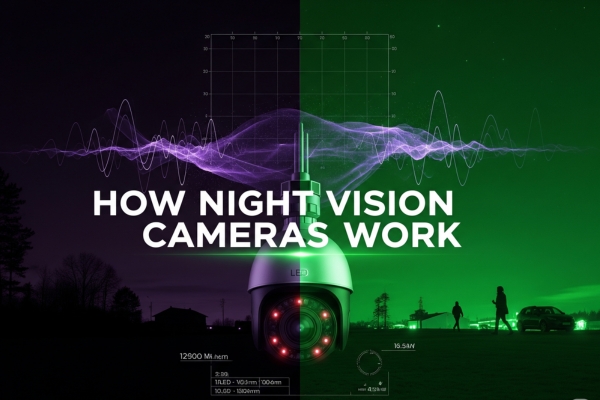
Night vision cameras work by combining three core technologies – infrared (IR) illumination, low-light image intensification, and thermal imaging – to capture images in conditions the human eye cannot see. Infrared illumination floods the scene with light just beyond visible wavelengths so the sensor can read reflected photons. Image intensification amplifies whatever faint ambient light already exists, such as starlight or distant streetlights, by factors of thousands. Thermal imaging reads the heat that every object radiates and turns temperature differences into a visible picture. Together these techniques explain how night vision cameras work across security, wildlife, and professional applications.
Modern night vision has quietly become one of the most important tools in photography, security, and field science. A consumer security camera on a porch in 2026 uses radically different hardware than a Generation 3 military monocular, yet both deliver the same promise: a usable image when light is missing. Over the past decade, sensor sensitivity, on-device AI, and color starlight imaging have moved the field far beyond the grainy green tubes of the early 2000s. Understanding the underlying physics makes it much easier to choose the right system, troubleshoot poor performance, and avoid the marketing terms that obscure real capability.
This guide breaks down exactly how night vision cameras work, from the microbolometer pixels that read heat, to the photocathode tubes that multiply photons, to the wide-aperture sensors that turn starlight into color video. You’ll find a full explanation of the three technology families, the Gen 1/2/3 image intensification ladder, a section on the new IR cut filter mechanism, and a deep look at the starlight and color night vision sensors that are reshaping the consumer market in 2026.
When people ask how do night vision cameras work, the short answer is that there are three completely different physical principles at play. A thermal camera reads infrared heat radiation. An infrared camera lights the scene with near-IR and reads the reflection. An image intensifier takes whatever photons are already there and multiplies them by tens of thousands. Most consumer security cameras combine the first two in a single housing, while professional and military systems use image intensification tubes that have been refined for more than sixty years.
The three approaches differ in what they require from the environment. Thermal imaging needs nothing but a temperature difference. Infrared illumination needs power for the LEDs and a clear line of sight to the subject. Image intensification needs at least some ambient photons to amplify. Knowing which technology fits your scene is the single biggest factor in night vision performance, which is why photographers and security integrators spend more time matching technology to environment than chasing the latest spec sheet.
Thermal imaging is the only one of the three night vision technologies that ignores light entirely. Every object warmer than absolute zero emits infrared radiation, and thermal cameras turn that emission into a picture. The sensor core is a microbolometer array – thousands of tiny pixels made from vanadium oxide or amorphous silicon. Each pixel changes electrical resistance in response to incoming infrared energy, and on-board electronics convert those resistance changes into a temperature value. The result is a heat map of the scene where warm objects glow against cooler backgrounds.
Most professional thermal cameras work in the 7 to 14 micrometer long-wave infrared band, which the atmosphere passes through cleanly. Sensitivity has improved dramatically: modern uncooled sensors can resolve temperature differences as small as 0.05°C, and radiometric models assign actual temperatures to each pixel. For deeper coverage of sensor types and use cases, our thermal imaging guides walk through FLIR-class handhelds, pan-tilt security systems, and the new sub-$500 entry-level units released in 2025.
In the field, thermal imaging behaves the same way at noon and at midnight. I’ve watched it pick out a person crossing a snowy field at 200 meters when a regular camera showed nothing but a white blur. It also sees through light fog, smoke, and vegetation cover that defeats visible-light cameras. The trade-off is resolution – even premium 640×480 thermal cores look soft compared to a 4K visible-light sensor – and the inability to read fine detail like a license plate through a windshield. For detection, thermal is unmatched. For identification, it usually needs a visible-light partner.
Most consumer night vision cameras on the market today use active infrared illumination. The camera surrounds the lens with a ring of infrared LEDs that flood the scene with light in the 850 nm or 940 nm near-infrared range. Human eyes cannot see this light, so the scene looks dark to anyone standing in it, but the camera’s image sensor – usually a CMOS chip with the IR cut filter removed or mechanically flipped aside – sees the reflected photons and produces a clear black-and-white image.
The two common wavelengths behave differently. 850 nm LEDs are more efficient, throw farther, and produce a faint red glow that a person can spot up close. 940 nm LEDs are completely invisible to the human eye and to most wildlife, but they cost roughly 30 percent of the effective range. Trail cameras and wildlife photography setups almost always use 940 nm so animals ignore the camera, while perimeter security often prefers 850 nm for the extra reach.
Range is mostly a function of illuminator power and the lens aperture. Budget cameras with small IR arrays illuminate 30 to 50 feet, midrange systems reach 100 to 150 feet, and high-power illuminators push past 500 feet. Many modern cameras adjust LED output automatically to avoid overexposing close subjects while keeping the background readable. That adaptive behavior is one of the most visible improvements in 2024 to 2026 firmware, and it solves the old problem of faces washing out white when someone walks within a few feet of the lens.
Active IR systems are the workhorse of the home security market, and they double as a great teaching example for how do night vision cameras work in practice: a standard CMOS sensor, a ring of LEDs, and a controller that flips between day and night profiles. They are inexpensive, reliable, and easy to deploy – which is why almost every outdoor Wi-Fi or PoE camera on store shelves uses this approach.
Image intensification is the original night vision technology, and it remains the gold standard for passive operation. Instead of adding light to a scene, an image intensifier takes the light that is already there – photons from the moon, stars, or distant streetlamps – and multiplies it. The amplification factor is enormous: a Gen 3 tube can boost a starlit scene by 30,000 to 50,000 times, producing a clean image in conditions where the naked eye sees nothing.
The physics happens inside a sealed vacuum tube. A photocathode surface, usually a gallium arsenide compound, releases an electron every time a photon strikes it. Those electrons are accelerated into a microchannel plate – a thin wafer pierced with millions of tiny glass channels. Each channel acts as a continuous-dynode electron multiplier, so a single electron entering one end can exit as several thousand electrons at the other. The multiplied electron stream then slams into a phosphor screen, where the kinetic energy is converted back into visible light – almost always in that familiar green hue because the human eye is most sensitive to green wavelengths.
Image intensifiers need photons to do their work. In total darkness, with zero ambient light, they produce no image at all. This is the one limitation that catches new users off guard: turn on a Gen 3 monocular inside a windowless room with the lights off and you will see only a dim green field. The fix is usually an IR illuminator added in front of the tube, which effectively turns the system into a hybrid that uses both technologies.
For field photographers, the appeal of image intensification is that it gives a passive view of the night. Hunters, wildlife observers, and security patrols use intensifiers precisely because the scene is not lit, so subjects and intruders cannot see the camera. The trade-off is weight, fragility, and cost – and a tube that slowly degrades with hours of use. Knowing how this technology works makes it easier to decide whether the passive advantage is worth the price.
Image intensification technology is classified into generations based on performance improvements. These generations are how the industry explains the gap between a $300 consumer monocular and a $6,000 military unit, and the depth here is a major differentiator for this guide. Understanding the generations also clarifies why prices vary so dramatically, and where the real performance boundaries sit.
Generation 1 image intensifiers deliver 1,000 to 5,000x light amplification using a basic photocathode and a single-stage electrostatic focusing system. They are the entry-level option, and they are what you find in most sub-$500 night vision devices. Image quality is usable but imperfect: there is noticeable distortion around the edges of the field of view, the resolution is modest, and the tubes show a faint honeycomb pattern from the fiber-optic inversion mechanism that early Gen 1 designs use to flip the image upright.
Tube life for Gen 1 averages 1,000 to 2,000 hours, which is plenty for casual security and recreational use. I have used Gen 1 monoculars for property patrols on moonlit nights, and they produce a clear, if slightly soft, image. They struggle in near-total darkness, however, and require either ambient light or an add-on IR illuminator to perform well. For first-time buyers, Gen 1 is a reasonable starting point, but the jump to Gen 2 in price is far smaller than the jump in image quality.
Generation 2 introduced the microchannel plate, the same component that defines modern intensifier performance. Electrons accelerated through the millions of parallel channels in the MCP are multiplied thousands of times, producing 20,000 to 25,000x light gain. The MCP also enables a smaller, more compact tube design, and the image is noticeably sharper with less edge distortion. Most Gen 2 tubes use a multi-alkali or early gallium arsenide photocathode for better quantum efficiency.
Tube life extends to 2,500 to 5,000 hours in Gen 2, and the resolution climbs to roughly 28 to 36 line pairs per millimeter in standard models. White phosphor variants, which produce a black-and-white image instead of green, are popular for users who need better contrast and reduced eye fatigue during long sessions. Gen 2 is the sweet spot for most professional civilian applications: a clear performance lift over Gen 1, without the export restrictions and price tag of Gen 3.
Generation 3 is the current military standard and the top of the consumer heap where export regulations allow. It uses a gallium arsenide photocathode, which is dramatically more sensitive than the multi-alkali coatings in Gen 2. The MCP is paired with an ion barrier film that prevents feedback ions from damaging the photocathode, extending tube life to 10,000+ hours. Light gain reaches 30,000 to 50,000x, and resolution climbs to 64 to 81 line pairs per millimeter in premium unfilmed variants.
Gen 3 systems can resolve a person in open terrain under overcast starlight – conditions that defeat most Gen 2 units without help. The trade-offs are weight, cost (commonly $3,000 to $10,000+), and U.S. International Traffic in Arms Regulations (ITAR) restrictions that limit who can purchase and export them. For most civilian uses, the additional performance over Gen 2 is real but rarely necessary. For military, law enforcement, and serious wildlife work, however, Gen 3 remains the benchmark.
There is also Gen 4, sometimes called “filmless and gated” Gen 3, which removes the ion barrier for higher signal-to-noise ratio. These tubes are even brighter and have faster automatic gating to handle sudden bright light, but they remain an active area of classification and trade, and most consumer guides lump them under the Gen 3 umbrella.
The sensor is the heart of every night vision camera, and how do night vision cameras work depends heavily on the sensor type. Most modern night vision cameras use CMOS (complementary metal-oxide-semiconductor) sensors, which have largely replaced older CCD (charge-coupled device) chips in this market. CMOS designs consume less power, read out faster, and integrate more on-chip processing, which is critical for AI features and color night vision modes.
Low-light sensor performance comes down to pixel size and quantum efficiency. Larger pixels capture more photons per frame, and modern 2-micron to 4-micron pixel designs dramatically outperform the sub-1.5-micron pixels common in daytime smartphone cameras. Back-illuminated CMOS (BSI) construction moves the wiring layer behind the photodiode, freeing up more of the pixel area to collect light. Combined, these advances have pushed ISO equivalents past 4,000,000, which is why modern low-light sensors can shoot color video under conditions that would have required infrared just a few years ago.
Sensor cooling also plays a role in extreme low-light applications. Cooling the sensor reduces dark current – the random thermal noise that contaminates the signal in long exposures. Professional astronomy and scientific cameras routinely cool their sensors to -20°C or below, and some industrial night vision cameras use thermoelectric coolers for the same reason. Consumer cameras rely on algorithmic denoising instead, and the result is good enough for almost all practical use cases at much lower cost.
An IR cut filter is a tiny piece of coated glass that sits between the lens and the sensor. During the day, the filter blocks infrared wavelengths from reaching the sensor, so the camera records accurate colors. Without an IR cut filter, daytime footage would have a pink or muddy cast, because the sensor would be receiving near-infrared light alongside visible light. When the camera detects that ambient light has dropped below a threshold, an electromechanical actuator slides the filter out of the optical path. The sensor then becomes fully sensitive to near-infrared, and the camera switches to its night mode for sharper black-and-white footage.
Two common implementations exist. Some cameras use a single sensor that physically swaps filters, which can produce a brief click and a momentary flash as the filter moves. Others use two separate sensors – one with the filter for day, one without for night – and a prism that directs light to the appropriate sensor. Dual-sensor designs cost more but eliminate the mechanical failure point and the visible transition. Both approaches are a big part of how night vision cameras work in real-world security installations, where day-and-night reliability is non-negotiable.
One practical note: IR cut filters and the surrounding housing can be fouled by dust, condensation, or spider webs, which then show up as bright blurry spots in night footage. Routine cleaning every few months, especially in outdoor installations, keeps the day/night transition crisp and prevents the IR glare problems that show up in forum reports after storms.
Traditional analog night vision relies on physical image intensification tubes. The light comes in, the photocathode turns it into electrons, the MCP multiplies them, and the phosphor screen turns them back into photons. The image exists only as long as the tube is producing it. Analog systems are still considered the best option for extreme low-light performance because the response is instantaneous and the tubes have a sensitivity that digital sensors cannot match in total darkness.
Digital night vision, by contrast, captures the image on a CMOS sensor and processes it electronically. Modern digital systems can record video directly to SD cards, output HDMI or USB video streams, and run image enhancement in real time. They can also display in color when ambient light is sufficient, which analog tubes cannot do. The downsides are higher noise in deep darkness and a slight processing lag compared to the instantaneous response of an analog tube.
Hybrid systems use a digital sensor paired with a removable or built-in image intensifier. The user can switch between passive digital mode, intensifier mode, or a combined mode that overlays the intensifier output on the digital sensor. The flexibility is appealing to wildlife observers and security professionals who work in widely varying conditions. As of 2026, hybrid monoculars have dropped in price to the $1,500 to $3,000 range, putting them within reach of serious hobbyists for the first time.
Starlight technology is the most important development in consumer night vision in the last five years. Rather than emit infrared light, a starlight camera works with whatever photons are already in the scene – moonlight, distant streetlights, or actual starlight – and amplifies them with a high-sensitivity CMOS sensor and a wide-aperture lens. The result is a color image in surprisingly dim conditions, which is a major shift from the black-and-white IR look that has dominated home security for two decades.
The two hardware factors that make starlight imaging work are sensor sensitivity and lens aperture. A fast lens with an F1.0 aperture lets in roughly four times as much light as a standard F2.0 lens, which is the difference between seeing a face in color and seeing a faint shape in grainy monochrome. Pair that aperture with a back-illuminated CMOS sensor and advanced noise reduction, and the camera can produce useful color video at illumination levels as low as 0.0005 lux, which is essentially overcast starlight with no moon.
Color night vision takes the same principle a step further. By keeping the IR cut filter engaged at very low light levels and relying entirely on visible-spectrum amplification, the sensor preserves hue and saturation. The catch is that color night vision requires at least some visible light, however faint. In a completely dark room, the camera will eventually drop to a black-and-white mode or trigger its IR illuminator for backup. This is the practical answer to the common question of why some cameras show color at night and others switch to monochrome – it depends entirely on how much ambient light the sensor can find.
Spotlight-assisted color night vision is a related approach: the camera includes a small white LED spotlight that turns on only when motion is detected, giving the sensor enough visible light to record full color. Spotlight cameras have become popular for porches and driveways because the visible flash doubles as a deterrent. The trade-off is that the spotlight is, well, visible – so this approach is not appropriate for stealth applications like wildlife observation or covert security work.
For most home and small-business use cases in 2026, starlight and color night vision have become the default expectation. The combination of F1.0 apertures, 1/1.2-inch sensors, and on-device AI denoising now matches or exceeds older IR-only designs, and it does so without flooding the scene with infrared light. If you are choosing a new camera, look for an explicit lux rating and the size of the sensor – those two specs tell you more about real night performance than any marketing claim.
Night vision camera performance depends on the environment as much as on the hardware. Thermal cameras ignore light, so they work just as well at noon as at midnight, but they cannot see through glass and they struggle to differentiate objects at the same temperature as the background. Infrared cameras need a clear line of sight to the subject, and rain, fog, and snow scatter the IR light and reduce range. Image intensifiers need at least some ambient light, but they excel at producing sharp, real-time images with no added illumination.
Weather cuts into range for every technology. Rain reduces thermal range by cooling the target and scattering the energy reaching the sensor. Snow reflects IR light unpredictably and can wash out the foreground of an IR camera. Fog is the most challenging condition for visible-light systems, because the water droplets scatter both visible and near-IR light. Thermal cameras handle fog best because the longer wavelengths pass through with less scattering.
For home and business security, infrared cameras remain the workhorse. They produce recognizable detail, they work with existing power over Ethernet (PoE) infrastructure, and they cost less than thermal systems. For most perimeter monitoring setups, I recommend a mix of IR cameras for identification and a small number of thermal or starlight cameras for early detection at the edge of the property. You can find detailed reviews in our security camera reviews and guides.
For larger properties – farms, warehouses, industrial sites – thermal cameras are worth the cost. A single thermal camera can monitor several acres and detect a person walking across a field at 200+ yards, regardless of clothing color or camouflage. The newest 2025 generation of thermal security cameras adds radiometric temperature alarms, so they can flag a vehicle with a hot engine in a parking lot or a person with a fever entering a building. These features were once reserved for industrial thermography, and they are now filtering down to consumer pricing.
Wildlife photographers have more night vision options than ever. Trail cameras with 940 nm illuminators are essentially invisible to deer, raccoons, foxes, and most birds, which means subjects behave naturally. The trade-off is range and image quality compared to 850 nm, but modern high-power 940 nm arrays close the gap to within 20 to 30 percent. For more in-depth coverage of how these cameras are deployed in field work, our wildlife photography resources cover trail camera placement, triggering strategies, and image interpretation.
Thermal imaging is also a powerful tool for wildlife observation. It can track a roosting owl through dense brush, monitor a fox den without disturbing the animals, or record bat emergence at dusk when visible-light cameras see only shadows. Combined with a digital recorder, a thermal monocular becomes a non-invasive observation tool that researchers and hobbyists can use across hundreds of nights without habituating the animals to a human presence.
One thing to watch for in the field is eye-shine. Bright IR illuminators pointed directly at an animal can cause a bright reflective glow in the eyes that ruins the photo and may briefly startle the subject. Lower the IR power, use a wider beam, or move the illuminator off-axis from the camera lens to reduce this effect. It is one of the small but important lessons that comes from real-world night vision work.
Night vision prices in 2026 span an enormous range. Basic IR security cameras can be found for $50, while a Gen 3 binocular with a Gen 3 image intensifier pair can exceed $10,000. The middle of the market – the $200 to $800 range – is where most buyers find what they actually need, especially for home security and casual wildlife observation. The key is matching the price to the application rather than chasing the highest spec.
For home security, $200 to $500 buys a starlight or color night vision camera with good low-light performance, smart detection, and weather resistance. The improvement from a 4MP to 8MP sensor at this price is marginal for night use – the lens aperture and sensor size matter more than pixel count once light is scarce. Spending more on a single well-placed F1.0 starlight camera is usually a better investment than buying several cheaper units that struggle after sunset.
Thermal cameras remain expensive, with entry-level units around $2,000 and professional radiometric systems past $15,000. For a homeowner, that is hard to justify. For a farmer protecting livestock, a security firm covering a large perimeter, or a search-and-rescue team, the cost is justified by the capability. Image intensifier monoculars and binoculars range from about $300 for Gen 1 to $4,000+ for Gen 3, with Gen 2 white phosphor offering the best value for most users.
Do not forget ongoing costs. Thermal cameras are largely maintenance-free, but image intensifier tubes have a finite lifespan. A Gen 2 tube might cost $800 to $1,500 to replace, so a worn monocular is not always worth repairing. IR security cameras have no consumable parts, but the LED arrays slowly lose output over 25,000 to 50,000 hours of use, and budget units may need a replacement camera after five to seven years of continuous operation.
Night vision technology is moving fast in 2026, and the trends that defined the last two years are now mainstream rather than experimental. Three areas in particular are reshaping what consumers and professionals can expect from a night vision camera in the next product cycle: on-device AI processing, 4K starlight sensors, and the rise of color night vision as the default mode rather than a premium feature.
On-device AI is the most visible change. New security cameras ship with dedicated neural processing units (NPUs) capable of running human, vehicle, animal, and package detection locally, with no cloud round-trip. The same chips denoise low-light footage in real time, sharpen edges, and balance color in mixed lighting. The practical impact is a dramatic reduction in false alerts – a wind-blown trash bag no longer triggers a person alert – and much better low-light image quality, because the denoising algorithm knows what a human face should look like and can preserve those details aggressively.
4K starlight sensors are another big shift. The combination of 1/1.2-inch or larger sensors, 2.4-micron pixels, and F1.0 lenses now produces usable 4K color video at illumination levels that would have produced nothing but green grain a few years ago. Reolink’s ColorX line, Hikvision’s ColorVu Pro, and Dahua’s FullColor 2.0 are leading examples, and the technology is moving into trail cameras and dash cams as well. The end of black-and-white-only night footage is in sight for most consumer applications.
Augmented reality overlays are starting to appear in professional-grade monoculars and helmets. A thermal or starlight image is annotated with range estimates, GPS coordinates, compass headings, and even object classification from a built-in neural network. Military and law enforcement have used similar features for years, but consumer pricing is finally within reach of serious hunters and search-and-rescue volunteers. Expect this to be a major differentiator in 2027 product cycles.
Finally, fusion imaging – blending thermal, low-light visible, and IR channels into a single picture – is moving from military hardware to consumer products. A fusion camera can highlight warm objects against a color starlight background, making it easier to find a person in foliage or a hot engine in a parking lot. Expect to see fusion as a standard feature in mid-to-high-end security cameras and trail cameras by the end of 2026.
Yes, most consumer night vision cameras emit near-infrared light from built-in LED arrays. The light is usually at 850 nm or 940 nm, both of which are invisible to the human eye. At 850 nm, a faint red glow can be seen up close; at 940 nm, the LEDs are essentially invisible. Thermal imaging cameras and image intensifiers do not emit any light at all – they work passively by reading heat or amplifying existing light.
Almost any solid material blocks night vision. Walls, doors, glass, and most clothing are opaque to both near-infrared and thermal wavelengths, with one important exception. Standard window glass blocks long-wave thermal radiation, so a thermal camera cannot see through a window any better than a regular camera. Smoke, heavy fog, and rain reduce range for all night vision types, but solid barriers block the signal completely.
Night vision cameras are legal for civilian use in the United States, Canada, the UK, Australia, and most of Europe. There are restrictions on Gen 3 image intensifier devices, which are classified under International Traffic in Arms Regulations (ITAR) and require a license to export. Recording on private property is generally allowed; recording in areas where there is a reasonable expectation of privacy is not. Always check local laws before deploying a night vision camera in public spaces or in another country.
Look for a small red glow at night, which indicates an 850 nm IR LED. 940 nm LEDs are virtually invisible, so a physical inspection is needed. Check for small dark windows on smoke detectors, doorbells, and outdoor fixtures. A phone camera can see most IR LEDs, even when the human eye cannot, because phone camera sensors are sensitive to near-infrared. Scan the room with the front-facing camera and look for bright dots in the image – those are IR emitters.
Thermal cameras work in complete darkness because they detect heat, not light. Infrared illumination cameras also work in total darkness because they provide their own invisible light. Image intensifiers require at least some ambient light to amplify; in zero light they produce no image unless paired with an IR illuminator. Starlight cameras need at least faint ambient light, such as starlight or distant streetlights, to produce a color image.
Range depends on the technology. Consumer IR security cameras typically see 30 to 150 feet. Professional IR systems reach 500 feet or more. Thermal cameras can detect a person at 200 to 500 feet and a vehicle past 1,000 feet. Image intensifiers depend on ambient light – Gen 3 tubes can recognize a human shape at 100 to 300 yards in starlight. Weather, lens aperture, and sensor size all influence the actual range you can expect.
No. Thermal cameras can read the heat on the surface of a wall, which can sometimes reveal a person’s presence on the other side as a faint warm spot, but they cannot see through solid barriers. Some specialized military radar systems can detect movement through walls, but those are not night vision cameras. Night vision technology in any form requires a clear line of sight to the subject.
Image intensifier tubes use a green phosphor screen to convert amplified electrons back into visible light. Green was chosen because the human eye is most sensitive to green wavelengths, so it produces the clearest perceived image. Modern digital night vision displays are not limited to green and can show black-and-white, amber, or full color. White phosphor tubes, which look more like black-and-white TV, are also popular for long viewing sessions.
IR illumination reflects off glass and produces a washed-out image, so a typical night vision camera pointed through a window will show glare. Thermal cameras cannot see through standard window glass at all. Image intensifiers and starlight cameras work through glass but lose range because the lens coatings and glass reduce light transmission. For an indoor camera looking out, mount it against the glass with the IR LEDs disabled, or use an external illuminator placed outside the window.
Digital IR security cameras typically last 5 to 10 years of continuous outdoor use. IR LED arrays slowly dim over 25,000 to 50,000 hours. Thermal sensors can operate for decades with proper care. Image intensifier tubes have a finite lifespan: Gen 1 tubes last 1,000 to 2,000 hours, Gen 2 tubes 2,500 to 5,000 hours, and Gen 3 tubes 10,000+ hours. After the rated hours, the tube begins to show blemishes and reduced gain.
The right night vision technology depends on what you need to see, in what conditions, and at what distance. There is no single best option. Instead, think of the four major approaches – thermal, infrared illumination, image intensification, and starlight – as tools for different jobs, and match the tool to the task.
For home and small business security, starlight or color night vision cameras with optional IR fallback cover the broadest range of conditions at the best price. For large perimeters, industrial sites, or detection-focused applications, thermal is hard to beat. For hunters, wildlife observers, and security patrols who need a passive view without revealing their position, image intensification in Gen 2 or Gen 3 is still the right answer. For photographers documenting wildlife behavior, the choice depends on whether you need to see the animal (a starlight or low-light camera) or detect the animal (a thermal scope).
A few practical buying criteria help cut through the marketing. Look for the lux rating rather than the IR LED count – a 0.001 lux sensor with an F1.0 lens will outperform a 0.01 lux sensor with the same LEDs. Check the sensor size, not just the resolution. A 4MP 1/1.2-inch sensor will outperform a 12MP 1/3-inch sensor in low light, every time. For outdoor installations, look for an IP66 or IP67 weather rating and an operating temperature range that matches your climate.
If you are still deciding, the best move is to start with one well-placed camera in a critical area and test it at night. Move the position, adjust the angle, and experiment with disabling the IR LEDs to see how the starlight mode performs. Once you have a working configuration for one camera, replicate it across the rest of the property. That practical approach saves money and produces a system that actually delivers in the conditions you care about.
Understanding how do night vision cameras work comes down to four mechanisms working in different ways. Thermal imaging reads heat signatures with a microbolometer array. Infrared illumination floods the scene with light just beyond human vision and lets a CMOS sensor record the reflection. Image intensification amplifies whatever photons are already there by 30,000 to 50,000 times inside a vacuum tube. Starlight and color night vision sensors, the newest of the four, work with extremely low ambient light and produce color images that were impossible at consumer prices just a few years ago. Each technology has strengths and trade-offs, and the right choice depends on the conditions you need to see in.
The bigger story is that the boundaries between these technologies are blurring. On-device AI now denoises and classifies footage in real time, fusion cameras blend thermal and visible-light channels into a single image, and 4K starlight sensors are bringing color night vision into the price range of mainstream security buyers. For more guides, reviews, and hands-on tests of the latest night vision gear, explore our complete night vision resource library along with our thermal imaging guides and hunting optics and night vision gear collections.
Looking ahead to the rest of 2026 and beyond, expect color night vision to become the default expectation in new cameras, AI-driven detection to replace simple motion alerts in everything from doorbells to trail cameras, and consumer-priced fusion imaging to reach the market in the next 18 months. The dark is no longer the obstacle it once was, and the people who understand the technology behind the lens will be the ones who choose the right system for the job.