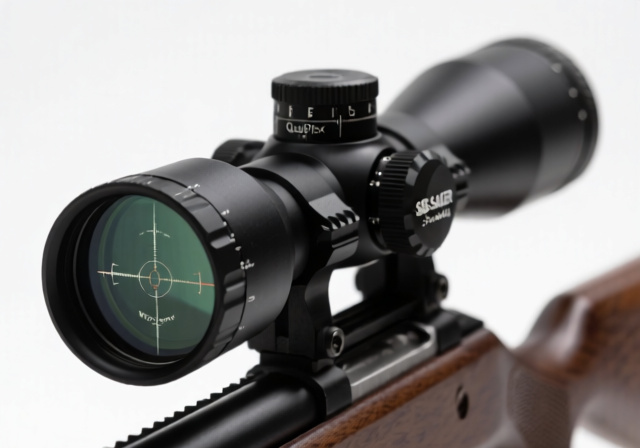
Sig Sauer Whiskey3 3-9×40 Review 2026: Budget Scope Excellence
After three months of rigorous testing across multiple rifles and shooting conditions, I can confidently recommend the Sig Sauer Whiskey3…


Modern rifle scope turret systems do far more than dial a bullet onto a paper target. They convert a rifle, a load, and a set of atmospheric conditions into a predictable trajectory, then give the shooter a tactile interface for making corrections at speed. As long-range shooting has matured into a defined discipline, the turret has become the most touched, most argued-over, and most upgraded component on the rifle.
This guide explains how rifle scope turret systems actually work, the difference between target, ballistic, capped, and exposed designs, and how MOA and MIL click values translate into real-world corrections. It also covers the modern features that separate premium scopes from budget ones, what data a manufacturer needs to cut a custom turret, and how to keep adjustments tracking accurately over years of hard use.
Readers who need a refresher on the broader scope landscape can start with the different types of rifle scopes before digging into turret specifics. Everything below assumes a basic understanding of how a scope mounts to a rifle and what zeroing means.
A scope turret is the adjustment knob on the outside of a riflescope that moves the internal erector lens assembly, which in turn shifts the reticle’s apparent point of aim relative to the target. Most scopes have two turrets: one for elevation (up and down) and one for windage (left and right). Higher-end scopes add a third turret or side focus knob for parallax correction, and many now incorporate a fourth mechanism called a zero stop that prevents the elevation turret from rotating below a preset zero.
Each click of a turret corresponds to a fixed angular measurement. The two industry standards are 1/4 MOA (one-quarter minute of angle, roughly 0.26 inch at 100 yards) and 0.1 MIL (one-tenth milliradian, roughly 0.36 inch at 100 yards). Click value, total adjustment range, and turret diameter together define how a scope feels in the hand and how much real-world correction it can deliver before running out of elevation or windage.
Key Definition: A scope turret is a mechanical adjustment knob that moves the erector lens inside a riflescope, producing a measurable shift in point of impact measured in MOA or MIL.
Inside every modern riflescope sits a tube called the erector assembly, held in place by a spring and a precision-threaded screw. Rotating the turret turns that screw, tilting the erector tube slightly, which shifts the light path through the scope and moves the reticle’s apparent aim point relative to the target. The turret, the threaded mechanism, and the erector spring are engineered to extremely tight tolerances: quality scopes hold adjustment accuracy within 0.1 MOA over their full travel range.
For a visual walkthrough of these internals, Ryan Cleckner’s NSSF tutorial is the most widely cited resource on the topic.
Watch: Ryan Cleckner walks through scope turret mechanics, click values, and reset-to-zero procedures.
The mechanical linkage is why turret feel matters as much as turret precision. A scope with mushy clicks or inconsistent detents makes the shooter guess whether each click actually registered. A scope with crisp, repeatable detents allows dialing by feel in low light, under stress, or while shooting from awkward positions.
The elevation turret sits on top of the scope and moves the point of impact up or down. The windage turret sits on the right side and moves it left or right. In practical shooting, elevation adjustments account for the majority of turret work because bullet drop increases with distance, while windage changes are typically limited to wind compensation.
The most important rule for choosing a system is consistency: the reticle and the turrets should both use the same angular measurement (both MOA or both MIL). Mixing a MIL reticle with MOA clicks, or vice versa, forces mental conversion under time pressure and is the single most common source of turret-related misses in the field.
Parallax error happens when the target image and the reticle sit on different focal planes inside the scope, so shifting eye position slightly behind the scope makes the reticle appear to wander across the target. Many shooters underestimate how large this error can be: parallax misalignment at 600 yards can shift apparent impact by several inches, producing misses that look like shooter error but are actually optical error.
The parallax turret (or adjustable objective bell) refocuses the internal image so the reticle and target share the same focal plane. The standard adjustment procedure is to mount the rifle on a steady rest, aim at a plain background, and rotate the parallax knob while moving the head side to side until the reticle stays still. Once adjusted, the turret stays put until the target distance changes significantly. Beyond 400 yards, parallax correction moves from a nice-to-have to a requirement for repeatable precision.
Rifle scope turret systems fall into four primary categories: target, ballistic, capped, and exposed. Each solves a different problem, and most modern scopes combine elements of more than one type. The chart below summarizes typical use cases and price tiers before the breakdown of each design.
| Turret Type | Best For | Adjustment Style | Typical Price Tier |
|---|---|---|---|
| Target Turrets | Competition, load development | Tall, fine clicks | Mid-range to premium |
| Ballistic Turrets | Long-range hunting | Yardage-marked dials | Mid-range to premium |
| Capped Turrets | Field hunting | Protected under caps | Entry to mid-range |
| Exposed Turrets | Tactical, competition | Open, large diameter | Mid-range to premium |
Target turrets are tall, exposed knobs with clearly printed graduations in MOA or MIL. Their defining feature is high adjustment range, often 60 to 80 MOA of total elevation travel, which is enough to dial all the way out to extreme distances without supplementing the scope base with a canted rail. Target turrets also offer the clearest visual reference of where the dial is set, which matters when a shooter wants to come back up through a known correction.
Adjustment style varies: fingertip-adjustable turrets turn easily with the thumb for quick dialing, while coin-slot or locking turrets require a tool or a deliberate motion. Fingertip turrets favor speed; locking turrets favor security in rough field conditions where an accidental bump could otherwise shift zero.
A ballistic turret replaces the standard MOA or MIL graduation with yardage or distance markings specific to a chosen load. Once zeroed and dialed correctly, the shooter dials to the target distance rather than counting clicks. The result is that ballistic drop compensation (BDC) becomes a single dial motion instead of a calculation.
Ballistic turrets are load-specific by definition. Change bullet weight, muzzle velocity, or shooting altitude, and the dial markings no longer match real-world trajectory. They work best for shooters who commit to a single load for an entire hunting season or competition series and who verify the dial against real-world hits before trusting it past 500 yards.
Capped turrets sit beneath screw-on or pop-up covers that protect the adjustment mechanism from accidental movement. Pull a cap off, dial the correction, replace the cap. The cover is the only thing standing between the shooter and a bumped zero, which is why capped turrets remain the standard for general-purpose hunting scopes.
The tradeoff is speed. In a PRS match or a fast follow-up shot, removing a cap costs fractions of a second that compound across multiple engagements. For hunters moving through thick cover where the rifle is bumped, brushed, or stacked against a tree, those same caps prevent the zero-shift that would otherwise produce a missed shot.
Exposed turrets leave the adjustment mechanism uncovered so the shooter can dial without removing anything. Most exposed designs are also locking: a lever or collar locks the turret so it cannot rotate accidentally, but the lock releases instantly when the shooter needs to dial. The result is fast adjustment combined with mechanical protection against zero loss.
Exposed locking turrets are the standard in PRS and NRL Hunter competition because they let a competitor move through multiple adjustments without breaking position. They are also increasingly common on premium hunting scopes, where modern manufacturing has made the locking mechanism reliable enough for rough field use.
Beyond the four basic categories, modern scopes include features that fundamentally change how the turret behaves. Understanding which scope tiers include which features helps match a scope to a discipline.
A zero stop is a mechanical hard limit inside the elevation turret that prevents rotation below a preset zero. Once the shooter dials up to engage a distant target, the zero stop catches the dial exactly at the original zero when the shooter returns down. This eliminates the guesswork of counting clicks back to zero in low light or under stress. Zero stops are considered essential by serious PRS and NRL Hunter shooters, and they are now standard on most scopes above the entry-level price tier.
A turret lock holds the turret at a fixed setting until the shooter deliberately releases it. Locking turrets prevent accidental adjustment during transport or while shouldering the rifle through heavy cover. Some scopes use a push-down or pull-up collar; others use a small lever. Either approach works, but the lock must be positive enough to survive recoil and rough handling.
A revolution indicator marks the number of full turret revolutions, so the shooter knows whether the dial is set at the first, second, or third revolution of internal travel. This matters because most scopes do not show total elevation beyond one revolution, and a shooter who has dialed two full revolutions up is in a different adjustment zone than someone on the first revolution. Indicators range from a simple numbered window to a secondary dial with a moving marker.
Zero Stop: A mechanical hard limit inside the elevation turret that prevents rotation below a preset zero, allowing an instant, click-free return to the original zero setting even under stress or in low light.
The choice between MOA and MIL is less about which is more accurate and more about which is more intuitive for the shooter. Both are angular measurements with identical mathematical precision; both work at any distance. The decision should match the shooter’s reticle, ballistic calculator, and rangefinder so the entire system speaks the same language.
| Feature | MOA System | MIL System |
|---|---|---|
| Common Click Value | 1/4 MOA (0.26″ at 100 yd) | 0.1 MIL (0.36″ at 100 m) |
| Total Elevation Range | 60 to 80 MOA typical | 17 to 30 MIL typical |
| Mental Reference | Inches at 100 yards | Centimeters at 100 meters |
| Common Use | American hunting, target | Tactical, international, metric |
The chart below shows click values translated into real distance at common engagement ranges, so the abstract numbers become concrete.
| Distance | 1/4 MOA per click | 0.1 MIL per click |
|---|---|---|
| 100 yd / 100 m | 0.26 in | 0.36 in / 1 cm |
| 300 yd / 300 m | 0.78 in | 1.08 in / 3 cm |
| 500 yd / 500 m | 1.30 in | 1.80 in / 5 cm |
| 800 yd / 800 m | 2.08 in | 2.88 in / 8 cm |
| 1000 yd / 1000 m | 2.60 in | 3.60 in / 10 cm |
MOA stands for minute of angle, an angular unit equal to 1/60 of one degree. At 100 yards, one MOA equals 1.047 inches, which most shooters round to one inch for fast field math. Because the unit scales linearly with distance, one MOA at 300 yards is about 3 inches, and one MOA at 1000 yards is about 10.4 inches. MOA is the dominant system in American hunting and recreational precision shooting, largely because factory ammunition data is typically published in MOA-equivalent trajectory tables.
One MOA divided into four clicks produces a 1/4 MOA click value, which moves the bullet roughly 0.26 inch at 100 yards. That level of resolution is finer than MIL equivalents and gives MOA scopes a slight advantage when the shooter is trying to split sub-MOA groups at known distance.
MIL stands for milliradian, equal to 1/1000 of a radian, which works out to 3.6 inches at 100 yards or 10 centimeters at 100 meters. Military and tactical shooters adopted MIL decades ago because the math aligns cleanly with base-10 metrics, and modern rangefinders and ballistic calculators output MIL hold values natively.
Most MIL scopes click in 0.1 MIL increments. That is a larger per-click correction than 1/4 MOA, which means fewer total clicks are required to make the same correction at distance. For shooters who run the math on a holdover reticle and prefer to dial fewer clicks for big corrections, MIL is faster. The MIL system also tends to offer more total revolutions of adjustment travel, so MIL scopes typically have more raw elevation available before running out of internal travel.
Conversion between the two systems is straightforward. One MIL equals approximately 3.438 MOA; one MOA equals approximately 0.291 MIL. The practical conversion rule of thumb is that 0.1 MIL is roughly 1/3 MOA, which is close enough for most field estimates.
Even so, mixing MOA and MIL systems within a single rifle setup is the most common source of long-range misses caused by confusion. Choose one system, configure the reticle, the turrets, the rangefinder, and the ballistic app in that system, and resist the temptation to switch later.
Capped and exposed turret designs address opposite priorities. Capped turrets protect zero at the cost of speed; exposed turrets deliver speed at the cost of vulnerability. The right choice depends on whether the rifle spends more time in a backpack or more time on a barricade.
Exposed turrets allow the shooter to dial corrections without removing anything, which matters in competition. Precision Rifle Series stages routinely require eight to ten adjustments between positions, and capped turrets would add measurable seconds to each transition. Exposed designs also typically support locking mechanisms, so the speed advantage comes with mechanical protection if the lock is engaged during movement.
Capped turrets shine in hunting scenarios where the rifle is carried over rough ground, stacked against a tree, and otherwise exposed to bumps that could rotate an exposed dial. The cap is a passive defense that requires no shooter action and no habit change. For hunters who rarely make turret adjustments in the field, the speed penalty is irrelevant.
Most hunters do best with capped turrets on windage and an exposed, locking elevation turret that carries a ballistic dial. This hybrid gives zero protection on the adjustment that rarely changes while preserving speed on the adjustment that defines long-range hunting. For a closer look at how this hybrid plays out on a specific cartridge, the best long range scope for 6.5 Creedmoor guide walks through how ballistic turrets perform on a popular western-hunting round.
Hunters who routinely shoot beyond 300 yards in open country where shots are deliberate may prefer fully exposed turrets with a zero stop, since quick adjustment becomes more important than accidental-bump protection. Hunters in dense timber or steep terrain usually lean toward capped designs for the zero-retention guarantee.
Competition disciplines almost universally require exposed turrets because cap-removal time compounds across dozens of adjustments per stage. PRS and NRL Hunter shooters also expect zero stops as standard equipment. The combination of exposed dialing, positive locking, and reliable zero return allows competitors to push the rifle hard between stages without losing the starting reference point.
It is worth noting that even elite long-range shooters miss more often than the benchrest community expects. Vortex Extreme Challenge data has shown top competitors hitting fewer than half of steel targets at known distance with spotters, which is a useful reality check for anyone setting expectations from a printed ballistic chart.
Custom turret systems transform a standard scope into a yardage-marked dialing tool. Instead of counting MOA or MIL clicks, the shooter dials the target distance and the scope does the work. Custom turrets are load-specific, ammunition-specific, and often environment-specific, so they reward shooters who commit to a setup and verify it carefully before relying on it.
Before choosing between a custom dial system and other long-range options, it helps to understand how the choice interacts with the rest of the rifle. The FFP vs SFP scope differences directly determine whether a ballistic reticle or a ballistic turret makes more sense for a given shooter.
The two long-range aiming systems solve the same problem in different ways. A ballistic turret uses a moving dial; a ballistic reticle uses aiming points etched into the glass. Each has advantages that suit different shooting styles.
| Feature | Ballistic Turret | Ballistic Reticle |
|---|---|---|
| Moving Parts | Yes (turret + erector) | No (etched glass) |
| Works in SFP Scopes | Yes, at any magnification | Only at one magnification in SFP |
Ballistic turrets work on any scope that has a removable elevation knob, including most second focal plane scopes. They also work in first focal plane scopes, where the reticle’s holdover scales with magnification. The downside is mechanical complexity: a tracking error, a loose set screw, or a bumped zero silently invalidates the markings.
Ballistic reticles have no moving parts. The hold points are etched into the glass, so a reticle that holds for 600 yards at one magnification will always hold for 600 yards, regardless of mechanical issues. In first focal plane scopes, the reticle scales with magnification, so hold values stay valid across the magnification range. In second focal plane scopes, however, the reticle only reads true at one specific magnification, and dialing up or down invalidates the hold points. This FFP-vs-SFP interaction is why shooters must match reticle choice to scope choice, not the other way around.
Practical Guidance: A custom ballistic turret is the right call for SFP scopes and for shooters who prefer dialing to holding. A ballistic reticle is the right call for FFP scopes and for shooters who prefer holding over dialing, especially in cold-weather hunting where turret exposure is impractical.
Focal plane selection drives turret strategy more than any other scope specification. In a first focal plane scope, the reticle grows and shrinks with magnification, so mil-based holdover points are valid at every power setting. This pairs naturally with a MIL turret and a mil-based ballistic reticle, allowing the shooter to hold or dial interchangeably.
In a second focal plane scope, the reticle stays the same physical size regardless of magnification, so the reticle’s mil or MOA markings only read correctly at one specific magnification. Shooters using SFP scopes typically rely on dialing the elevation turret to the target distance, which is exactly the case where a custom ballistic turret becomes most valuable. Understanding this interaction before buying prevents the common mistake of buying a ballistic reticle and discovering it only works at one power setting.
Custom turret manufacturers need a specific data package before they can cut a dial. Submitting incomplete information leads to dials that miss at distance. Most makers require the following inputs:
Manufacturers cut the dial from a ballistics solution based on these inputs. Any change to load, scope height, or environment requires a new dial. Shooters who switch ammunition frequently or who travel between drastically different altitudes will cycle through multiple dials per year.
Aftermarket turret makers cut replacement knobs that swap in for the factory elevation turret. Kenton Industries is the most established U.S. supplier and supports a wide range of scope models from Vortex, Zeiss, Nikon, Nightforce, Leupold, Burris, Bushnell, Meopta, and Minox. Kenton dials are machined in Columbia, Tennessee, and the typical turnaround runs two to three weeks once ballistic data is approved.
Drop-in turrets cost roughly $80 to $150 depending on scope and dial complexity. They preserve zero because they replace the existing turret without touching the erector assembly. The shooter zeros the rifle, locks the new dial in place, and from then on dials distance rather than clicks.
Several companies make custom or semi-custom turret solutions, each with a slightly different model. The list below covers the most commonly used options for North American shooters.
For shooters who want custom markings without sending a scope to a manufacturer, aftermarket adhesive turret labels offer a low-cost option. Labels are printed with yardage or mil markings based on the shooter’s ballistics solution and applied directly to the factory turret. The cost is typically $20 to $50 per dial, and labels can be replaced when loads change.
The tradeoff is durability. Adhesive labels wear with handling, can peel at temperature extremes, and may shift under heavy recoil. Shooters who run hard-use rifles in wet or dusty conditions typically replace labels annually. For range use and competition, labels work well as long as the shooter verifies them against known distances before trusting them in the field.
Even high-quality scopes develop turret issues under hard use. The three most common failure modes are tracking inconsistency, zero loss, and rough or sticking adjustments. Each has a known cause and a known fix.
Tracking inconsistency is the most damaging because it is invisible until the shooter misses. A scope that advertises 1/4 MOA clicks but actually moves 0.23 or 0.27 MOA per click will produce cumulative error at long range. The diagnostic tool is the box test: shoot a group at the starting point, dial up a known correction, shoot a second group, dial right, shoot a third, then return to the original dial settings and shoot a fourth group. If the fourth group does not land on top of the first, the scope has a tracking issue that requires manufacturer service.
Zero loss happens when the turret mechanism rotates unexpectedly, shifting the point of impact between shots. Exposed turrets without zero stops are most susceptible, especially on rifles that are carried in vehicles, slung on packs, or stacked against hard objects. The fix is mechanical: install a scope with a factory zero stop, retrofit a zero-stop kit if available, or use a locking turret design that holds position under recoil.
The defensive habit is to verify zero before each session and to return turrets to zero between hunts or matches. Many shooters develop a quick confirmation: dial back to the mechanical zero stop, then check that the rifle still prints at the established zero with a cold bore shot. A zero check takes less than a minute and prevents the kind of failure that ruins an expensive hunt.
Turret mechanisms can develop rough spots or stick at specific points in their rotation. Common causes are dried internal lubrication, contamination from dirt or moisture, and manufacturing defects. Adding lubricant to the turret is tempting but usually counterproductive because oil attracts grit that accelerates wear on the precision threads.
The right approach is preventive: keep turret caps on during transport, avoid exposure to temperature extremes, and never force a dial that resists rotation. Persistent roughness under warranty terms is grounds for a factory service request. Most scope manufacturers will repair or replace turrets with verified defects within the warranty period.
Routine maintenance extends turret life and preserves tracking accuracy. The good news is that modern scopes require very little: an annual cleaning, a zero verification, and careful handling around impact and transport.
Cleaning starts with a soft brush to remove grit from turret crevices, followed by compressed air to clear debris from the dial interface. Liquid cleaners should not be applied directly to turrets because they can wick into the scope body. For sticky residue, a barely damp microfiber cloth followed by immediate drying works. Turret torque and detent feel should be checked monthly; loose or wobbly turrets indicate a worn mechanism that needs factory service.
Before hunting season, run a full zero verification with fresh ammunition, perform a box test to confirm tracking, and check that adjustments feel smooth across the full rotation. This pre-season check catches problems during the off-season when there is time to send the scope back for service.
Harsh-use cleaning is environmental. Salt air exposure requires immediate wipe-down and drying to prevent corrosion on external turret components. Desert use demands thorough grit removal from the dial interface. Wet-weather use should be followed by drying the scope body and removing any moisture from under turret caps before storage.
Long-term storage positions the rifle vertically if possible, with turrets facing down so internal lubricants settle evenly through the mechanism. Climate-controlled storage away from direct sunlight protects the lubricants and plastic components that degrade with UV exposure.
Before storing, set all turrets to mechanical zero and engage any locking mechanisms. This relieves tension on the erector spring and the dial assembly, which extends functional life and prevents the kind of stuck adjustment that surfaces months later when the rifle is pulled out for a hunt.
The right turret system depends on what the rifle is used for, how often it gets bumped, and how disciplined the shooter is about returning to zero. A simple capped MOA setup covers most hunting needs; a more advanced exposed MIL setup with a zero stop suits competition; a custom ballistic turret serves shooters committed to a single load at known distances.
For a broader look at scope selection beyond turrets alone, the choosing a rifle scope hub covers how turret systems fit into overall scope selection.
Beginners benefit from capped MOA scopes with 1/4 MOA clicks. The inch-based mental math matches American factory ballistics tables, and the cap protects against the accidental adjustments that newcomers make while learning. A zero stop is nice but not necessary at this stage.
Intermediate shooters typically upgrade to exposed locking turrets with a zero stop and either a MIL or MOA system that matches their reticle. As skills develop, a custom ballistic turret becomes a sensible add-on for shooters who commit to a load. Advanced shooters usually specialize: competition shooters lean toward MIL for fast dialing and base-10 mental math, while long-range hunters lean toward MOA custom ballistic dials for yardage-marked engagement.
In 2026, a quality hunting scope with reliable tracking and capped turrets typically runs $700 to $1500. Mid-range precision scopes with exposed locking turrets and zero stops start around $1200 and run to $2500. Premium competition scopes with custom ballistic turret support, advanced zero-stop mechanisms, and first focal plane MIL reticles range from $2500 to $4500 and up.
The biggest performance jump for the dollar is moving from a no-zero-stop scope to a scope with a verified zero stop. The next jump is moving to a custom ballistic turret for shooters who use one load consistently. Premium materials (such as 7075-T6 aluminum housings versus 6061-T6) and ultra-fine click values matter more at competition levels than for general hunting use.
A scope turret system is the mechanical interface between a shooter’s skill and a rifle’s accuracy. The investment shows up in the field as faster corrections, fewer missed opportunities, and a more confident shooter.
– Precision shooting instruction standard practice
A scope turret rotates a precision-threaded screw inside the scope that moves the erector lens assembly. Each click shifts the lens by a fixed angular measurement, which translates to a measurable change in point of impact at the target. Most scopes have elevation and windage turrets; higher-end scopes add parallax and zero-stop mechanisms.
A zero stop is a mechanical hard limit inside the elevation turret that prevents the dial from rotating below a preset zero. It allows the shooter to dial up to a distant target and return to the original zero by dialing back down until the stop engages, without counting clicks. Zero stops are standard on most mid-range and premium scopes and are considered essential by serious PRS and NRL Hunter competitors.
Exposed turrets are adjustment knobs on a riflescope that are not covered by caps, allowing the shooter to dial corrections without removing anything. They are typically tall, large in diameter, and may include locking mechanisms to prevent accidental adjustment. Exposed turrets favor speed and are standard in precision rifle competition and tactical shooting.
Custom scope turrets are worth it for shooters who commit to a single ammunition load and shoot at consistent distances. They replace MOA or MIL click counting with a yardage-marked dial, dramatically reducing the time to make a long-range correction. For shooters who frequently change loads, scopes, or shooting environments, standard turrets offer more flexibility.
Three-turret scopes include a parallax adjustment turret in addition to standard elevation and windage turrets. The third turret eliminates parallax error between the reticle and target by refocusing the scope’s internal image. Parallax correction becomes important for precision shooting beyond 400 yards, where small eye-position shifts can otherwise move the apparent aim point.
Yes, many scopes allow turret replacement through aftermarket companies such as Kenton Industries. The process typically involves sending the scope to the manufacturer with ballistic data, who then machines a yardage-marked replacement turret. Custom drop-in turrets cost roughly $80 to $150 and can transform a standard scope into a yardage-adjustable system. Not all scopes are compatible, so compatibility should be verified with the manufacturer before ordering.
One MIL equals approximately 3.438 MOA, which means one MOA equals approximately 0.291 MIL. A common field rule of thumb is that 0.1 MIL is roughly 1/3 MOA. Mixing MIL and MOA systems in one rifle setup is discouraged because the conversion introduces error under time pressure.
The amount of MOA needed at 1000 yards depends entirely on the load, but a typical 6.5 Creedmoor 140-grain load requires around 25 to 28 MOA of total elevation from a 100-yard zero. Heavier bullets at higher ballistic coefficients and faster muzzle velocities require less MOA; lighter, slower bullets and longer distances require more. A scope with at least 60 MOA of total elevation travel is recommended for 1000-yard work with common hunting loads.
Turret calibration should be checked before each hunting season or major competition, and after any rough handling, scope removal, or environmental extreme. A box test verifies tracking accuracy, and a cold-bore zero confirmation catches zero shift. Frequent shooters may want to verify calibration monthly during active use.
Neither MIL nor MOA is more accurate than the other in absolute terms; both are angular measurements with identical mathematical precision. MIL offers larger per-click corrections (0.1 MIL equals about 1 cm at 100 m), which means fewer total clicks for the same adjustment. MOA offers finer per-click corrections (1/4 MOA equals about 0.26 inch at 100 yd), which is useful for splitting very small groups. The right choice depends on the shooter’s reticle, ballistic calculator, and personal preference.
Understanding rifle scope turret systems is what separates an average shooter from a precise one. The turret is the mechanical interface that turns a rifle, a load, and a set of atmospheric conditions into a predictable trajectory, and the best systems give the shooter a fast, repeatable, verifiable way to control that interface.
For most readers, the highest-leverage upgrades are a zero stop on the elevation turret and a custom ballistic dial for the chosen load. Both pay back their cost quickly in saved time, fewer missed shots, and more confidence at distance. Pair them with a verified tracking test, an annual cleaning, and a habit of returning to mechanical zero between sessions, and the turret system becomes a reliable tool rather than a source of doubt.
For specific rifle setups, the FFP vs SFP scope differences guide explains how focal plane choice interacts with turret strategy, and the best long range scope for 6.5 Creedmoor page shows how these principles play out on a popular long-range cartridge.