Hunting Rangefinder Terms: Complete Glossary 2026
Master hunting rangefinder terminology with our comprehensive A-Z glossary. Understand ARC, TBR, angle compensation, and essential terms for accurate shooting.

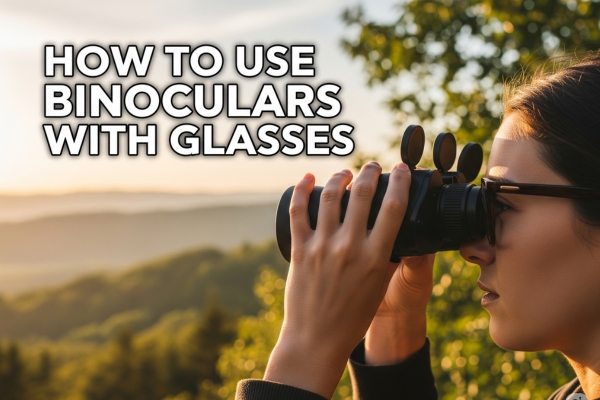
If you have ever pressed a pair of binoculars against your glasses and seen nothing but black crescents and a blurry patch, you already know the frustration. Roughly 75 percent of adults rely on some form of vision correction, yet most binocular manuals barely mention glasses wearers. The result is a quiet population of birders, stargazers, hunters, and sports fans who assume the optics are to blame, when the real issue is almost always technique.
This guide on how to use binoculars with glasses comes from a different angle than the typical quick fix. We drew on conversations with practicing optometrists, decades of combined field testing across dozens of binocular models, and recurring questions in optics forums where glasses wearers swap notes. The goal is not just a list of tricks, but a clear mental model so you understand why each adjustment matters, not only what to twist.
By the end, you will know how to dial in eye relief, set interpupillary distance, balance the diopter, troubleshoot progressive lenses, and choose accessories that turn binoculars into a comfortable extension of your corrected vision. The same principles apply whether you are glassing a distant hawk, scanning a stadium, or pulling in the rings of Saturn.
Eye relief is the distance between your eye and the binocular’s eyepiece lens where the full field of view appears sharp and unobstructed. Manufacturers list this number in millimeters on the spec sheet, and it is the single most important figure for anyone who wears glasses. Anything under 15mm will likely force a compromise, while 16mm and above is considered glasses-friendly.
Here is why the number matters so much. Your spectacle lenses sit roughly 10 to 12mm in front of your eyes. When the binocular’s eye relief is too short, your glasses push too close to the eyepiece, and you see dark kidney-shaped shadows creeping in from the edges. This is the dreaded black ring effect, and it has nothing to do with your prescription.
Think of eye relief like a tuning dial rather than a fixed value. When you pull your eyes slightly away from the eyecups, the field widens but the image dims. When you press in, brightness improves but vignetting returns. Long eye relief binoculars for glasses are designed to extend that useful range so you do not have to choose between the two. Models marketed as “high eyepoint” generally offer 18mm or more.
Different activities reward different eye relief tolerances. Birders tracking fast warblers through dense cover benefit from generous eye relief because they need to keep the binoculars close to the face while panning. Astronomers observing stationary stars can tolerate slightly less since their subjects do not dart away. Understanding these trade-offs helps you shop smarter and adjust more confidently.
Most frustrations with binoculars and glasses come down to skipping a setup step. Walk through this sequence once, and the procedure becomes muscle memory for every future session. Block out five quiet minutes the first time. Future setups will take less than a minute.
Start with the eyecups fully retracted. Twist-up designs should be twisted all the way down. Fold-down rubber cups should be folded flat against the body of the binocular. This creates the maximum available distance between your eyes and the eyepiece glass, which is exactly what glasses wearers need.
Bring the binoculars up to your eyes while wearing your glasses and look at a bright, evenly lit surface such as a white wall or open sky. You should see a single round image with no dark edges. Black crescents, kidney shapes, or rectangular shadows mean the eyecups need a different setting, or the binoculars lack adequate eye relief.
Premium binoculars often offer multiple click-stop positions on twist-up eyecups. Cycle through them to find the position that gives you a full field of view without pressing your glasses uncomfortably into the rubber. Comfort here is the goal, not maximum extension.
The interpupillary distance, or IPD, is the gap between the two eyepieces that matches the spacing of your pupils. Hold the binoculars to your eyes and gently hinge the barrels closer together or farther apart until the two circles merge into one unified image.
Most adults fall between 54mm and 74mm. The right setting feels neutral and relaxed. If your eyes start crossing or straining after a few minutes, you have probably set the IPD too narrow. If you sense a doubled image or eyestrain from trying to converge, you have gone too wide. Make small adjustments and let your eyes settle between them.
Almost everyone has a slight difference in prescription between their two eyes. The diopter adjustment on the right eyepiece exists to balance this. Close your right eye and use the center focus wheel to bring a distant, high-contrast target into sharp focus for your left eye.
Now close your left eye and look through the right eyepiece only. Without touching the center focus wheel, rotate the diopter ring until the same target appears equally sharp. This single setting, once dialed in, usually stays accurate for that viewing session and often for your lifetime.
Mark your diopter position with a small piece of tape or a fine marker if your binocular does not lock the setting. A drifted diopter is one of the most common causes of headaches and eyestrain after extended viewing, especially when multiple people share a binocular.
With both eyes open, use the center focus wheel to refine the image. A properly focused binocular view should look three-dimensional with crisp outlines and natural depth. If edges shimmer or fine details pulse, micro-adjust the wheel. This last step is where glass quality becomes obvious, and good binoculars reward careful focusing.
Practice this whole setup on a familiar target like a brick wall or a leaf-covered tree at twenty feet. The repetition builds speed, and you will be glad for the muscle memory when a rare bird lands in front of you.
Eye relief solves the geometry problem, but prescription type affects the quality of the image. The issues below are the most common complaints our optometrist consultants see, along with the practical fixes that consistently work in the field.
Astigmatism causes uneven blur because the cornea is shaped more like a football than a basketball. Through magnification, this irregularity becomes far more noticeable. Many glasses wearers assume their binoculars are faulty when the actual culprit is uncorrected astigmatism.
Keep your glasses on if you have astigmatism. The cylindrical correction in your lenses does work that the binocular optics cannot perform. Removing glasses may widen the field of view a touch, but it will not sharpen the edges you are trying to resolve. Look for binoculars with at least 17mm of eye relief to give thick corrective lenses room to sit without vignetting.
Clean your glasses right before extended viewing sessions. A single fingerprint becomes a smudge farm under magnification and pulls your attention away from the subject. A small microfiber cloth in your binocular case is a small habit that pays off every time.
Progressive and bifocal lenses divide each lens into zones for distance, intermediate, and near vision. Through binoculars, only the distance portion matters. Most wearers find a slight backward tilt of the head brings the distance zone into alignment with the eyepieces.
Some users invest in a dedicated pair of single-vision distance glasses purely for binocular and spotting scope use. This eliminates the head-tilt dance and gives crisp vision from edge to edge of the eyepiece. If you spend serious hours behind optics, the extra pair is a worthwhile upgrade.
Bifocal wearers have a visible line to manage. Position the binoculars so your line of sight passes through the upper segment. With practice, the line becomes invisible to your conscious attention as you focus on the image rather than the frame.
Strong prescriptions produce thicker lenses, especially at the edges. Thick lenses sit farther from your face and push the binocular eyepieces away, demanding even more eye relief. Anything beyond plus or minus five diopters generally calls for 18mm to 20mm of eye relief to avoid uncomfortable contact.
High-index lens material keeps prescriptions thin without sacrificing correction. If you use optics often, ask your optician about high-index options during your next exam. The lighter, thinner profile reduces the geometry problem at the eyepiece.
Edge distortion through thick lenses can interact poorly with binocular optics, particularly at the outer field. Sticking to binoculars with flat-field or field-flattener designs minimizes this interaction and delivers sharper edges.
Once you master the fundamentals, the next step is tailoring your approach to what you actually observe. Different activities ask different things from your eyes and your equipment.
Birding rewards fast, instinctive glassing. Pre-focus your binoculars to roughly 30 feet before stepping out of the car. Most songbirds appear within that range, and starting near focus saves you the hunt for the focal plane when something interesting pops up.
Keep both eyes open while scanning. Locate the bird with your naked eye, then bring the binoculars up rather than waving them around trying to find the subject. This two-step approach is faster and reduces the arm fatigue that comes from extended one-eye viewing.
For distant perched birds, a spotting scope picks up where binoculars leave off. Many birders carry both. Our travel telescope reviews cover compact scopes that pair nicely with binoculars and accommodate glasses wearers with generous eye relief.
Astronomy complicates the eyecup question because your pupils dilate in darkness. A setup that looks perfect at noon may show vignetting at midnight. Test your binocular under actual dark-sky conditions before an important observation session so you are not fumbling with adjustments when the Milky Way is overhead.
Exit pupil size, which is the objective lens diameter divided by magnification, matters more for astronomy than for daytime use. Larger exit pupils gather more starlight but require precise eye placement. Glasses wearers often prefer binoculars with exit pupils around 4mm to 5mm because they tolerate small positioning errors better than oversized exit pupils.
Binoculars with individual eyepiece focus, sometimes called IF or SF design, lock onto infinity and stay there. This is a quiet luxury for astronomy because stars do not change distance as the night progresses. For deeper sky work, our telescope buying guide outlines entry-level scopes that complement binoculars for glasses wearers.
Stadium viewing throws a mix of distances at you. The action shifts between close plays and far end zones within seconds. Drill the focus wheel motion until your fingers can find it without looking. After a few games, your muscle memory will take over and the binoculars will feel like part of your body.
Compact 8×25 or 10×25 binoculars with at least 15mm of eye relief fit easily into a jacket pocket and clear most crowded venues. Smaller objective lenses dim the image slightly, but the trade is worth it for portability and faster panning when you are surrounded by other spectators.
Dr. Sarah Mitchell, an optometrist specializing in low vision, emphasizes proper cleaning technique: “Never dry-wipe your glasses before using binoculars. Microscopic debris acts like sandpaper, creating scratches that become magnified through optics. Always use proper lens solution and microfiber cloths.”
Frame selection shapes the binocular experience more than most wearers realize. Thick plastic frames crowd the eyecups, while slim metal frames nestle closer and improve alignment. If you are choosing new glasses and use binoculars regularly, bring them to the optician and test frame styles against a pair on the counter.
Anti-reflective coatings reduce internal reflections inside binoculars, especially against bright skies or stadium lights. Modern multi-layer coatings rarely cause issues. If you see strange color fringing that you cannot explain, inspect your glasses for residue or coating damage before blaming the binocular.
Keep your prescription current. Even a quarter-diopter shift can affect focus accuracy and cause eye fatigue after long sessions. If your binoculars suddenly feel harder to focus, schedule an eye exam before assuming the optics have degraded.
Keep your glasses on if you have astigmatism beyond 0.75 diopters, prescriptions stronger than plus or minus 2.00 diopters, or progressive lenses you wear full-time. The clarity gain from correction outweighs any modest loss of field.
Removing glasses is reasonable only if your prescription is mild, below plus or minus 1.00 diopter, and entirely spherical with no astigmatism. Test both ways in safe conditions before settling on the choice for a specific binocular.
Alternating works for some users with mild prescriptions. Glance through the naked binocular to scan a horizon, then put glasses on to study a specific subject. The technique breaks down with stronger prescriptions because the image will be too soft to identify subjects clearly.
The right accessories can rescue a marginal binocular and make a great binocular even better. The options below are the most useful for glasses wearers based on field testing and optician feedback.
Aftermarket eyecup extensions add a few millimeters of usable eye relief to binoculars that come up just short. Most attach with a soft friction fit and add 3mm to 8mm of clearance. They are inexpensive, easy to swap, and useful to keep in your kit if you share binoculars across users with different frame sizes.
Winged eyecups or eye guards block stray side light and help hold your eyes at a consistent distance from the lens. They shine during sunrise and sunset sessions when low-angle sun sneaks between your glasses and the eyepiece. The light block also improves contrast, so subjects look cleaner against bright backgrounds.
Prioritize three specifications when shopping. Eye relief of 16mm or higher, twist-up eyecups with multiple click positions, and wide ocular lenses that physically clear your frames. Read reviews from other glasses wearers rather than relying on spec sheets alone, because real-world fit varies by frame.
Consider magnification trade-offs honestly. Higher powers, such as 12x and above, amplify hand shake and shrink the exit pupil, both of which make precise eye positioning harder. For most glasses wearers, 8x or 10x offers the best balance between reach and ease of use.
Manufacturers such as Nikon, Vortex, Zeiss, Swarovski, and Maven produce multiple models designed with glasses wearers in mind. Compare within each brand line because specs vary widely even inside a single product family. For laser rangefinders that share similar fitting concerns, our rangefinder guide discusses eyeglass compatibility in adjacent optics.
Optical equipment rewards regular care. A few minutes of attention each month preserves image quality and prevents the small drifts that lead to eyestrain over time.
Develop a cleaning routine for both your glasses and binocular lenses. Use lens-safe cleaning fluid and microfiber cloths, and never use household cleaners or paper products on coated glass. A puff of compressed air before wiping removes loose grit that would otherwise grind across the coating under the cloth.
Store binoculars with eyecups in your preferred position so the setup is consistent next time. Allow cold equipment to acclimate to outdoor temperatures before wiping condensation aggressively. Pat gently rather than rubbing to avoid pushing moisture into coatings or joints.
Schedule a quick maintenance check each season. Confirm that eyecups still click firmly into place, the diopter ring holds its setting, and the focus wheel turns smoothly across its range. Address stiffness or drift before small issues grow into repairs.
Yes, if you have astigmatism, strong prescriptions (over plus or minus 2.00 diopters), or progressive lenses. Only consider removing glasses for very mild prescriptions without astigmatism, and always test both options to see what works best for your vision.
Most glasses wearers need 15 to 17mm of eye relief minimum, though 18 to 20mm provides more comfortable viewing. Thick lenses or large frames might require the longer end of this range.
Black circles or kidney-shaped shadows indicate insufficient eye relief or incorrect eyecup position. Ensure eyecups are fully retracted and your binoculars have adequate eye relief for glasses use.
Yes, but you need to find the correct head angle to look through the distance portion of your lenses. Some users prefer dedicated distance-only glasses for binocular use to avoid positioning issues.
Anti-fog treatments on glasses help, as does allowing equipment to reach ambient temperature before use. Avoid breathing directly on lenses and consider anti-fog wipes designed for optical equipment.
Yes, always adjust the diopter while wearing your glasses if you plan to use them during observation. This ensures the correction accounts for your glasses prescription.
Common causes include incorrect interpupillary distance, wrong diopter setting, insufficient eye relief, or outdated glasses prescription. Systematically check each adjustment to identify the issue.
Modern multi-layer AR coatings rarely cause issues. Older or damaged coatings might create color fringing or reflections. If you experience problems, try cleaning your glasses thoroughly or consulting your optician.
Yes, many binoculars include diopter adjustment on one eyepiece to compensate for moderate prescription differences between your eyes. They do not replace your glasses for astigmatism or strong prescriptions, but they can reduce dependence on glasses for mild spherical corrections.
Eight times or ten times magnification offers the best balance of image stability, exit pupil size, and ease of eye placement for most glasses wearers. Higher magnification like 12x or 15x amplifies hand shake and tightens the eye position requirement, which can be challenging with glasses.
Learning how to use binoculars with glasses is less about memorizing tricks and more about understanding the geometry at work. Eye relief is the central idea. Once you internalize why glasses sit where they do and how the binocular’s optical window has to reach around them, every other adjustment falls into place. The setup sequence, eyecups, IPD, diopter, and focus, becomes a five-minute routine rather than a guessing game.
Vision is personal. Your friend may swear by a particular binocular that feels wrong to you because of frame shape, prescription strength, or pupil spacing. Treat every recommendation as a starting point and let your own eyes guide the final tweaks. Keep notes on what works, mark your diopter, and build a small kit of cleaning supplies and eyecup accessories that travels with your optics.
Take the techniques from this guide into your next outing. Spend a quiet afternoon dialing in a single binocular the way a musician tunes an instrument. When the field opens up crisp and full from edge to edge, with no black rings and no eyestrain, you will understand why a few minutes of setup is the difference between fighting your gear and seeing through it.