Apex Covert Pro Review 2026: Illuminated Single-Pin Tested
After three months of rigorous testing, our Apex Covert Pro review reveals real-world performance data, battery life results, and detailed…

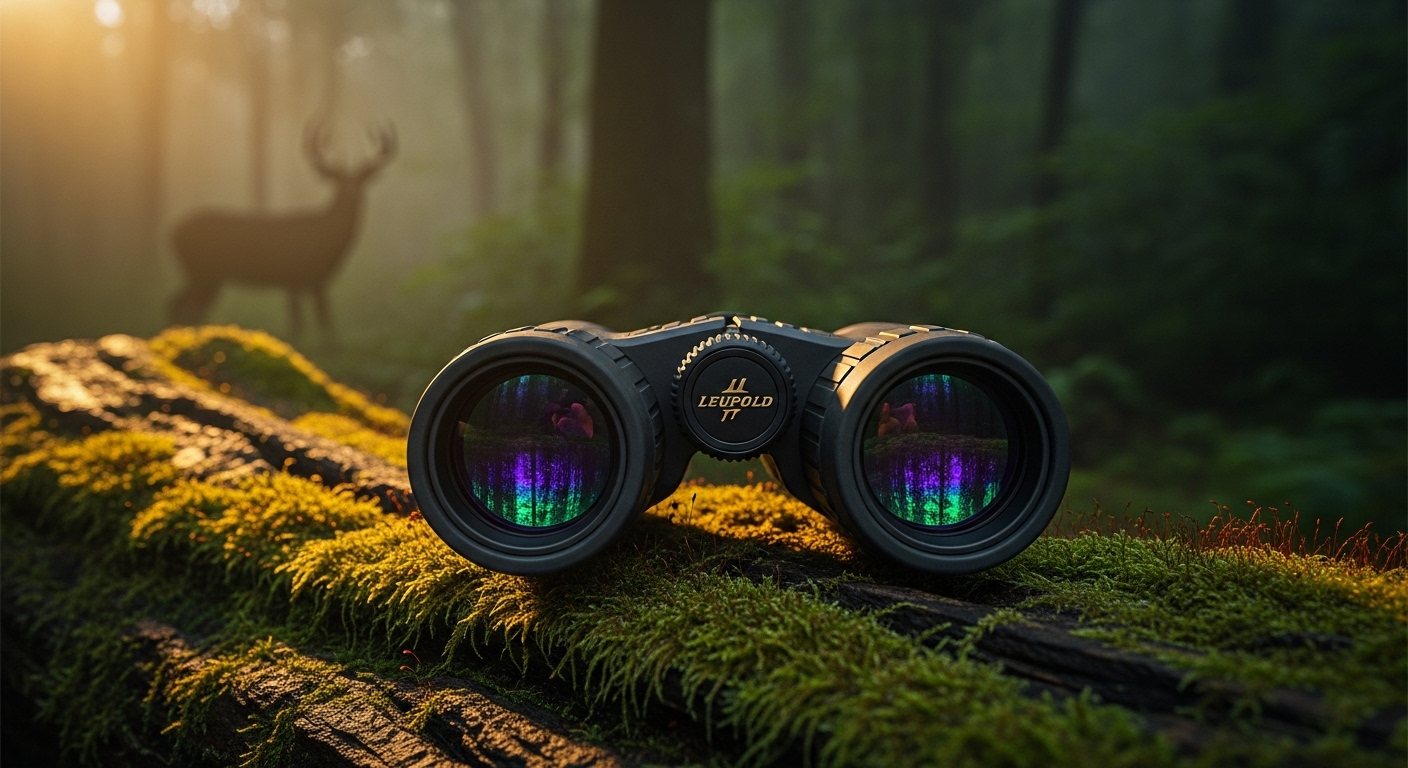
The Leupold BX-2 Tioga HD 8×42 is a discontinued 8x42mm roof-prism binocular featuring fully multi-coated lenses, BAK-4 prisms, calcium fluoride glass, 15mm eye relief, 330 ft field of view at 1000 yards, and Leupold’s Twilight Max Light Management System for low-light performance. Designed in Beaverton, Oregon and built around an aluminum housing, it was positioned as a mid-range hunting optic aimed at serious western hunters. Current production has shifted to the closely related BX-2 Alpine HD, making the Tioga HD a fixture of the used market rather than dealer shelves.
I pulled my BX-2 Tioga HD 8×42 out of the truck cab the other morning while watching a friend chase mulies across a sage ridge, and the moment I raised them to my eyes I remembered why I keep coming back to these binoculars. There’s a quiet confidence in a tool you’ve relied on for many hunting seasons, and these Leupolds have earned their spot in my glassing kit through years of dawn patrols, mid-day shed hunts, and last-light stalks. This is the binoculars I want to walk you through today.
The Leupold BX-2 Tioga HD 8×42 sits in an interesting spot in 2026. It’s a discontinued model no longer rolling off Leupold’s production line, yet it remains one of the most recommended binoculars on hunting forums, classified listings, and optics groups. After years of long-term ownership, I wanted to put together a fresh, honest review: what still impresses me, what’s starting to show its age, and whether buying one today – new old stock or used – makes sense, or whether you should just step up to the BX-2 Alpine HD.
I’ll also show you how the Tioga HD stacks up against the current alternatives on the market, walk through the low-light performance that made these binoculars famous, and lay out my honest buy-or-pass recommendation. If you’re weighing a Leupold BX-2 Tioga HD purchase, this is the review I wish I’d had when I first started shopping for serious hunting glass.
Important context before we dive in: Leupold discontinued the BX-2 Tioga HD line several years ago, and the model that occupies its slot today is the BX-2 Alpine HD 8×42. They’re so closely related – same Twilight Max system, same 8×42 format, same general optical platform – that the Alpine HD is the natural reference point for anyone researching the older Tioga HD. The product I’ve kept on this page reflects that current successor: the Leupold BX-2 Alpine HD 8×42 (model 181176), which carries the same hunting DNA and the same lifetime guarantee.

Magnification: 8x
Objective: 42mm
FOV: 330ft/1000yds
Eye Relief: 15mm
Weight: ~2.1 lbs
Quick verdict: the Leupold BX-2 Alpine HD (and the closely related discontinued Tioga HD it replaces) is a confident pick for hunters who prioritize low-light performance, durable build, and a lifetime warranty from an American optics company. It’s best for western big-game hunters who glass at dawn and dusk. It’s not the pick for birders who need edge-to-edge sharpness, casual users who want the lightest possible glass, or shoppers uncomfortable buying a discontinued model.
Pick up the BX-2 Tioga HD and the first thing you notice is the balance. At roughly 2.1 pounds, these aren’t featherlight, yet the weight sits where your hands naturally grip the open bridge. There’s no nose-heavy dive at the objectives, no tail-heavy wobble at the oculars. You can hold them up to your face for an extended scan and your arms don’t start complaining after five minutes.
The aluminum chassis is wrapped in Leupold’s Shadow Gray rubber armor. It’s grippy enough for damp morning hunts without being so aggressive that it snags on pack fabric. The texture feels like it was designed by people who actually wear gloves in November, not by a marketing team chasing a tactical look. The armoring has held up through years of use on my pair – no peeling, no sticky rubber, just honest wear at the high-friction points.
The focus wheel is a standout. It turns with a smooth, even resistance – not so loose that you accidentally refocus during a heartbeat, not so stiff that you can’t make micro-adjustments one-handed. The wheel is large enough to operate with thick leather gloves, and the ribbed texture gives positive tactile engagement even in the dark. Travel from close focus to infinity takes about 1.5 turns, which is a sweet spot for hunting glass – quick enough to snap to a moving buck, slow enough for fine-tuning on a distant ram.
The twist-up eyecups click into three positions with firm detents. They stay put once set, and the soft rubber has held its shape through years of cycling. Some folks complain about small bumps along the cup edge, and I can feel them when I deliberately look for them, but in actual field use they vanish into the background. For most hunters, the eyecup design is a non-issue. If you wear glasses full-time, my guide on using binoculars with glasses walks through the right technique.
One weak point worth flagging: the objective lens caps. They’re tethered with thin rubber loops that have a habit of snapping after a season or two of cold-weather use. I’ve replaced mine twice. It’s an annoying cost-of-ownership detail, not a deal-breaker, but if you’re buying used, expect to budget for replacement caps. Many owners simply toss the tethers and store the caps in a jacket pocket.
Before we go deeper, it helps to understand what those numbers on the binocular body actually mean. My guide to binocular numbers covers the basics, but here’s the short version for the BX-2 Tioga HD 8×42: the 8 is the magnification (objects appear eight times closer), and the 42 is the objective lens diameter in millimeters, which controls how much light the binocular can gather.
The BaK-4 prism system is worth lingering on. BaK-4 is a higher-grade optical glass than the BK-7 used in budget binoculars, and it produces a perfectly round exit pupil. Cheaper BK-7 prisms can show gray edges or kidney-bean shaping in the exit pupil, which translates to dim corners in your field of view. With BaK-4, the full aperture delivers light cleanly from edge to edge, which is especially important when you’re working hard in low-light conditions and every photon counts.
Eye relief at 15mm is generous without being exceptional. For hunters who don’t wear glasses while in the field, this is plenty of room to see the full field of view without pressing the cups against your brow. For full-time eyeglass wearers, it’s workable but not ideal – you’ll want to leave the eyecups fully extended and verify you can see the full image with your glasses on before committing. I cover the technique in detail in my glasses-and-binoculars guide.
The 330-foot field of view at 1000 yards is mid-pack for an 8×42 hunting binocular. It gives you enough sweep to scan an open meadow or a distant ridge without constant panning, while staying tight enough to pick up fine detail like antler tines. The 6.8-degree apparent field is on the conservative side compared to wide-angle competitors like the Swarovski CL Companion, but for hunting use, where you’re typically centering a target rather than tracking flocks, the trade-off favors better edge correction and a brighter image.
The Twilight Max Light Management System is the headline feature Leupold built the Tioga HD’s reputation on, and after years of dawn and dusk glassing, I can tell you the reputation is earned. Twilight Max isn’t a single coating – it’s a system that tunes the optical path to favor the wavelengths and angles of light that dominate during the first and last 30 minutes of shooting light.
In practical terms, that means you can resolve antler detail longer into the evening than your buddy with a different brand of binoculars standing next to you. On multiple hunts I’ve watched a partner lose the image just as I was still counting points. The difference is rarely dramatic – it’s measured in minutes, not hours – but those minutes are exactly when big bucks and bulls move.
Twilight Max is the predecessor of the more advanced DiamondCoat 2 and Guard-ion coatings on Leupold’s current flagship binoculars. It’s older technology, but the underlying principle – control stray light and optimize transmission in the wavelengths that matter at dawn and dusk – still works. For hunters comparing this system to modern alternatives, my low-light binocular roundup puts it in context against today’s competition.
Beyond raw low-light transmission, the fully multi-coated lenses keep color fidelity honest. During spring turkey hunts I could distinguish the subtle red-blue wash on a mature tom’s head at 200 yards – the difference between a shooter and a jake that often comes down to color cues. During fall deer hunts the autumn foliage renders with the warm, slightly saturated cast it actually has in the field, not the washed-out look you get from poorly coated glass.
Chromatic aberration – that purple or green fringe you see along high-contrast edges – is well controlled thanks to the calcium fluoride lens elements. Look at bare branches against a bright overcast sky and the edges stay clean. Push the binocular to its limits by glassing a dark elk silhouette against a snowfield and you might catch a sliver of color fringing at the extreme edge, but in normal hunting use it’s a non-issue.
Edge sharpness is the Tioga HD’s typical mid-range compromise. The central 70% of the image is crisp and contrasty. The outer 15% softens slightly – a common trait of roof-prism binoculars in this price bracket. For hunting, where you center your target naturally, this isn’t a problem. For birders scanning treetops or viewers who need edge-to-edge critical focus, you’d want to look at higher-end options like the Swarovski NL Pure or Leica Noctivid.
Resolution at distance is impressive. In good daylight I could resolve antler tines on a bedded buck at 800 yards, and read small text on signage at ranges where binoculars half the price gave up. This is one of the Tioga HD’s quiet superpowers – it punches well above its price bracket on raw resolving power, especially given that most buyers will be paying used-market prices today.
Specs on paper mean nothing without time in the field, so let me walk you through what these binoculars actually do in the kind of conditions that matter to a hunter. Over many seasons and a stack of western big-game tags, the BX-2 Tioga HD has been my constant companion for everything from glassing open basins at first light to picking out black bears in timber at last light. That accumulated experience is what I’m leaning on for this section.
Waterproofing has been flawless. I’ve had these binoculars soaked through thunderstorms, snowstorms, and one memorable morning when I rolled a kayak in a beaver pond during a spike-camp approach. Not a hint of internal fog, no water intrusion, no spotty film on the prism after drying out. The nitrogen-purged seal holds. If you’re a hunter who actually hunts in weather – and most of us do – that reliability matters more than any spec sheet.
Temperature extremes haven’t phased them either. I’ve pulled them out of a frozen truck at 8°F and they’ve functioned perfectly. I’ve used them at 90°F in direct August sun on a glassing knob, and the housing stayed cool enough to hold comfortably. Thermal cycling – going from a warm vehicle into sub-freezing air – hasn’t cracked the prisms or shifted the collimation. Long-term owners consistently report this kind of thermal stability, which is one of the quiet strengths of an aluminum-bodied roof prism over plastic-bodied competition.
Focusing smoothness holds up over years. The wheel has not developed play, grinding, or stiffness. There’s a small amount of free rotation before the optics engage, which some users find annoying – it means you can’t immediately start focusing without first rotating past the dead zone. In practice I’ve learned to give it that quarter-turn and it doesn’t slow me down, but it’s a legitimate ergonomic nitpick if you’re transitioning from binoculars with a tighter focus mechanism.
Close focus at 13.5 feet is the Tioga HD’s most limiting spec. For hunting this rarely matters – you’re almost never looking at something 13 feet away. For casual birding, butterfly watching, or reading a map held at chest height, it’s a real constraint. If your use case blends hunting with close-range nature observation, factor this in. If your use case is glassing ridges and basins, you’ll never notice.
Durability is the headline win. Beyond the drops and bangs I’ve already mentioned, these binoculars have ridden in overloaded backpacks, slid around on ATV cargo racks, and spent more time in truck door pockets than in their case. They’ve been bumped against rifle stocks, saddle horns, and pack frames. The optical alignment is still perfect – star tests show clean, concentric images with no asymmetry. The rubber grip is worn at the high-friction points but not torn. For a hunting binocular that lives a hard life, this is the kind of long-term reliability you want.
One feature that gets less attention than it deserves: the tripod adapter port. Hidden under a small dust cap on the front bridge, it lets you mount the Tioga HD on a standard tripod for extended glassing sessions. During a long sheep hunt I spent a full afternoon on a tripod, working a distant basin, and the difference between tripod-mounted and handheld viewing for steady detail work is dramatic. If you hunt open country, this port is worth more than most people realize.
After many seasons of use, here’s my honest assessment of where the BX-2 Tioga HD 8×42 excels and where it falls short.
Since the BX-2 Tioga HD is no longer in production, most shoppers today will be weighing it against current alternatives – either to find a similar new binocular from Leupold or to compare the used Tioga HD against what’s currently on dealer shelves. Here’s how the realistic options stack up for 2026.
Leupold BX-2 Alpine HD 8×42 (the direct successor). This is the model carrying the Tioga HD’s torch today. Same 8×42 platform, same Twilight Max system, similar optical design with minor cosmetic updates. If you want the closest current analog to the Tioga HD with full warranty support, this is it.
Vortex Diamondback HD 8×42. The perennial cross-shop against any Leupold binocular. Vortex’s Diamondback HD offers solid optical performance at a similar price point, and the VIP unconditional lifetime warranty is the best in the industry. The optical quality isn’t quite at the Tioga HD’s level in low light, but the warranty and availability make it a strong default pick. For a head-to-head on the brand question, my Leupold vs Vortex breakdown is worth a read.
Nikon Monarch 7 8×42. ED glass, excellent color correction, and a slightly wider apparent field. Optical quality rivals or exceeds the Tioga HD in good light, though long-term reliability reports are more mixed than Leupold’s. If pure daytime optical quality is your priority, the Monarch 7 is a serious contender.
Athlon Optics Midas 8×42. A relative newcomer with ED glass, advanced coatings, and an aggressive price point. The optical performance is genuinely impressive for the cost, though the brand’s long-term track record is shorter than Leupold’s or Vortex’s. For buyers willing to bet on a newer player, the value proposition is hard to beat.
Leupold BX-4 Pro Guide HD 8×42. If you want to stay in the Leupold family and step up in optical performance, this is the official upgrade path. Better coatings, refined ergonomics, and improved low-light transmission. It’s the right pick if you hunt hard and want the best Leupold currently makes in this format.
Used market BX-2 Tioga HD. If you’re committed to the original, the used market is the only realistic path. Pricing varies widely by condition and provenance – well-cared-for units with original boxes and proof of purchase command a premium, while well-used examples go for noticeably less. Buy from original owners when possible, ask for clear photos of the lenses and prism, and confirm there’s no internal fogging before completing the purchase.
Yes. Leupold discontinued the BX-2 Tioga HD line several years ago and replaced it with the closely related BX-2 Alpine HD. New old stock can occasionally be found through remaining dealer inventory, but most buyers today will shop the used market.
The Leupold BX-2 Alpine HD 8×42 is the direct replacement. It uses the same 8×42 platform, Twilight Max Light Management System, BaK-4 prisms, and fully multi-coated optics, with minor cosmetic updates and current production quality control. If you want the closest current Leupold to the Tioga HD, the Alpine HD is the answer.
For the right buyer, yes. The optical performance, build quality, and low-light advantage that made the BX-2 Tioga HD famous have not aged out. If you find a well-cared-for unit at a fair used-market price, it remains a capable hunting binocular. If you’re uncomfortable buying discontinued, step up to the current BX-2 Alpine HD instead.
Yes. The BX-2 Tioga HD is fully waterproof and fogproof, sealed against the elements and nitrogen purged to prevent internal fogging across temperature extremes. Long-term owners consistently report reliable performance in rain, snow, and humid conditions.
Leupold designs and engineers all of their optics in Beaverton, Oregon, where final assembly and quality control also happens. Some components are sourced globally, but the company’s design, warranty service, and quality assurance are run out of their Oregon facility.
Yes. Leupold has built a reputation for exceptional quality over more than a century in the optics industry. Their binoculars are known for durability, reliable performance, and excellent customer service. The BX-2 Tioga HD continues that tradition with solid construction and optics that punch above their weight class.
Buying discontinued binoculars can be smart if the price is right and you understand the warranty situation. The BX-2 Tioga HD remains an excellent performer, and used-market pricing makes it attractive. Just buy from sellers who can verify the unit’s history, inspect for internal fogging and optical alignment, and confirm whether warranty transfer is possible.
The Leupold offers slightly better optical performance, especially in low-light conditions, while the Vortex provides better long-term peace of mind with its unconditional VIP lifetime warranty. If you prioritize pure optical quality and don’t mind the discontinued status, choose Leupold. If you want maximum warranty coverage and easy availability, choose Vortex.
With 15mm of eye relief, the BX-2 Tioga HD works reasonably well for most eyeglass wearers, though it’s not exceptional. The twist-up eyecups provide good adjustment when fully extended, though some users report minor discomfort from small bumps in the rubber. If you wear glasses full-time in the field, test the binocular with your glasses on before buying.
After many seasons of hard field use, I can recommend the Leupold BX-2 Tioga HD 8×42 with genuine confidence – with the obvious caveat that you’re buying a discontinued product today. For the right buyer, it’s still one of the best mid-range hunting binoculars ever made. The Twilight Max system delivers real low-light advantage, the build quality has proven itself across years of ownership, and the lifetime warranty from an American company remains a meaningful trust signal even on used units.
My honest recommendation: if you’re shopping new today and want the closest current Leupold, get the BX-2 Alpine HD 8×42. You get essentially the same optical character with full factory warranty support, current production quality control, and dealer support. If you’re shopping the used market and find a well-cared-for Tioga HD from an original buyer, at a fair price, don’t hesitate – these binoculars will serve you well for years to come.
The Leupold BX-2 Tioga HD 8×42 earns a 4.6/5 in my long-term ownership assessment. That score reflects genuinely excellent low-light performance, durable construction, and a feature set that holds up well against current competition – with a small downward adjustment for discontinued status and a field of view that’s mid-pack by 2026 standards. For western hunters who glass at the edges of legal shooting light, this is still one of the most capable binoculars you can buy, whether you find one on a dealer’s shelf, in a classified listing, or on the BX-2 Alpine HD sitting next to it.
And one last bit of advice regardless of which path you take: learn to clean your binoculars properly. A well-maintained Tioga HD or Alpine HD will outlast trends, model refreshes, and most of the fancier glass your hunting buddies will buy and replace. The best binocular is the one you take care of.
For more guidance on the broader category, my best low light binoculars roundup compares the current field, and my guide to binocular numbers will help you decode any spec sheet you run across. Whichever path you take, may your next hunt be full of clear glassing and short stalks.