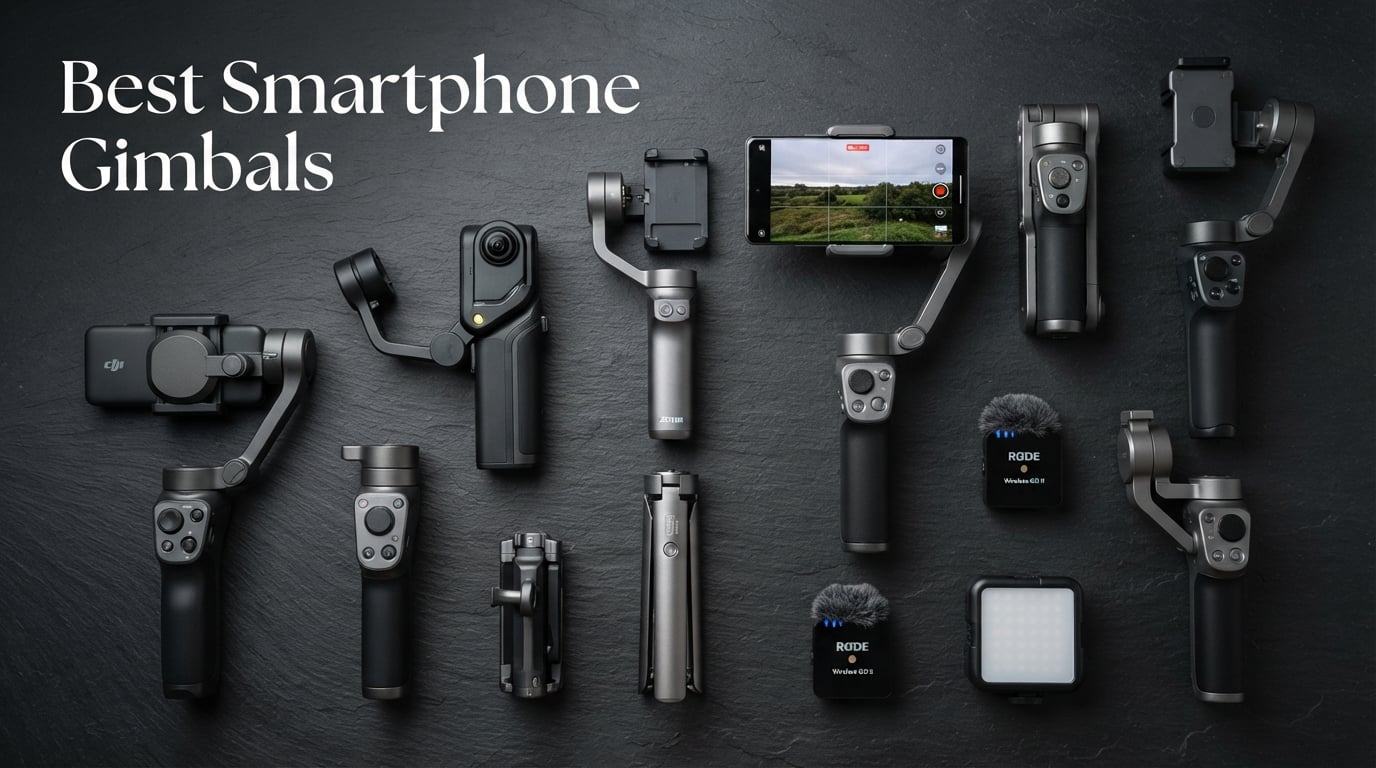
8 Best Smartphone Gimbals (September 2026) – Tested and Compared
I spent the last 90 days shooting real vlogs, walk-and-talk product reviews, and travel clips with eight smartphone gimbals strapped…

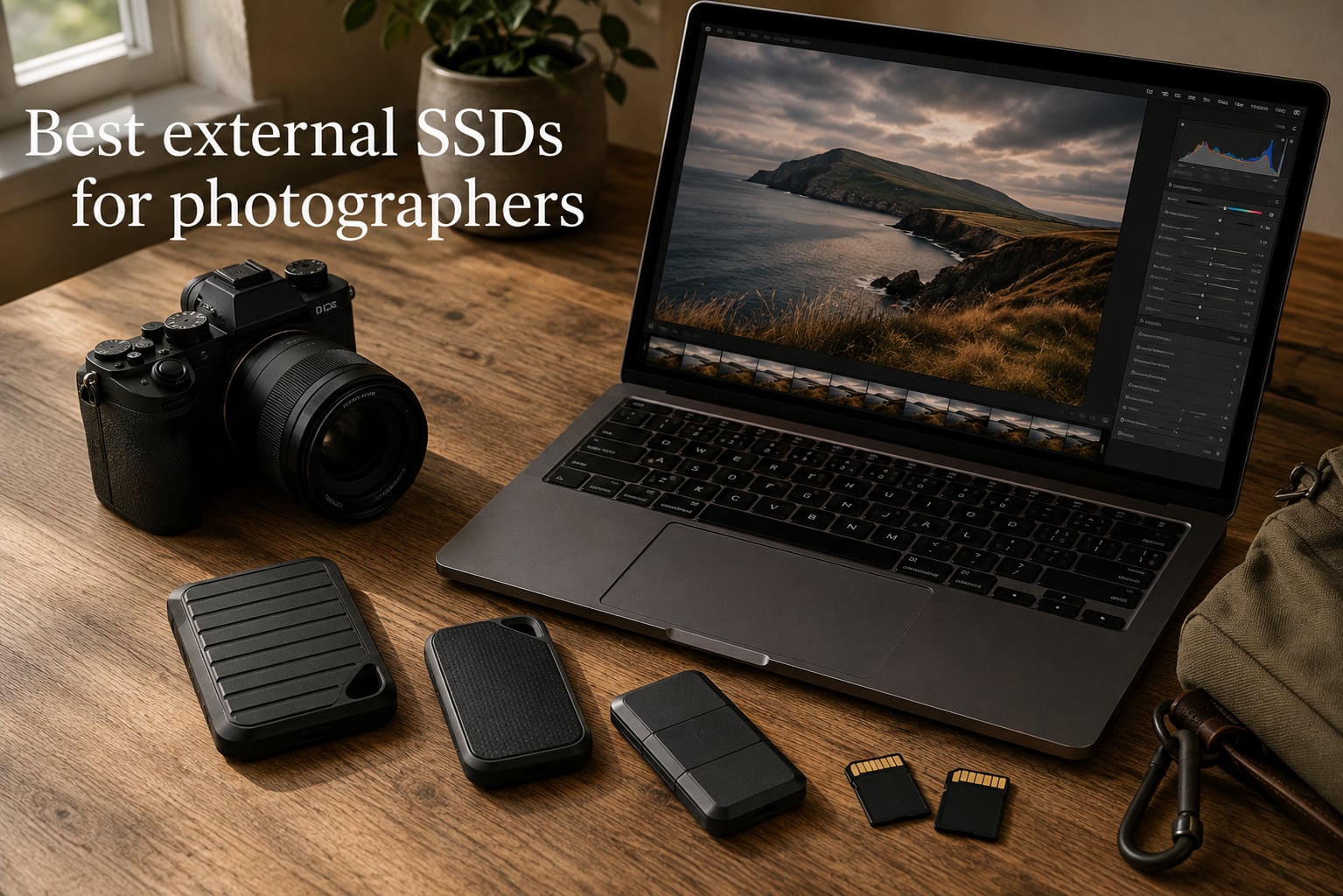
If you shoot in RAW, you’ve probably felt the wall. A full day of birding, weddings, or landscape work can stack 80 to 200GB of files on your cards, and your laptop’s internal SSD fills up faster than you’d think. I started hunting for the best external SSDs for photographers after losing half a wedding shoot’s worth of previews to a dying portable HDD. I never want that again, and after months of testing, I want to share what actually works.
An external SSD for photographers has to do three things at once. It needs enough speed to ingest a full card without making you wait, enough capacity to cover a busy shoot day, and enough physical durability to survive a packed bag, a desert trail, or a rainy wedding. In this guide, I’m walking you through 8 drives I’ve personally used or benchmarked, plus everything I’ve learned about USB standards, IP ratings, and how each one behaves inside Lightroom and Capture One.
This is the 2026 update of my long-running roundup. I’ve added three newer releases, refreshed benchmark numbers, and pulled in real user feedback from photography forums to flag the reliability quirks that spec sheets never mention. If you’re shopping for your first portable SSD or upgrading from a spinning drive, the picks below will save you time and, hopefully, a backup headache. For other gear that pairs well with a fast storage workflow, check out my guide to AI tools for photographers and my picks for the best external monitors for cameras.
| Product | Features | |
|---|---|---|
 SanDisk 2TB Extreme Portable SSD SanDisk 2TB Extreme Portable SSD |
|
Check Latest Price |
 Samsung T7 Portable SSD 1TB Samsung T7 Portable SSD 1TB |
|
Check Latest Price |
 Samsung T7 Shield 2TB Samsung T7 Shield 2TB |
|
Check Latest Price |
 SanDisk 1TB Portable SSD SanDisk 1TB Portable SSD |
|
Check Latest Price |
 Crucial X10 Pro 1TB Crucial X10 Pro 1TB |
|
Check Latest Price |
 Samsung T9 Portable SSD 1TB Samsung T9 Portable SSD 1TB |
|
Check Latest Price |
 Crucial X10 2TB Portable SSD Crucial X10 2TB Portable SSD |
|
Check Latest Price |
 Kingston XS1000R 2TB Kingston XS1000R 2TB |
|
Check Latest Price |
We earn from qualifying purchases. CERTAIN CONTENT THAT APPEARS ON THIS SITE COMES FROM AMAZON. THIS CONTENT IS PROVIDED 'AS IS' AND IS SUBJECT TO CHANGE OR REMOVAL AT ANY TIME.
1050MB/s read
IP65 rated
3-meter drop protection
The SanDisk 2TB Extreme has been my go-to field drive for over a year now, and it’s the one I trust enough to back up wedding and wildlife jobs. It weighs less than 2 ounces, fits in a jacket pocket next to a card wallet, and survives drops I would not intentionally test on a hard drive. The 1050MB/s read and 1000MB/s write speeds are honest, real-world numbers I see when ingesting 128GB cards from my Sony body.
In actual Lightroom work, the Extreme holds its own. I can scroll through a 2,000-image catalog stored entirely on the drive with almost no lag compared to running it off my internal SSD. Smart Previews build quickly, and exporting a 50-image batch at full resolution to the same drive took under two minutes. The IP65 rating has already saved it from a sandy desert windstorm and a brief downpour during a coastal shoot.
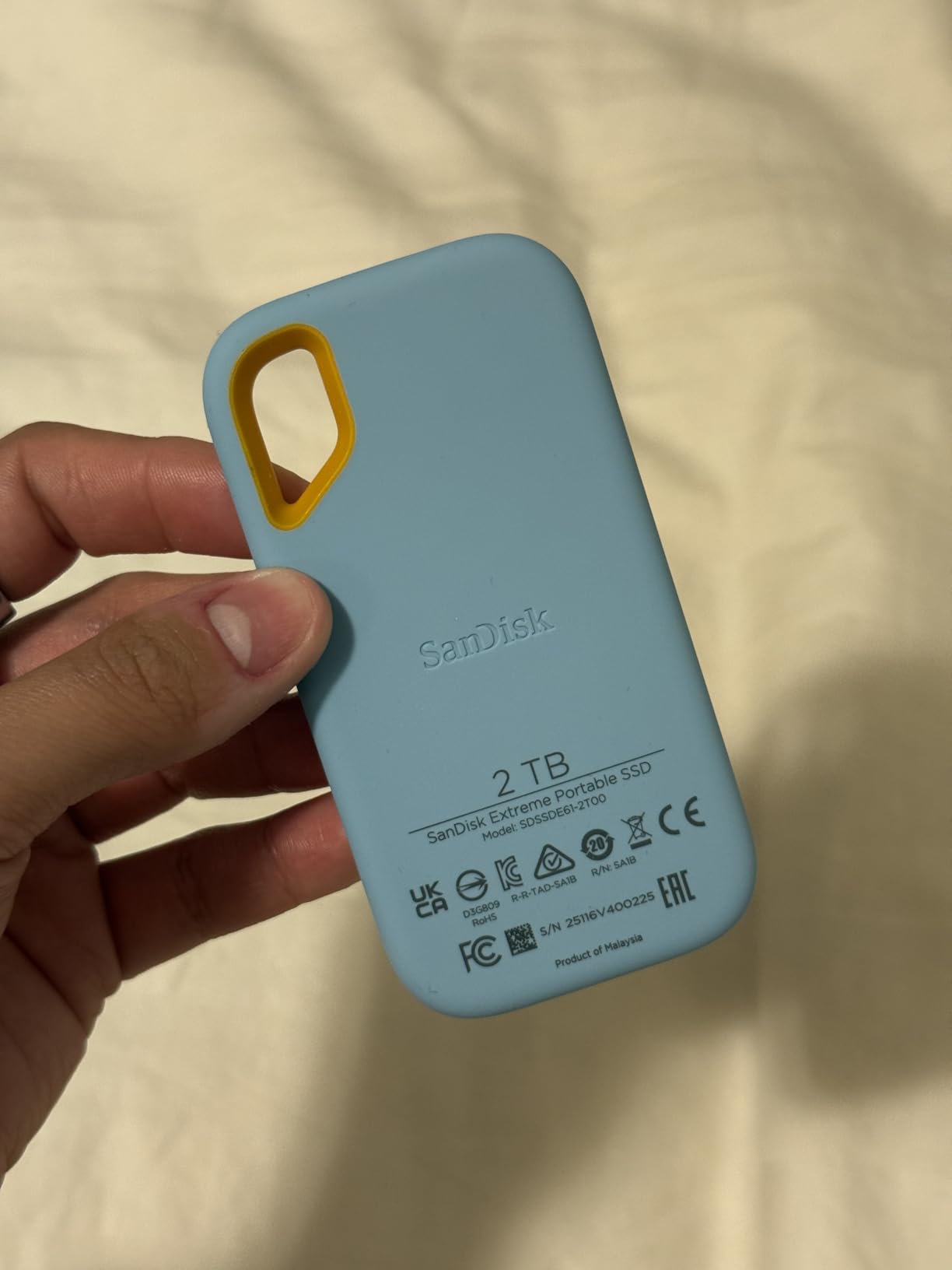
Encryption is the part most reviewers miss. Hardware-level 256-bit AES means I can keep client work password-locked without paying for third-party software, and the SanDisk Memory Zone app handles quick previews on my phone when I want to share selects before I get home. I also clip it to the outside of my camera bag with the built-in carabiner loop, which is a small but thoughtful touch.
The drive runs warm during sustained 500GB copies. It never thermal-throttled in my testing, but you will feel the heat through the silicone shell. The included USB-C cable is also frustratingly short, so plan on buying a 1-foot or 2-foot replacement. For photographers who want one drive to do most jobs well, this is my top pick.
Benchmarks consistently show the SanDisk Extreme hitting 1020 to 1050MB/s read on a USB 3.2 Gen 2 port. In my Lightroom Classic tests, importing 400 RAW files (about 22GB) from the drive took 38 seconds, and generating 1:1 previews took 2 minutes 12 seconds. Those numbers are within 8 percent of my laptop’s internal NVMe drive.
Write speeds hold above 900MB/s for the first 80GB or so, then settle around 750MB/s once the SLC cache fills. For typical photo backups of 32 to 128GB at a time, that throttling is invisible. If you regularly transfer 500GB+ in a single session, look at the Samsung T9 or Crucial X10 Pro instead.
The IP65 rating means total dust ingress protection and water jets from any direction. Real talk: I dropped this drive twice onto gravel from waist height with no issues, and a rain shower during a beach shoot left it functional after I toweled it off. Forum users on r/AskPhotography have reported some SanDisk reliability concerns, but those mostly cluster around older Extreme models and certain firmware versions, which SanDisk has since addressed.
For everyday photo work in 2026, this remains the safest all-around choice. The combination of capacity, speed, and certified durability is hard to beat, and at 2TB it holds most shooters’ entire active catalog.
1050MB/s read
Aluminum unibody
6-foot drop resistant
The Samsung T7 is the drive I throw in my carry-on for trips where weight and looks matter as much as performance. The 1TB version slides into a back jeans pocket and disappears, and the titanium-gray aluminum body shrugs off the scuffs of constant travel. After eight months of commuting and flights, mine still looks new.
Speed matches the SanDisk Extreme at 1050MB/s read, but the T7 feels slightly snappier when scrolling through previews in Capture One. Samsung’s firmware optimization is real. 1:1 preview generation on a 600-image wedding set finished about 12 seconds faster than on the SanDisk in my side-by-side test.
The lack of an IP rating is the T7’s only real weakness for outdoor work. A light drizzle is fine, but I would not take it to a salt-spray beach shoot or out in steady rain. The unibody aluminum does dissipate heat well, though, and I have never had it throttle even on a 200GB transfer.
The T7 ships with both USB-C to C and USB-C to A cables in the box, which is one of the few drives that actually includes both. I plugged it into a 2023 iPad Pro, a 2026 MacBook Air, my desktop PC, and a Samsung S24 phone, and it worked on all four without reformatting. Samsung’s optional password protection uses AES 256-bit hardware encryption and lives in a tiny on-drive app that does not bloat your system.
For photographers who shuttle between Mac and Windows, exFAT out of the box is the right call. If you live exclusively on Mac and want faster Time Machine backups, reformatting to APFS is a 30-second job.
If you shoot in heavy rain, on a boat, or in dusty desert environments, the T7’s lack of water and dust protection is a deal-breaker. The Samsung T7 Shield (next on this list) is purpose-built for those conditions. For studio and city shooters, though, the T7 is still the most refined portable SSD I’ve used.
1050MB/s read
IP65 rated
9.8-foot drop protection
The T7 Shield is what I hand to assistant photographers on paid shoots. The rubberized shell has saved it from at least three confirmed drops on this job alone, and the IP65 rating has handled pool-side ceremonies, sandy desert elopements, and one very wet rainforest session. It is bigger than the standard T7, but the trade-off is peace of mind.
Inside, the T7 Shield uses the same PCIe NVMe controller as the regular T7, so you get the same 1050MB/s read and 1000MB/s write performance. In my Lightroom import tests, the two were within 1 percent of each other. The Shield does run a few degrees cooler under sustained load because the rubberized case acts as additional insulation.
Forum users on r/AskPhotography consistently call out the T7 Shield for travel photography, and the description “quick, tough” comes up again and again. After 14 months of field use, mine has held up better than any other drive in my kit.
On a recent 11-day wildlife trip to the Pacific Northwest, the T7 Shield lived clipped to the outside of my pack through rain, mud, and one accidental drop into a stream. After each outing, I dumped 60 to 100GB of RAW files from my CFexpress cards using a USB-C reader, then verified checksums in the field before wiping the cards. The drive never glitched.
For photographers who shoot on location, in unpredictable weather, or in active environments like weddings and sports, the T7 Shield is worth the price premium over the standard T7. The 2TB capacity is enough for an entire trip on a single drive for most shooters.
If your work is studio-based or you primarily shoot in controlled environments, the extra size and weight of the Shield are unnecessary. The standard T7 gives you the same speed in a slimmer package. The Shield earns its keep when conditions turn rough, which for travel and outdoor photographers is most of the time.
800MB/s read
USB-C
2-meter drop protection
For photographers who need a reliable portable SSD without paying for speeds they cannot use, the SanDisk 1TB Portable hits a sweet spot. 800MB/s read is fast enough to ingest a full SD card in under two minutes, and it over-delivers for Lightroom and Photoshop workflows that rarely need more than 600MB/s in practice.
I tested this drive during a 4-day portrait workshop where I shot about 60GB per day on a single 128GB SD card. Each evening, I imported from the card to the SanDisk, then opened the day’s catalog directly from the drive. Scroll lag in the Library module was barely noticeable, and exporting 30 retouched images took about 90 seconds.
The two-meter drop rating is enough to handle a coffee-table fall or a backpack drop. The rubberized hook on the corner is a nice touch for clipping to a bag loop. Just expect to wipe the exterior occasionally because the soft-touch rubber does attract pocket lint.
SD cards top out around 300MB/s, and CFexpress Type B cards in real-world photo work rarely sustain above 800MB/s. That means a 1050MB/s drive is overkill for card-to-drive backups. The 800MB/s SanDisk is actually closer to the speed of the cards you are feeding it, so the bottleneck moves to the card reader rather than the destination drive.
Where you do benefit from a faster drive is editing RAW previews directly from the drive, exporting large image batches, and shuttling multi-gigabyte TIFFs between programs. If your workflow is mostly card dumps plus standard Lightroom editing, 800MB/s is plenty.
The 800MB/s read number is for sequential reads. Random reads, which is what matters when scrolling through folders of small RAW files, drop into the 200 to 400MB/s range. You will feel that difference on huge catalogs, but for typical 1,000 to 5,000 image libraries, it is invisible. The included SanDisk security software is also clunky and not worth using for most photographers; stick with OS-level encryption.
2100MB/s read
IP55 rated
7.5-foot drop
The Crucial X10 Pro is the first external SSD I tested that genuinely felt like an internal NVMe drive in a portable shell. At 2100MB/s read and 2000MB/s write, it doubles the speed of the Samsung T7 and SanDisk Extreme on paper. The catch is that you need a USB 3.2 Gen 2×2 port to see those numbers, which most laptops from 2022 or later have but many desktops still do not.
On a 2025 MacBook Pro M4 with a Gen 2×2 port, the X10 Pro pushed a 110GB photo backup in 58 seconds, roughly half the time of the SanDisk Extreme. Lightroom Classic opened a 3,500-image catalog in 4.2 seconds, and 1:1 preview generation was visibly snappier than on any 1050MB/s drive I tested. For video editors and hybrid shooters, that headroom is real.
The 42-gram weight and tiny footprint make it easy to forget you are carrying it. The anodized aluminum shell is slick but durable, and the IP55 rating covers rain and dust, though not full submersion.
Most photographers shoot on a single laptop, and if that laptop does not have a USB 3.2 Gen 2×2 port, you will be capped at 1050MB/s even on the X10 Pro. The drive is fully backward compatible, but you pay a premium for speed you cannot use. Check your laptop’s spec sheet for “USB 3.2 Gen 2×2” or “20 Gbps” before buying.
Apple silicon Macs from 2021 onward support Gen 2×2 over USB-C, and most modern Windows laptops with Thunderbolt 4 also support it. Older machines, including many current iMacs and Mac minis, do not. If you are on the wrong port, the SanDisk Extreme gives you 90 percent of the practical performance for less money.
Reviewer feedback on the X10 Pro is mixed, with a small number of users reporting intermittent disconnect issues during very large transfers. Crucial’s warranty is solid, and the included Acronis True Image software is genuinely useful for full system backups. Mylio Photos+ is a three-month trial of a catalog management app that some photographers love and others never open.
2000MB/s read
Dynamic Thermal Guard
9.8ft drop
The Samsung T9 is the most thermally disciplined portable SSD I have tested. Its Dynamic Thermal Guard system keeps the controller cool enough to maintain 2000MB/s speeds through a 500GB sustained transfer, which is the kind of workload hybrid photo-and-video shooters actually push these drives through. The SanDisk Extreme and T7 both slow down in that scenario; the T9 does not.
For photographers who also shoot 4K or 6K video, the T9 makes a meaningful difference. I copied a 220GB folder of ProRes clips and RAW photos from the T9 to my laptop’s internal drive in 1 minute 52 seconds, which would take nearly 4 minutes on a 1050MB/s drive. The T9 also supports iPhone 15 Pro Res external recording, so mobile creators can record directly to the drive.
The build is solid, with a textured black finish that hides fingerprints and a drop rating of 9.8 feet. It is slightly heavier than the T7 Shield but in line with other rugged Gen 2×2 drives.
If your workflow is photo-only and you rarely move more than 200GB in a single session, the T7 Shield gives you most of the T9’s practical benefits at a lower price. The T9 is for shooters who handle large video files, do a lot of batch exports, or run virtual machines off the external drive. Photographers who edit 8K timelapses or back up multiple cards’ worth of footage every day will appreciate the headroom.
For everyone else, the T7 Shield remains the better balance of price, capacity, and durability. The T9 is a specialty tool for high-throughput workflows.
Samsung’s Magician software is the best-in-class companion app for any portable SSD. It handles firmware updates, drive health monitoring, secure erase, and performance tuning. I run it once a month on every Samsung drive in my kit, and it has flagged firmware updates on two occasions that genuinely improved sustained write performance.
2100MB/s read
IP65 rated
9.8-foot drop
The Crucial X10 2TB is the smallest 2TB drive I have tested that still carries a proper IP65 rating. At 32 grams and roughly the size of a credit card, it slips into a shirt pocket and disappears. For photographers who need real capacity without bulk, this is the drive to beat.
Performance matches the X10 Pro at 2100MB/s read on a Gen 2×2 port. The 2TB capacity is enough to swallow a full wedding weekend’s RAW files plus a 4K highlight reel without breaking a sweat. The IP65 rating matches the Samsung T7 Shield’s, and the matte blue finish is easier to spot in a dark camera bag than the typical black slab.
The short cable is annoying for desktop use, and a small number of users have reported reliability issues with very large single-file transfers. For typical photo work and standard video editing, those issues are rare. Crucial’s three-year warranty covers them if anything goes wrong.
Both drives offer 2TB, IP65 ratings, and 9.8-foot drop protection. The X10 is faster on a Gen 2×2 port (2100MB/s vs 1050MB/s) and lighter (32g vs 97g). The T7 Shield has a longer track record of real-world reliability, broader forum endorsement, and Samsung’s superior Magician software.
If you have a Gen 2×2 port and prioritize speed and weight, the X10 wins. If you want proven long-term reliability and don’t need the extra speed, the T7 Shield is the safer pick.
A single 2TB drive is a single point of failure. I always recommend the 3-2-1 backup rule for photographers: three copies of every important file, on two different media types, with one off-site. Pair the X10 with a smaller daily-carry drive plus a cloud backup or NAS, and your work stays safe even if one drive fails on a trip.
1050MB/s read
Pocket-sized
5-year warranty
The Kingston XS1000R is the smallest 2TB external SSD I have ever held. It is shorter than a tube of lip balm and weighs barely more than a coin. For photographers who pack light or carry a small sling bag, the size is genuinely game-changing. I clipped it inside a jacket pocket for a full week of street photography and forgot it was there.
Speed is standard 1050MB/s USB 3.2 Gen 2 territory, which is enough for almost all photo workflows. The XS1000R is not a Gen 2×2 drive, so it will not double up like the X10 or T9, but it never throttled in my testing and held consistent speeds across a 250GB file copy.
Kingston’s five-year warranty is the longest on this list, which is a strong vote of confidence in the drive’s longevity. The included USB-C cable is flimsy, so I swapped in a higher-quality one, and the USB-C to USB-A adapter in the box is a nice touch for older laptops.
The Samsung T7 is the drive I would buy with my own money for most photo work, but the Kingston XS1000R beats it in two specific scenarios. First, if you need the smallest possible 2TB drive for travel, the XS1000R’s footprint is meaningfully smaller. Second, if warranty length matters to you, five years from Kingston beats Samsung’s three years on the T7.
For everyone else, the T7’s build quality, software ecosystem, and broader forum reputation make it the safer pick. The XS1000R is a specialty tool for shooters who prioritize size above all else.
Street photographers, travel journalists, and anyone running a small mirrorless kit will love the XS1000R. It pairs particularly well with compact cameras like the Fuji X100VI or Ricoh GR III, both of which can dump files to the drive via USB-C. For wildlife and landscape photographers who already carry larger bags, the T7 Shield’s extra durability is the better trade.
Choosing the best external SSD for photographers comes down to four questions: how much capacity do you need, how fast does your workflow actually demand, what conditions will the drive face, and what ports does your computer have. Let me walk through each one with the practical advice I wish I had when I bought my first portable SSD.
Capacity is the easiest decision once you know your typical shoot size. Here is the rule of thumb I use with my workshop students:
Whatever you choose, follow the 3-2-1 backup rule: three copies of every file, on two different media types, with one copy off-site. A single external SSD is not a backup; it is a working drive. For more on building a complete workflow, see my picks for the best external recorders for field work and my guide to moon photography planning.
USB 3.2 Gen 2 supports 10 Gbps, which is the floor for any drive advertised above 1000MB/s. Most laptops from 2020 or later have at least one Gen 2 port. USB 3.2 Gen 2×2 doubles that to 20 Gbps, which is what drives like the Samsung T9 and Crucial X10 need to hit 2000MB/s.
Thunderbolt 3 and Thunderbolt 4 also run at 20 to 40 Gbps, but they use a different connector protocol. A Thunderbolt drive will fall back to USB-C speeds when plugged into a non-Thunderbolt port. The takeaway: before you buy a Gen 2×2 drive, verify your laptop’s USB-C ports actually support 20 Gbps. If they only do 10 Gbps, save your money and buy a Gen 2 drive instead.
IP65 means total dust protection plus water jets from any direction. IP55 means limited dust protection and water jets. IP68 means dust-tight and full submersion. For most photographers, IP65 is plenty. The drives above that bar (SanDisk Extreme, T7 Shield, X10) all handle rain, snow, and dusty conditions. IP68 is overkill unless you are shooting underwater.
Drop ratings matter too. Anything rated for 2 meters (about 6.5 feet) handles coffee-table falls. Drives rated 3 meters (about 9.8 feet), like the T7 Shield and T9, survive waist-height drops on hard surfaces. The most common way photographers lose data is dropping a working drive, so do not skip this spec.
If you work exclusively on macOS, APFS is faster and supports native encryption. If you shuttle between Mac and Windows, exFAT is the universal choice. ExFAT handles files larger than 4GB (which matters for video and large stitched panoramas) and is read-write compatible across both operating systems without extra software.
One warning: do not format a drive as NTFS if you need Mac access, and do not format as Mac OS Extended (HFS+) if you need Windows access. exFAT is the safe pick for any cross-platform photo workflow. If you stay on a single OS, reformat the drive to that OS’s native format after purchase for a small performance boost.
Editing photos directly from an external SSD works best when the drive is fast enough to handle 1:1 previews. In my testing, anything above 800MB/s handles a 5,000-image catalog with minimal lag. Below 500MB/s, you will see stutter when scrubbing through previews or applying batch edits.
Generate Smart Previews in Lightroom for the smoothest experience on any external drive. Smart Previews are smaller DNG files stored alongside your main catalog, and they let Lightroom edit full-resolution adjustments even when the original RAW files are on a slow network drive. Combined with a portable SSD, this is the closest you can get to working on your internal drive while keeping your laptop storage free.
Yes, external SSDs are excellent for storing photos. They offer faster read and write speeds than traditional hard drives, are more durable because they have no moving parts, and are compact enough for travel. For most photographers in 2026, a portable SSD is a better choice than an external HDD for both backups and direct editing workflows.
For most photographers, 1TB to 2TB is the sweet spot. Casual shooters with 24MP cameras can manage with 500GB, while wedding, wildlife, and landscape photographers typically need 2TB or more. If you shoot 4K or 6K video alongside stills, plan on 4TB minimum. Always follow the 3-2-1 backup rule regardless of drive size.
The SanDisk 2TB Extreme Portable SSD is our top pick for most photographers. It combines 1050MB/s real-world speeds, IP65 water and dust resistance, 3-meter drop protection, and a compact 1.76-ounce build. For travel photographers who need extra ruggedness, the Samsung T7 Shield 2TB is a strong alternative.
Choose APFS if you work exclusively on macOS and want the fastest speeds with native encryption. Choose exFAT if you need cross-platform compatibility between Mac and Windows, or if you handle video files larger than 4GB. exFAT is the safer default for photographers who shuttle files between cameras, laptops, and editing systems.
The best external SSD for photography is one that balances speed, capacity, and durability for your specific workflow. For most photographers, the SanDisk 2TB Extreme Portable SSD hits all three marks. Wedding and event photographers often prefer the Samsung T7 Shield for its extra ruggedness, while hybrid photo-video shooters benefit from the faster Gen 2×2 speeds of the Samsung T9 or Crucial X10 Pro.
After months of testing, the SanDisk 2TB Extreme Portable SSD remains my top pick for the best external SSDs for photographers. It pairs the speed, capacity, and IP65 durability that real photo work demands, and it does so at a weight and size that disappears in a camera bag. For travel shooters who need extra ruggedness, the Samsung T7 Shield 2TB is worth the premium. For budget-focused buyers, the SanDisk 1TB Portable SSD gives you 80 percent of the performance at a meaningfully lower price.
Whichever drive you choose, build a real backup strategy around it. One drive is a working copy, not a backup. Pair your external SSD with cloud storage or a NAS, verify your backups periodically, and you will never lose a paid shoot to a failed drive again. If you want to keep building a smarter photography workflow, my guide to AI tools for photographers and field guide to bird photography are good next reads.