Nightforce TS-82 20-70x Review 2026: Worth $2,700?
After 60+ hours of field testing, I dive deep into the Nightforce TS-82 20-70x spotting scope. Discover if this $2,700…

![How Do Binoculars Work? Complete Optical Science Guide [cy]](https://revellphotography.com/wp-content/uploads/2026/09/featured-update-1467-1789230772361.jpg)
Binoculars are essentially two side-by-side telescopes, each one a compact refracting telescope mounted parallel to the other and aligned to point in the same direction. Light from a distant object enters the front lens of each barrel, gets magnified through a series of internal lenses and prisms, and arrives at your eyes as a single, correctly oriented, three-dimensional view. This simple definition hides more than four centuries of optical refinement, from the earliest Dutch spyglasses of the 1600s to the modern phase-corrected, dielectric-coated instruments carried into the field today.
If you’ve ever wondered how do binoculars work in practice, the answer is a careful orchestration of refraction, total internal reflection, and stereoscopic vision. Refraction bends incoming light rays through curved glass so they converge to a focal point. Prisms then redirect that light along a folded path, flipping the inverted image back to its natural orientation while keeping the body of the binocular short enough to hold. Your brain, receiving slightly different images from each eye, fuses them into one scene with genuine depth. Understanding how each stage contributes turns a handheld tool into a small, portable observatory.
This guide walks through the physics, components, and engineering choices behind every pair of binoculars on the market. You’ll learn what those numbers printed on the body mean, how prism designs differ, why lens coatings matter, and how far binoculars can really see. Whether you wear glasses, observe birds at dawn, study the night sky, or simply want to make sense of the spec sheet, the same underlying science explains it all.
The story of binoculars begins in 1608, when Dutch spectacle maker Hans Lippershey applied for a patent on a device that made distant objects look larger. His single-tube refracting telescope, built from a convex objective and a concave eyepiece, used the same basic principles Galileo would soon turn skyward. For most of the 17th and 18th centuries, the only way to get a two-eyed view was to hold two of these simple telescopes together. These early instruments, called Galilean binoculars or opera glasses, were compact and produced an upright image but had a painfully narrow field of view.
True binocular instruments had to wait for the prism. In 1825, Frenchman J.P. Lemiere combined two achromatic telescopes with a single shared eyepiece, and by 1854 Italian engineer Ignazio Porro patented the two-prism system that still defines classic wide-bodied binoculars. Carl Zeiss brought the first commercially successful prism binoculars to market in 1894, refining the design with precision ground glass and a central focus wheel. The 20th century added anti-reflective coatings, ED glass, and roof prism designs that shrank the form factor dramatically. Today’s smart binoculars, with built-in cameras, rangefinders, and AI-assisted bird identification, are the latest step in a chain of refinements stretching back more than 400 years.
Every binocular, from a 7×50 marine glass to a pocket 8×25 compact, rests on a foundation of three optical principles: refraction, total internal reflection, and stereoscopic fusion. Light does not need to be amplified or created from nothing inside the instrument. The binocular simply gathers light through a wide front lens, manipulates it, and delivers it to your eye in a form your visual system can interpret. That distinction matters more than it sounds, because a 50mm objective lens can collect roughly 25 times more light than the dark-adapted pupil of your eye, which is why binoculars perform so well in twilight and low-light conditions.
Refraction is the bending of light as it passes between materials of different optical density. When parallel rays from a distant object strike the convex front lens, they slow down entering the glass and bend toward a focal point on the far side. That focal point creates what physicists call a real image, an actual projection of the scene that exists in space inside the binocular tube. The eyepiece then acts as a sophisticated magnifying glass, taking that small real image and producing a much larger virtual image that your brain perceives as a magnified view of the original scene.
The image produced by a simple convex lens is both upside down and mirror-reversed, which is fine for astronomy but useless for everyday viewing. To correct this, every binocular places a pair of prisms between the objective and the eyepiece. These prisms rely on total internal reflection, the same principle that makes a diamond sparkle or a fiber optic cable carry light, to fold the light path and rotate the image back to its proper orientation. Two main prism designs are used, and their differences shape nearly every spec, price tag, and silhouette in the market.
The third principle, stereoscopic vision, is what makes a binocular feel different from a high-powered monocular or a spotting scope. Each eye receives a slightly different view, and your visual cortex merges the two into a single scene with real depth. That is also why binoculars feel more comfortable to look through for long periods, your brain is doing exactly what it evolved to do.
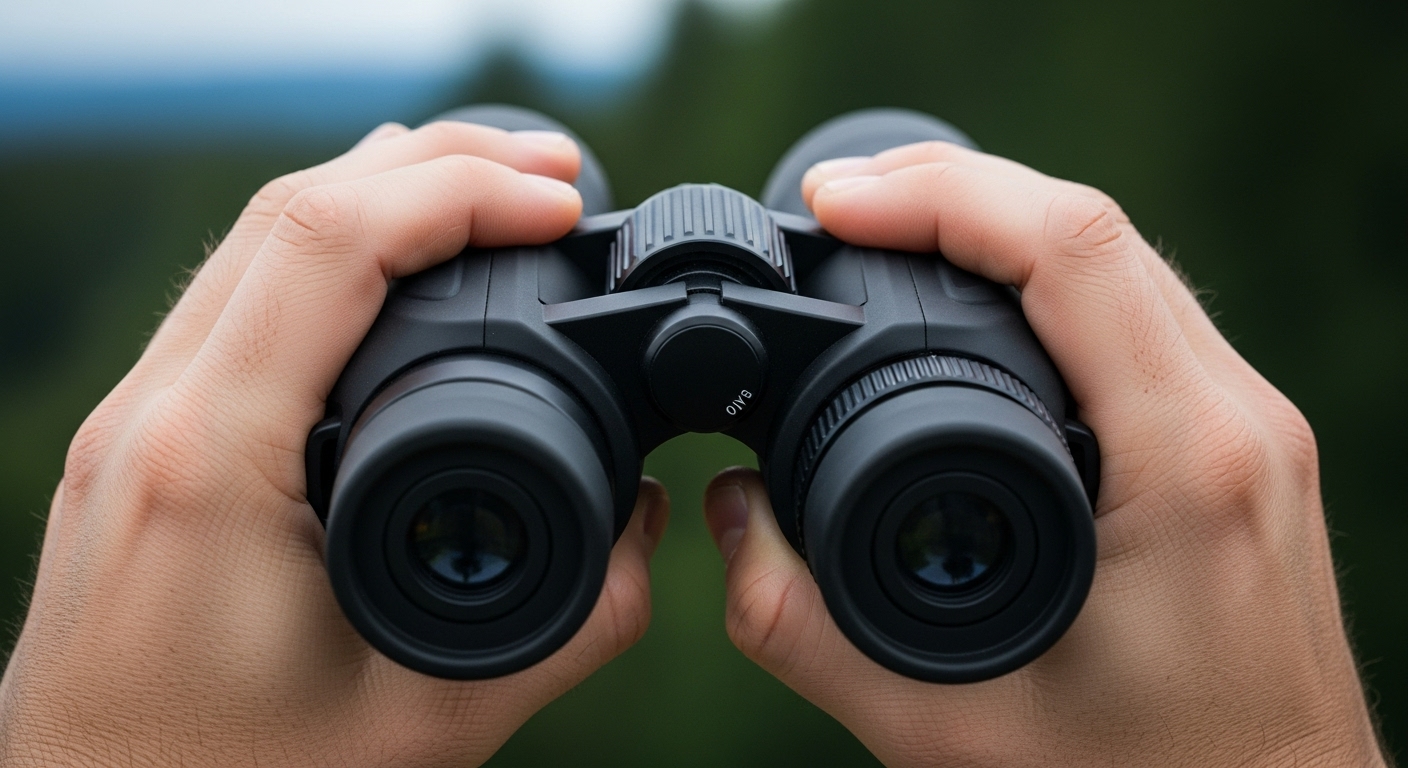
Every pair of binoculars is marked with a two-number code such as 8×42, 10×50, or 7×35. Knowing what does 10×50 mean on binoculars is the fastest way to compare models. The first number is the magnification, how many times larger an object will appear than with the naked eye. The second number is the diameter of the front objective lens, in millimeters. A 10×50 binocular makes things look ten times closer and gathers light through a 50mm-wide front lens. A 7×35 is more modest in power but easier to hold steady because lower magnification amplifies hand shake less.
Two other numbers come from this same code. The exit pupil, the diameter of the bright disc of light leaving the eyepiece, is calculated by dividing the objective diameter by the magnification. A 10×50 binocular produces a 5mm exit pupil, which matches the fully dark-adapted pupil of a healthy adult eye, ideal for astronomy or marine use in low light. A pair of 8×42 binoculars produces a 5.25mm exit pupil, the sweet spot that birders and hunters have gravitated toward for decades. The second derived spec is the relative brightness index, which is just the exit pupil squared. Higher numbers mean a brighter perceived image in dim conditions, but only up to the size of your own pupil.
Other markings on the body or barrel tell you about field of view, eye relief, and whether the binocular accepts a tripod adapter. Eye relief, the distance your eye must sit from the eyepiece to see the full image, is critical for glasses wearers. Anything below about 14mm will feel cramped, and serious astronomy or birding models offer 17mm to 20mm of long eye relief so eyeglass wearers can keep their glasses on and still see the full field of view. The field of view is usually given as feet at 1,000 yards, or in degrees, and it shrinks as magnification rises, which is why most handheld binoculars stop at around 10x or 12x.
The objective lens is the unsung hero of any binocular system. Typically ranging from 20mm to 56mm in diameter, this front element determines how much light the instrument can gather. Larger objectives collect more light, which makes them better for low-light conditions, but they also make the binoculars heavier and bulkier. The quality of the glass and the coatings on this lens directly impact image brightness, contrast, and color fidelity. Premium binoculars use extra-low dispersion (ED) or high-density (HD) glass in the objective, materials that bring different wavelengths of light to the same focal point and dramatically reduce color fringing around high-contrast edges.
Between the objective lens and the eyepiece sits the prism system. The glass used in those prisms matters more than most buyers realize. BaK4 (barium crown) glass has a higher refractive index and lower dispersion than the more common BK-7 (borosilicate) glass, which means it transmits a rounder, brighter exit pupil with less light cut off at the edges. You can often see the difference by looking at the exit pupil from a short distance away: a BaK4 prism produces a perfectly round bright disc, while a BK-7 prism produces a slightly squared-off disc with darker corners. For daytime use the difference is small, but in low light it can mean the difference between spotting a distant owl and not.
The eyepiece is not a single lens but a small lens group, typically three to six elements working together. These elements correct various optical aberrations and provide a comfortable viewing experience. Modern eyepieces often include aspherical elements, lenses with non-spherical surfaces that reduce distortion at the edges of your view. Eye relief, the distance you can hold your eye from the eyepiece while still seeing the full field of view, is one of the most important eyepiece specs for glasses wearers, who usually need at least 15mm.
Do not overlook the focusing mechanism. Most binoculars use a central focusing wheel that moves the eyepieces simultaneously, allowing you to focus both barrels at once. Many also include a diopter adjustment on one eyepiece to compensate for differences between your eyes. This mechanical precision ensures that both optical paths remain perfectly aligned while allowing for quick focus adjustments in the field. A properly adjusted diopter is the difference between a sharp image and a headache after a long observation session.
Without prisms, binoculars would show you an upside-down and backwards world. The objective lens naturally creates an inverted image, and that is simply how convex lenses work. In astronomical telescopes, this is not a problem since there is no real “up” in space. But for terrestrial viewing, that image needs to be flipped back to match what your eyes expect to see.
Porro prisms achieve this through total internal reflection. When light hits the angled surfaces of the prism at the correct angle, it bounces off like a perfect mirror without any loss of brightness. The first prism flips the image horizontally, and the second flips it vertically. The result is an image that matches what you would see with the naked eye, just magnified. The offset design of Porro prism binoculars also provides slightly better depth perception than equivalent roof prism models, because it increases the effective distance between the two objective lenses, giving your eyes a wider baseline to triangulate from.
Roof prisms are engineering marvels that accomplish the same image correction in a straight line. They use a combination of reflective surfaces arranged in a roof-like peak, hence the name, to redirect light multiple times within a compact space. The Schmidt-Pechan design is the most common in mid-priced binoculars, while the Abbe-Koenig design, used in some premium models, transmits slightly more light because the light path crosses fewer glass-to-air surfaces. Roof prisms require extremely precise manufacturing tolerances, sometimes down to a few arcseconds, and special phase-correction coatings to match the performance of simpler Porro prisms.
The choice between prism types affects more than just binocular shape. Porro prisms naturally provide slightly brighter images because they require fewer special coatings. Roof prisms need phase-correction coatings to prevent light wave interference that would otherwise reduce image quality, and many premium models also use dielectric coatings that boost prism reflectivity above 99 percent, well above the roughly 88 percent of an uncoated roof prism surface. High-end roof prism binoculars with proper coatings can match Porro prism performance, but at a significantly higher manufacturing cost.
Our brains evolved to process images from two eyes simultaneously, creating depth perception through stereoscopic vision. Binoculars preserve and enhance this natural ability by providing each eye with a slightly different viewing angle of the same scene. This stereoscopic effect is why binoculars feel more immersive than monoculars or spotting scopes. Your brain interprets the two images just as it would natural vision.
The interpupillary distance adjustment (IPD) on binoculars lets you match the instrument to your eye spacing. When properly adjusted, the two circular fields of view merge into one, and your brain seamlessly combines them. This is not just about comfort. Proper IPD alignment ensures that both eyes are looking straight through the optical centers of their respective barrels, minimizing eye strain and maximizing image quality. Most adults sit between 55mm and 75mm, and binoculars adjust across a range that covers nearly everyone.
Binocular vision also provides practical advantages beyond depth perception. Using both eyes reduces eye fatigue during extended viewing sessions. Your brain averages out small imperfections or floaters in individual eyes, resulting in a cleaner perceived image. Studies have shown that binocular viewing can improve contrast detection by around 40 percent compared to monocular viewing, which makes it easier to spot wildlife or pick out subtle details. That is also why two good eyes, properly corrected, will always beat a single eye with the same optical instrument behind it.
That first number in binocular specifications tells you the magnification power. An 8x binocular makes objects appear eight times closer than they do to the naked eye. But higher is not always better. As magnification increases, the field of view narrows, image stability decreases because every hand tremor is amplified, and depth of field becomes shallower. That is why most handheld binoculars stay between 8x and 12x magnification. Past that, even a slight tremor in your hands turns a steady image into a jittery mess, which is why astronomers and long-range shooters mount their high-power binoculars on a tripod.
Field of view (FOV) represents how wide an area you can see through the binoculars. It is usually expressed as feet at 1,000 yards or in degrees of arc. A typical 8×42 binocular might have a field of view of 330 feet at 1,000 yards, meaning you could see an area 330 feet wide if you were looking at something 1,000 yards away. Wide-angle binoculars sacrifice some edge sharpness for a broader view, while standard models prioritize edge-to-edge clarity. A 10x binocular with the same apparent field will show a noticeably narrower real-world area than an 8x, which is one reason birders often prefer 8x.
How far can binoculars see, then? The honest answer is that any binocular, even a modest 8×25 compact, can see to the horizon and beyond. Magnification does not extend the maximum distance at which light from an object can still reach your eye. What magnification does is reveal detail at distance. A 10x binocular will not let you see a deer that is six miles away any better than your naked eye could, because the air between you and the deer scatters the light too much. But a 10x binocular will let you read the deer’s ear tag at 200 yards, something the naked eye cannot do. In clear air, the practical limit for useful detail is usually set by atmospheric turbulence and the exit pupil, not the magnification number.
The exit pupil, calculated by dividing the objective lens diameter by magnification, determines how bright the image appears to your eye. An 8×42 binocular has a 5.25mm exit pupil (42 divided by 8). In bright daylight, your eye’s pupil contracts to about 2-3mm, so extra exit pupil size does not help. But in dim conditions, when your pupil dilates to 5-7mm, a larger exit pupil delivers a noticeably brighter image. This is why 7×50 binoculars, with a 7.1mm exit pupil, remain popular for marine use and astronomy in dark-sky locations.
Every time light passes through a glass surface, about 4 percent reflects back instead of transmitting through. With 10 to 14 glass surfaces in a typical binocular, that adds up quickly. Without coatings, an uncoated binocular loses nearly half of its incoming light to reflection. Modern anti-reflective coatings reduce these losses to less than 0.5 percent per surface, dramatically improving brightness and contrast. A fully multi-coated binocular, where every air-to-glass surface receives multiple coating layers, can achieve total light transmission of 90 percent or higher, compared to roughly 60 percent for an uncoated instrument.
Fully multi-coated optics apply multiple layers of anti-reflective compounds to every glass surface. These coatings are incredibly thin, often just a quarter wavelength of light, and must be applied with nanometer precision. Different coating materials target different wavelengths, which is why quality binocular lenses often show green, purple, amber, or ruby reflections. These colors indicate which wavelengths are being controlled to optimize transmission of the visible spectrum. Premium manufacturers like Zeiss, Leica, and Nikon tune their coating colors deliberately; the specific hue is essentially a fingerprint of the optical design.
Beyond basic anti-reflective coatings, premium binoculars feature specialized treatments. Dielectric coatings on roof prism models increase light reflection to over 99 percent, matching the naturally high reflectivity of Porro prisms. Phase-correction coatings on roof prisms keep light waves in sync after they bounce off the prism surfaces, preserving image contrast and resolution. Without phase correction, the light waves that pass through a roof prism can interfere with each other in destructive ways, producing a slightly soft, low-contrast image that no amount of anti-reflective coating will fix. External lens coatings often include hydrophobic treatments that repel water and oils, making the binoculars easier to clean and maintain in the field.
Coatings, prism glass, and lens design all add up to a single number that marketing teams like to quote: light transmissivity. Top-tier roof prism binoculars can reach 92 to 95 percent light transmission. Mid-priced Porro prism models typically land between 80 and 88 percent. Older or cheaper designs may transmit as little as 60 to 70 percent. In daylight the difference is subtle, but in low light the gap becomes obvious, and it is the single biggest reason premium binoculars command premium prices.
Chromatic aberration, where different colors focus at slightly different points, creates color fringing around high-contrast edges. Binocular manufacturers combat this using ED (Extra-low Dispersion) or HD (High Density) glass in objective lenses. These special glasses bend all wavelengths of light more uniformly. Some high-end models use fluorite crystal lens elements, which virtually eliminate chromatic aberration but at significant cost. The effect is most visible against dark silhouettes against bright skies, like a black bird against a white cloud, where cheap glass shows a green or purple fringe that ED glass all but erases.
Spherical aberration occurs because spherical lens surfaces do not focus light from the edges the same as light from the center. Aspherical lens elements solve this by having a more complex surface profile that compensates for these differences. The manufacturing complexity of aspherical lenses explains why binoculars with edge-to-edge sharpness cost considerably more than those with soft edges. This is most visible when looking at stars or flat walls, anything with straight lines that should stay straight all the way to the edge of the field of view.
Internal reflections and stray light can wash out images and reduce contrast. Manufacturers address this through internal baffling, blackened lens edges, and specially designed lens hoods. The interior of quality binoculars is painted with ultra-matte black paint that absorbs over 99 percent of stray light. Some models include sliding or built-in lens hoods that extend beyond the objective lenses to block oblique light rays. Without this careful light management, a bright sunlit scene behind a shaded subject would bloom and flare across the image, ruining the view.
Many users experience the “kidney bean effect,” where the image briefly blacks out or shows a kidney-shaped dark blob at the edge of the field. This is not a defect. It happens when your eye sits too far from the eyepiece, beyond the designed eye relief. Twist-up eyecups solve the problem by holding your eye at the correct distance, and glasses wearers who keep their glasses on can simply leave the eyecups rolled down. Adjusting the IPD and keeping both eyes relaxed and level prevents the vast majority of these issues.
Binoculars, telescopes, and monoculars share the same basic physics, but each is built for a different job. A telescope is essentially one half of a binocular, a single optical tube optimized for high magnification and a sharp, narrow field of view, usually mounted on a tripod because the high power amplifies every hand tremor. Binoculars split the same job across both eyes, trading some magnification for stability, depth perception, and the comfort of two-eyed viewing. A monocular is one half of a binocular in a single tube. It is essentially a tiny, pocketable refracting telescope with the same upright image correction but no depth perception and no two-eyed comfort.
For most outdoor activities, binoculars are the right choice. They offer a wide, stable view, comfortable extended use, and enough magnification to read a license plate at 200 yards or resolve the rings of Saturn. Telescopes win for astronomy at higher magnifications, where a steady mount and a single, very bright image matter more than portability. Monoculars are best when size and weight are the top priority, for backpackers, concertgoers, or anyone who wants a basic magnifier in a jacket pocket. The same physics, three different answers to three different problems.
The first number, 10, is the magnification. Objects appear ten times closer than they do to the naked eye. The second number, 50, is the diameter of the front objective lens in millimeters, which determines how much light the binocular can gather. Dividing 50 by 10 gives a 5mm exit pupil, which matches the size of a fully dark-adapted human eye and makes 10×50 a popular format for astronomy, marine use, and low-light observation.
Any binocular can see to the horizon and beyond, because magnification does not change the maximum distance light can travel. What changes is how much detail you can resolve at distance. A 10x binocular will not reveal a deer six miles away, because atmospheric haze scatters the light long before it reaches you, but it will let you read that deer’s ear tag at 200 yards. The practical limit for useful detail is set by the air between you and your subject, the size of the objective lens, and the exit pupil, not the magnification number alone.
Yes. Astigmatism causes parts of the image to look slightly blurred or smeared, but a binocular with a properly adjusted diopter will compensate for most of it. Start by focusing the left barrel using the diopter ring until the image is sharp, then use the central focus wheel for the right. Users with severe astigmatism may still prefer to leave their glasses on, in which case long eye relief of 15mm or more is essential so the full field of view remains visible. A short focus distance, often under 2 meters, also helps because most astigmatism-related blur is most noticeable at far distances, where binoculars are designed to perform best.
Weight distribution and construction materials make a huge difference. Roof prism binoculars concentrate weight along the central axis, while Porro prisms spread it wider, so a Porro 8×42 often feels bulkier in the hand even if it weighs the same. Magnesium alloy bodies weigh less than aluminum ones, and internal focusing mechanisms, where lenses move inside the body rather than extending the barrels, add weight but improve weather sealing. Rubber armoring, while protective, also adds several ounces.
Absolutely. Look for binoculars with at least 15mm of eye relief, the distance your eye can be from the eyepiece while seeing the full field of view. Most modern binoculars have twist-up or fold-down eyecups that allow glasses wearers to get their eyes close enough to the eyepieces. You may not need your glasses at all if the binoculars have sufficient diopter adjustment to correct for your vision, but always test in a store if you can, since eye relief and glasses thickness vary.
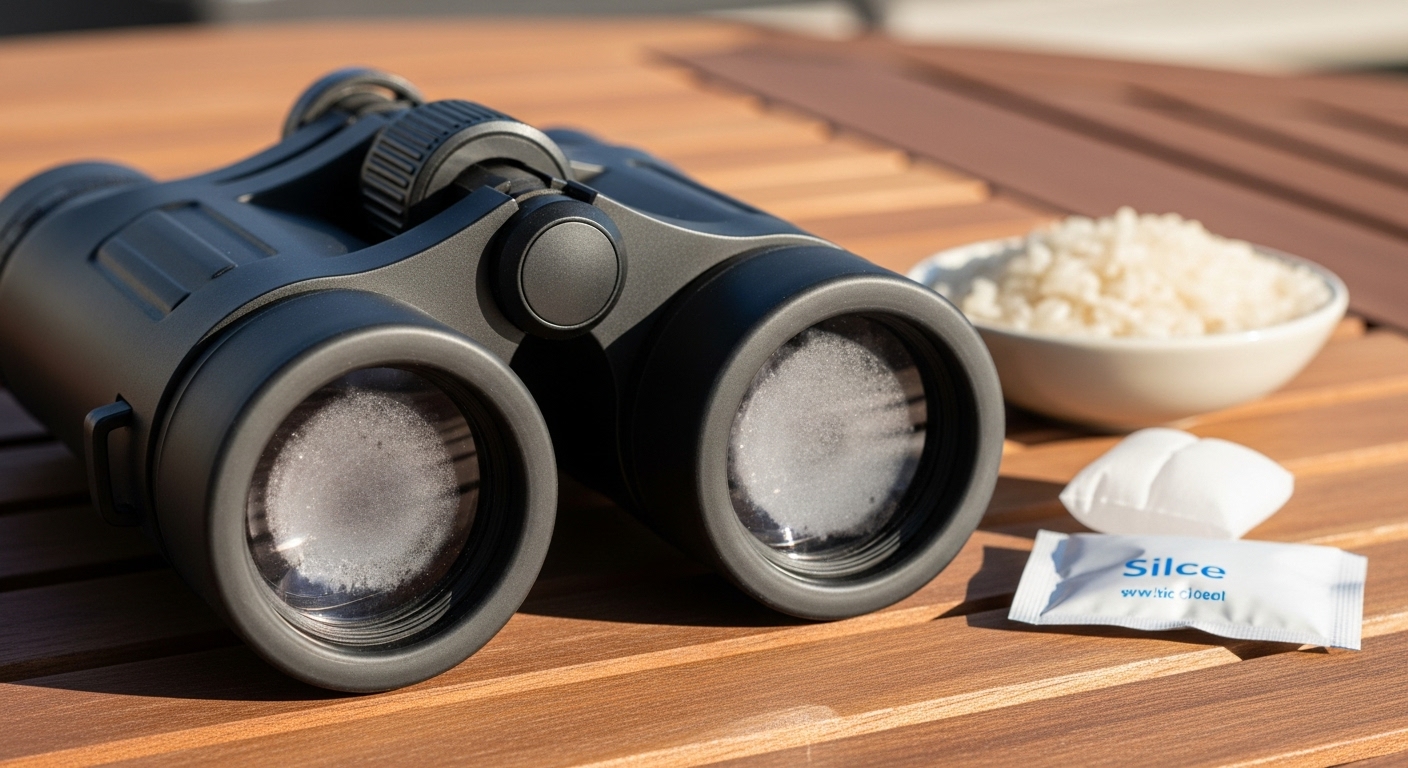
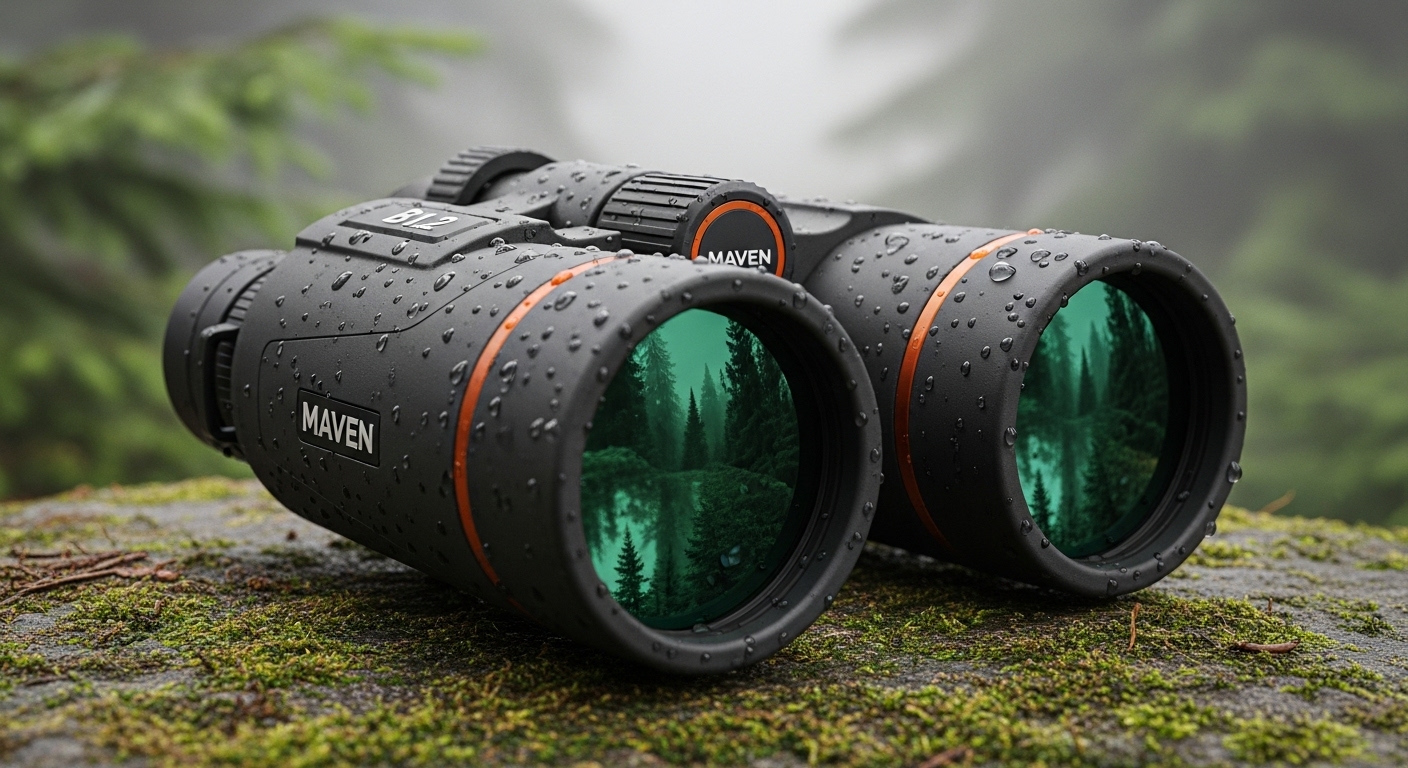
Waterproof binoculars use O-ring seals and nitrogen or argon purging to keep any moisture from entering the body. They can be submerged without damage and will not fog when moved from a warm car into cold air. Weather-resistant models resist rain and splashes but are not fully sealed, so they should not be dropped in a stream. For marine use, hiking in wet climates, or any activity that involves real water exposure, choose a fully waterproof, nitrogen-purged model.
Image-stabilized binoculars use either electronic sensors and motors or a gyroscopic mechanism to counteract hand shake. Electronic models detect movement and shift internal lens elements a few millimeters in real time to keep the image steady. Gyroscopic versions use a spinning mass to maintain orientation passively. Both systems allow stable viewing at magnifications of 12x or higher that would otherwise be impossible handheld, but they add weight, complexity, and, in the electronic versions, the need for batteries.
Binoculars represent centuries of optical refinement packed into a portable package. From the objective lenses gathering light to the prisms correcting orientation and the eyepieces presenting a magnified view, every component works in harmony to extend our visual reach. Understanding how do binoculars work helps us appreciate both the physics principles and the engineering decisions behind their design, from the choice of BaK4 or BK-7 prism glass to the precise tuning of phase-correction coatings that keep roof prism images sharp.
The next time you pick up a pair of binoculars, take a moment to consider the journey light takes through them. Those photons travel from a distant object, get focused by precision-ground lenses, bounce through carefully aligned prisms, and finally reach your eyes as a bright, magnified image. It is a testament to human ingenuity that we have made this complex process feel as natural as simply looking through two tubes, and as the technology continues to evolve, smart binoculars with built-in rangefinders, image capture, and AI-assisted species identification are already making their way into the field.
To explore more optics and binoculars guides from our team, visit the Revell Photography homepage for the latest reviews, comparisons, and beginner explainers covering the gear that brings distant subjects within reach.