Rifle Scope Turret Systems: Complete Guide 2026
Expert guide to rifle scope turret systems - master MOA vs MIL adjustments, custom turrets, and maintenance for precision shooting.

Walk into any gun counter, optics retailer, or hunting show in 2026, and red dots dominate the conversation. What began as a 1970s Swedish military project has become the default aiming solution across handguns, rifles, shotguns, crossbows, and even camera rigs. Yet despite the popularity, most users treat these optics as magic boxes: a bright dot floats in front of the target, the bullet follows, and nobody asks why it works.
That curiosity is worth pursuing, because the engineering inside a modern sight explains almost every practical behavior you encounter in the field. The way parallax disappears at designed distances, the reason a 2 MOA dot feels different from a 6 MOA dot, why some shooters see starbursts while others see crisp dots, how shake-awake extends battery life into the decades, and why a Trijicon RMR costs more than a budget Holosun all trace back to physics, materials science, and electrical engineering choices made decades ago and refined every year since.
This guide walks through the complete mechanism of how do red dot sights work, from LED emission through dichroic reflection to your retina, then expands into the practical details: types, power management, coatings, reticle geometry, mounting footprints, durability ratings, troubleshooting, and the smart-optic future. Whether you are a photographer mounting a finder scope, a competitive shooter chasing a faster split time, or a home defender choosing a first pistol optic, the same principles apply.
Key Takeaways: Red dot sights project an illuminated reticle from an LED onto a curved, dichroic-coated lens that reflects only the chosen wavelength back to the shooter’s eye while letting the target scene pass through; the LED sits at the lens’s focal point so reflected rays are collimated, producing a virtual image at infinity that stays on target regardless of eye position; modern variants include open reflex, enclosed tube, holographic, and prism designs, with shake-awake, solar backup, and multi-reticle systems now standard; and astigmatism, battery chemistry, mounting footprint, and IP rating are the four variables that most often decide whether a sight works for a particular user.
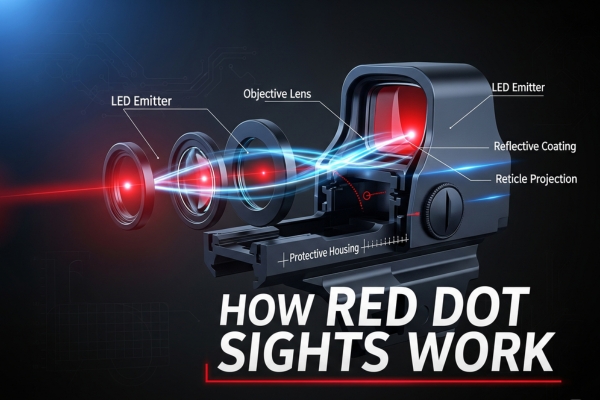
At the most fundamental level, a red dot sight is a single-lens reflector, the same optical family as a heads-up display in a fighter jet or the ghost image Pepper first demonstrated in 1862. An LED inside the housing emits light at a precise wavelength, typically 650 to 670 nanometers for red emitters or around 530 nanometers for green. That light strikes a curved front lens coated with a wavelength-selective dichroic film. The coating reflects the LED color back toward your eye while transmitting every other wavelength, so the target scene appears unchanged.
The Pepper’s Ghost analogy makes this accessible. The 19th-century stage illusion used an angled piece of glass to project a hidden actor into the audience’s line of sight. A red dot sight does the same thing in miniature: the curved coated glass projects the LED’s image into your sight line while the rest of the world passes through unobstructed. The reflection appears as a bright point floating on whatever you are aiming at.
The crucial physics is collimation. The LED sits exactly at the focal point of the curved lens. Light rays from a point at the focal point reflect off the curved surface and emerge parallel, behaving as if they originated at optical infinity. Your eye, lens, and brain interpret parallel incoming light as a distant object, so the dot appears to sit at the same distance as the target rather than at the surface of the sight window. Because the dot and the target share a focal plane, the sight is effectively parallax-free within its design range.
Three components define every reflex sight, no matter the brand or price: an LED emitter, a curved dichroic-coated reflector lens, and a precision housing that holds them in exact alignment. Disassemble an Aimpoint CompM2, a Holosun 507C, or a budget sight from a discount retailer, and you find the same three pieces in slightly different configurations.
Parallax is the apparent shift of a reticle relative to a target when the eye moves behind the sight. In a magnified scope with the reticle etched on a fixed focal plane, any head movement shifts the reticle against the target and produces an aiming error. Red dot sights largely eliminate this problem, but not perfectly, and the specifics matter.
Most reflex sights are engineered to be parallax-free at a specific distance, usually 50 or 100 yards for full-size optics and around 25 yards for pistol-sized open-reflex designs. At the parallax-null distance, the dot and the target share an optical axis, so lateral head movement produces no shift. Move closer or farther than that designed distance, and the dot drifts slightly when you move your head. In practice, the error stays under 1 MOA within the intended engagement range, which is why the marketing phrase “parallax-free” is technically accurate only in context.
Eye relief is the distance your eye can sit behind the sight and still see the full window. Iron sights need a specific cheek weld; magnified scopes demand a precise eye-to-ocular distance. A red dot sight has effectively unlimited eye relief because the collimated dot stays visible whether your eye is one inch or ten inches from the rear of the optic. This matters in dynamic shooting, with night-vision goggles, behind a magnifier, or when wearing a gas mask or sunglasses.
The geometry that makes parallax-free viewing possible is the same geometry that enables unlimited eye relief. The reflector is a section of a sphere or parabola with the LED precisely at its focal point. Any ray leaving the LED reflects off the curved surface parallel to the line connecting the LED to the lens center. Because those reflected rays are parallel, the dot’s apparent position depends only on the angle at which your eye intercepts the beam, not on how far your eye is from the rear of the housing.
Four distinct technologies compete under the “red dot” label. They look similar through the lens but use different mechanisms to create the aiming reference, and each carries different tradeoffs in battery life, weight, durability, and cost.
Reflex sights use a single curved lens and a single LED. The open-emitter design exposes the front lens from above and below the housing, giving a wide field of view and a low profile. Open reflex sights dominate the pistol and lightweight rifle market because they weigh less, sit lower, and cost less to manufacture than enclosed designs.
The exposed lens is also the main weakness. Rain, snow, mud, and dust can land directly on the reflective surface, and a cracked front lens means the optic is unusable. Modern manufacturers counter this with protective shrouds, deep lens recesses, and hydrophobic coatings, but the open architecture remains vulnerable. Open emitters also suffer dot washout in bright sunlight when the LED struggles to outshine ambient reflection off the front lens.
The terms “reflex sight” and “red dot sight” are essentially interchangeable in modern usage. Burris, Aimpoint, and most academic sources use them as synonyms. A few purists reserve “reflex” for the open-lens design and “red dot” as the umbrella term, but in practice you see both labels on the same product.
Tube-style (also called enclosed-emitter) red dots wrap the optical system in a cylindrical housing similar to a traditional rifle scope. The objective lens sits at the front, the ocular lens at the rear, and the LED-and-reflector assembly lives inside the sealed tube. Aimpoint’s CompM2, M68 CCO, and most Trijicon ACOG-adjacent designs follow this form factor.
The sealed tube protects the optical components from impact, debris, and weather. Enclosed designs also reduce glare in bright conditions because ambient light cannot reach the rear surface of the reflector lens. The trade-off is weight and bulk, which is why enclosed red dots historically dominated rifles while open reflex designs took over pistols. Recent designs like the Aimpoint Acro and Holosun AEMS have shrunk enclosed optics to pistol size, but open reflex still wins on slimness.
Holographic sights, pioneered by EOTech, replace the LED-and-reflector combination with a laser that illuminates a pre-recorded hologram recorded on a photosensitive plate inside the window. The hologram reconstructs a full reticle pattern (typically a 68 MOA ring with a 1 MOA center dot) when lit by the laser wavelength.
The advantage is that the hologram itself encodes the reticle pattern, so even if the front window is partially shattered, broken, or obscured, the visible portion still projects a complete aiming reference. The reticle also stays the same apparent size at any distance because the hologram is reconstructed in three dimensions. The disadvantage is power draw. Holographic sights consume far more current than LED reflex designs, often giving only a few hundred hours on a single battery compared to 50,000-plus hours for an Aimpoint.
Prism scopes are not red dots in the strict sense, but they are often sold alongside them and confused with them. A prism scope uses a glass prism to bend the image path, an etched reticle on a fixed focal plane, and usually a small amount of magnification (commonly 1x to 5x). The etched reticle is visible without batteries, an advantage in austere conditions. The magnification trades the unlimited eye relief of a true red dot for precision at distance.
Prism scopes solve one problem red dots cannot: precise holdover at extended ranges. The fixed etched reticle can include bullet drop compensator marks, ranging stadia, or custom hash patterns that survive without electronics. For hunters who want a single optic for 25 to 400 yard shots, prism scopes offer capabilities LED red dots cannot match.
The table below summarizes the practical differences between the four main aiming technologies. Choose based on your priorities rather than brand loyalty.
| Feature | Reflex / Tube Red Dot | Holographic | Prism Scope |
|---|---|---|---|
| Light source | LED (650-670nm red, 530nm green) | Laser diode + hologram | None (etched reticle) |
| Magnification | 1x (true red dot) | 1x | Typically 1x-5x |
| Battery life | 10,000 to 50,000+ hours | 500 to 1,000 hours | No battery needed |
| Eye relief | Unlimited | Unlimited | Fixed (3-4 inch typical) |
| Reticle when window damaged | May be lost or distorted | Survives partial window damage | Unaffected |
| Typical weight | 1-7 oz (pistol to rifle) | 9-12 oz | 12-20 oz |
| Price range | $50-$800 | $400-$700 | $300-$900 |
| Best use case | General purpose, fast acquisition | CQB with magnifier, reticle pattern preference | Engagements beyond 100 yards, battery-free reliability |
Modern LEDs are remarkably efficient. A quality red emitter converts roughly 30 to 50 percent of input electrical energy into light, with the rest lost as heat. Early red dots used bulky incandescent bulbs that consumed far more power and produced less consistent wavelengths. The shift to semiconductor LEDs in the 1990s and 2000s is what allowed battery life to stretch from hundreds of hours to tens of thousands.
Red emitters at 650 to 670 nanometers remain the most common because the human eye is highly sensitive in that range and the wavelength is far enough from the sodium-vapor lines of typical artificial lighting to look clean. Some manufacturers offer green emitters around 530 nanometers because green sits closer to the peak photopic sensitivity of the human eye and can appear brighter in daylight. The trade-off is higher power draw per lumen.
Modern red dot power management has become more sophisticated than simply on and off. Four features now dominate the category.
Shake-awake (motion activation): An internal accelerometer detects movement and instantly powers the LED. After a programmable inactivity timeout, usually 2 to 10 minutes depending on the model, the sight returns to sleep mode. Holosun popularized the feature at consumer price points in 2020-2022, and it has since spread to Aimpoint, Trijicon, and Sig Sauer designs. Shake-awake effectively eliminates the “battery died because I forgot to turn it off” failure mode.
Auto-brightness sensors: A photodiode behind the front lens measures ambient light and adjusts LED output automatically. High-end models sample the environment dozens of times per second, keeping the dot readable from dawn through midday sun without manual adjustment. Manual override remains available for night-vision use or specific lighting conditions.
Solar backup: Photovoltaic cells on the housing supplement or replace battery power in bright conditions. Holosun’s solar-equipped 503 and 515 series can run indefinitely in daylight on solar alone, falling back to a CR2032 only in dim conditions. Solar backup is a redundant power source rather than a primary one, but it has rescued many users from dead-battery failures.
Top-loading battery compartments: A relatively recent innovation, top-loading trays let you swap a CR2032 or CR1632 without removing the sight from the firearm. Zero retention was the original weakness of pistol-mounted red dots, and top-loading battery designs address it directly. Aimpoint’s ACRO P-2, the Trijicon SRO, and the Holosun 507 Comp all use this approach.
The CR2032 coin cell remains the dominant battery because it stores roughly 220 mAh in a slim package that fits any sight housing. Budget sights often use CR1632 or LR44 cells, which save space but cut runtime. A quality CR2032 in a low-draw LED sight delivers 20,000 to 50,000 hours at the medium brightness setting, enough to leave the optic on for years without changing the battery.
The dichroic coating on a red dot’s reflector is the most technically demanding component. It must reflect only the LED wavelength (typically a 20 to 30 nanometer band) while transmitting everything else with minimal absorption or color shift. The coating is built up by vacuum deposition, alternating layers of high-refractive-index material (often titanium dioxide or tantalum pentoxide) and low-refractive-index material (typically silicon dioxide) at thicknesses measured in fractions of the wavelength of light.
A modern dichroic reflector may stack 10 to 30 individual layers, each tuned to a specific interference condition. Light of the target wavelength reflects through constructive interference; light of other wavelengths transmits because the reflections cancel out. The result is a near-perfect bandpass filter at the LED’s frequency. Some designs use a dielectric mirror instead of a dichroic, which uses thicker oxide layers and produces higher reflectivity across a wider band. Dielectric coatings are more expensive but deliver brighter dots and better color neutrality.
Beyond the dichroic coating, manufacturers apply several secondary treatments.
Anti-reflective (AR) coatings on both lens surfaces minimize back-reflection of the target image. Without AR coatings, internal lens surfaces can bounce ambient light back to your eye, producing ghost images and reducing contrast.
Hydrophobic coatings cause water to bead and roll off the front lens, keeping the sight usable in rain. The coating is a fluorinated polymer layer that reduces surface energy below that of water.
Oleophobic coatings repel skin oils and fingerprints, making the lens easier to clean and reducing the oily smear that accumulates on pistol-mounted optics.
Scratch-resistant hard coatings apply a thin quartz or sapphire-like layer that resists abrasion from cleaning or impact. The Aimpoint Acro uses a chemically strengthened glass front lens with a hardness approaching that of sapphire.
The lens substrate itself matters. Optical-grade borosilicate glass is the standard for high-end sights, offering clarity, scratch resistance, and thermal stability. Some budget optics use polycarbonate, which is lighter and cheaper but scratches more easily and can distort under thermal stress. A few manufacturers bond two thin lens elements together with the dichroic coating between them, protecting the coating from damage and reducing its visibility in transmission.
Mangin mirror systems, used in a few specialized tube-style red dots, place the dichroic reflector on the rear surface of a lens and use the curved front surface as a refracting element. This dual-element approach can correct some optical aberrations and produce a flatter image plane, but it adds cost and complexity. Most reflex sights stick with a single curved lens because the simpler design works well enough for 1x use.
Zeroing aligns the dot with the firearm’s actual point of impact at a specific distance. Because the LED sits at a fixed point inside the housing, moving the LED shifts the dot across the reflector and therefore across the target. Most red dot adjustments use a screw or turret that physically translates the LED emitter within a calibrated range.
Adjustment turrets click in discrete increments, allowing precise and repeatable changes. One click on a 1 MOA-per-click sight moves the dot one MOA across the target, which is roughly one inch at 100 yards, half an inch at 50 yards, or a quarter inch at 25 yards. A 0.5 MOA-per-click sight offers finer adjustment but requires twice as many clicks for the same shift. Most competition shooters prefer 0.5 MOA clicks for fine-tuning, while 1 MOA clicks are sufficient for general use.
Milliradian (mrad) adjustments show up on European optics and precision-oriented designs. One mrad equals 3.437 MOA, or roughly 0.36 inches at 100 yards. Mrad sights let you range targets and dial corrections using the mil-dot reticle math familiar to long-range shooters, but mrad-based red dots remain less common than MOA designs because the audience is smaller.
Field-zeroing procedure works the same regardless of the optic.
Mount the sight and confirm torque on the mount screws per the manufacturer’s spec (typically 15-20 in-lbs for cross-bolt mounts).
Bore-sight the firearm by removing the bolt or looking down the bore, then aligning the dot to a target at the closest practical distance.
Fire a three-shot group at 10 to 15 yards to confirm the dot and point of impact are close.
Move to your zero distance (25 yards for pistol, 50 or 100 yards for rifle) and fire a fresh group.
Adjust windage and elevation to walk the group onto the dot, counting clicks and confirming with follow-up shots.
Confirm zero with cold and hot shots, multiple positions, and if possible, a second shooter.
Quality sights hold zero under recoil because their adjustment mechanisms use hardened steel components, precision threads, and spring-loaded detents that resist loosening. Budget sights use softer alloys and looser tolerances, which is why their zero shifts after a few hundred rounds. The mechanical precision required for reliable adjustment is one of the main drivers of price differences between brands.
Reticle choice affects how a sight feels in use. The simple single dot is the most common and most versatile option, but the dot’s apparent size in MOA or mrad changes the trade-off between precision and speed.
A 1 MOA dot covers roughly one inch at 100 yards and 0.5 inches at 50 yards. A 2 MOA dot covers two inches at 100 yards. A 6 MOA dot covers six inches at 100 yards. The table below shows how common dot sizes translate to real-world target coverage at typical engagement distances.
| Dot Size | 10 yards | 25 yards | 50 yards | 100 yards |
|---|---|---|---|---|
| 1 MOA | 0.10 in | 0.26 in | 0.52 in | 1.05 in |
| 2 MOA | 0.21 in | 0.52 in | 1.05 in | 2.09 in |
| 3 MOA | 0.31 in | 0.79 in | 1.57 in | 3.14 in |
| 4 MOA | 0.42 in | 1.05 in | 2.09 in | 4.19 in |
| 6 MOA | 0.63 in | 1.57 in | 3.14 in | 6.28 in |
Two MOA has become the default pistol dot size because it balances speed and precision well for typical self-defense distances (3 to 25 yards). Three MOA is a popular middle ground for both pistols and rifles. Six MOA dots are common on shotguns, where the larger dot is faster to acquire and the wider pattern forgives imprecise aiming. One MOA dots favor precision rifle and rimfire competition where the target is small at distance.
Circle-dot reticles (popularized by EOTech and now common on Holosun and Sig Sauer designs) combine a large outer ring (often 65 or 68 MOA) with a precise center dot (typically 1 or 2 MOA). The ring gives the eye a quick target reference, then the dot provides the actual aiming point. Multi-reticle systems like Holosun’s MRS let the user cycle between a 2 MOA dot, a 32 MOA circle with 2 MOA dot, or a 32 MOA circle alone, adapting to different conditions.
BDC (bullet drop compensator) reticles include hash marks below the center dot representing hold points for longer distances. These work for a specific cartridge and barrel combination, limiting flexibility but adding precision. Programmable reticles, where the user can select patterns through a smartphone app, are emerging in high-end models but remain rare in the consumer market.
Mounting determines whether the sight sits at the correct height, holds zero under recoil, and fits the host firearm. Each platform uses different standards, and the wrong footprint means the sight literally will not fit.
Picatinny (MIL-STD-1913): The dominant rifle mounting standard, with cross-bolt slots on 0.5-inch centers. Most full-size red dots ship with Picatinny mounts and can also clamp to Weaver rails. Picatinny adds weight but provides a stable, repeatable mounting surface.
Weaver: The older civilian counterpart to Picatinny, with slightly different slot dimensions. Most modern mounts accept both standards, but some tighter Weaver-spec rails will not accept Mil-spec Picatinny bases.
RMR footprint (Trijicon RMR / SRO / Holosun 407/507/508): The dominant pistol red dot footprint. Uses a dovetail base with a single recoil lug and two cross-bolts. Compatible across most modern pistol slides cut for the RMR standard.
Docter footprint: A smaller European footprint common on older European pistol slides (CZ, Walther, some HK). Docter-Noblex optics used this pattern, and several modern micro-red dots (Leupold DeltaPoint Pro, certain Burris FastFire models) share it.
Aimpoint Micro (Patrol Rifle Optic mount): The standard for Aimpoint CompM2/M68-style optics, with a 30mm ring or proprietary base. Compatible across rifles, shotguns, and magnifier setups.
Aimpoint Acro: Aimpoint’s enclosed-emitter pistol footprint with a unique four-bolt rectangular base. The Acro P-2 and similar optics require slides cut specifically for this standard.
Shield RMS / RMSc: A small footprint used by Shield Sights and adopted by Sig Sauer, Glock, and Springfield for several pistol models. RMSc is the compact version with slightly different dimensions.
C-More: A competition-shooting footprint with a large rectangular base. Used primarily in practical shooting disciplines.
Co-witness means aligning the red dot with backup iron sights so both are visible simultaneously. Absolute co-witness positions the dot at the same height as the iron sights, which clutters the sight picture but provides true redundancy. Lower 1/3 co-witness raises the dot slightly so only the upper third of the iron sight post is visible below the dot, producing a cleaner view while still offering a backup if the optic fails.
Lower 1/3 co-witness has become the default for tactical rifle setups because it preserves the speed advantage of the red dot without permanently obscuring the irons. For home-defense shotguns and patrol rifles, absolute co-witness remains common because the redundancy is worth the visual clutter.
Quick-detach (QD) mounts use a cam lever to clamp onto the rail and release under thumb pressure. The American 519 QD mount, Larue Tactical mounts, and similar designs hold zero within 1 MOA across repeated removals. QD mounts suit users who switch sights between firearms, remove optics for transport, or want to swap a red dot for a magnifier without tools.
Astigmatism is the single most common reason shooters complain about red dots. A shooter with an astigmatic eye sees the dot as a starburst, comet, or smear rather than a clean point, regardless of how expensive the optic is. The phenomenon is not a defect in the sight; it is how the eye focuses light from a near-point source.
Human eyes are roughly spherical but not perfectly so. Astigmatism means the eye’s refractive power differs between meridians, so light from a single point focuses to multiple points on the retina instead of one. A red dot sight produces a near-point source at optical infinity, and an astigmatic eye cannot resolve that point cleanly. The result looks like a starburst, with rays extending in the direction of the eye’s meridional difference.
Several workarounds help. Some shooters find that switching from a red emitter (650-670nm) to a green emitter (530nm) tightens the perceived dot because the eye’s chromatic aberration interacts differently with the two wavelengths. Others dial the brightness down to the lowest visible setting, which shrinks the dot and reduces the perceived starburst. A small percentage of users get relief by looking through the sight with corrective lenses (glasses or contacts that correct the astigmatism).
For shooters whose astigmatism is severe enough that no red dot looks clean, a prism scope is the most reliable fallback. The etched reticle on a fixed focal plane remains visible without an LED, and the magnification (typically 1x to 5x) lets the eye resolve detail that a single red dot cannot deliver. Primary Arms and Burris make affordable prism scopes in 1x and 2x configurations that fill this niche well.
Red dots must survive recoil, weather, temperature swings, and the occasional drop onto concrete. The standards used to rate this durability vary, but the most common are IP (Ingress Protection) ratings, operating temperature ranges, and recoil-rated round counts.
IP ratings follow the format IPXY, where X is dust protection and Y is water protection. Red dots typically focus on the water side.
IPX4: Splash-resistant. The sight survives light rain and brief water spray but not immersion.
IPX7: Survives temporary immersion in up to 1 meter of water for 30 minutes. Suitable for rain, snow, and brief submersion.
IPX8: Survives continuous immersion beyond 1 meter, with depth and duration specified by the manufacturer. Open-emitter sights like the Cosmic Tactical Mercury claim IPX8 at 3 meters.
IP68: Dust-tight and waterproof beyond IPX7, the rating usually cited for the most rugged reflex sights.
Fog resistance requires nitrogen or argon purging during assembly. Inert gas inside the housing eliminates moisture that could condense on internal surfaces during rapid temperature changes. Quality sights are sealed and purged in a clean room to prevent internal fogging, then verified with temperature-cycle testing from -40°F to 140°F or wider.
Recoil rating matters for pistol-mounted optics and any rifle chambered in hard-kicking cartridges. Reputable manufacturers rate their pistol dots for 4,000 to 10,000 rounds of .40 S&W equivalent recoil. Magnifier and rifle-rated optics should handle tens of thousands of rounds without zero shift. The battery and electronics are typically potted in epoxy to absorb shock, and the adjustment turrets use spring-loaded mechanisms that will not back out under vibration.
Wildlife and sports photographers have adopted reflex-style sights as finder scopes. Mounted on a camera’s hot shoe or a telephoto lens collar, a red dot gives a wide field of view for initial subject acquisition. Once the subject is in the red dot, the photographer switches to the camera’s viewfinder for composition and focusing. The technique dramatically improves keeper rates for birds in flight, fast mammals, and unpredictable sports action where the subject can leave a narrow telephoto frame in seconds.
Astronomers have used similar setups for decades. A small reflex sight mounted on a telescope tube provides an easy way to align the main optic with a celestial target. The unlimited eye relief and bright reticle work well in dark conditions, and the parallax-free design means alignment errors are minimal.
Archers use single-dot sights as alternatives to multi-pin setups. A 2 or 3 MOA dot zeroed at 20 yards can be paired with holdover for longer distances, replacing a 5-pin sight for shooters who prefer a single aiming point. Crossbow manufacturers now ship red dots as standard equipment on mid- and high-end models, taking advantage of the flat trajectory and single-distance zero typical of modern crossbows.
Survey instruments sometimes use reflex-style optics for initial alignment before fine adjustment with a theodolite or total station. Construction lasers occasionally incorporate similar reflective sight technology to speed up rough alignment. The same principles that make red dots fast on the range translate to any task where you need to align two objects quickly.
Red dots are low-maintenance optics, but a few habits extend their service life significantly. Wipe the front lens with a microfiber cloth after exposure to dust or grit. Avoid touching the coated surface with bare fingers, because skin oils can etch the dichroic coating over time. If the dot gets contaminated, use lens cleaning solution designed for coated optics and a clean microfiber pad.
Battery contacts deserve periodic inspection. Remove the battery every one to two years, clean the contacts with a cotton swab lightly dampened with isopropyl alcohol, and inspect the O-ring seal for damage. A cracked O-ring is the most common cause of water intrusion, and replacement O-rings cost pennies. Apply a thin film of silicone grease to the O-ring when reinstalling to maintain the seal.
Mount screws and adjustment turret caps should be checked periodically. A small drop of blue thread locker (Loctite 242 or equivalent) on mount screws prevents gradual loosening under recoil without preventing future removal. Cap the adjustment turrets when the sight is in storage to keep debris out of the adjustment mechanism.
Storage in a temperature-controlled environment prevents unnecessary exposure to humidity and extremes. A padded case or scope cover protects the optic during transport. Some manufacturers include specific long-term storage instructions; following them preserves the optic for years.
Dot flicker or sudden shutdown usually means a battery issue. Check the battery orientation, inspect contacts for corrosion or debris, and confirm the O-ring is properly seated. Most “dead sight” reports trace back to a battery that was installed backward or a contact that lost spring tension.
Starburst or comet-shaped dots usually mean astigmatism rather than a sight defect (see the dedicated Astigmatism section above). If the dot looks clean through glasses but distorted without them, the issue is in your eye. If the dot looks distorted through glasses, the optic itself may have a coating defect or internal moisture.
Zero shift after recoil usually indicates a loose mount. Confirm the mount screws are torqued to spec, check the rail for damage, and inspect the recoil lugs or cross-bolts for wear. Some pistols require a sight-specific mounting plate that interfaces with the slide cut; a missing or wrong plate will produce zero shift no matter how tight the screws are.
Dim or invisible dots in bright conditions suggest insufficient brightness or dying batteries. Auto-brightness sensors can be fooled by backlighting or shadows; manual override often solves these issues. Lens contamination, especially oily fingerprints, can scatter the LED light and reduce apparent brightness without affecting battery level.
Shake-awake failing to activate usually means a weak battery or a stuck accelerometer. A fresh CR2032 restores function in most cases. If the issue persists, the optic may need service.
Internal fogging after temperature change means the seal has failed. Some sights can be returned to the factory for re-purging, but most manufacturers replace the optic under warranty. Fogging caused by a manufacturing defect usually shows up in the first year; fogging from impact damage is not warrantable.
The red dot market reached roughly $787 million in 2026, with a projected compound annual growth rate near 6.4 percent through the end of the decade. Three trends are reshaping the category: solar hybrid power, smart optics, and ruggedization at lower price points.
Solar hybrid power, popularized by Holosun’s 503 and 515 series and now appearing in budget designs, uses photovoltaic cells on the housing to supplement the battery. In bright daylight, the solar cell powers the LED directly. The internal battery kicks in only when ambient light falls below a threshold. The result is an optic that can run for years in mixed-use conditions without a battery change. Solar backup does not replace batteries, but it dramatically extends the practical service interval.
Smart optics with Bluetooth connectivity emerged around 2024-2026 and have started shipping in commercial quantities. These designs pair with smartphone apps to log shots, program reticles, and integrate with ballistic calculators. Several brands now offer app-connected optics, and the major manufacturers are watching adoption closely. Battery use and Bluetooth pairing add power draw, but the value of automatic shot logging for competition shooters and instructors is clear.
Ruggedization at lower price points is the most disruptive trend. Holosun, Sig Sauer, and a handful of direct-to-consumer brands have demonstrated that sub-$150 optics can deliver IPX7 water resistance, 50,000-hour battery life, and multi-reticle systems with shake-awake. Ten years ago, those features belonged to $400-plus Aimpoint and Trijicon designs. The competitive pressure has driven rapid feature migration down-market.
Material science continues to advance housing design. Magnesium alloys, carbon-fiber-reinforced polymers, and titanium are replacing aluminum in some premium designs to cut weight without sacrificing strength. Sapphire-like glass coatings, originally a watchmaking technology, are appearing on high-end reflex sights to improve scratch resistance.
Law enforcement adoption has crossed a tipping point. A 2025 POLICE Magazine survey found 77 percent of US law enforcement agencies authorize handgun optics, and 76 percent of officers in those agencies actively use them. That is a dramatic shift from a decade earlier, when reflex sights on duty pistols were rare. Military adoption continues to expand, with the US Army’s M17 and M18 sidearms shipping with optic-ready slides as standard.
“Red dot” and “reflex sight” are not different categories. The terms are interchangeable in modern usage, though some purists reserve “reflex” for open-lens designs. If a product listing distinguishes them, it is marketing, not physics.
Red dots are not limited to close range. A quality reflex sight with proper zero and ammunition is effective to 100 yards and beyond. Hunters regularly take game at 75 to 150 yards with 2 MOA dots on rifles, and competition shooters run 100-yard stages with open reflex pistol sights. The dot does not magnify, but the lack of parallax and unlimited eye relief often beats iron sights at distance for many shooters.
Red dots do not need magnification to be accurate. The aiming reference sits at optical infinity, so it appears in the same focal plane as the target. Your eye sees both at the same time without refocusing, which is faster and easier than the front-post-to-rear-notch-to-target alignment that iron sights require.
Battery-free red dots do not exist. Tritium-illuminated reticles (Trijicon’s signature feature) glow without batteries, but tritium provides only a faint outline. The bright aiming point on a Trijicon RMR still uses a battery-powered LED plus fiber optics. Tritium-only sights lack the brightness for daylight use.
Selection comes down to use case and budget. For a home-defense or concealed-carry pistol, an enclosed-emitter design (Aimpoint ACRO P-2, Holosun AEMS) or a quality open reflex (Trijicon RMR, Holosun 507C, Sig Sauer Romeo2) in the mid-tier price range delivers the durability and battery life that justify the investment. Budget optics in the lower entry range can work for range training but rarely hold zero under carry-grade recoil or survive the moisture and sweat of daily carry.
For a duty rifle or patrol carbine, a tube-style red dot (Aimpoint CompM5, Trijicon MRO, Vortex Spitfire HD Gen II) on a 1.93-inch-height mount gives proper cheek weld and absolute or lower 1/3 co-witness with backup irons. Battery life, durability, and night-vision compatibility matter more than weight or size.
For a 3-gun or USPSA competition rifle, a small reflex sight paired with a magnifier (Sig Juliet 3, Vortex Micro 3x) gives close-quarters speed and long-range precision in one package. Multi-reticle systems help transition between stages with different target sizes.
For hunting, a tube-style red dot with a BDC reticle and reliable auto-brightness suits brush-country deer hunting, while a 1-6x or 2-7x LPVO (low-power variable optic) is the better choice for western big game where shots can extend past 300 yards. Red dots excel at the close end of hunting ranges; LPVOs cover the long end.
Budget considerations extend beyond the optic. Factor in mount height, backup irons, batteries, and any gunsmithing required to fit the optic to the host firearm. Entry-level optics from reputable manufacturers often suffice for occasional range use; professional applications justify premium prices because zero retention and reliability translate directly to performance.
Red dot regulations vary by jurisdiction. Some US states regulate electronic sights for hunting, particularly for primitive-weapons seasons or certain game species. Hunters should verify their state’s regulations before mounting a red dot on a hunting rifle. International travelers face stricter rules: several countries prohibit optical sights on firearms entirely or require special permits.
Training and proficiency remain essential. A red dot speeds up target acquisition but does not replace fundamental marksmanship. Dry fire practice, live fire drills, and courses that stress movement and unconventional positions develop the muscle memory that makes a red dot effective under stress. The optic is a tool; skill comes from the user.
Responsible use requires attention to safety and ethics. Faster target acquisition and cleaner hits reduce the chance of missed shots that could harm bystanders or damage property. Disciplined trigger control and target identification matter more when the optic makes aiming faster. Like any aiming system, a red dot amplifies the shooter’s existing habits, good and bad.
The first reflex-style sight was patented by Howard Grubb in 1900 as a collimating gunsight for the British military. The technology sat largely dormant for half a century until the Swedish company Aimpoint was founded in 1974 to develop reflex sights for military customers. Aimpoint’s first product was a red dot sight delivered to the Swedish Army in 1975.
US adoption began in the 1990s with the M68 Close Combat Optic (CCO), a variant of the Aimpoint CompM2. The M68 armed armored vehicles and crew-served weapons during Operations Desert Storm and Iraqi Freedom, proving that reflex sights could survive the recoil of heavy machine guns and the vibration of tracked vehicles.
The Aimpoint CompM2 and later the Trijicon ACOG defined military and law enforcement reflex sights through the early 2000s. The technology spread to hunting and competition in the 2010s, then to pistols with the rise of milled slides and aftermarket cuts in the late 2010s. Today, reflex and tube-style red dots are standard equipment across hunting, competition, self-defense, and military applications.
As of 2026, red dot adoption has crossed the threshold once held by iron sights. The technology that started as a Swedish military experiment in 1975 is now the default aiming solution for most modern firearms, and the category continues to evolve with solar backup, shake-awake, and smart connectivity adding new capabilities every year.
A red dot is accurate to the same degree as any precision aiming device, but it lacks magnification, so target identification at long range is harder. For engagements inside 100 yards, a quality red dot with proper zero is as accurate as a magnified scope and faster for most shooters. Beyond 100 yards, a magnified optic or a red dot paired with a magnifier gives better precision.
Yes, both-eyes-open shooting is the standard technique with a red dot. Because the aiming reference sits at optical infinity, your dominant eye can focus on the dot while your non-dominant eye continues to gather ambient information about the surroundings. This preserves situational awareness and depth perception that closing one eye sacrifices.
Present the firearm so the dot appears in the sight window, focus your dominant eye on the target, and place the dot on the aiming point. Press the trigger without shifting your gaze between the dot and the target, because they share the same focal plane. Start your practice at 7 to 10 yards to build the muscle memory of presenting the dot quickly, then extend to your intended engagement distance.
For pistols, 25 yards is the standard zero distance because point-blank trajectory and self-defense distances cluster there. For rifles, 50 yards is a common intermediate zero that lets the bullet hit close to point of aim at 25 and 100 yards with appropriate holdover, while 100 yards gives a longer-range baseline. Start at 25 for a coarse zero, then refine at your chosen final distance.
Yes. A quality red dot zeroed at 50 or 100 yards is effective at those distances and beyond, depending on the cartridge and your holdover skill. A 2 MOA dot covers roughly 2 inches at 100 yards, which is smaller than most torso targets. The lack of magnification makes precise target identification harder past 100 yards, but a magnifier solves that without removing the red dot.
Shake-awake is a motion-activation feature that uses an internal accelerometer to detect movement. The LED powers up instantly when the sight moves and returns to sleep mode after a programmed timeout (typically 2 to 10 minutes of inactivity). Shake-awake eliminates the failure mode of leaving the sight off and finding a dead battery when you need it, dramatically extending practical battery life.
A starburst or comet-shaped dot almost always means astigmatism in your eye, not a defect in the sight. Astigmatism causes light from a single point to focus at multiple points on the retina, producing rays in the direction of the eye’s meridional difference. Try a green emitter, dial the brightness down, look through corrective lenses, or consider a prism scope as an alternative.
A quality pistol red dot will last 5 to 10 years of regular use before mechanical or coating failure, with many examples in service for 15 years or more. Battery life is independent of optic lifespan; a CR2032 in a modern reflex sight delivers 20,000 to 50,000 hours at medium brightness, which is multiple years of constant operation. Recoil rating matters: a sight rated for 10,000 rounds of .40 Su0026amp;W equivalent will outlast most shooters’ trigger time.
A red dot sight looks simple from the outside: a tube with a lens and a glowing dot. Inside, it is a precise optical instrument that combines LED semiconductors, multi-layer thin-film coatings, and parabolic geometry to create a virtual image at optical infinity. That image collapses the three-plane alignment problem of iron sights into one plane, putting the aiming point and the target on the same focal surface.
Understanding how do red dot sights work turns the optic from a black box into a tool you can optimize. Knowing why parallax disappears at designed distances, why a 2 MOA dot balances speed and precision, why shake-awake extends battery life, why astigmatism produces starbursts, and why mounting footprints matter lets you choose the right optic for your application and troubleshoot problems when they appear.
The category continues to evolve. Solar hybrid power, smart Bluetooth optics, and ruggedized budget options are reshaping what shooters expect from a red dot. Last updated for 2026, this guide reflects the current state of the technology. Whether you are a photographer tracking a bird in flight, a competitive shooter chasing a stage win, or a home defender trusting an optic to perform under stress, the principles are the same: a precise optical projection of an LED-generated reticle, working with your eye rather than against it.