![Best Low Light Rifle Scopes [cy]: Complete Guide with 12 Models Tested](https://revellphotography.com/wp-content/uploads/2026/09/featured-update-4262-1789318647741.jpg)
12 Best Low Light Rifle Scopes (September 2026): Tested
Expert reviews of the top low light rifle scopes for [cy]. After testing 12 models in real hunting conditions, we…

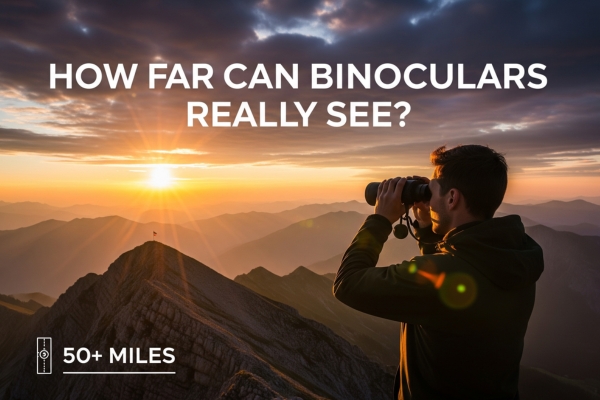
Binoculars can typically see between a few hundred meters to several miles, depending on magnification, lens quality, and atmospheric conditions. Under ideal conditions with 10×50 binoculars, you can observe recognizable details on objects up to 2–5 kilometers away and large structures like buildings or ships from 10–20 kilometers. However, Earth’s curvature ultimately limits ground-level viewing to approximately 5 kilometers from sea level — no amount of magnification can overcome this physical barrier. The key factors determining your effective viewing distance are magnification power, objective lens size, atmospheric clarity, and your elevation above the surrounding terrain.
If you’ve ever wondered how far binoculars can actually see, the answer involves a surprising interplay of physics and environmental conditions. The truth is, binoculars don’t have a maximum viewing distance in the traditional sense — they’re limited by something far more fundamental: the curvature of the Earth itself. In this comprehensive guide, I’ll explain the physics behind binocular viewing distances, break down the factors that affect what you can see at different magnifications, and provide practical calculations you can use to understand your own binoculars’ capabilities.
Binocular magnification works by using a combination of objective lenses and eyepiece lenses to enlarge the image of distant objects. When you see binoculars labeled as 10×50, that first number (10x) indicates the magnification power — objects appear 10 times closer than they would to the naked eye. The second number (50) represents the diameter of the objective lenses in millimeters, which determines how much light the binoculars can gather and their ability to resolve fine details at distance.
The relationship between magnification and viewing distance follows a simple but important principle: if an object is 1,000 meters away and you’re using 10x magnification binoculars, it will appear as if it’s only 100 meters away. This doesn’t mean you’re seeing 10 times farther — you’re seeing the same physical distance, but with objects appearing 10 times larger. This distinction is crucial for understanding why even the most powerful binoculars can’t let you see beyond the horizon, and why atmospheric conditions often limit practical viewing long before you reach theoretical optical limits.
To understand practical viewing distances, we need to consider angular resolution — the smallest angle between two points that can still be distinguished as separate. The human eye has an angular resolution of about 1 arcminute (1/60th of a degree) under ideal conditions. Binoculars improve this by their magnification factor. With 10x binoculars, you can theoretically resolve details 10 times smaller than with the naked eye, meaning you can distinguish features on distant objects that would otherwise appear as a blur.
Exit pupil, calculated by dividing the objective lens diameter by magnification, also plays a crucial role in determining what you can see. A larger exit pupil (typically 5–7mm for low-light conditions) allows more light to reach your eye, improving visibility in dim conditions. However, in bright daylight when your eye’s pupil contracts to 2–3mm, having an exit pupil larger than 3–4mm provides no additional benefit for distance viewing.
The most fundamental limit to how far binoculars can see is the horizon created by Earth’s curvature. No amount of magnification can overcome this physical barrier. The distance to the horizon depends on your height above sea level and can be calculated using a relatively simple formula: distance (in kilometers) equals 3.57 times the square root of your height (in meters). For more precision including atmospheric refraction, use 3.86 × √h, which accounts for the typical 8% increase in visible distance due to light bending through the atmosphere.
For someone standing at sea level with eyes approximately 1.7 meters above the ground, the horizon is about 4.7 kilometers away. If you’re standing on a 30-meter cliff, your horizon extends to about 20 kilometers. From the top of a 100-meter building, you can see approximately 36 kilometers to the horizon. These distances represent the absolute maximum range for viewing objects at ground level, regardless of your binoculars’ power. Understanding this limit is essential for setting realistic expectations about what your binoculars can achieve.
When viewing elevated objects like mountains or tall buildings, the calculation becomes more complex. You need to account for both your height and the object’s height. The visible distance equals the sum of your horizon distance plus the horizon distance from the top of the object you’re viewing. For example, if you’re at sea level looking at a 1,000-meter mountain, you could theoretically see it from about 117 kilometers away (4.7km for your horizon plus 112.3km for the mountain’s horizon). This is why mountain peaks are often visible from extraordinary distances on clear days.
The following reference table shows practical viewing distances for common binocular specifications under good atmospheric conditions:
| Binocular Spec | Typical Clear-Day Range | Object ID Range | Best For |
|---|---|---|---|
| 8×25 | 500m–2km | 100–300m | Concerts, travel |
| 8×42 | 1–5km | 150–500m | Birdwatching, wildlife |
| 10×42 | 2–8km | 200m–1km | General observation |
| 10×50 | 3–10km | 300m–2km | Nature, astronomy |
| 12×50 | 4–15km | 500m–2km | Long-range observation |
| 15×56 | 5–20km | 1–3km | Marine, astronomy |
| 20×50 | 5–25km | 1–4km | Stationary observation |
| 25×100 | 10–50km | 2–10km | Astronomy, fixed position |
Note: These ranges assume good atmospheric conditions (clear air, minimal haze). Actual distances may be significantly shorter in humid, hazy, or turbulent conditions.
Even when objects are well within the horizon limit, atmospheric conditions often determine what you can actually see through binoculars. Air molecules, water vapor, dust, and pollution all scatter and absorb light, reducing visibility. On a perfectly clear day with minimal atmospheric interference, visibility might extend to 50–100 kilometers for large objects. However, typical conditions limit practical viewing to much shorter distances.
Atmospheric turbulence, caused by temperature variations and air movement, creates the shimmering effect you often see when looking at distant objects on hot days. This turbulence, known as “seeing” in astronomical terms, can severely limit the useful magnification for terrestrial viewing. While your binoculars might offer 20x magnification, atmospheric turbulence might make anything beyond 10x magnification result in a blurry, wavering image. This is why the best astronomical observation and long-distance terrestrial viewing are typically done in the early morning when the air is most stable.
Humidity plays a particularly significant role in limiting viewing distance. Water vapor in the air absorbs and scatters light, creating haze that reduces contrast and detail. On humid days, even relatively close objects might appear washed out and indistinct through binoculars. Coastal areas often have limited visibility despite being at sea level with unobstructed views. Temperature inversions, where warm air sits above cooler air, can create unusual viewing conditions — sometimes extending visibility well beyond normal limits through a phenomenon called superior mirage.
To calculate what you can see at various distances with different binocular magnifications, we need to consider the concept of visual acuity. The average human eye can distinguish details that subtend an angle of about 1 arcminute. This means that at 100 meters, the naked eye can distinguish objects or features that are at least 2.9 centimeters apart. With 8x magnification binoculars, this resolution improves to distinguishing features 3.6 millimeters apart at 100 meters — or 3.6 centimeters at 1,000 meters.
For specific magnification ranges, here are practical guidelines: 8×42 binoculars can typically identify a person at 200–500 meters, recognize bird species at 100–200 meters, and read large signs at 300–500 meters under good conditions. 10×50 binoculars extend these ranges considerably — you can identify a person at 2–3 kilometers, recognize facial features at 200–300 meters, and read large text like street signs at 500–800 meters. 20×50 binoculars push further still, with person identification possible at 3–5 kilometers and detailed observation of structures at 2–4 kilometers, though these magnifications typically require tripod mounting for stable viewing.
It’s important to note that these are theoretical maximums based on optical resolution. Real-world performance depends heavily on lighting conditions, atmospheric clarity, and the contrast between the object and its background. A dark bird against a bright sky will be visible at much greater distances than the same bird against dark foliage. This is why wildlife photographers and hunters often say “reading the light” is as important as choosing magnification.
Night viewing with binoculars presents unique challenges and opportunities. In darkness, your eyes transition from cone-dominated daytime vision to rod-dominated scotopic vision, which has much lower acuity but higher sensitivity to low light levels. The larger the exit pupil of your binoculars (5–7mm is ideal for night use), the more light reaches your eyes, improving your ability to see in the dark.
On a clear moonless night, you can see the Milky Way and thousands of stars with the naked eye — and binoculars make this dramatically better. However, for terrestrial night viewing, practical distances drop significantly. You can typically see large objects like buildings or trees illuminated by ambient city light at 100–500 meters. The moon itself, of course, is visible at 384,400 kilometers, and through binoculars you can easily see lunar craters and mare. With image-stabilized binoculars, some observers have reported seeing planets like Jupiter and its moons, Saturn’s rings, and even bright deep-sky objects like the Andromeda Galaxy at 2.5 million light-years distance.
For night wildlife observation, lower magnification binoculars (8x–10x) with large exit pupils (5–7mm) work best. These allow your dilated pupils to capture maximum light while maintaining a stable image. Higher magnifications amplify hand shake, making them difficult to use effectively in low light. If you need to observe at night regularly, consider binoculars specifically designed for low-light use with BaK-4 prisms and fully multi-coated optics for maximum light transmission.
One of the most persistent misconceptions is that binoculars have a maximum range, like “these binoculars can see 10 miles.” This misunderstanding likely comes from confusing the detection range of objects with the binoculars’ optical capabilities. Binoculars don’t have a maximum range — they simply magnify whatever light reaches them. The limiting factors are Earth’s curvature, atmospheric conditions, and the size and contrast of the objects being viewed.
Another common myth is that higher magnification always means better distance viewing. In reality, increasing magnification also amplifies atmospheric distortion, reduces field of view, and makes hand-holding more difficult. For most terrestrial viewing, magnifications between 8x and 12x provide the best balance of image detail and usability. Higher magnifications are primarily beneficial for tripod-mounted observation under stable atmospheric conditions. When comparing binoculars vs telescope for long-distance viewing, telescopes typically offer higher magnification but with a much narrower field of view, making binoculars more practical for scanning large areas.
The idea that image-stabilized binoculars can see farther than traditional optical binoculars is also incorrect. Image stabilization reduces shake and blur, making high magnifications more usable, but it doesn’t extend viewing range. The stabilization effectively increases the useful magnification range by compensating for hand movement, allowing you to resolve more detail at distance, but it cannot overcome Earth’s curvature or atmospheric limitations.
For those interested in calculating exact viewing distances, here are the key formulas you’ll need. The basic horizon distance formula is: d = 3.57 × √h, where d is distance in kilometers and h is height in meters above sea level. For more precision including atmospheric refraction, use d = 3.86 × √h, which accounts for the typical 8% increase in visible distance due to light bending through the atmosphere.
To calculate how much of a distant object is hidden by Earth’s curvature, use: hidden height = (distance²) / (2 × Earth’s radius). With Earth’s radius at 6,371 kilometers, an object 10 kilometers away has approximately 7.8 meters hidden below the horizon when viewing from ground level. This explains why you might see the upper floors of a distant building but not its base — the lower portion is literally hidden behind the Earth’s curve.
For determining if an elevated object is visible, calculate the maximum viewing distance as: D = 3.57 × (√h₁ + √h₂), where h₁ is your eye height and h₂ is the object’s height above the surrounding terrain. When planning observations, remember that these calculations assume a smooth Earth surface. In reality, terrain features, vegetation, and man-made structures create additional obstacles that can significantly limit your actual viewing distance.
Beyond magnification and objective lens size, several technical specifications significantly impact distance viewing performance. Field of view, expressed in degrees or meters at 1,000 meters, determines how much area you can observe without moving the binoculars. A wider field of view makes finding and tracking distant objects easier but typically comes at the expense of magnification. Optical coatings play a crucial role in long-distance observation — fully multi-coated lenses reduce light loss and internal reflections, improving contrast and clarity at extreme distances.
The type of prism system affects both light transmission and image quality. Roof prism binoculars require more sophisticated coatings to match the light transmission of porro prism designs. However, phase-correction coatings on modern roof prism binoculars largely eliminate this disadvantage. For maximum light transmission in challenging conditions, traditional porro prism designs still hold a slight advantage. The prism glass quality also matters — BaK-4 prisms with higher refractive indices produce brighter, sharper images than BK-7 prisms, particularly visible at longer distances.
Twilight factor, calculated as the square root of (magnification × objective diameter), provides a rough measure of low-light performance. A higher twilight factor means better visibility in dim conditions, which often accompanies better distance viewing during golden hour or overcast conditions. However, this metric doesn’t account for optical quality, coatings, or exit pupil size, so it should be used as a guideline rather than a definitive measure.
You don’t need expensive equipment to test your binoculars’ practical viewing range. Start by finding a known landmark — a building, tower, or mountain peak whose distance you can look up on a map. With a smartphone rangefinder app or a simple laser rangefinder, you can verify the exact distance. Then observe the object through your binoculars and note what level of detail is visible. Can you read large text? Identify a person? Distinguish individual windows on a building?
To test resolution specifically, find two objects that are close together at a known distance — such as two streetlights or fence posts — and see if you can distinguish them as separate through your binoculars at various magnifications. The Dawes’ Limit formula (R = 116 / D, where D is aperture in millimeters and R is resolution in arcseconds) gives the theoretical resolution limit of your binoculars. Compare this to the angular separation of the objects you’re trying to resolve.
The human eye has a resolution of approximately 60 arcseconds under good conditions. With 10x binoculars, you can theoretically achieve 6 arcsecond resolution, and at 20x magnification, just 3 arcseconds. This means at 1 kilometer distance, 10x binoculars could theoretically distinguish objects separated by about 3 centimeters — though atmospheric conditions usually prevent reaching this theoretical limit in practice.
10×50 binoculars can typically see clearly up to 3–10 kilometers depending on conditions. Under good atmospheric conditions, you can identify a person at 2–3 kilometers, read large text at 500–800 meters, and observe large structures like buildings or ships from 10–20 kilometers. The limiting factor is usually atmospheric clarity rather than optical capability. The 50mm objective lenses gather ample light for most daytime conditions, though they provide their greatest advantage during dawn and dusk observation.
In space or at extreme elevations, binoculars can certainly see objects 100 miles away — you can see the Moon (384,400 km) and planets easily. For terrestrial viewing at sea level, however, Earth’s curvature limits the horizon to approximately 5 kilometers. To see terrestrial objects at 100 miles (160 km), you would need to be at an extremely elevated position — from the top of a 2,000-meter mountain, your horizon extends to about 160 kilometers. Aircraft at altitude can also be seen at great distances.
Image-stabilized binoculars don’t inherently see farther, but they make high magnifications far more usable by compensating for hand shake. This allows you to use 15x or 20x magnification hand-held, whereas traditional binoculars become difficult to use steadily beyond 10x–12x. The stabilization effectively increases the useful magnification range, allowing you to resolve more detail at distance. However, they cannot overcome Earth’s curvature or atmospheric haze limitations.
First, determine your eye height and the object’s height above surrounding terrain. Use the formula: maximum distance = 3.57 × (√your height + √object height). For example, from a 10-meter viewpoint, a 500-meter mountain could theoretically be visible at 91 kilometers (3.57 × (√10 + √500) = 91.1km). Remember to account for intervening terrain, vegetation, and atmospheric conditions, which often reduce actual visibility below the theoretical maximum.
To identify individuals at 1 kilometer, you typically need 12x–15x magnification under good conditions. At 12x, a person at 1,000 meters appears as they would at about 83 meters to the naked eye — enough to distinguish clothing and general features, but facial recognition usually requires 20x or higher. Atmospheric conditions rarely allow such detail resolution at this distance in practice, so 10x–12x binoculars are usually adequate for general human detection at 1 kilometer.
Higher elevation provides two distinct advantages: extended horizon distance and clearer air. From a 1,000-meter mountain, your horizon extends to about 113 kilometers compared to just 5 kilometers at sea level. The thinner air at altitude also contains less water vapor and pollution, providing optically clearer views. This is why astronomical observatories are built on mountains — the viewing conditions improve dramatically with altitude, both in terms of horizon distance and atmospheric clarity.
Understanding how far binoculars can see requires grasping the interplay between optical magnification, Earth’s curvature, and atmospheric conditions. While binoculars don’t have a maximum viewing distance in the traditional sense, practical limits exist based on the horizon (typically 5–20 kilometers depending on elevation), atmospheric clarity (usually limiting useful viewing to 10–50 kilometers), and the size and contrast of objects being observed. The key takeaway is that magnification doesn’t extend viewing distance — it makes distant objects appear larger and more detailed.
For most practical applications, 8x to 12x magnification provides the best balance of image detail, field of view, and usability. Higher magnifications can be useful for specialized stationary observation but require stable support and favorable atmospheric conditions to realize their potential. Remember that even the most powerful binoculars cannot overcome the fundamental limit imposed by Earth’s curvature — at sea level, the horizon is only about 5 kilometers away. Whether you’re choosing binoculars for birdwatching, astronomy, or general observation, understanding these principles helps set realistic expectations and select the right specifications for your needs.
![Best Low Light Binoculars [cy]: Expert Testing Results](https://revellphotography.com/wp-content/uploads/2026/09/featured-update-660-1789231076311.jpg)