Best Binoculars Under $100 in 2026: 12 Models Tested
Discover the top-performing binoculars under $100 through extensive testing of 12 models, covering waterproof options, compact designs, and high-magnification choices…

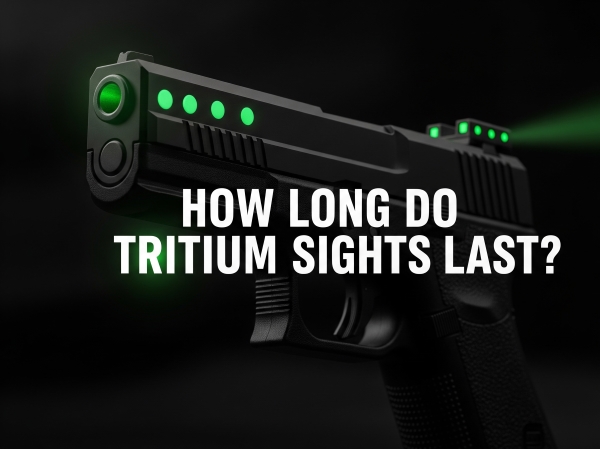
If you’ve ever racked a pistol in a dim hallway or lined up a shot before sunrise, you already know why a glowing front sight matters. Tritium night sights give you that battery-free aiming reference, and they work beautifully right out of the box. The catch is that they fade on a predictable clock, and most owners don’t know where that clock sits when they’re staring at a dimmer-than-expected dot.
After more than a decade of comparing tritium-equipped pistols from Trijicon, Meprolight, TruGlo, XS Sights, and Night Fision, I’ve watched this 12-year problem play out the same way every time: a sight that felt nuclear in the gun store goes gentle somewhere between year seven and year twelve. The science is exact. The real-world experience is messier, and it depends on how hard you lean on those dots when it counts.
This guide pulls together the underlying physics, the published half-life data from NIST, current manufacturer warranty terms (verified for 2026), and field reports from shooters and law enforcement officers. You’ll come away with a clear replacement timeline, a comparison table against modern alternatives, and a practical sense of when to send your sights back for relamping instead of buying new.
Last updated: September 2026
Most tritium sights stay bright enough for reliable low-light aiming for 10 to 12 years. The radioactive half-life of tritium (hydrogen-3) is 12.32 years, which means your sights lose half their brightness every twelve-and-a-third years. By year 12 you’re at 50% output, by year 24 you’re at 25%, and they never go fully dark.
Practical lifespan: 10 to 12 years of confident low-light performance
Replacement threshold for duty/defense use: Year 8 to 10 (roughly 57% to 65% brightness remaining)
Replacement threshold for recreational use: Year 12 to 15
Common warranty range: 5 to 12 years depending on brand and tritium color
Tritium (³H) is a radioactive isotope of hydrogen that decays by emitting low-energy beta particles. Inside each sealed glass vial, those beta particles strike a phosphor coating on the inner wall. The phosphor absorbs the energy and re-emits it as visible light, a process called radioluminescence. The result is a steady glow that needs no batteries, no ambient light, and no charging from any external source.
The decay itself follows a strict exponential curve described by N(t) = N₀ × e^(−λt), where λ = 0.693 / t₁⁄₂. Plug tritium’s half-life in, and you get a brightness loss curve that’s mathematically identical for every tritium sight on the planet, no matter the brand. What changes from manufacturer to manufacturer is how much tritium goes into the vial, which phosphor they use, and how well the vial is sealed.
Here’s the year-by-year brightness drop you can expect from any standard tritium sight:
| Years Since Manufacture | Approximate Brightness | Practical Implication |
|---|---|---|
| 1 | 94.5% | Fresh-out-of-the-box appearance |
| 5 | 75.5% | Visibly bright in total darkness |
| 10 | 57.4% | Start of noticeable dimming |
| 12 | 50.0% | Half-life milestone; many warranties end here |
| 15 | 43.0% | Marginal for defensive use |
| 20 | 32.4% | Reliable only in well-lit environments |
| 25 | 24.6% | Effectively standard iron sights |
One critical point many owners miss: the clock starts at manufacture, not at purchase. A sight that sat on a distributor’s shelf for two years is already at 89% brightness when you install it. Always check the manufacture date on the packaging if it’s available.
The National Institute of Standards and Technology (NIST) maintains the authoritative value of 12.32 ± 0.02 years for tritium’s half-life in its physical reference data. The U.S. Nuclear Regulatory Commission regulates tritium quantities in consumer products under 10 CFR 30, and the small amounts in firearm sights fall well below the threshold for special licensing or disposal.
The half-life curve is non-negotiable, but the practical replacement window varies by role. Law enforcement agencies and military units typically replace tritium sights on a five to seven year cycle because they need maximum visibility during the 70 to 77% of officer-involved shootings that FBI data shows occur in low-light conditions. Competition shooters can usually stretch to eight to ten years. Hunters and casual range users often get twelve to fifteen years out of a good set.
Here’s how the experience typically breaks down across the lifespan of a tritium-equipped pistol:
Years 0 to 5. The brightness decrease is essentially invisible to the human eye. Green tritium holds its perceived output the longest because the human eye is most sensitive to green wavelengths. Orange and yellow phosphors look bright at this stage but tend to fade in perceived intensity earlier than green.
Years 5 to 8. You’ll start to see slight dimming in pitch-black conditions, especially if you compare your sights to a brand-new reference set. The sights are still fully functional for defensive work, but you’re now closer to the planning side of replacement than the install side.
Years 8 to 12. The dimming becomes obvious in side-by-side comparisons. Most shooters start shopping for replacements during this window. The sights still work in most low-light scenarios but struggle in true darkness with no ambient light source.
Years 12 to 15. At 50% brightness or below, the sights become marginal for defensive use. They’re still visible in total darkness if you’re looking for them, but rapid target acquisition under stress becomes harder. This is the typical retirement point for recreational sights.
Beyond 15 years. Technically still glowing, but for all practical purposes these are standard iron sights. They may still serve a purpose as backups or training sights, but they should not be relied on for low-light defensive work.
The half-life curve is a clean mathematical line. The lived experience is anything but, and the gap between the two is worth understanding before you trust any one manufacturer’s claim.
On a long-running Reddit r/CCW thread, one shooter remembered encountering tritium sights for the first time in the mid-1990s on a friend’s LAPD duty weapon. His recollection: the dots glowed so brightly in a dimly lit room that they seemed almost nuclear. The same user, shopping fresh from the shop in 2018, found modern sights underwhelming by comparison. This vintage-versus-modern brightness gap is one of the most consistent complaints across shooting forums.
A GlockTalk thread from 2017 captures the other common disappointment. A user with Trijicon green night sights reported them as “about dead less than 9 years,” well before the 12-year warranty would have ended. Other users in the same thread reported no problems past the ten-year mark. The variance comes down to a few real factors: vial fill pressure, phosphor batch quality, exposure to extreme temperatures, and how often the sights see hard use.
Smith & Wesson forum users in 2025 reached a similar consensus: most tritium sights give a useful ten years, with some lasting longer and a meaningful minority dimming earlier. As one regular put it, “not all tritium is created equally.” Quality variance between production batches is real, which is why documenting your installation date matters more than relying on a warranty card alone.
The takeaway: budget for replacement somewhere between year eight and year ten if your use case is defensive. If you carry the gun for duty or home defense, treat the warranty period as an upper bound, not a guaranteed useful life.
Manufacturer warranties tell you how confident each company is in its tritium, and they roughly mirror the underlying half-life math. The most common terms right now are 12 years for green and yellow phosphor and 5 years for orange, which has a shorter useful life because of how the eye perceives its color. As of 2026, here’s what each major brand offers:
Trijicon. The industry leader backs green and yellow tritium with a 12-year limited warranty and orange tritium with a 5-year warranty. The orange tier reflects the actual decay profile of those phosphors, not a quality discount.
Meprolight. Covers all tritium colors under a 12-year warranty, with the standard caveat that brightness will decrease over time as expected from radioactive decay.
TruGlo. Provides a 12-year warranty on the TFX and TFO lines, including the popular TFX Pro. Warranty terms are documented on truglo.com as of 2026.
XS Sights. Offers a 10-year tritium warranty, slightly more conservative than the half-life-aligned competition. This includes the DXT2 Big Dot and Standard Dot lines.
Night Fision. Covers their night sights under a 12-year tritium warranty, with normal decay explicitly excluded from defect coverage.
Ameriglo. Warranty terms vary by product line. Many Ameriglo sights carry a 5-year warranty on tritium, with some specialty lines extending to 12 years. Check the specific product page before purchase.
All of these warranties cover manufacturing defects and premature failure, not gradual radioactive decay. If your sights go dark in year three because of a cracked vial, that’s a defect claim. If they fade gradually through year ten, that’s physics doing what physics does.
Warranty terms on tritium sights have been remarkably stable for decades. Trijicon’s 12-year alignment with the half-life of tritium has been the de facto industry standard since the 1990s. If you see a warranty that doesn’t match the underlying science, ask why before you trust the sight.
Radioactive decay is constant, but several real-world factors change how long a tritium sight remains useful in your particular gun. None of them slow or speed the underlying decay curve. They all change how the curve translates to your sight picture.
Decay rate doesn’t change with temperature. What does change is the housing and the seals. Repeated exposure above 140°F or below -40°F can stress the hermetic seal, eventually causing the vial to leak tritium and stop glowing entirely. Holsters and guns left in vehicles see this most often.
The glass vials are surprisingly tough but not indestructible. A hard impact from a drop, a muzzle strike, or a bad holster can crack the vial. Once the seal is compromised, tritium escapes and the sight goes dark immediately, regardless of its age. This is one of the most common failure modes reported on shooting forums.
The phosphor coating inside the vial converts beta energy into visible light. Higher-quality phosphors maintain their conversion efficiency longer, which is why premium sights often appear brighter even when the tritium fill is identical. Lower-grade phosphors can yellow or lose efficiency faster than the tritium decay would predict.
Manufacturers can vary the tritium pressure inside each vial, up to NRC limits. Higher-pressure fills start brighter and stay above the practical-use threshold longer, even though the decay rate is the same. Premium lines from Trijicon and Night Fision typically use the maximum legal fill, which is one reason they appear noticeably brighter than budget alternatives when new.
Storage doesn’t change decay rate, but UV exposure degrades the phosphor coating and the housing polymer. Sights stored in direct sunlight can fail for materials reasons long before tritium decay would have made them unusable. A climate-controlled gun safe is the right home for any tritium-equipped pistol you’re not actively carrying.
Replacement timing depends on what you need the sights to do. Here’s a practical decision framework based on common use cases:
Duty and defense use (5 to 7 years). If your life depends on the sights, replace them when they reach 60 to 70% brightness. You want maximum visibility during the critical first second of a low-light encounter, and gradual dimming under stress is the last thing you want to discover.
Competition shooting (8 to 10 years). Replace when brightness consistency becomes an issue. Mismatched front and rear dot brightness can affect your sight picture, especially at speed. Year eight is a sensible trigger point.
Hunting (10 to 12 years). Most hunters can wait until sights reach 40 to 50% brightness. Dawn and dusk hunting still works at these levels, and replacing every ten years keeps your gear current without burning money.
Range and recreational (12 to 15 years). If you primarily shoot in good lighting, you can run the sights until they stop providing any meaningful low-light advantage. By year fifteen you’re at roughly 38% brightness, which is a fair place to retire a recreational set.
A simple field test: take the firearm into a fully darkened room after letting your eyes adjust for five minutes. If you can’t immediately pick up the front sight dot, the sights are past their useful life for your use case.
When your tritium sights dim past your threshold, you have three paths: buy a fresh set, send the existing sights in for factory relamping, or upgrade to a different technology. Each has trade-offs.
New tritium sight sets run roughly $50 to $200, with professional installation adding $30 to $80 depending on the gunsmith and whether the sights need to be fit to a specific slide. Over a 12-year useful life, that’s $8 to $15 per year of service, often less than a single box of practice ammunition. Replacement gives you a fresh warranty, the latest sight geometry, and a guaranteed brightness floor.
Factory relamping replaces the tritium vials in your existing sight bodies. Trijicon, Meprolight, and Night Fision all offer relamping for their respective lines. Turnaround time is typically two to four weeks, and you ship just the slide or the sight set, not the whole firearm. Pricing varies by brand and model.
For Trijicon specifically, factory relamping is the most common path for owners of older sight bodies who don’t want to re-fit a new set to their slide. Cost is generally lower than buying new, and the existing sight body has already proven it fits your pistol. Limitations include model restrictions, possible warranty complications, and the fact that you’re keeping an older sight design rather than getting the latest geometry.
If you’re already planning to spend money on new sights, it may be worth considering a hybrid or LED system. Hybrid tritium and fiber optic sights (TruGlo TFX, Meprolight FT Bullseye) offer much better daylight visibility alongside tritium for darkness. LED electronic sights give adjustable brightness and longer effective lifespan, though they introduce a battery dependency. Either option typically runs $80 to $300 for a quality set.
Calculate your own cost per year. If your $100 sights gave you ten years of service, that’s $10 per year, a bargain compared to the practical value of a working low-light aiming system.
You can’t slow tritium decay, but you can prevent every other common cause of premature failure. Six habits will get you to the natural end of your sights’ useful life without wasted money on early replacement.
Use a quality holster that keeps the sights from contacting hard objects during carry. A cracked vial means immediate replacement regardless of age. Sight protectors add insurance during storage and transport.
Don’t leave firearms in hot vehicles or unheated storage for extended periods. Repeated thermal cycling stresses the vial seals. A climate-controlled gun safe is the right home for any tritium-equipped pistol not in active rotation.
Use non-abrasive cleaners and keep harsh solvents away from the sight vials. Aggressive cleaning compounds can cloud the vial glass, which reduces apparent brightness even with fully active tritium. A soft brush and a quality gun oil are enough for routine sight maintenance.
Check for cracks, cloudiness, or uneven glow every few months. Early detection of a failing vial prevents the embarrassment of discovering a dead dot when you actually need it.
Record the install date in your phone or in a small logbook kept with the firearm. This is the only reliable way to plan replacement before brightness becomes a problem. Include the manufacture date from the packaging if it’s printed.
Keep tritium-equipped firearms in controlled environments when possible. UV light degrades phosphor coatings and polymer housings faster than tritium decay does, so a darkened safe is better than a windowsill display.
Before you assume your sights need replacement because of age, rule out the few things that can mimic tritium decay. Most of these are cheaper to fix than a new sight set.
Uneven brightness. If one dot is significantly dimmer than the others, you likely have a cracked vial or a manufacturing defect. This is a warranty claim if the sights are within coverage, not an age issue.
Sudden complete failure. Tritium doesn’t stop glowing due to decay. If a sight goes dark overnight, the vial is breached and the tritium has escaped. This requires immediate replacement, regardless of how new the sight is.
Cloudy appearance. Vial glass can cloud from chemical exposure or age, reducing apparent brightness even with healthy tritium inside. There’s no field fix for this. The sight set needs replacement.
Daylight visibility loss. If the sights glow fine in darkness but disappear in daylight, the white outline paint may have worn off rather than the tritium having faded. Touch-up paint from the manufacturer is sometimes available, and it costs almost nothing compared to new vials.
Comparison testing. Take the firearm into total darkness with a known-age reference. Side-by-side comparison gives you an objective brightness read, much more reliable than memory.
Front-vs-rear dimming. A common forum complaint is uneven dimming between front and rear dots, which creates sight picture confusion. If the rear dots fade faster than the front (or vice versa), it usually reflects manufacturing batch variance, not user error.
Tritium in an intact sight vial poses no health risk at all. The beta particles it emits can’t penetrate the vial glass, and they can’t penetrate your skin. Even if a vial breaks, the tritium inside a firearm sight is far below any dangerous threshold.
For context, tritium in gun sights is regulated by the Nuclear Regulatory Commission under 10 CFR 30. Most sight vials contain 15 to 25 millicuries of tritium, well below the levels requiring special licensing or disposal protocols. To approach harmful exposure from a broken vial, you’d have to inhale the contents of hundreds of vials in an enclosed space, a scenario that essentially never happens.
The same physics that makes tritium safe in a vial also means it can’t hurt you from across the room. The beta particles travel a maximum distance of about 6 millimeters in air, which is roughly the thickness of a quarter. A useful analogy: a tritium sight is to a hazardous radioactive source what a sealed mercury thermometer is to liquid mercury. The hazard is contained, and it stays contained unless the container breaks.
If a vial does break indoors, simple precautions cover the situation:
Ventilate the area by opening a window
Avoid deliberately breaking or opening any vial
Dispose of old sights in regular household trash (they’re exempt from NRC hazardous-waste rules)
Wash hands after handling any broken vial components
The radioactivity of old tritium sights decreases with the same 12-year curve. A 12-year-old sight contains exactly half the tritium of a new one. By the time you’d think to dispose of a sight as worn out, it’s also significantly less radioactive than it was when you bought it.
Tritium isn’t the only path to a glowing front sight anymore. If you’re planning a replacement anyway, here are the practical alternatives and how they stack up against traditional tritium.
| Technology | Lifespan | Batteries | Works in Total Darkness | Daylight Visibility | Best Use Case |
|---|---|---|---|---|---|
| Traditional Tritium | 10 to 12 years | None | Yes | Limited | Duty, concealed carry, low-light defense |
| Hybrid Tritium / Fiber Optic | 10 to 12 years (tritium portion) | None | Yes | Excellent | All-day carry, varied lighting |
| LED Electronic | Battery-dependent (years) | Yes | Yes | Adjustable | Competition, range use |
| Photoluminescent Paint | Decades (paint-dependent) | None | Briefly, after light charging | Moderate | Budget builds, training guns |
| Electroluminescent | Decades (panel-dependent) | Yes (small) | Yes | Adjustable | Emerging technology, future-focused users |
Hybrid systems combine a tritium vial with a fiber optic rod that gathers ambient light. The result is dramatic daylight visibility plus tritium backup for darkness. TruGlo’s TFX Pro and Meprolight’s FT Bullseye are the most common examples, and they work well across the full range of lighting conditions. The tritium still fades on the same 12-year clock, but the fiber optic keeps the sight visible in daylight indefinitely.
Battery-powered LED sights offer adjustable brightness and a lifespan measured in battery life rather than half-life. Models like the XS Sights DXT2 Big Dot with LED upgrade can run for years on a single battery with constant-on function. The trade-off is that you now have a battery to manage, and a dead battery means a dark sight.
Modern glow-in-the-dark paints charge from any ambient light source and emit a soft glow for several hours afterward. They never expire and never contain anything radioactive, but they don’t work in true darkness after the charge fades, which makes them a poor choice for defensive applications. They’re useful for training guns and budget builds.
Still an emerging category, electroluminescent panels use a thin layer powered by a small battery to produce a steady glow. The panels can last decades, and the battery is replaceable. As of 2026, options are limited but the technology is gaining traction in specialty applications.
If you run a night vision device (NVD), tritium sights interact with your optic in a way that matters. Standard green tritium emits at wavelengths that can bloom or wash out a Gen 3 night vision image. Bright tritium dots that look reasonable to the naked eye can saturate a sensitive NVG tube, hiding your sight picture rather than enhancing it.
NVIS-compatible (Night Vision Imaging System-compatible) tritium sights are designed to emit at wavelengths that don’t overlap with NVG sensitivity, allowing both to function together. Brands like Trijicon offer NVIS-compliant options for military and law enforcement users working under night vision. Standard consumer tritium sights generally do not meet NVIS specifications.
For most civilian shooters, this is not an issue. If you occasionally use a handheld thermal or a clip-on night vision device, standard tritium is fine. If your primary aiming setup is a Gen 3 NVG monocular or binocular, you need NVIS-compatible sights or you need to plan for sight bloom during use.
Several manufacturers also offer fiber-optic-only or photoluminescent alternatives that produce no NVG bloom at all. These are worth considering if you train frequently under night vision.
Knowing the exact manufacture date of your tritium sights is the only way to plan replacement accurately. Most brands stamp some kind of code on the packaging or the sight body, but the format varies by manufacturer.
Trijicon uses a year-letter coding system on the packaging and often on the sight itself. The first character is a digit indicating the year within a decade, and the second is a letter indicating the production quarter. The full code usually also includes a lot identifier. XS Sights uses a similar lot code stamped on the sight body. Meprolight and TruGlo typically print the manufacture date on the retail packaging rather than on the sight itself.
If the manufacture date isn’t visible, contact the manufacturer with your serial number. Most brands can look up the production date from the serial. Keep your purchase receipt regardless, as it serves as your proof of acquisition date for warranty claims.
No. Tritium decay is irreversible. Once the radioactive material has decayed, it’s gone. What people call recharging actually means replacing the sealed tritium vials, something only factory relamping services can do.
The tritium itself decays at the same rate regardless of color. Different phosphor coatings affect perceived brightness, however, because the human eye is most sensitive to green wavelengths. Green sights appear brightest and seem to last longest, while orange and yellow may seem to fade faster even though the underlying decay is identical.
No. At 12 years the sights are at exactly 50% brightness and continue glowing at decreasing levels for decades. They never fully stop, but they become too dim for practical defensive use somewhere between 15 and 20 years.
Most manufacturers stamp a date code or lot number on the packaging or the sight body. Trijicon uses a year-letter coding system, XS Sights stamps lot codes on the sight, and Meprolight or TruGlo typically print dates on the packaging. If nothing is visible, contact the manufacturer with your serial number. Keep your purchase receipt as proof of acquisition date for warranty purposes.
Generally no. At 10 years old they’re at roughly 57% brightness with limited remaining useful lifespan. Unless they’re heavily discounted at 75% off or more, new sights deliver better long-term value and come with a fresh warranty.
Yes. Radioactive decay continues at the same rate at any temperature. Extreme cold can make the phosphor coating slightly less efficient, causing a brief dimming that returns once the sight warms up. The decay rate itself doesn’t change.
No. The vials are hermetically sealed and maintain their own internal pressure regardless of altitude or external atmospheric pressure. Tritium decay and brightness are unaffected by changes in elevation.
Yes, in the United States tritium gun sights are exempt from NRC hazardous-waste disposal regulations due to their low radioactivity. Most states follow the federal guideline, though checking local regulations is sensible. Normal household trash disposal is acceptable.
Trijicon warrants green and yellow tritium sights for 12 years and orange tritium for 5 years. In practice, most Trijicon sights deliver 10 to 12 years of confident low-light performance before users start to notice dimming. The 12-year warranty aligns with the underlying tritium half-life of 12.32 years.
Tritium sights emit low-energy beta radiation that cannot penetrate the glass vial or your skin. Each vial contains 15 to 25 millicuries of tritium, well below NRC thresholds for special licensing or disposal. The beta particles travel roughly 6 millimeters in air and are stopped completely by the vial itself.
Tritium sight lifespan is the rare topic in firearms where the underlying science gives you a near-perfect planning tool. The 12.32-year half-life means predictable, gradual fade with no surprises, no sudden failures from decay, and no need to wait until something goes wrong. If you install a fresh set and record the date, you know almost exactly what the next decade looks like.
The practical answer to how long do tritium sights last is simple: ten to twelve years for confident low-light performance, with eight to ten years being the right replacement window for any defensive role. Warranty terms from Trijicon, Meprolight, TruGlo, XS Sights, and Night Fision track that range closely, and modern alternatives give you a credible exit ramp if you decide tritium isn’t what you want anymore.
Document your install date, inspect your sights every few months, and budget for replacement as part of normal firearm maintenance. If your use case is defensive, plan to replace at year eight rather than waiting for the warranty to expire. If your use case is recreational, run them until they stop working for you. Either way, the science is on your side.
Today’s tritium sight market offers solid options at every price tier, from budget replacements that handle casual range use to premium Trijicon and Night Fision builds designed for hard duty rotations. Match the sight to your use case, choose the right replacement window, and you’ll never find yourself with dim dots when you actually need them.