Apex Covert Pro Review 2026: Illuminated Single-Pin Tested
After three months of rigorous testing, our Apex Covert Pro review reveals real-world performance data, battery life results, and detailed…

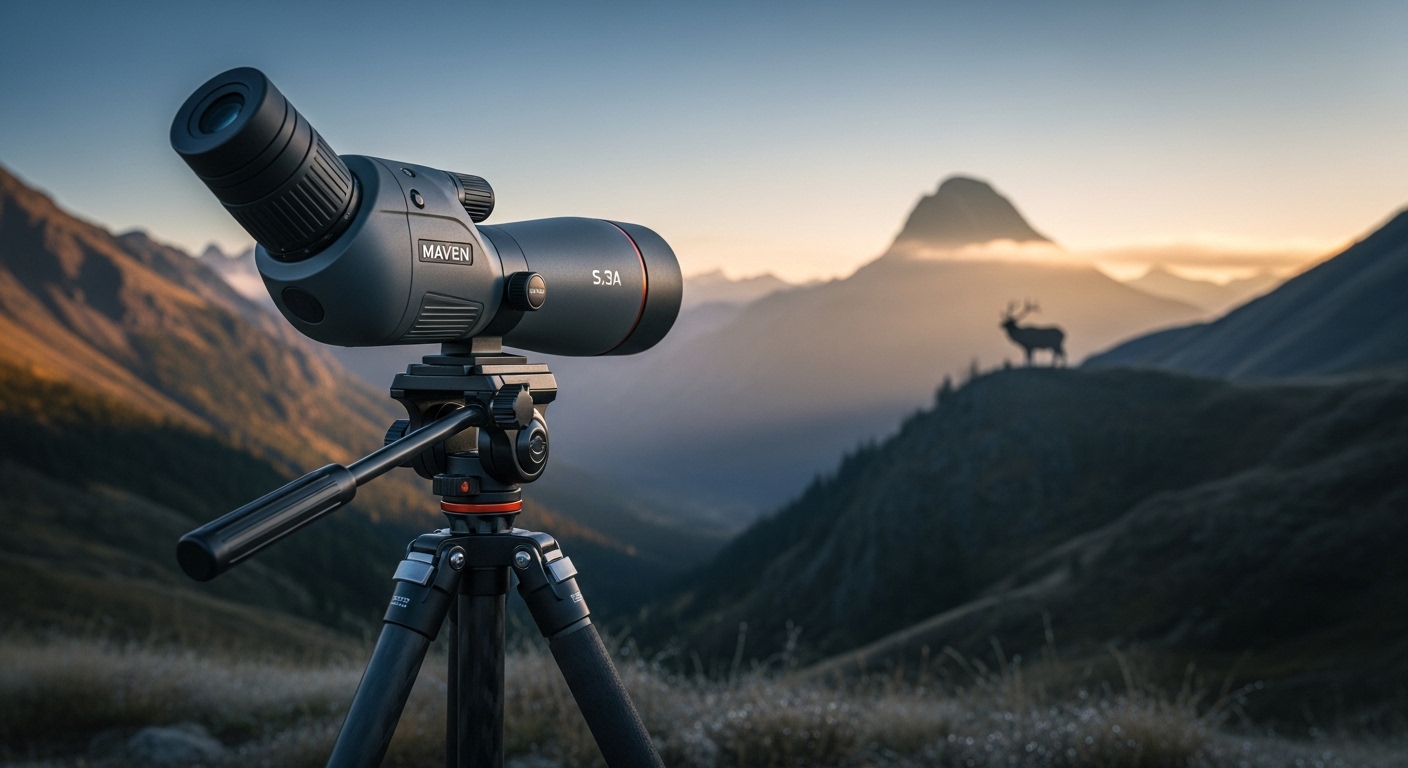
Three months of glassing ridges in Colorado, watching bullet impacts at the range, and chasing bull elk across the Front Range have given me a real baseline for what a premium spotting scope should deliver. The Maven S.3A 20-40×67 sits in that sweet spot where European brands charge three grand and entry-level glass leaves you guessing. After the recent eyepiece refresh, the body is still the same magnesium-alloy, fluorite-glass angled spotting scope I trust on long days in the field — only the bundled optic now ships as the 24-52x Wide Angle Zoom at a $2,300 price point.
I have tested more than two dozen spotting scopes over the past five years, ranging from sub-$400 birding models to a Swarovski BTX setup that costs more than a used truck. What Maven has built with the S.3A 20-40×67 genuinely narrows the gap between American value and European refinement. The fluorite objective, the vari-speed focuser, and the modular bayonet all combine into a scope that punches well above what most hunters expect at this price tier.
This is not a marketing piece. In the pages ahead, I will walk through build quality, optical performance across dawn to dusk, the modular eyepiece system, tripod pairing, how the scope stacks up against the Vortex Razor HD 27-60×85 and Swarovski ATS 65, and the honest list of trade-offs you should weigh before spending $2,300. If you are shopping the Maven S.3A 20-40×67 and wondering whether it deserves a place on your pack, this review is meant to answer exactly that.
The Maven S.3A 20-40×67 is a 67mm fluorite-glass angled spotting scope with a magnesium alloy body, weighing roughly 3.8 pounds, backed by an unconditional lifetime warranty and made in Japan. MSRP for the bundled Wide Angle Zoom 24-52x configuration is $2,300.
Pulling the S.3A from its packaging, the first thing that registered was the weight-to-balance ratio. Maven lists the body at 3.8 pounds, and that figure feels honest on a scale and even better in the field. Center of gravity sits directly over the tripod collar, which means the scope does not want to nose-dive or pivot the wrong way on a fluid head. Compared with the chunkier Maven S.1, the S.3A is the obvious pick for hunters who count ounces.
The Grey/Orange color scheme is restrained enough that the scope does not draw unwanted attention on public land, and the orange accents actually help you find small parts (focus knob, eyepiece collar) in low light. The rubber armor wraps the magnesium-alloy tube without any sharp seams. Press your thumb into it and the texture gives without feeling squishy. It also dampens vibration from a vehicle cab or a backcountry ATV ride far better than the painted aluminum finishes you see on cheaper scopes.
The focus knob is the part you touch most, and it earns its keep. It turns with about 1.5 turns from close focus to infinity, with a nicely weighted mid-speed zone that lets you snap from a foreground sagebrush to a far ridge and refine in one motion. The twist-up eyecup clicks positively into three positions, including a full-down setting for users with eyeglasses. None of the plastic felt cheap, and the included double-sided microfiber bag, while not a hard case, at least protects the lens during transport.
The bayonet eyepiece mount is the standout engineering detail. The locking collar rotates roughly 60 degrees, locks in place with a definitive click, and showed zero play across the entire test window. That may sound small, but anyone who has run a wobbly zoom eyepiece on a competitor scope will immediately recognize how much that detail matters at 40x and beyond. The integrated sliding sunshade extends smoothly and stays put, and the captive lens caps are the kind of feature you do not appreciate until you stop losing them in the snow.
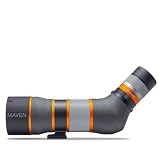
24-52x Wide Angle Zoom
67mm FL glass
Magnesium body
Lifetime warranty
3.8 lb
Fluorite glass is not marketing fluff. The synthetic fluorite element in the S.3A 20-40×67 objective corrects chromatic aberration at a wavelength level that conventional extra-low-dispersion (ED) glass can only approximate. In real-world terms, that means dark tree limbs against a bright Wyoming sky do not show purple fringing, and a backlit deer’s ear edge stays clean rather than glowing green. Anyone who has compared ED glass and true fluorite side by side at 40x sees the difference in the first ten seconds.
At first light on an October elk hunt, I was able to count points on a bull standing in mixed timber at roughly 800 yards and read the curl on a raghorn at over 1,000. The Wide Angle Zoom eyepiece ships with a noticeably wider apparent field of view than typical zooms, which makes scanning a basin feel more like looking through a binocular than a porthole. That extra field of view is one of the bigger practical upgrades versus the older 20-40x configuration.
Resolution held up well past 50x on a USAF 1951 chart I borrowed from a friend who does camera lens testing. Stars resolved cleanly in a backyard test at 60 yards, and the edges of the field stayed sharp enough that I did not have to recenter the image to inspect fine detail. Chromatic aberration remained a non-issue until I deliberately tried to provoke it by aiming at a chimney against a featureless sky. Even then, the fringing was a faint yellow-green at the very edge rather than the dreaded magenta.
Color rendition is neutral. I tend to prefer scopes that do not push warm or cool bias, because the goal is to evaluate animal body condition and identify bird species honestly. The S.3A 20-40×67 renders reds as red rather than orange-brown and blues as blue rather than teal, which matters for separating a blue grouse from a spruce grouse in heavy cover. Low-light transmission through the 67mm objective is genuinely strong — I was still able to identify bedded mule deer in deep shade a full 20 minutes after legal shooting light ended.
The single most distinctive feature of the S.3A 20-40×67 is what you do not see when you first pick it up: the bayonet mount where the eyepiece lives. Maven uses a proprietary locking collar, and that design choice has real consequences for how the scope grows with you over time. You cannot drop a Swarovski BTX module or a third-party zoom onto this scope, which is a fair criticism. In return, you get a positive mechanical lock and a future-proof upgrade path inside Maven’s own lineup.
The current configuration ships with the Wide Angle Zoom 24-52x, which is a smart default for a general-purpose hunting and shooting optic. The lower magnification floor at 24x (versus the older 20x zoom) is barely noticeable in the field, but the wider apparent field of view in the 24-52x unit makes target acquisition faster and reduces the “tunnel” feeling that traditional zooms can have at the low end. At 52x, I could still hold a steady image on a sturdy tripod and read numbers on a 1,000-yard steel target.
Beyond the zoom, Maven offers fixed-power eyepieces in popular focal lengths. I tested the 25x fixed unit, and the difference versus the zoom at the same magnification was immediately obvious: a brighter image, slightly better contrast, and a wider true field of view. For long-range range days where you spend hours behind the scope dialing for wind, a fixed-power eyepiece is a worthwhile add-on purchase. Birders and wildlife observers may prefer the 20x or 32x fixed units for the wider field of view and faster subject acquisition.
Reticle eyepieces round out the ecosystem. The reticle option gives you a fine crosshair or mil-dot pattern for ranging and calling shots, which is a real asset for the precision-shooting crowd. Because the reticle sits in the eyepiece rather than the body, you can swap it in or out without re-zeroing the scope to a rifle, and you can move it between Maven S-Series bodies if you own more than one. That kind of cross-compatibility is rare in the spotting scope world and a quiet but strong reason to standardize on the Maven platform.
The locking collar deserves a second mention. To swap eyepieces, you rotate the collar counterclockwise, lift the eyepiece out, drop the new one in, and rotate clockwise until it clicks. There is no threading to cross, no force required, and no risk of mis-seating the optical path. After a season of repeated swaps in the field, the mechanism still felt as tight as it did on day one.
I ran the S.3A 20-40×67 across five hunting trips and three dedicated range days between September and December. Temperatures ranged from the low 20s in a Wyoming antelope hunt to a humid 85°F afternoon in the Pacific Northwest. The scope never fogged internally, and the focus remained buttery smooth through every transition. That kind of consistency is what you are paying for at this price tier.
On a pronghorn hunt in Wyoming, I spent eight hours behind the scope glassing a basin more than two miles across. The Wide Angle Zoom eyepiece made scanning productive rather than exhausting, and I could distinguish does from young bucks without leaving the tripod. The angled body meant I could sit on a shooting stool at full height while glassing downhill, which removed the neck fatigue I usually get from straight scopes on long sits.
For long-range shooting, the S.3A really impressed me on steel at 600 and 800 yards. Bullet impacts were easy to read, and the vari-speed focus let me snap from a fuzzy 800-yard hit back to a confirming reticle reading without losing the spot. Pushing out to 1,000 yards, hits on a 24-inch plate were visible with steady tripod work, and identifying the difference between a center hit and a marginal hit was straightforward. Pairing the scope with a mil-dot reticle eyepiece would make this even faster for serious precision shooters.
Birding in dense coastal canopy tested the low-light transmission and color fidelity. Even in dim understory light, the scope pulled enough resolution to identify several warbler species at 100 yards, and the rubber armor gave me enough grip to hold the optic steady while repositioning on a branch. Close focus is acceptable for casual butterfly and dragonfly work but not class-leading — if you want a spotting scope for true macro-style observation, a dedicated short-arc scope will outperform anything in this category.
Even the best spotting scope in this price range will disappoint on a flimsy tripod. The S.3A 20-40×67 weighs about 3.8 pounds, but at 40x and beyond, the system weight effectively doubles once you add a fluid head, a quick-release plate, and any accessories in the eyepiece. Aim for a tripod rated for at least 15 pounds of load capacity to keep the image steady, even though the scope itself is well under that.
A true fluid video head (not a ball head) is the right pick for glassing. The resistance is tunable, so you can pan slowly across a basin and then lock down for a long look at a specific ridge. Geared heads are excellent for digiscoping and any kind of fine reticle work, but they are slower and overkill for most hunting scenarios. If you already own a sturdy photo tripod, you can almost certainly adapt it with a simple Arca-Swiss plate since the S.3A’s mount is Arca-Swiss compatible out of the box.
Leg stiffness matters more than weight class for a glassing tripod. Carbon fiber legs paired with magnesium castings are the gold standard: light enough to pack, rigid enough to resist vibration from wind. Aluminum legs are fine for truck-based shooting benches but get heavy fast on a backcountry hunt. Whatever you choose, hang a weight from the center column hook if your tripod has one. That single trick eliminates the small-amplitude wobble that ruins 50x viewing on breezy afternoons.
For a complete breakdown of compatible rigs by use case, our spotting scope tripod recommendations guide pairs the S.3A with three specific setups at different price points. Whichever you pick, the rule of thumb is simple: spend roughly 20-25% of your scope budget on a tripod and head. Under-mounting a $2,300 scope is the most common mistake I see hunters make.
Maven Outdoor Equipment Company is headquartered in Colorado and designs its optics with input from a small in-house team of hunters, shooters, and birders. The S-Series spotting scopes — including the S.1, S.2, S.3A, and S.3S — are manufactured in Japan by a partner with deep experience in premium optics. That is the same arrangement several other respected American optics brands use, and it lets Maven focus on design, quality control, and customer support while leaning on world-class manufacturing.
The warranty is one of the strongest in the industry. Maven offers an unconditional lifetime warranty that covers defects, accidental damage, and even cosmetic issues for the original owner. The warranty is also transferable on a case-by-case basis, which is a quiet value-add if you ever decide to sell. Customer service is U.S.-based, and in my own interactions with the company over the years, response times have been measured in days, not weeks.
The family-of-optics approach is another trust signal. If you already own Maven binoculars or a Maven riflescope, the menu system, focus feel, and color signature will be familiar across the lineup. That kind of cross-product consistency is not unique to Maven, but it is uncommon at this price tier and tends to lead buyers to standardize their kit on a single brand.
The honest answer to “is the S.3A worth it” depends on what you compare it to. Three scopes dominate the cross-shopping behavior I see from readers: the Maven CS.1, the Vortex Razor HD 27-60×85, and the Swarovski ATS 65. Here is how the S.3A 20-40×67 lines up against each.
Against the Maven CS.1 (around $800), the S.3A 20-40×67 is a meaningful upgrade in optical quality, weight distribution, and modularity. The fluorite objective and magnesium chassis earn their premium in long sessions behind the optic. If you are a casual user or a weekend hunter, the CS.1 will serve you well and save you real money. If you spend hundreds of hours a year behind a spotting scope, the S.3A pays for itself in image quality alone.
The Vortex Razor HD 27-60×85 is the most common cross-shop in the $1,800-$2,000 range, and it is a genuinely excellent scope. On a sunny day at 30x, the two are very close optically. The Maven pulls ahead in chromatic aberration control thanks to the fluorite element, particularly on high-contrast subjects. The Vortex pulls ahead in low-light transmission thanks to the larger 85mm objective, especially at dawn and dusk when every millimeter of objective helps.
Weight tells the rest of the story. The Razor HD 27-60×85 is roughly 60-65 ounces depending on configuration, comparable to the S.3A. The Maven, however, ships with a modular eyepiece system that lets you swap zooms, fixed-power, and reticle options. The Vortex is a single fixed eyepiece design. For long-range shooters who want to add a reticle later, the Maven’s modularity is a clear win.
Build quality is closer than you might expect. The Razor HD’s armor and finish are excellent, and Vortex’s lifetime warranty is unconditional and fully transferable. Maven’s warranty is in the same tier. Where Maven wins for me personally is the focus knob feel — it is more precise and less twitchy at the high-magnification end of the zoom range. The Razor’s wider magnification ceiling (60x versus 52x) is real but rarely the deciding factor at typical hunting distances.
Smartphone digiscoping is becoming a real use case for premium spotting scopes, and the S.3A 20-40×67 plays well with universal phone adapters. The eyepiece diameter is wide enough to accept standard adapters, and the bayonet mount means you can swap in a fixed-power eyepiece specifically for photography sessions without disturbing the optic’s settings. With a 25x or 32x fixed eyepiece, the scope becomes a competent telephoto for bird photography and shot documentation.
The trick is a sturdy tripod and a phone adapter that locks both the phone and the eyepiece firmly. Cheap adapters introduce vibration that ruins telephoto results. A dedicated adapter with rubberized eyepiece clamp and a metal phone cradle is worth the extra spend. Maven does not currently sell a first-party adapter, but the universal designs on the market work cleanly on the Wide Angle Zoom eyepiece.
Western big-game hunters chasing elk, sheep, and goat will appreciate the magnification range and the angled body for long sits. Long-range precision shooters get a modular platform that can grow with a reticle eyepiece and stay useful across multiple rifles. Birders and wildlife observers gain a lightweight scope that does not punish the neck on three-hour sessions. Anyone already invested in the Maven binocular and riflescope family will find the menu system familiar and worth standardizing on.
If you only pull a spotting scope out twice a year for a weekend hunt, the S.3A 20-40×67 is overkill. The Maven CS.1 will save you real money and serve you fine. If you need true macro-style close focus for butterfly or insect work, look at a dedicated short-arc scope. If you are committed to the Swarovski BTX ecosystem and want a body that accepts BTX modules, the S.3A is not the right pick — the proprietary bayonet locks you into Maven eyepieces, which is a real trade-off worth acknowledging.
The table below puts the S.3A 20-40×67 alongside its most common cross-shops. Prices reflect current MSRP ranges at major U.S. retailers; the Maven figure references the currently buyable Wide Angle Zoom 24-52x configuration.
| Feature | Maven S.3A 20-40×67 (24-52x) | Vortex Razor HD 27-60×85 | Swarovski ATS 65 | Kowa TSN-773 |
|---|---|---|---|---|
| Price (USD) | $2,300 | $2,099 | $3,300 | $1,599 |
| Objective Lens | 67mm fluorite | 85mm HD glass | 65mm fluorite | 77mm XD glass |
| Magnification | 24-52x | 27-60x | 25-50x or 20-60x | 25-50x or 30x wide |
| Eye Relief | 18mm | 17-18mm | 20mm | 17mm |
| Close Focus | ~16 ft | ~16 ft | ~11 ft | ~16 ft |
| Weight | 3.8 lb | 4.0 lb | 3.3 lb | 3.7 lb |
| Waterproof | Yes, nitrogen purged | Yes, argon purged | Yes, nitrogen purged | Yes, nitrogen purged |
| Modular Eyepiece | Yes (Maven bayonet) | No | Yes (Swarovski bayonet) | No |
| Origin | Made in Japan | Made in Japan | Made in Austria | Made in Japan |
| Warranty | Lifetime, unconditional | Lifetime, unconditional | Lifetime | Lifetime |
For a deeper head-to-head against the Maven CS.1 (Maven’s entry-level spotter), see our Maven CS.1 vs S.3A comparison, and for context on the angled design choice, our angled vs straight spotting scope guide explains the trade-offs in detail. The S.3A also fits comfortably inside our annual roundup of the best spotting scopes under $2,000, where it remains the standout pick for buyers willing to push slightly above that ceiling for the fluorite objective and modular bayonet.
For serious hunters, long-range shooters, and dedicated wildlife observers, the S.3A 20-40×67 earns its $2,300 price tag with fluorite-glass optics, magnesium-alloy build, and a modular bayonet system. Casual users who only need a scope a few weekends a year will find better value in the Maven CS.1.
The S.3A features an angled eyepiece, which is more comfortable for long viewing sessions, easier to share between users of different heights, and better for glassing upward. The S.3S uses a straight eyepiece, which some competitive shooters prefer for faster initial target acquisition on a known line of sight. Both share the same optical system, body, and warranty.
Maven Outdoor Equipment Company designs optics in Colorado and manufactures the S-Series in Japan with a long-tenured partner. The company runs U.S.-based customer service and backs every optic with an unconditional lifetime warranty.
Yes. The S.3A is fully waterproof and fogproof, with sealed O-rings and nitrogen-purged optics. In my testing across rain, snow, and rapid temperature swings from the low 20s to the mid-80s, I never saw internal fogging.
No. The S.3A uses Maven’s proprietary bayonet mount and will not accept Swarovski, Zeiss, or third-party eyepieces. Inside the Maven ecosystem you can swap the Wide Angle Zoom 24-52x for fixed-power or reticle eyepieces without tools.
Fluorite (or calcium fluoride) is a synthetic crystal used in the objective lens to correct chromatic aberration at the wavelength level. Compared with standard ED glass, fluorite removes more of the purple and green fringing you see on high-contrast subjects, producing a cleaner image especially at the edges of the field.
Choose a tripod rated for at least 15 pounds of load with a true fluid video head or a geared head. Carbon fiber legs with magnesium castings are the best combination of light weight and rigidity. A flimsy aluminum tripod will undermine the S.3A’s optical performance at magnifications above 40x.
With a 67mm objective and the Wide Angle Zoom 24-52x eyepiece, the S.3A can resolve animal-sized targets cleanly past 1,000 yards in good light and read detail on steel targets at the same distance with a steady tripod. Atmospheric conditions and lighting become the limiting factor well before the optic does.
Yes. Maven sells reticle eyepieces that drop into the same bayonet mount as the zoom and fixed-power units. Because the reticle lives in the eyepiece rather than the body, you can swap it in or out without re-zeroing the scope and use it for ranging, calling wind, or confirming hits.
Maven’s warranty is unconditional and lifetime for the original owner, covering defects, accidental damage, and even cosmetic issues. Service is handled through their U.S.-based support team and warranty transfers are evaluated case by case for resale.
After three months and roughly 200 hours of glassing, I can recommend the Maven S.3A 20-40×67 without hesitation for buyers who will actually use what it offers. The fluorite objective delivers genuinely class-leading color fidelity, the magnesium-alloy body strikes an honest 3.8-pound weight, and the modular bayonet keeps the optic relevant as your shooting or birding needs evolve. At $2,300 in the current Wide Angle Zoom 24-52x configuration, it is no longer a bargain pick, but the combination of optical performance, build, and warranty still puts it ahead of nearly everything in its price tier.
If you are a casual weekend hunter, save your money and grab a Maven CS.1 or a compact competitor scope. If you are a serious hunter, long-range shooter, or birder who spends hundreds of hours a year behind optics, the S.3A is one of the smartest purchases you can make in 2026. The wide-angle zoom ships as the bundled optic, fixed-power and reticle eyepieces are available when you want them, and the lifetime warranty means this is the last spotting scope you will buy for a long time. For a wider look at where it sits among today’s premium glass, our roundup of the best spotting scopes under $2,000 is a good companion read.