How Does a Flashlight Work: Complete Guide 2026
Discover how flashlights convert electricity into light through simple circuits, LED technology, and the components that make modern portable lighting…

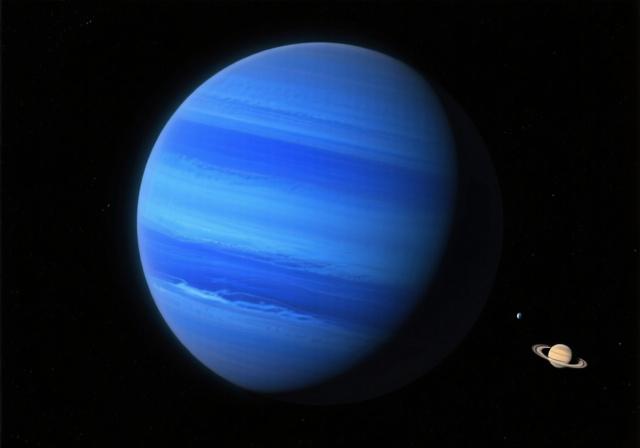
Neptune is the eighth and farthest known planet from the Sun, an ice giant that hosts the fastest winds in the solar system and a striking deep blue color driven by atmospheric methane. Discovered in 1846 through mathematical prediction, Neptune remains one of the most mysterious and least-explored worlds in our cosmic neighborhood, with supersonic storms, 16 known moons, and a captured retrograde satellite called Triton. This complete guide to Neptune facts covers its discovery, physical profile, atmosphere, moons, rings, exploration history, and practical observation tips for amateur astronomers.
Last updated: June 2026
As you explore these Neptune facts, you’ll discover why this distant ice giant continues to captivate planetary scientists decades after Voyager 2’s brief flyby. From diamond rain hypothesized in its deep interior to a Great Dark Spot that vanishes and reappears on timescales of years, Neptune challenges our understanding of how giant planets behave at the cold edge of the Sun’s reach.
Whether you’re researching a school project, planning a night of stargazing, or simply curious about the outer solar system, this guide pulls together the most important Neptune facts in 2026 from NASA, the Planetary Society, and recent peer-reviewed research.
Neptune’s discovery in 1846 stands as one of the most remarkable achievements in the history of astronomy. No one saw it first. Instead, two mathematicians on opposite sides of the English Channel independently calculated where an unseen planet had to be, simply because Uranus was not following its predicted orbit.
The story begins in the early 1840s, when astronomers noticed that Uranus drifted slightly off course. Something massive was tugging on it gravitationally. French mathematician Urbain Le Verrier spent two years working out the mass, orbit, and present-day position of the perturbing body. Across the Channel, British student John Couch Adams reached a similar conclusion, but his predictions received less attention from the Astronomer Royal.
On September 23, 1846, German astronomer Johann Gottfried Galle at the Berlin Observatory pointed his telescope at the coordinates Le Verrier had sent. Within hours, and within one degree of the predicted position, a small blue disk appeared. The planet was real, and the age of predicting worlds with a pen and paper had begun.
Interestingly, Neptune had almost been discovered 234 years earlier. In December 1612, Galileo Galilei recorded Neptune as a faint star near Jupiter while sketching the planet’s moons. Modern analysis of his notebook pages shows he actually observed Neptune moving against the background stars, but his small telescope could not resolve it as a disk. He missed the discovery of the solar system’s eighth planet by just 234 years.
Once Le Verrier had secured the discovery, a naming debate broke out. Le Verrier initially wanted to call the planet after himself, but the international astronomical community settled on a classical name instead. The decision followed the long tradition of naming planets after Roman gods, fitting Neptune’s deep blue appearance with the Roman god of the sea, equivalent to the Greek Poseidon.
The name also marked a quiet break with the other planets. The five classical planets visible to the naked eye – Mercury, Venus, Mars, Jupiter, and Saturn – were all named for Roman deities tied to individual attributes. Neptune, hidden in the dark beyond Saturn, extended that lineage into the modern era. Today, the convention is so strong that all major bodies in the outer solar system carry mythological names: Uranus, Neptune, Pluto (the Roman ruler of the underworld), and most of their moons.
Triton, Neptune’s largest moon, takes its name from the sea god’s son in Greek mythology. Smaller moons such as Nereid (a sea nymph) and Proteus (a shape-shifting sea god) keep the maritime theme, reflecting how the planet’s family was named as a single mythological set.
Neptune belongs to a class of planets called ice giants, alongside its near-twin Uranus. Unlike the gas giants Jupiter and Saturn, which are dominated by hydrogen and helium, ice giants carry a much larger share of heavier elements such as oxygen, carbon, nitrogen, and sulfur, bound up in water, methane, and ammonia ices under crushing pressure.
With an equatorial diameter of 49,528 kilometers (30,775 miles), Neptune is the fourth-largest planet in our solar system. About 58 Earths could fit inside it, though its mass is only 17 times Earth’s because of its lower average density. Neptune’s surface gravity is roughly 11.15 m/s², only about 14% stronger than Earth’s. If you could stand on a cloud platform at the top of its atmosphere, you would feel almost at home.
Scientists model Neptune’s interior as a small rocky core roughly the size of Earth, surrounded by a deep, slushy mantle of water, methane, and ammonia ices. Above this mantle sits a thick atmosphere of hydrogen, helium, and methane that gradually transitions from gas to liquid as pressure increases with depth.
One of Neptune’s most surprising features is its internal heat source. Despite being 30 times farther from the Sun than Earth, Neptune radiates 2.5 times more energy than it receives from solar radiation. The exact mechanism remains an open question, but residual heat from the planet’s formation and slow gravitational contraction of its interior are the leading explanations. This internal furnace is what powers Neptune’s extreme weather and dramatic atmospheric features.
Deep inside Neptune, conditions may be exotic enough to produce one of the solar system’s strangest phenomena: diamond rain. Laboratory experiments and shock-compression studies suggest that methane molecules at pressures of more than a million atmospheres can break apart, releasing carbon that crystallizes into diamond. Numerical models indicate that these diamonds could grow to substantial sizes in Neptune’s mantle before slowly settling toward the core, producing a slow, glittering precipitation in the planet’s interior. The effect has not been directly observed, but it is widely cited by planetary scientists as a plausible consequence of Neptune’s carbon-rich chemistry.
| Characteristic | Neptune | Earth |
|---|---|---|
| Diameter | 49,528 km (30,775 miles) | 12,742 km (7,918 miles) |
| Mass | 1.02 × 10^26 kg | 5.97 × 10^24 kg |
| Distance from Sun | 4.5 billion km (2.8 billion miles) | 150 million km (93 million miles) |
| Year Length | 165 Earth years | 365.25 days |
| Day Length | 16.1 Earth hours | 24 hours |
| Surface Gravity | 11.15 m/s² (1.14× Earth) | 9.81 m/s² |
| Cloud-Top Temperature | -200°C (-328°F) | 15°C (59°F) average |
| Known Moons | 16 | 1 |
Neptune’s atmosphere is one of the most extreme weather systems in the solar system. This distant world hosts wind speeds that dwarf any hurricane on Earth, creating massive storms that rage across its deep blue face.
The atmosphere consists of roughly 74% hydrogen, 25% helium, and about 1% methane. That small methane fraction gives Neptune its vivid blue color. Methane preferentially absorbs red light and scatters blue wavelengths, so the planet reflects more blue than any other visible color back to space.
What makes Neptune’s atmosphere especially strange is the wind speed relative to solar energy. Neptune receives only about 1/900th as much sunlight as Earth, yet its winds reach 1,200 mph (1,950 km/h), nine times faster than jet streams on Earth. The strongest hurricanes here top out near 200 mph. Something other than sunlight is driving the weather, and that something is the planet’s internal heat radiating outward from below.
Voyager 2’s 1989 flyby revealed the Great Dark Spot, an anticyclone larger than Earth with winds measured at 300 mph (480 km/h) around its edges. When the Hubble Space Telescope returned to Neptune in 1994, the Great Dark Spot had vanished. By 2018, Hubble imaging showed a new large dark spot in Neptune’s northern hemisphere, demonstrating that these storms form and dissipate on timescales of years, not centuries.
More recent Hubble observations through 2023 have confirmed that Neptune’s storm cycle is highly variable. Cloud bands brighten and dim, dark vortices appear and fade, and the overall brightness of the planet has fluctuated with the solar cycle. The James Webb Space Telescope also captured infrared images of Neptune in 2022, showing cloud structure and thermal patterns invisible to optical telescopes. These observations confirm that Neptune’s atmosphere is in constant flux, even as the planet receives only a sliver of the Sun’s light.
Neptune and Uranus look like siblings at a glance. Both are ice giants, similar in size, and dominated by methane-rich atmospheres. Up close, though, they behave like very different worlds. Neptune is stormy, dynamic, and radiates significant internal heat. Uranus is featureless, almost calm, and barely gives off any heat of its own.
Here is how the two ice giants stack up against Earth across a few key metrics.
| Property | Neptune | Uranus | Earth |
|---|---|---|---|
| Diameter | 49,528 km | 50,724 km | 12,742 km |
| Mass (Earth = 1) | 17.1 | 14.5 | 1 |
| Year Length | 165 Earth years | 84 Earth years | 1 year |
| Day Length | 16.1 hours | 17.2 hours | 24 hours |
| Cloud-Top Temperature | -200°C | -224°C | 15°C average |
| Surface Gravity (Earth = 1) | 1.14 | 0.89 | 1.00 |
| Known Moons | 16 | 28 | 1 |
| Internal Heat Output | 2.5× solar input | Negligible | Negligible |
The contrast in weather is striking. Neptune’s atmosphere churns with dark spots, fast jets, and bright cloud features. Uranus, by comparison, often appears almost cloudless in visible-light images. The leading explanation is that a catastrophic collision early in Uranus’s history knocked the planet on its side, releasing much of its internal heat into space. Neptune kept its heat, and its heat keeps the storms going.
Neptune’s moon system includes 16 known satellites, and one stands far above the rest. Triton ranks among the most fascinating objects in the solar system, and its unusual orbit points to a violent history.
Triton is Neptune’s largest moon by far, measuring 2,707 kilometers (1,680 miles) in diameter, larger than dwarf planet Pluto. It was discovered just 17 days after Neptune itself, found by British astronomer William Lassell in 1846 using a reflecting telescope he had built himself.
What makes Triton truly remarkable is its retrograde orbit. It circles Neptune in the opposite direction of the planet’s rotation, the wrong way around. This unusual orientation strongly suggests that Triton was not born with Neptune but was instead a dwarf planet from the Kuiper Belt that was captured billions of years ago. The capture event would have been catastrophic, scattering or destroying any previous regular moons and leaving Triton to dominate the system.
Triton’s surface is among the coldest places in the solar system, with temperatures near -235°C (-391°F), yet it is surprisingly active. Voyager 2 imaged cryovolcanoes erupting plumes of nitrogen gas and dust up to 8 kilometers (5 miles) into space. These geysers leave dark streaks across Triton’s icy surface, evidence of ongoing geological activity even at temperatures just 38°C above absolute zero.
Beyond Triton, Neptune’s other moons are far smaller. Nereid, discovered in 1949, follows a highly eccentric orbit that takes it as far as 9.6 million kilometers (6 million miles) from Neptune. The smallest known moon, Hippocamp, was identified in Hubble images from 2013 and is only about 35 kilometers across. The remaining 13 moons are small, irregular bodies likely captured from the Kuiper Belt or the asteroid belt.
Neptune also has a faint ring system first confirmed during Voyager 2’s 1989 flyby. The five main rings – Galle, Le Verrier, Lassell, Arago, and Adams – are made of dark ice particles mixed with dust. Unlike Saturn’s bright, icy rings, Neptune’s are so dark and tenuous they were never confirmed from Earth-based telescopes before Voyager 2 arrived. The outermost Adams ring is unusual for containing several bright arcs named Liberté, Egalité, and Fraternité, dense clumps whose survival against gravitational spreading remains an active area of research.
For more than three decades, Voyager 2 has been our only in-person visitor to Neptune. The spacecraft launched on August 20, 1977, as part of a grand tour of the outer solar system, using gravity assists from Jupiter and Saturn to fling itself toward the ice giants. After visiting Uranus in 1986, Voyager 2 reached Neptune on August 25, 1989, the first and only spacecraft ever to fly by the planet.
The flyby was timed to use a rare planetary alignment that occurs only once every 175 years. This geometry let Voyager 2 redirect itself onto a course that would carry it past Triton just hours after its closest approach to Neptune. The mission discovered the Great Dark Spot, six new moons, Neptune’s ring arcs, and Triton’s erupting geysers, and it measured the planet’s tilted magnetic field. After passing Neptune, Voyager 2 continued toward interstellar space and crossed the heliopause in 2018.
Since Voyager 2’s departure, our view of Neptune has come from Earth-based observatories. The Hubble Space Telescope has tracked Neptune’s atmosphere year after year, watching dark spots come and go and watching cloud bands brighten and fade with the solar cycle. In September 2022, the James Webb Space Telescope captured its first images of Neptune, revealing bright cloud activity and thermal structure invisible in optical light. JWST data showed that some of Neptune’s cloud features appear and disappear within hours, and that the planet’s average brightness has dropped in recent years, possibly tied to solar activity.
Looking ahead, NASA has signaled strong interest in returning to Neptune. The Planetary Science Decadal Survey 2023-2032, the leading community-driven roadmap for U.S. planetary science, identified a Neptune-Triton mission as a top-priority flagship concept for the next decade. The leading proposed mission, called Trident, would fly by Neptune and conduct a focused investigation of Triton, a captured Kuiper Belt object that may harbor a subsurface ocean. If funded, Trident or a successor mission could launch in the 2030s and reach Neptune in the 2040s, more than 60 years after Voyager 2’s brief encounter.
Concept studies have also explored orbiters and atmospheric probes that could measure Neptune’s wind speeds directly, map its magnetic field, and characterize the deep structure where diamond rain is thought to form. Until any of these missions fly, Hubble and JWST will remain our best tools for watching Neptune’s evolving atmosphere.
Observing Neptune from Earth is a unique challenge for amateur astronomers. At nearly 30 times farther from the Sun than Earth, Neptune appears as a tiny blue dot even through large amateur telescopes. With the right equipment and techniques, however, you can find and follow this distant world yourself.
First, you’ll need adequate astronomy observation equipment. Binoculars will only show Neptune as a faint star-like point, so a telescope with at least 8 inches of aperture is the practical minimum for resolving it as a disk. Many amateurs succeed with reflectors in the 10-14 inch range.
The key to finding Neptune is timing. Neptune reaches opposition, when it is closest to Earth and fully illuminated by the Sun, once each year. During opposition Neptune rises at sunset and is visible all night. At magnitude 7.7, it is technically just below naked-eye visibility from a perfect dark sky, so a finder chart or planetarium app is essential. Star charts will show Neptune moving slowly against the background stars over a period of weeks.
Through a medium-sized telescope, Neptune will appear as a small, pale blue disk rather than a sharp point like a star. You may notice its subtle blue color, but resolving any cloud features or the Great Dark Spot requires much larger telescopes (16 inches or more) and excellent atmospheric seeing. Astrophotographers with tracking mounts and stacked video can sometimes capture the planet’s disk and color, but visual observers should expect a quiet blue point of light.
For the best results, consider investing in quality observation gear. The best binoculars for planet viewing can help you locate Neptune’s general area, while a good telescope will reveal it as a disk. When choosing between equipment types, a reflector vs refractor telescope comparison can help you decide based on your budget and observing goals.
Don’t be discouraged if Neptune appears small or underwhelming at first. You are looking at a world 2.8 billion miles away, and the fact that you can pick it out from your backyard at all is a small victory in itself. Each observation connects you to one of the most distant major planets in our solar system, and to the long history of discovery that began with a French mathematician’s pen in 1846.
Neptune was the first planet discovered through mathematical prediction, has the fastest winds in the solar system (around 1,200 mph), takes 165 Earth years to orbit the Sun, appears deep blue because of methane in its atmosphere, has 16 known moons including the retrograde-orbiting Triton, hosts a faint ring system first imaged by Voyager 2, has been visited by only one spacecraft (Voyager 2), radiates 2.5 times more energy than it receives from the Sun, hosted the Great Dark Spot storm that has since disappeared, and is classified as an ice giant planet alongside Uranus.
Neptune is special because it is the windiest planet in the solar system with supersonic winds, the only planet ever discovered by mathematical prediction rather than direct observation, and home to Triton, a large moon that orbits backward and was likely captured from the Kuiper Belt. It also produces more internal heat than it receives from the Sun and remains the least explored of the major planets.
One year on Neptune equals about 165 Earth years. Because Neptune orbits the Sun at an average distance of 30 astronomical units, it moves very slowly along its orbit, taking roughly 60,190 Earth days to complete a single revolution. Neptune has not yet finished a full orbit since its discovery in 1846.
No, Neptune is not all water. Its atmosphere is mostly hydrogen and helium with a small amount of methane, and its interior is thought to contain a small rocky core surrounded by a slushy mantle of water, methane, and ammonia ices. The planet is sometimes called an ice giant because of these heavier compounds, but the dominant material by mass is still hydrogen and helium, with the water-ice layer making up only part of its total structure.
Neptune orbits approximately 2.8 billion miles (4.5 billion kilometers) from the Sun, which is about 30 astronomical units (AU). At this extreme distance, sunlight takes more than 4 hours to travel from the Sun to Neptune, making it the most distant known planet in our solar system.
Neptune has 16 known moons. Triton is by far the largest, accounting for 99.5% of all mass orbiting Neptune. The other 15 moons are much smaller, with Nereid being the second-largest at only 340 kilometers in diameter. The most recently identified moon, Hippocamp, was discovered in 2013 using Hubble images.
No, Neptune cannot be seen with the naked eye from Earth. At magnitude 7.7, Neptune is too faint to be visible without optical aid. You need at least binoculars to detect it, and a telescope of 8 inches or more to resolve it as a small blue disk rather than a point of light.
Only one spacecraft has ever visited Neptune: Voyager 2, which flew by the planet on August 25, 1989. Voyager 2 discovered the Great Dark Spot, six new moons, Neptune’s ring arcs, and Triton’s erupting geysers, and it measured the planet’s tilted magnetic field. NASA is now studying a proposed Neptune-Triton mission concept for the 2030s.
Neptune remains one of the most intriguing worlds in our solar system, a distant blue giant that continues to surprise planetary scientists more than three decades after Voyager 2’s flyby. From its mathematical discovery to its supersonic winds, captured moon, and hypothesized diamond rain, Neptune reminds us how much we still have to learn about the outer solar system.
Ongoing observations from Hubble and JWST are already reshaping what we know. New dark spots form and fade, cloud bands shift with the solar cycle, and infrared imaging is finally pulling back the curtain on Neptune’s deep atmosphere. The proposed Neptune-Triton flagship mission, highlighted in the Planetary Science Decadal Survey 2023-2032, could fly in the coming decades and turn Neptune from a single flyby target into a fully explored world.
Until then, these Neptune facts are the best summary of what we know in 2026. Whether you are planning a night of stargazing with a backyard telescope, researching a school project, or simply curious about the edge of the Sun’s reach, Neptune offers a fitting reminder that the most interesting discoveries often begin with a question, a calculation, or a quiet look up at a clear night sky.

![Mars Facts: Complete Guide to the Red Planet [cy]](https://revellphotography.com/wp-content/uploads/2026/09/featured-update-4302-1789317129635.jpg)