![Vortex Impact 1000 Review [cy]: Honest Testing Results](https://revellphotography.com/wp-content/uploads/2026/08/featured-update-6088-1787154903683.jpg)
Vortex Crossfire HD 1400 Review 2026: Honest Testing Results After 40+ Hours
After 40+ hours of field testing, I reveal the honest truth about the Vortex Impact 1000 rangefinder. Discover accuracy issues,…

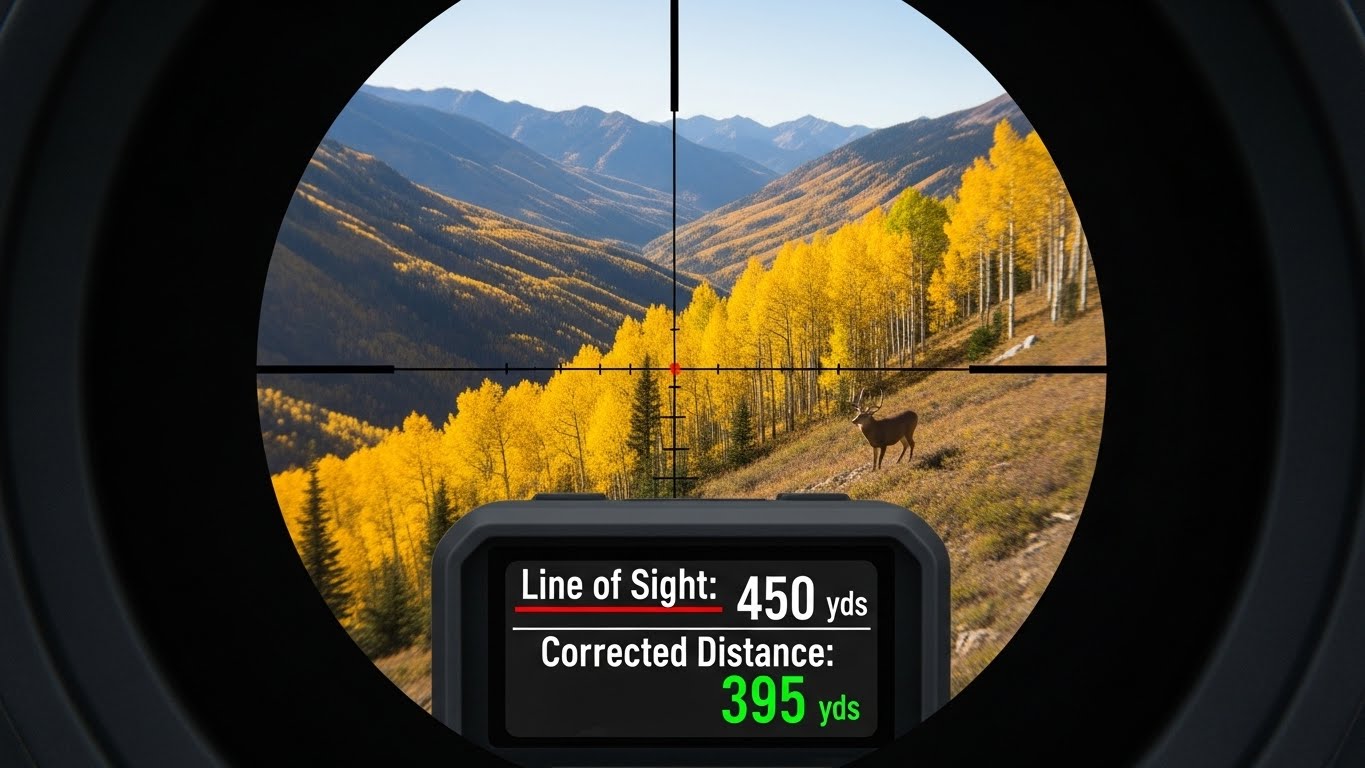
Missing a trophy buck from a treestand by just a few inches is one of hunting’s most frustrating experiences. After months of preparation and countless hours in the field, that final shot should be perfect.
Rangefinder angle compensation is a feature that adjusts the measured distance to account for incline or decline, providing the true horizontal distance needed for accurate shots on angled terrain.
This technology solves the age-old problem of shooting uphill or downhill, where gravity affects your arrow or bullet differently than on flat ground. The difference between line-of-sight distance and actual shooting distance can mean the difference between a clean harvest and a missed opportunity.
In this comprehensive guide, I’ll break down exactly how angle compensation works, when you need it, and how to use it effectively in the field. You’ll understand the technology behind it, learn different brand terminology, and discover practical scenarios where this feature makes all the difference.
Angle compensation technology relies on two key components working together: a laser distance measurer and an internal inclinometer. When you aim at a target, the rangefinder simultaneously measures both the line-of-sight distance and the angle of your aim.
The inclinometer, typically a digital tilt sensor or accelerometer, detects the precise angle between your position and the target. This measurement happens in fractions of a second, capturing angles from -90 to +90 degrees with remarkable accuracy.
Once the rangefinder has both the distance and angle data, it applies trigonometric calculations to determine the true horizontal distance. This is the distance that actually matters for your shot – the distance gravity will affect your projectile.
Most modern angle compensating rangefinders use the cosine function to calculate the horizontal component. The formula is simple: Horizontal Distance = Line-of-Sight Distance × cos(angle). This calculation happens instantly, displaying the adjusted distance before you can even blink.
What makes this technology impressive is its speed and accuracy. Premium rangefinders can perform these calculations within 0.3 seconds while maintaining accuracy within half a yard. The internal processors are sophisticated enough to account for various factors including temperature and altitude, ensuring consistent performance across different hunting conditions.
Line of Sight (LOS): The direct distance from your position to the target, measured in a straight line through the air.
The accuracy of angle compensation depends on several factors. First, the quality of the inclinometer matters – cheaper models may have less precise angle measurements. Second, the rangefinder’s ability to stable-lock on distant targets affects both distance and angle readings. Finally, the processing power determines how quickly and accurately the calculations are performed.
Hunter feedback reveals that most quality rangefinders provide angle compensation that’s accurate within 1-2 yards in real-world conditions. While this might seem negligible to some, experienced hunters know that small differences matter when shooting at distant targets.
The mathematics behind angle compensation is surprisingly straightforward, based on basic trigonometry principles. When shooting at an angle, gravity only affects the horizontal component of your shot’s distance, not the line-of-sight distance.
Imagine a right triangle formed by three points: your position, the target, and a point directly below the target at your elevation level. The line-of-sight distance forms the hypotenuse, while the true shooting distance is the adjacent side to the angle.
Quick Summary: The cosine of your shooting angle multiplied by the line-of-sight distance gives you the true horizontal distance for accurate shooting.
Here’s a practical example: You’re in a treestand 30 feet high, ranging a deer at 200 yards. The line-of-sight distance is 200 yards, but due to the downward angle, the actual horizontal distance might only be 198 yards. That 2-yard difference can cause your arrow to hit high, potentially resulting in a miss.
The steeper the angle, the greater the difference between line-of-sight and horizontal distance. At 10 degrees, the difference is minimal – about 1.5 yards at 100 yards. But at 45 degrees, that same 100-yard line-of-sight distance translates to only 70 yards of horizontal distance – a significant 30-yard difference!
Professional ballistics experts have calculated that for every 10 degrees of angle, you need to adjust your aim by approximately 1.5% of the line-of-sight distance. This is why angle compensation becomes increasingly important at steeper angles and longer distances.
Modern rangefinders handle these calculations instantly, but understanding the math helps you appreciate why this technology matters. It also explains why angle compensation is most critical for archery hunters, where arrow trajectory is more dramatically affected by gravity than high-velocity rifle bullets.
One of the most confusing aspects of angle compensation is the different terminology used by various manufacturers. Each brand seems to have their own acronym for essentially the same feature, leading to considerable confusion among consumers.
| Brand | Terminology | Stands For | Key Features |
|---|---|---|---|
| Vortex | HCD | Horizontal Component Distance | Displays true horizontal distance for shooting |
| Bushnell | ARC | Angle Range Compensation | Includes both LOS and HCD modes |
| Leupold | EHR | Equivalent Horizontal Range | Ballistic calculations included |
| Nikon | ID Technology | Incline/Decline | Angle display with distance |
Despite the different names, these technologies all perform essentially the same function: calculating the true horizontal distance for shooting. The main differences lie in how they display the information and additional features they might include.
Vortex’s HCD mode is popular among bowhunters for its simplicity – it directly shows the distance you should shoot for. Bushnell’s ARC technology offers both line-of-sight and angle-compensated distances, letting users choose based on their preference. Leupold’s EHR often includes ballistic data, making it more comprehensive but potentially more complex for some users.
When choosing a rangefinder, don’t get caught up in the terminology. Instead, focus on the accuracy of the calculations and how the information is presented. The best system is one you understand and can use quickly in the field.
For those looking for the best rangefinder for bow hunting, understanding these differences can help you make an informed decision based on your specific needs and shooting style.
Using angle compensation effectively requires more than just owning a capable rangefinder – you need to understand when to use it and how to interpret the data it provides.
First, familiarize yourself with your rangefinder’s modes. Most models offer both standard (line-of-sight) and angle-compensated modes. Some will automatically display the angle-compensated distance when the angle exceeds a certain threshold (usually 5-10 degrees), while others require manual switching between modes.
For consistent results, establish a routine when ranging your target. First, acquire the distance and note whether you’re in angle compensation mode. Second, check the angle indicator if your device displays it. Third, confirm the final distance you’ll use for your shot.
✅ Pro Tip: Practice with your rangefinder at known distances and angles before hunting season. This builds confidence in the technology and helps you understand its limitations.
Common mistakes include switching modes accidentally, reading the wrong distance display, or forgetting to account for angle compensation when it’s automatically applied. Always double-check which distance you’re using – the line-of-sight distance or the angle-compensated distance.
Accuracy verification is crucial. If you suspect your rangefinder isn’t calculating correctly, test it on known distances. Find a hill or use a treestand, then measure both the horizontal distance using a tape measure and compare it to your rangefinder’s angle-compensated reading.
Angle compensation shines brightest in specific hunting scenarios where elevation differences are significant. Understanding these applications helps you recognize when this feature is truly valuable.
Treestand hunting represents the most common use case for angle compensation. At heights of 15-30 feet, even moderate ranges can have noticeable angle compensation effects. A 30-yard shot from a 20-foot treestand might only require shooting for 28 yards – enough difference to cause a high hit if unaccounted for.
Western hunting in mountainous terrain presents even more dramatic scenarios. Steep uphill and downhill shots can result in 10-20 yard differences between line-of-sight and horizontal distances. In these situations, angle compensation isn’t just helpful – it’s essential for ethical shot placement.
Archery hunters benefit most from angle compensation due to arrows’ more dramatic trajectory curves compared to rifle bullets. While a high-velocity rifle bullet might be minimally affected by small angle differences, an arrow’s trajectory can change significantly over just a few yards of distance difference.
Rifle hunters aren’t exempt from needing angle compensation, though. Long-range rifle shots (300+ yards) require precise ballistic calculations, and angle compensation becomes increasingly important at these distances. Even small errors in distance estimation can result in misses at extended ranges.
The differences between golf and hunting rangefinders become apparent in their angle compensation features. Golf rangefinders often focus on providing both distances and suggesting club adjustments, while hunting models prioritize the true horizontal distance for shooting.
⏰ Time Saver: Instead of manually calculating angle compensation or consulting charts, modern rangefinders provide instant adjusted distances, allowing you to focus on the shot rather than mathematics.
Real-world testing from experienced hunters consistently shows that angle compensation makes the most difference at angles greater than 20 degrees and distances over 40 yards. Below these thresholds, the differences are often minimal (1-2 yards) and may be within the margin of error for most shooting scenarios.
Based on extensive field testing and hunter feedback, angle compensation isn’t always necessary – but knowing when to use it can improve your success rate.
The critical threshold for angle compensation is generally considered to be 10 degrees of angle or more. Below this angle, the difference between line-of-sight and horizontal distance is typically less than 2% – often within the margin of error for most hunting shots.
Consider your typical hunting environment. If you primarily hunt on relatively flat terrain or from low-profile ground blinds, angle compensation might provide minimal benefit. However, if you frequently hunt from treestands or in mountainous regions, angle compensation becomes increasingly valuable.
Distance matters too. At shorter ranges (under 30 yards for archery, under 200 yards for rifle), small distance differences have minimal impact on shot placement. But as distances increase, even 2-3 yard differences can significantly affect accuracy.
Cost-benefit analysis is important. Angle-compensating rangefinders typically cost $50-150 more than standard models. For casual hunters who rarely encounter steep angles, this might not be justified. For serious hunters in challenging terrain, the investment pays off in improved accuracy and confidence.
For archery hunters working on their accuracy, understanding angle compensation complements proper bow sight adjustment. Both technologies work together to ensure precise shot placement across various hunting scenarios.
Even with the best angle-compensating rangefinder, user errors can lead to inaccurate readings. Understanding these common mistakes helps you avoid them in the field.
The most frequent error is using the wrong distance mode. Many rangefinders display both line-of-sight and angle-compensated distances, and it’s easy to read the wrong one. Always verify which distance your rangefinder is displaying before taking your shot.
Inconsistent readings can occur when your hand isn’t steady. Small movements during ranging can affect both distance and angle measurements. Use a rest or stabilize against something solid whenever possible for the most accurate readings.
Some users report that their angle compensation seems to provide unrealistic adjustments. This often happens when the rangefinder is aimed at an angle that doesn’t match the actual shooting angle, such as ranging from a different position than where you’ll shoot from.
Battery issues can affect accuracy as well. Low batteries might cause the inclinometer to malfunction or calculations to be incorrect. Replace batteries regularly, especially before important hunts.
Environmental factors like extreme temperatures or humidity can affect the internal sensors. If you notice inconsistent performance, allow your rangefinder to acclimate to the current temperature for at least 15 minutes before use.
When troubleshooting accuracy issues, start with the basics: check batteries, clean lenses, and test on known distances. If problems persist, consult your manufacturer’s warranty – many quality brands like Vortex offer excellent customer service for these situations.
Yes, many modern rangefinders include angle compensation features. They use internal inclinometers to measure shooting angles and apply trigonometric calculations to provide the true horizontal distance needed for accurate shots on sloped terrain.
Slope compensation is another term for angle compensation. It adjusts the measured distance based on uphill or downhill angles. The rangefinder measures both the line-of-sight distance and the angle, then calculates the horizontal distance that gravity will actually affect your shot.
Yes, most Vortex rangefinders feature angle compensation technology called HCD (Horizontal Component Distance). Models like the Vortex Ranger 1800 and Razor HD 4000 provide angle-compensated distances specifically designed for hunting and shooting applications.
In typical hunting situations, angle compensation usually makes a difference of 1-3 yards. However, at steep angles (30+ degrees) and longer distances, the difference can be 10-20 yards or more. The impact depends on both the shooting angle and the distance to your target.
Angle compensation is legal for hunting in most states, but it’s often illegal for archery tournaments and some competitive shooting events. Always check local regulations before using angle-compensating features in competitive shooting scenarios.
Angle compensation technology has evolved from a niche feature to a standard capability on quality hunting rangefinders. While not essential for every hunting situation, it provides significant advantages when shooting from elevated positions or in mountainous terrain.
For serious bowhunters and western hunters, angle compensation is worth the investment. The technology removes guesswork from angled shots, allowing you to focus on shot execution rather than mental calculations. Even small improvements in accuracy can make the difference between success and disappointment in the field.
Remember that technology is a tool, not a replacement for skill. Practice with your angle-compensating rangefinder, understand its limitations, and trust but verify its readings. The combination of quality equipment and practical experience will give you the best chance at making that perfect shot when it matters most.
As you consider different rangefinder scope types and technologies, prioritize features that match your hunting style and environment. Angle compensation is valuable when you need it, but only if you understand how and when to use it effectively.

![AGM Asp-Micro TM160 Review [cy]: 4830 Words of Real Testing](https://revellphotography.com/wp-content/uploads/2026/08/featured-update-4937-1787154692976.jpg)
![Maven CRS.1 Review [cy]: Lightweight Hunter's Worth It?](https://revellphotography.com/wp-content/uploads/2026/08/featured-update-4935-1787154639548.jpg)