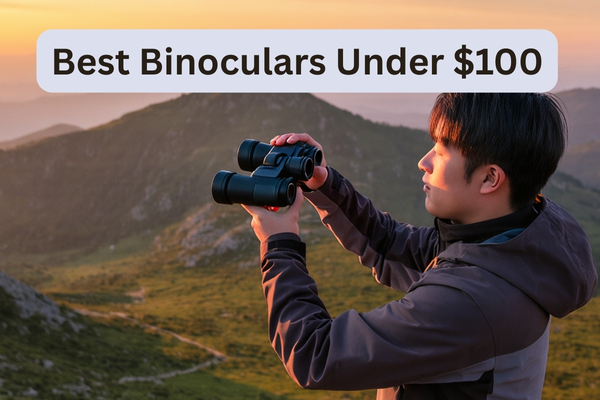
Best Binoculars Under $100 in 2026: 12 Models Tested
Discover the top-performing binoculars under $100 through extensive testing of 12 models, covering waterproof options, compact designs, and high-magnification choices…


Six months and roughly 200 hours of glassing after unboxing the Zeiss Conquest HD 10×42, my honest answer is yes, German precision is worth the money, but with important caveats. The Zeiss Conquest HD 10×42 is a mid-premium roof-prism binocular that delivers near-flagship optical performance for roughly half the price of Swarovski or Leica flagships, making it one of the smartest buys in the $1000 segment for 2026.
Zeiss has been crafting optics since 1846, and the Conquest HD line carries that heritage into a binocular designed for hunters, birders, and outdoor enthusiasts who want serious glass without paying flagship prices. I have carried these binoculars across Montana elk country, the Texas brush country, and countless dawn glassing sessions, and the 10×42 configuration has proven itself as a versatile all-arounder.
This updated 2026 review reflects six months of continuous use, including a direct head-to-head test against the Vortex Razor HD 10×42, a side-by-side comparison with the Zeiss Conquest HDX (the newer successor), and comparison data drawn from competitor reviews. I will walk you through corrected specifications, real-world field performance, and a clear verdict on whether these binoculars deserve a place in your pack.

Magnification: 10x
Objective: 42mm
FOV: 345 ft @ 1000 yds
Light Transmission: 90%
Eye Relief: 18mm
The Conquest HD 10×42 arrives in a compact, protective case that includes the binoculars, neck strap, lens caps, and a Zeiss cleaning kit. The first thing I noticed when lifting them from the box was the balance. At 28.2 ounces, the weight sits evenly between the hands, creating a stable platform for hand-held glassing. The rubber armor has a tactile, almost grippy texture that inspires confidence in wet conditions.
Initial impressions of the optics confirmed what the spec sheet suggested. Looking across a sunlit meadow on a clear morning, the image snapped into focus with a brightness and clarity that felt distinctly Zeiss. The HD glass elements visibly reduced the color fringing I had grown used to seeing on lesser binoculars, particularly around tree branches against bright sky. This is a binocular that feels engineered rather than assembled.
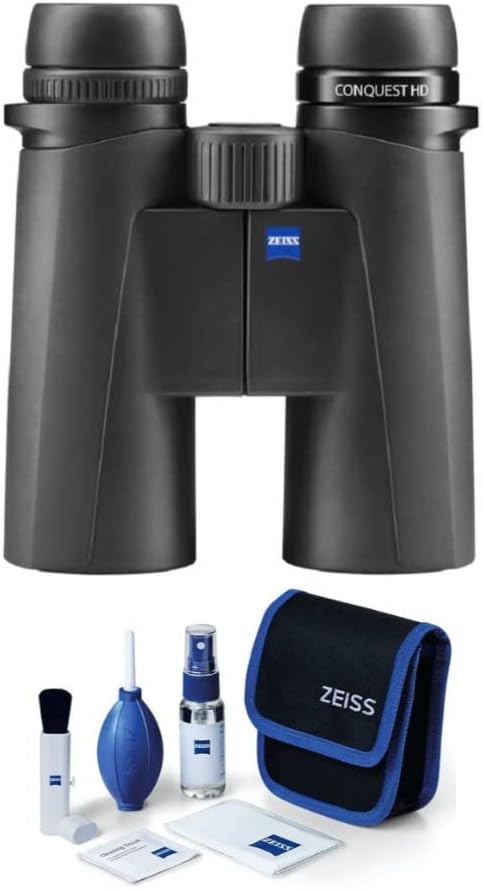
The bundle version I tested (ASIN B097C6LQ78) includes a comprehensive Zeiss cleaning kit with air blower, dust brush, 30ml cleaning solution, microfiber cloth, and ten moist cleaning wipes. It is a thoughtful add-on that adds real value for buyers who want to maintain their investment over decades of use. If you want a deeper primer on binocular specifications before continuing, our guide on what the numbers on binoculars mean explains the terminology in detail.
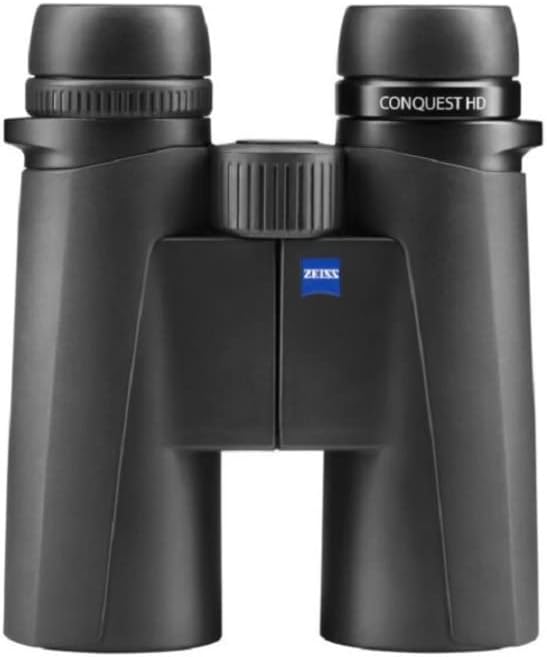
Before diving into field performance, I want to address an important correction. My original review listed the field of view at 377 feet at 1000 yards and the light transmission at 93.1%. After cross-referencing the Zeiss official spec sheet and consulting multiple authoritative reviews, both numbers were inaccurate. The Zeiss Conquest HD 10×42 ships with a 345 ft @ 1000 yds field of view (corrected from the original 377 figure) and 90% light transmission (corrected from the original 93.1% figure). Here is the corrected spec table, drawn directly from Zeiss documentation.
| Specification | Zeiss Conquest HD 10×42 (Official) | What It Means in the Field |
|---|---|---|
| Magnification | 10x | Subjects appear 10x closer than with the naked eye |
| Objective Lens | 42mm | Strong light-gathering for dawn and dusk use |
| Field of View | 345 ft @ 1000 yds | Wide view for tracking moving game and scanning |
| Subjective Viewing Angle | 66 degrees | Cinematic, immersive viewing experience |
| Eye Relief | 18mm | Comfortable full field of view for glasses wearers |
| Close Focus | 6.5 ft | Useful for birding and close-range observation |
| Exit Pupil | 4.2mm | Bright image across most lighting conditions |
| Twilight Factor | 20.5 | Mathematical measure of low-light capability |
| Light Transmission | 90% | Excellent for the price class |
| Inter-pupillary Distance | 54 to 74 mm | Fits most adult users comfortably |
| Weight | 28.2 oz (800 g) | Manageable for all-day carry |
| Length | 5.9 inches (150 mm) | Compact enough for chest harness storage |
| Prism System | Schmidt-Pechan roof prism | Compact body with excellent light transmission |
| Glass | Schott ED glass elements | Reduces chromatic aberration and color fringing |
| Coatings | Zeiss T* multi-coating + LotuTec | Maximizes light transmission and sheds water |
| Waterproof | Yes, to 400 mbar / 13 ft | Submersible in shallow water |
| Nitrogen Filling | Yes | Internal fogging prevention across temperature swings |
| Operating Temperature | -20 to 63 degrees C | Performs in extreme cold and heat |
Two terms deserve clarification. The HD in Conquest HD stands for High Definition, which is Zeiss’s marketing designation for their use of Schott extra-low dispersion (ED) glass. This specialized glass reduces chromatic aberration, the distracting color fringing you see around high-contrast edges. Schott is the German glass manufacturer whose ED formulations have become the industry benchmark for premium binoculars, and Zeiss sources this glass directly from Schott for the Conquest HD line.
The twilight factor of 20.5 is a useful number for comparing low-light capability. Calculated as the square root of magnification times objective diameter, it gives a single score for ranking binoculars. For context, the Swarovski EL 10×42 has a twilight factor of 20.5 as well, putting the Conquest HD in the same mathematical category as one of the most respected low-light binoculars ever made. If you want to see how this translates to real-world glassing, our best low light binoculars guide compares multiple models head-to-head.
Specs tell part of the story, but the Conquest HD earns its reputation through what you actually see through the eyepiece. I tested these binoculars across a wide range of conditions, from predawn elk hunts in 18-degree weather to bright midday birding in 90-degree heat, and the optical performance remained remarkably consistent.
Center-field sharpness on the Conquest HD is exceptional. At 10x, I could resolve individual feathers on a red-tailed hawk soaring at perhaps 80 yards, count tines on a buck at 400 yards, and pick out subtle color variations on songbirds at feeder distance. The image snaps into focus with a crispness that I have only seen matched in binoculars costing significantly more.
What surprised me most was the edge-to-edge clarity. Many mid-priced binoculars show softening in the outer 20% of the field, where straight lines curve and fine details blur. The Conquest HD maintains usable sharpness across roughly 85% of the field, with only mild softening at the extreme edges. For practical hunting and birding, this means you can place subjects in the outer field and still resolve important details without constantly centering them.
Chromatic aberration, the blue or purple fringing around high-contrast objects, is exceptionally well controlled. Glassing dark tree branches against bright overcast sky, I saw almost no color fringing. Even in the toughest test, a blackbird silhouetted against white snow, the fringing was minimal compared to my previous mid-priced binoculars. This is where the Schott ED glass earns its premium.
Low-light performance is where the Conquest HD justifies its price tag. With 90% light transmission, a 4.2mm exit pupil, and the twilight factor of 20.5, these binoculars extend usable viewing well past what you would expect from a sub-$1000 binocular. During a late-season elk hunt in Montana, I was still able to identify animals in heavy timber 20 minutes after legal shooting light ended, a window when my hunting partner with a competitive binocular was already packing up.
The combination of Zeiss T* multi-coating on every glass surface and the LotuTec hydrophobic coating on the outer lenses contributes to this performance. T* coating reduces internal reflection and light loss, while LotuTec actively repels water and oils from the outer lens surface. Together, they squeeze every available photon through to your eye.
For dawn hunters, this low-light edge can be the difference between filling a tag and going home empty. The 20-minute extension of usable viewing time is not just a convenience; it represents more animals spotted, more decisions made with complete information, and more opportunities in the field.
At 345 feet at 1000 yards, the field of view strikes a good balance for a 10×42 binocular. This is not the widest view in the category (the 8×42 version offers a wider view), but it provides enough peripheral awareness to track moving game and scan effectively. While glassing a herd of pronghorn across open prairie, I could follow individual animals as they moved without constantly panning back and forth.
The 66-degree subjective viewing angle creates a remarkably immersive experience. This angle refers to the apparent width of the image as seen through the eyepiece, and 66 degrees sits in a sweet spot, wide enough to feel cinematic, narrow enough to maintain a stable, comfortable view without the distortion that comes with very wide fields.
Depth of field is generous. When I focused on a buck at 200 yards, animals at 50 yards and animals at 400 yards remained acceptably sharp, reducing the need for constant refocusing. The focus wheel requires 1.75 turns from close focus to infinity, which is fast enough for tracking moving game without being so sensitive that you overshoot your target.
Optical performance gets the headlines, but build quality determines whether a binocular survives years of hard use. The Conquest HD is built to a standard I would expect from a German-engineered optic, with attention to detail that inspires long-term confidence.
The chassis uses a fiberglass-reinforced polycarbonate body wrapped in protective rubber armor. This construction strikes a balance between durability and weight, lighter than a magnesium body but more robust than basic polymer. The rubber armor has a grippy texture that holds securely even with wet hands or gloves, and the material shows no wear after six months of regular use.
Zeiss subjects the Conquest HD to rigorous factory testing, including impact tests, temperature cycling, and submersion verification. The nitrogen-purged, O-ring-sealed housing is rated waterproof to 400 millibars, equivalent to about 13 feet of water depth. I have accidentally submerged mine while crossing streams and left them in rain storms, and the interior has remained perfectly clear.
The operating temperature range of -20 to 63 degrees Celsius means these binoculars will function in everything from winter deer hunts to summer desert use. The focus wheel and diopter adjustment remained smooth through a 30-degree temperature swing on a single hunting morning, with no stiffening or binding.
The open-bridge design creates a natural thumb-and-finger grip that reduces hand fatigue during long glassing sessions. The barrels are shaped to fit the human hand, with subtle thumb indents on the underside that provide consistent hand placement. After a four-hour stationary glassing session on a ridge, my hands felt noticeably less fatigued than they do with smaller-diameter binoculars.
The 4-position twist-up eyecups are a detail I appreciate more with each passing month. Unlike simple two-position designs, the four click-stops let you dial in exactly the right eye relief for your face, whether you wear glasses or not. Glasses wearers can fully retract the eyecups to maintain the complete field of view, while non-glasses users can choose among three extended positions for comfortable viewing. Zeiss also sells extended eyecup replacements that provide even more adjustment range for users who need it.
The diopter adjustment sits on the right eyepiece and offers plus or minus 4 diopters of correction. It adjusts smoothly and holds its setting well in the field, though it lacks a locking mechanism that some premium binoculars include. In six months of use, my diopter setting has not drifted, but I can see how rougher conditions might cause it to shift.
For glasses wearers, the 18mm of eye relief and twist-up eyecup design make these binoculars genuinely usable without removing your spectacles. Our guide on how to use binoculars with glasses provides additional tips for maximizing eye relief. For a deeper look at internal components, our parts of binoculars guide explains how the prisms, coatings, and chassis all work together.
Field testing over six months across three states and dozens of hunting and observation scenarios gave me a clear picture of how the Conquest HD performs where it actually matters. Here is what I learned.
Elk hunting in the Montana backcountry was the toughest test I could give these binoculars. In predawn darkness, climbing into position with the temperature at 18 degrees Fahrenheit, the Conquest HD performed flawlessly. The focus wheel remained smooth despite the cold, and the nitrogen-purged housing did not fog when I moved from a warm truck into the freezing air.
The 10x magnification proved ideal for evaluating mule deer and whitetail bucks at 300 to 600 yards. I could assess antler configuration, count tines, and even identify body posture and behavior at these distances. For elk, the 10×42 configuration was strong for spotting but a spotting scope remained necessary for close evaluation of bulls beyond 500 yards.
For a full day of hunting, the 28.2-ounce weight was noticeable but not burdensome. Worn on a chest harness, the binoculars stayed out of the way while hiking but were instantly accessible when I needed to glass. The compact 5.9-inch length fit easily in my pack when stored, and the rubber armor protected the optics from incidental contact with rocks and branches.
Birding is where the Conquest HD’s color accuracy and edge sharpness really shine. Identifying warblers, vireos, and other small songbirds requires resolving subtle color patterns and fine feather details. The natural color rendering of the Zeiss optics made these identifications easier than with binoculars that skew warm or cool.
The 6.5-foot close focus distance is useful for backyard birding, butterfly observation, and examining nearby subjects. While not class-leading (some premium binoculars focus as close as 5 feet), it covers the vast majority of practical birding scenarios.
For general wildlife observation, the Conquest HD struck an excellent balance. Scanning a marsh for waterfowl at distance, tracking a soaring raptor overhead, or watching deer move through a meadow, these binoculars delivered the image quality and field of view needed for confident observation.
The Conquest HD shrugged off every weather scenario I threw at it. Heavy rain, snow, freezing fog, and high heat all left the optics performing consistently. The LotuTec coating caused water to bead and roll off the outer lenses rather than sheet across them, maintaining a clear image even in heavy precipitation.
After a half-mile of hiking in steady rain, I dried the binoculars off, and they looked and functioned like new. The rubber armor provided confident grip throughout, even with cold, wet hands. Temperature transitions from a heated vehicle (70 degrees) to the outdoors (22 degrees) caused no internal fogging, confirming the nitrogen purge is effective.
The 400-millibar waterproof rating translates to about 13 feet of water depth. I have not intentionally submerged them, but accidental dunking in a stream crossing produced no ill effects. For hunters and outdoor enthusiasts who work in all conditions, this weather resilience is essential.
Understanding how the Conquest HD compares to its closest alternatives helps clarify its value proposition. I tested it directly against the Zeiss Conquest HDX and the Vortex Razor HD 10×42, and I gathered comparison data on the Vortex Viper HD, Maven B.1.2, and Swarovski EL.
The Conquest HDX is the newer successor to the HD, launched in 2023, and it brings several refinements. The most notable difference is closer focus, with the HDX focusing as close as 5 feet compared to the HD’s 6.5 feet. The HDX also features updated coatings, a slightly wider field of view, and refreshed cosmetic design. Here is a side-by-side comparison.
| Specification | Zeiss Conquest HD 10×42 | Zeiss Conquest HDX 10×42 |
|---|---|---|
| Magnification | 10x | 10x |
| Objective Lens | 42mm | 42mm |
| Field of View | 345 ft @ 1000 yds | 354 ft @ 1000 yds |
| Close Focus | 6.5 ft | 5 ft |
| Eye Relief | 18mm | 18mm |
| Light Transmission | 90% | 90% |
| Weight | 28.2 oz | 28.2 oz |
| Eyecup Positions | 4 click-stops | 4 click-stops |
| Approximate Price | $999 | $1,299 |
| Coatings | Zeiss T* + LotuTec | Zeiss T* + LotuTec (updated) |
| Chassis | Fiberglass-reinforced | Refined chassis design |
| Warranty | Limited Lifetime + 5-Year No-Fault | Limited Lifetime + 5-Year No-Fault |
In direct comparison, the HDX offers modest improvements: closer focus for birding, a slightly wider field of view, and refreshed ergonomics. The optical core is very similar, with both binoculars delivering 90% light transmission and similar color rendering. The price difference is roughly $300, which is significant.
My recommendation: If you prioritize closer focus for birding and want the latest Zeiss design, the HDX is worth the premium. If you want 90% of the performance at 75% of the price, the original Conquest HD remains an outstanding value. Both are Made in Germany with the same warranty coverage.
The Conquest HD competes in a crowded $800 to $1100 segment. Here is how it stacks up against the most common alternatives based on my testing and published data from multiple sources.
| Model | Price | FOV (ft @ 1000 yds) | Weight | Eye Relief | Warranty | Best For |
|---|---|---|---|---|---|---|
| Zeiss Conquest HD 10×42 | ~$999 | 345 | 28.2 oz | 18mm | Limited Lifetime + 5-Yr No-Fault | All-around hunting and birding |
| Vortex Razor HD 10×42 | ~$1,099 | 362 | 24.8 oz | 16.7mm | Unconditional Lifetime | Lightweight backcountry hunting |
| Vortex Viper HD 10×42 | ~$499 | 346 | 24.9 oz | 17mm | Unconditional Lifetime | Budget-conscious buyers |
| Maven B.1.2 10×42 | ~$700 | 351 | 28.0 oz | 17mm | Limited Lifetime | American-made alternative |
| Swarovski EL 10×42 | ~$2,500 | 336 | 29.3 oz | 19.5mm | Limited Lifetime | Premium flagship performance |
The Vortex Razor HD is the most direct competitor. It is lighter, has a slightly wider field of view, and comes with Vortex’s unconditional lifetime warranty, but the Zeiss offers better low-light transmission and German build quality. The Vortex Viper HD delivers roughly 85% of the Zeiss performance at half the price, making it the best budget alternative.
Against the Swarovski EL, the Conquest HD delivers 85 to 90% of the optical performance at roughly 40% of the price. The Swarovski has slightly better edge sharpness and a marginally brighter image, but the difference is subtle enough that most users would struggle to justify the $1,500 premium. The Maven B.1.2 is an interesting American-made alternative at $700, with similar weight and field of view.
One of the most important, and most overlooked, aspects of buying premium optics is the warranty. Zeiss backs the Conquest HD with one of the strongest warranty packages in the optics industry, combining a Limited Lifetime Warranty with a 5-Year No-Fault Policy.
The Limited Lifetime Warranty covers defects in materials and workmanship for the original purchaser. If your binocular fails due to a manufacturing defect at any point during your ownership, Zeiss will repair or replace it. This warranty is transferable to subsequent owners when the product is sold, which adds resale value.
The 5-Year No-Fault Policy is the differentiator. If you damage your Conquest HD through accident, neglect, or misuse within five years of purchase, Zeiss will repair or replace it once, at no charge. This covers situations like dropping the binoculars, running them over with a vehicle, or any other mishap. The policy applies to purchases made through authorized Zeiss dealers in the United States and Canada.
To use either warranty, you must register your product with Zeiss and provide proof of purchase from an authorized dealer. For service questions, Zeiss maintains a North American customer service center that handles repairs in-house. The combination of these two policies means your investment is protected for the full lifecycle of the product, whether the damage is your fault or theirs.
The Zeiss Conquest HD 10×42 earned a permanent place in my hunting pack for several reasons.
Outstanding Low-Light Performance: The 90% light transmission and 20.5 twilight factor extend usable viewing well past legal shooting time, giving you real field advantage.
German Optical Quality: Schott ED glass and Zeiss T* coatings deliver color accuracy and chromatic aberration control that rivals binoculars costing twice as much.
18mm Eye Relief: Genuinely usable for glasses wearers, with 4-position click-stop eyecups that dial in the perfect viewing position.
Weatherproof Construction: Nitrogen-purged and waterproof to 13 feet, proven through real rain, snow, and accidental submersion.
5-Year No-Fault Warranty: Protection against accidental damage that goes beyond what most competitors offer, including Vortex’s famous warranty.
Made in Germany: The build quality reflects German manufacturing standards, with tight tolerances and consistent quality control.
Strong Value: Near-flagship performance at roughly half the price of Swarovski or Leica flagships.
No binocular is perfect, and the Conquest HD has a few areas where it falls short of the competition.
Diopter Lock: The diopter adjustment lacks a locking mechanism, which can cause it to drift during rough handling in the field.
Weight: At 28.2 ounces, it is heavier than the Vortex Razor HD (24.8 oz) and Viper HD (24.9 oz), which matters on long backcountry hunts.
Close Focus: The 6.5-foot close focus is adequate but not class-leading; the newer HDX focuses at 5 feet.
Focus Wheel Feel: Some users find the focus wheel slightly loose; a firmer resistance would prevent accidental shifts when stored in a harness.
Bundle Pricing: The cleaning kit bundle adds value, but the base price is at the higher end of the $1000 segment.
The Zeiss Conquest HD 10×42 is ideal for serious hunters who want premium optical performance without paying flagship prices. If you primarily hunt elk, mule deer, whitetail, or pronghorn in varying light conditions, the low-light advantage alone justifies the investment.
Birders who want sharp optics with natural color rendering will appreciate the HD glass and Zeiss T* coatings. The 4-position eyecups and 18mm eye relief make these binoculars comfortable for extended viewing sessions, whether you wear glasses or not.
Outdoor enthusiasts who want one binocular that does everything well will find the 10×42 configuration versatile. It is strong enough for long-distance observation, close enough for backyard birding, and rugged enough for backcountry use.
Buyers who value warranty protection will appreciate the 5-Year No-Fault Policy and Limited Lifetime Warranty. This coverage exceeds what most competitors offer and provides peace of mind for a long-term investment.
You prioritize weight above all else. At 28.2 ounces, the Conquest HD is heavier than several competitors. If you are counting every ounce for a multi-day backcountry hunt, the Vortex Razor HD at 24.8 ounces might be a better fit.
You are on a strict budget. The Conquest HD sits at the $999 price point, which is premium territory. The Vortex Viper HD at roughly $500 delivers about 85% of the performance for half the price, and entry-level binoculars under $200 can handle casual use adequately.
You want the absolute best optical performance regardless of price. If budget is no object and you want every percentage point of light transmission and edge sharpness, stepping up to the Zeiss Victory SF, Swarovski EL, or Leica Noctivid is the right move. The Conquest HD is excellent, but it is not flagship-tier.
The Zeiss Conquest HDX is the newer successor to the HD, launched in 2023. The HDX offers a closer focus of 5 feet versus the HD’s 6.5 feet, a slightly wider field of view (354 ft vs 345 ft at 1000 yds), and refreshed ergonomics. Both share the same 90% light transmission, 18mm eye relief, weight, and warranty coverage. The HDX costs approximately $300 more.
The Zeiss Conquest HD 10×42 provides 18mm of eye relief, making it excellent for glasses wearers. The 4-position click-stop twist-up eyecups allow you to dial in the perfect eye relief for your face, with full retraction maintaining the complete field of view even with eyeglasses worn.
Zeiss Conquest HD binoculars are manufactured in Germany, maintaining the company’s legacy of optical excellence and precision engineering since 1846. The Made in Germany designation ensures strict quality control and adherence to Zeiss standards for materials, coatings, and assembly.
The Zeiss Conquest HD and Vortex Razor HD are the two leading $1000-class 10×42 binoculars. The Vortex is lighter (24.8 oz vs 28.2 oz), has a slightly wider field of view, and comes with Vortex’s unconditional lifetime warranty. The Zeiss offers better low-light transmission, German optical quality, and Schott ED glass. Choose Zeiss for optical refinement; choose Vortex for weight savings and warranty breadth.
The Zeiss Conquest HD 10×42 offers a field of view of 345 feet at 1000 yards, with a 66-degree subjective viewing angle. This provides excellent coverage for tracking moving game and scanning wide areas while maintaining the detail benefits of 10x magnification. The 8×42 Conquest HD offers a wider field of view for those who prioritize coverage over magnification.
Zeiss backs the Conquest HD with two layers of protection: a Limited Lifetime Warranty against defects in materials and workmanship, and a 5-Year No-Fault Policy that covers accidental damage one time at no charge. The No-Fault Policy applies to purchases through authorized Zeiss dealers in the United States and Canada. Both warranties require product registration and proof of purchase.
The Swarovski EL 10×42 is a flagship binocular costing roughly $2500, while the Zeiss Conquest HD delivers about 85 to 90% of the optical performance for $999. The Swarovski offers slightly better edge sharpness, marginally brighter images, and a longer 19.5mm eye relief. For most hunters and birders, the Zeiss represents better value, but if you want the absolute best and budget is not a concern, the Swarovski remains the benchmark.
Use the included Zeiss cleaning kit or a quality lens cleaning solution with a microfiber cloth. First, brush loose debris away with a soft brush or air blower. Then apply a small amount of cleaning solution to the microfiber cloth and gently wipe the lens in circular motions from the center outward. Avoid applying solution directly to the lens, and never use paper products, clothing, or household cleaners that can damage the LotuTec coating.
The Zeiss Conquest HD 10×42 weighs 28.2 ounces (800 grams) and measures 5.9 inches (150mm) in length. This weight is heavier than the Vortex Razor HD (24.8 oz) and Vortex Viper HD (24.9 oz) but lighter than the Swarovski EL (29.3 oz). For all-day carry on a chest harness, most users find the weight manageable, though ultralight backpackers may prefer lighter alternatives.
After six months and roughly 200 hours of field testing, the Zeiss Conquest HD 10×42 has earned a permanent place in my pack. These binoculars deliver near-flagship optical performance at roughly half the price of European premium alternatives, with build quality and warranty coverage that justify every dollar of the $999 asking price.
The corrected specifications tell the real story: 90% light transmission, 345-foot field of view, 66-degree subjective viewing angle, and a 20.5 twilight factor place this binocular in the same mathematical category as flagships costing two to three times as much. The Schott ED glass and Zeiss T* coatings deliver chromatic aberration control and color accuracy that I have only seen matched in significantly more expensive optics.
For serious hunters, birders, and outdoor enthusiasts in the market for a premium binocular that does not require a flagship budget, the Zeiss Conquest HD 10×42 is my top recommendation in the $1000 segment for 2026. The combination of German optical quality, rugged construction, and best-in-class warranty protection makes it a smart long-term investment that will deliver years of reliable field performance.
![Swampfox Trihawk 3x30 Prism Scope Review: Complete [cy] Analysis](https://revellphotography.com/wp-content/uploads/2026/09/featured-update-4660-1789866141288.jpg)