
How to Choose a Rifle Scope: The Complete Guide (May 2026)
The rifle scope market explodes with choices each year, leaving shooters drowning in specifications they do not understand. A 3-9×40…

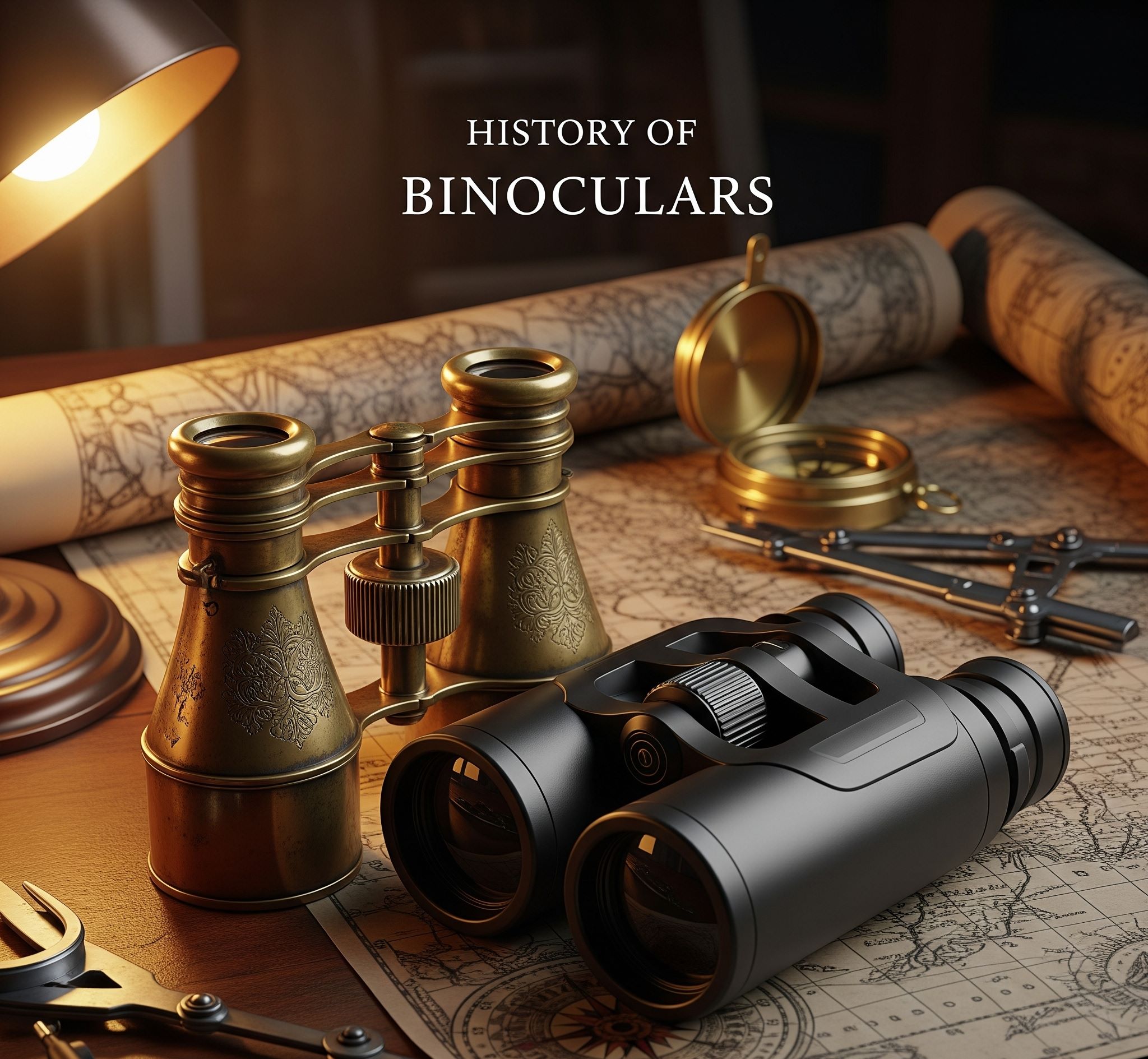
Every time you lift a pair of binoculars to your eyes, you hold in your hands four centuries of human ingenuity. The story of how these remarkable instruments evolved from primitive magnifying glasses into sophisticated optical devices connects us to some of history’s greatest minds and most determined inventors. This guide traces the complete history of binoculars, from their origins in ancient glass workshops to the digital marvels available today, exploring the breakthroughs that transformed how we see the world around us.
Understanding the evolution of binoculars reveals why modern optical instruments work so well. Each design choice, from prism configurations to lens coatings, emerged from specific challenges that inventors struggled to solve. By appreciating this historical context, you gain deeper insight into the binoculars you might consider purchasing or simply develop a greater respect for the technology we often take for granted.
Before binoculars could exist, humanity needed to understand how light interacts with curved glass surfaces. This knowledge did not come all at once but developed gradually over thousands of years through experimentation and observation.
Ancient Egyptian craftsmen of the 4th dynasty, working around 2613-2494 BCE, created polished crystal lenses from quartz. These artifacts, discovered by archaeologists, served primarily decorative purposes rather than magnification. The Egyptians valued them as rare objects, not as tools for improving vision. Some researchers believe these lenses may have been used as burning glasses to focus sunlight, but direct evidence remains limited.
Roman scholars advanced optical understanding considerably around the 1st century AD. They developed water-filled glass spheres that functioned as simple magnifying devices. These “burning glasses” demonstrated that curved glass could manipulate light in useful ways. While Romans used them primarily for starting fires, the principle opened doors for later experimentation.
The critical breakthrough arrived in 13th-century Italy. Roger Bacon, a Franciscan friar and philosopher, published significant works on optics in 1267. Among his many observations, Bacon noted that placing a sheet of glass over text could assist reading. This simple insight sparked widespread experimentation with corrective lenses.
By the end of the 1200s, Italian craftsmen mounted magnifying lenses into frames to create eyeglasses. These early spectacles used convex lenses to correct farsightedness, establishing the foundation for all subsequent optical instruments. The ability to shape and polish glass to precise specifications created the technical foundation that would eventually enable telescope and binocular development.
The telescope emerged during a period of remarkable intellectual activity in Europe. Scientists and craftspeople shared ideas across borders, creating an environment where optical innovations could flourish.
In October 1608, Hans Lippershey, a Dutch spectacle maker operating in Middelburg, submitted a patent application to the States-General of the Netherlands. His description called the device “a certain instrument for seeing things far away as if they were nearby.” The design combined a convex objective lens with a concave eyepiece, achieving approximately 3-4x magnification. Lippershey had created the first practical telescope, though he likely did not fully grasp the implications of his invention.
News of the Dutch invention spread rapidly across Europe. Galileo Galilei in Italy heard descriptions and began constructing his own versions in 1609, improving the design significantly. Without ever examining a Dutch telescope directly, Galileo created instruments achieving up to 20x magnification initially, later reaching 30x. These relatively modest magnifications enabled groundbreaking astronomical discoveries, including detailed observations of lunar craters and the identification of Jupiter’s four largest moons.
Johannes Kepler proposed an important design improvement by suggesting two convex lenses instead of Galileo’s convex-concave combination. The Keplerian configuration produced clearer images with greater magnification but introduced one significant problem: inverted images. Solving this limitation drove innovations for over a century.
One of the most significant dates in optical history marks the birth of binoculars as we recognize them today. When Hans Lippershey demonstrated his telescope to the Dutch States-General, officials posed an unusual question: could he adapt the device for two-eyed viewing?
Lippershey accepted the challenge and on December 8, 1608, presented what we would now call binoculars. His device mounted two telescopes side by side, allowing simultaneous viewing with both eyes. The dual viewing configuration provided improved depth perception and reduced eye strain compared to single-eye observation.
Interestingly, the States-General requested that Lippershey produce additional units using quartz crystal rather than glass for the optics. They believed crystal would provide superior clarity, given the poor quality of optical glass available at that time. Lippershey attempted to fulfill this request but encountered significant manufacturing challenges with crystal optics.
Despite completing several instruments, Lippershey never received his patent. Other inventors claimed similar devices, and the patent office rejected his application. Nevertheless, December 8, 1608, stands as the recognized birth date for binoculars. These first instruments offered only 3-4x magnification with limited image quality, but they established the fundamental concept that subsequent generations would refine.
Following Lippershey’s initial invention, binoculars entered an extended period of stagnation. While telescopes advanced rapidly through the 17th and 18th centuries, binoculars remained crude and impractical. This disparity surprises many people who assume continuous improvement in both technologies.
Several interconnected factors caused this lag:
The first commercially successful binoculars appeared in 1823, when Johann Friedrich Voigtländer of Vienna introduced handheld binocular telescopes. These compact “opera glasses” used Galilean optics and achieved 2-4x magnification. While far from perfect, they proved popular for theater attendance, where their modest magnification and portable size made them practical for seated viewing.
The transformation of binoculars from novelty items to serious optical instruments began in 1854. Italian optician Ignazio Porro patented a prism erecting system that solved multiple problems simultaneously, launching the modern era of binocular design.
Porro’s innovation involved recognizing that prisms could fold the optical path within binoculars. His design used two right-angled prisms in each barrel, arranged in a Z-shaped configuration. Light entered through the objective lens, bounced between the prisms, and exited through the eyepiece correctly oriented.
This configuration offered transformative advantages:
Despite these advantages, Porro prism binoculars faced significant commercialization challenges. Glass quality in the 1850s-1870s remained inconsistent, and manufacturing tolerances for precision prisms exceeded available techniques. Many early manufacturers attempted Porro designs but could not produce reliable products at scale.
The collaboration of three exceptional minds transformed binoculars from practical curiosities into professional-grade optical instruments. Carl Zeiss, Ernst Abbe, and Otto Schott combined their expertise to establish standards that continue influencing optics today.
Carl Zeiss opened his optical workshop in Jena, Germany, in 1846, initially focusing on microscopes rather than binoculars. His scientific approach to lens design differed from competitors who relied primarily on trial and error. When physicist Ernst Abbe joined as a partner in 1866, their partnership began applying rigorous optical physics to instrument design.
The critical enabler arrived with Otto Schott, who developed new optical glass compositions in 1886. His borosilicate “crown glass” achieved unprecedented clarity with minimal bubbles or internal stresses. This material enabled lens designs previously impossible with inconsistent glass stock.
In 1893, Ernst Abbe presented a revolutionary prism telescope design at the Vienna Trade Fair. This combined Porro’s prism concept with Schott’s superior glass to create an instrument delivering dramatically improved performance. Building on this foundation, Zeiss introduced commercially successful Porro prism binoculars in 1894, available in 6x and 8x magnifications.
These instruments set new standards for clarity, brightness, and build quality. Within years, Zeiss binoculars equipped military units, scientific expeditions, and discriminating enthusiasts worldwide. The company’s success established Jena as the world center for precision optics, a reputation that continues more than a century later.
The evolution of 10x binoculars illustrates how optical engineering involves balancing competing demands. Higher magnification revealed new challenges that required innovative solutions spanning decades.
Early binoculars typically offered 3-6x magnification, considered sufficient for most purposes. However, users in military, maritime, and astronomical applications desired greater power. Reaching 10x magnification required solving several interconnected technical problems simultaneously.
Lens coating technology provided the key breakthrough. In 1935, Alexander Smakula working at Zeiss invented anti-reflective coating, increasing light transmission by approximately 50%. This advancement allowed 10x binoculars to deliver acceptably bright images despite the inherent light loss of higher magnification.
Modern 10x binoculars remain among the most popular configurations. The 10×42 format, combining 10x magnification with 42mm objective lenses, offers an excellent balance of power, brightness, and handheld stability. These instruments excel for birdwatching, nature observation, hunting, and general recreational use.
While Porro prisms dominated binocular design for decades, an alternative configuration emerged in the late 19th century. Roof prism designs offered different advantages that eventually made them the preferred choice for compact binoculars.
French optician Achille Victor Emile Daubresse developed the first roof prism concept around 1870, though early models could not be manufactured reliably. The design gained practical importance when Moritz Hensoldt began commercializing roof prism binoculars in 1897.
Two distinct roof prism configurations achieved widespread use:
Roof prism binoculars feature objective lenses aligned in a straight line with the eyepieces, creating a narrower, more streamlined profile than Porro designs. This compactness made them attractive for portable use. However, roof prisms demanded extremely precise manufacturing tolerances and required specialized phase-correction coatings to achieve performance comparable to Porro prisms.
Phase correction coatings, introduced commercially in the 1990s, finally enabled roof prism binoculars to match Porro prism image quality. Zeiss P-coating and similar technologies eliminated interference effects that had limited earlier roof prism designs. Today, high-quality roof prism binoculars compete directly with Porro designs across all performance categories.
The 20th century transformed binoculars from delicate scientific instruments into durable consumer products. Each decade brought refinements that expanded accessibility and improved performance across all price ranges.
Anti-reflective lens coatings, pioneered by Alexander Smakula at Zeiss in 1935, revolutionized optical performance. The thin magnesium fluoride layers reduced light reflection from approximately 5% to just 1% per surface. This improvement dramatically increased image brightness and contrast.
During World War II, coated optics provided significant tactical advantages. Allied forces could observe effectively during low-light conditions when uncoated instruments failed. The military significance accelerated coating technology development, and post-war consumer binoculars benefited from these wartime advances.
Housing materials evolved from brass to aluminum and eventually to engineering polymers. This transition reduced weight by half or more without compromising structural integrity. Lighter binoculars could be carried comfortably for extended periods, expanding practical outdoor applications.
Zeiss introduced compact telescopic eyepieces in 1954, enabling smaller overall designs. Their iconic 8×20 pocket binoculars, released in 1969, folded small enough for shirt pockets while delivering optical performance previously requiring much larger instruments.
Nitrogen-purged waterproof binoculars appeared in the early 1970s, making quality optics practical for marine environments and inclement weather. O-ring seals prevented moisture ingress, while nitrogen filling eliminated internal fogging during temperature changes.
Rubber armor coatings became standard during the 1980s. Beyond providing shock absorption for the optical system, rubber armor improved grip and protected against minor impacts. These features made binoculars more accessible to casual users who lacked the careful handling habits of traditional optics enthusiasts.
Phase-correction coatings for roof prisms reached commercial viability in the 1990s. These specialized coatings eliminated the polarization interference that had prevented roof prism binoculars from matching Porro prism performance.
Zeiss introduced their P-coating system, representing a significant advancement in roof prism technology. With phase correction standard in quality roof prism designs, consumers could finally choose between Porro and roof configurations based on size preference rather than accepting image quality compromises.
Binoculars in the 21st century incorporate electronic technologies that early pioneers could never have imagined. These innovations extend functionality far beyond traditional optical viewing.
Zeiss introduced the first commercially successful stabilized binoculars in 1990 with their 20×60 S model. The system employed gyroscopic sensors detecting hand movement, with tiny motors adjusting prism positions to maintain a steady image despite user motion.
Modern stabilized binoculars achieve remarkable results, enabling steady handheld viewing at magnifications up to 20x. This capability previously required tripods or specialized mounting systems. Canon, Nikon, and other manufacturers now offer image-stabilized models across various price ranges.
Digital binoculars incorporate cameras capable of capturing still images and video through the optical system. Some models include GPS receivers for location tagging, digital compasses showing bearing, and laser rangefinders measuring distances to subjects.
Wi-Fi connectivity enables immediate sharing of observations and images. Mobile applications allow smartphone integration, extending functionality through software updates and expanded features. These smart binoculars appeal to users who want documentation alongside direct viewing.
Modern multi-layer coating systems achieve performance levels impossible with single-layer approaches. Contemporary binoculars may feature:
Electronic image intensification and thermal sensors have expanded binocular applications into complete darkness. Night vision binoculars amplify ambient light to enable observation under moonless conditions. Thermal imaging detects heat signatures from living creatures, vehicles, and machinery regardless of ambient illumination.
These electronic enhancement technologies serve wildlife observation, search and rescue, security, and hunting applications where traditional optics provide no useful image. Consumer models have become increasingly affordable while improving performance.
A dedicated community of collectors preserves and studies historic optical instruments. While no single “Binocular History Society” exists, enthusiasts worldwide connect through various organizations and online platforms.
Notable groups serving collectors include:
Vintage binoculars command significant prices among collectors, particularly these sought-after categories:
These collectors perform valuable historical work, maintaining not only instruments but the knowledge surrounding their manufacture and use. Many vintage binoculars from the early 20th century remain fully functional today, testament to their exceptional construction quality.
Standardized specifications emerged as binoculars became more sophisticated. Understanding these measurements illuminates how optical technology has advanced since Lippershey’s first instruments.
From Hans Lippershey’s 3x binoculars to modern stabilized models reaching 25x handheld magnification, capability has expanded dramatically. Interestingly, the most popular configurations for general use (7x, 8x, and 10x) have remained remarkably consistent since the early 1900s. This consistency suggests these magnifications represent practical optimums balancing capability against handheld stability.
Objective lens diameter, measured in millimeters, determines light-gathering ability and ultimately image brightness. Early binoculars typically featured 20-30mm objectives. Contemporary designs range from compact 20mm travel binoculars to substantial 100mm astronomical instruments. The popular 42-50mm range represents an effective balance between light-gathering capability and portability for general outdoor use.
Eyepiece design innovations have substantially increased fields of view. Early binoculars typically provided 3-4 degrees of visible angle. Modern wide-angle designs exceed 8 degrees at equivalent magnifications, making subject acquisition and tracking considerably easier.
Different regions developed distinctive optical manufacturing traditions, influenced by local materials, technical expertise, and market demands.
Germany, centered on Jena, became synonymous with optical excellence during the late 19th and 20th centuries. Zeiss, Leitz, and Hensoldt established quality benchmarks that remain relevant today. German manufacturers pioneered most major optical innovations, from anti-reflective coatings to sophisticated roof prism configurations.
Post-World War II Japan emerged as a major optical force. Nikon, Canon, and Fujinon combined German optical principles with innovative manufacturing techniques, substantially improving affordability. Japanese manufacturers excel particularly at high-quality roof prism designs and have introduced numerous electronic features common in modern instruments.
American manufacturers including Bausch & Lomb emphasized practical, durable designs for military and civilian markets. They pioneered rubber armoring, nitrogen purging, and specialized configurations for marine and hunting applications. American designs often prioritized reliability and ease of use over追求 absolute optical perfection.
The Soviet Union developed distinctive binocular designs optimized for military requirements. Unique wide-angle configurations served tank commanders and naval officers. These robust instruments, built to withstand harsh conditions, have become popular among collectors who appreciate their historical significance and mechanical reliability.
Binocular technology continues evolving with innovations that would have seemed miraculous to early pioneers. Several emerging technologies promise to further transform these instruments.
AR integration could overlay digital information onto the optical view, providing real-time identification of observed subjects. Birdwatchers might see species names automatically displayed, while astronomers could view stellar coordinates and object information. This technology already appears in specialized military and professional instruments, with consumer applications emerging.
AI-powered image recognition could enable automatic subject identification and tracking. Intelligent systems might suggest points of interest based on location and user preferences, learning from observation patterns to improve recommendations over time.
Graphene and nanotechnology promise ultra-thin, ultra-strong lens coatings with unprecedented optical properties. Carbon fiber composites and advanced polymers continue reducing weight while improving durability. These material advances could enable binoculars lighter and stronger than current designs.
Technology borrowed from astronomical telescopes could allow real-time compensation for atmospheric distortion. Compact adaptive optics systems might enable dramatically sharper views at high magnifications, particularly beneficial for astronomical and long-distance terrestrial observation.
The complete history of binoculars teaches valuable lessons applicable to modern purchasing decisions. Despite remarkable technological advances, fundamental principles remain unchanged: binoculars exist to provide natural, comfortable extended-distance viewing. When selecting binoculars in 2026, consider insights gained from four centuries of development:
As optical technology advances, preserving its historical development becomes increasingly important. Museums, collectors, and specialized organizations all contribute to maintaining optical heritage.
Several types of organizations work to preserve binocular history:
From Hans Lippershey’s crude first binoculars in 1608 to today’s digitally enhanced instruments, the history of binoculars reveals persistent human desire to extend our natural vision. Each innovation, from Ignazio Porro’s prisms to modern image stabilization, has built upon previous discoveries to create instruments that would seem miraculous to early users.
The development of binoculars mirrors broader technological progress: initial discovery, gradual refinement, revolutionary breakthroughs, and continuous improvement. Contemporary binoculars incorporate centuries of accumulated optical knowledge, materials science, and manufacturing expertise into instruments accessible to anyone.
Binoculars remain relevant despite competition from digital cameras and smartphones. The immediacy of optical viewing, three-dimensional perspective, and connection to a rich historical tradition ensure continued evolution to meet new challenges. Whether you collect vintage instruments, use modern ED glass binoculars for birdwatching, or simply experience magnified vision for the first time, you participate in a story spanning over four centuries and still unfolding.
The following timeline summarizes the most significant developments in binocular evolution, from initial conception to modern digital integration:
Binoculars were first created on December 8, 1608, when Dutch spectacle maker Hans Lippershey presented his device combining two telescopes side by side to the States-General of the Netherlands. These first binoculars offered only 3-4x magnification with limited image quality.
Hans Lippershey, a Dutch spectacle maker from Middelburg, is credited with creating the first binoculars in 1608. He responded to a request from the Dutch States-General to adapt his recently invented telescope for two-eyed viewing.
The telescope preceded binoculars by only months. In October 1608, Lippershey patented the telescope. The States-General then asked him to create a binocular version, which he delivered on December 8, 1608. For over 200 years afterward, binoculars remained crude and impractical while telescopes advanced significantly. The modern binocular era began in 1854 with Ignazio Porro’s prism system and further advanced with Zeiss improvements in the 1890s.
The two main binocular types are Porro prism and roof prism designs. Porro prisms, invented by Ignazio Porro in 1854, use two right-angled prisms in a Z-shaped configuration and typically offer excellent depth perception. Roof prisms, developed in the 1870s, align objectives directly with eyepieces for a compact profile but require precise manufacturing and phase-correction coatings for optimal performance.
Binoculars use two parallel telescope systems to provide magnified, correctly oriented views of distant objects. Light enters through objective lenses, passes through magnification lenses, and is directed by prisms (Porro or roof) to fold the optical path and correct image orientation before reaching the eyepieces. The dual viewing configuration provides improved depth perception compared to single-eye telescope viewing.