![Best Compound Microscopes [cy]: 10 Models Tested & Reviewed](https://revellphotography.com/wp-content/uploads/2026/09/featured-update-2564-1789319609551.jpg)
Best Compound Microscopes 2026: 10 Models Tested & Reviewed
After testing 17 microscopes for 120+ hours, we've identified the top compound microscopes for every budget and skill level. Our…

Last updated: 2026
You have probably seen both types displayed in laboratories, school classrooms, or hardware stores. Maybe you have been researching microscopes for your child is science project, or perhaps you need a microscope for electronics repair work at your bench. The terminology can be confusing, and making the wrong choice means wasted money and frustration.
This guide cuts through that confusion permanently. We will explain the fundamental differences between compound and stereo microscopes, show you exactly where each type excels, and help you determine which one matches your specific situation. Whether you are a parent buying a microscope for kids, a student choosing equipment for biology coursework, or a hobbyist needing precise magnification for detailed work, you will find clear answers here.
We will cover the technical details without overwhelming you, examine real-world applications, discuss budget considerations, and address the questions that microscope buyers ask most frequently. By the end, you will have the confidence to make the right decision for your needs.
Before diving into technical details, use this framework to narrow your options quickly. Your intended specimens and viewing requirements determine which microscope type serves you best.
You need to examine specimens that are invisible or barely visible to the naked eye. A compound microscope delivers the magnification required for cellular-level work and provides the resolution needed to see fine details in biological samples.
You will need to prepare slides with thin, transparent specimens. The compound light microscope requires samples that allow light to pass through for optimal viewing clarity.
Your work involves larger specimens that you can manipulate with tools while observing them. Stereo microscopes, also called dissecting microscopes or stereomicroscopes, provide the three-dimensional visualization needed for detailed assembly, repair, and inspection work.
No slide preparation is required. You can examine opaque objects directly under natural lighting conditions, which makes stereo microscopes particularly popular as a microscope for beginners due to their simple setup.
Professional laboratories, research facilities, and serious enthusiasts often maintain both microscope types. This dual approach provides complete coverage across all magnification ranges and specimen types.
Some specialized applications even require examining the same specimen under both microscope types. For example, a woodworker might use a stereo microscope for surface grain analysis while requiring a compound microscope to examine cellular structure in wood samples.
| Quick Comparison | Compound | Stereo |
|---|---|---|
| Best for | Cells, bacteria, thin specimens | Insects, coins, electronics |
| Magnification | 40x – 1000x | 6x – 50x |
| View Type | 2D, high detail | 3D, depth perception |
| Specimen Prep | Slides required | Direct placement |
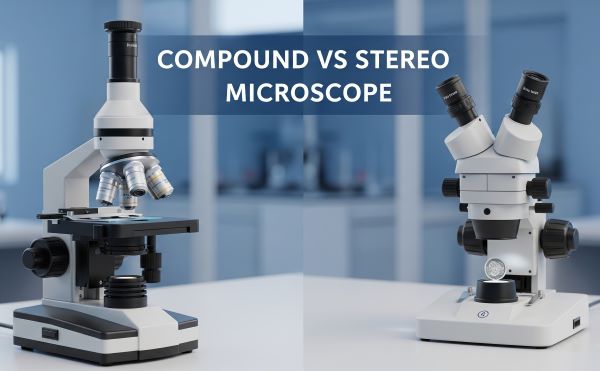
A compound microscope represents the classic laboratory instrument that most people picture when they hear the word “microscope.” This optical system uses multiple lenses arranged in series to achieve powerful magnification levels that reveal structures invisible to the naked eye.
The term “compound” refers to its lens arrangement. Unlike simple magnifying glasses that use a single lens, these instruments employ objective lenses, eyepieces, and sophisticated illumination systems working together to produce high-resolution images.
Light travels through your specimen from below, passes through the objective lens for initial magnification, then continues through the eyepiece for additional magnification. This two-stage magnification process creates the impressive total magnification that makes cellular structures visible.
The illumination system underneath the stage provides controlled lighting that passes through the specimen. Modern compound microscopes typically feature LED lights with adjustable brightness controls for optimal specimen contrast.
The compound microscope function relies on transmitted light, meaning light passes through transparent or semi-transparent specimens. This is why samples must be extremely thin for effective viewing.
Understanding the essential components helps you operate these instruments effectively:
Objective lenses mount on a rotating turret, typically offering 4x, 10x, 40x, and 100x magnifications. These lenses determine your primary magnification level and working distance.
Eyepieces provide secondary magnification, usually 10x power. Total magnification equals objective power multiplied by eyepiece power.
Stage mechanics include specimen clips and sometimes mechanical controls for precise positioning. Higher-end models feature graduated mechanical stages for exact measurements and controlled specimen movement.
Focus controls consist of coarse and fine adjustment knobs. Coarse adjustment moves the stage dramatically for initial focusing, while fine adjustment provides precision refinement.
Standard compound microscope systems offer four primary magnification levels:
Professional models may extend beyond 1000x, but practical limitations of visible light restrict useful magnification to approximately 1500x maximum regardless of the magnification numbers advertised.
Stereo microscopes, also known as stereomicroscopes or dissecting microscopes, provide a fundamentally different viewing experience. These instruments excel at examining larger, opaque objects with remarkable depth perception and three-dimensional visualization.
The key difference lies in the dual optical paths. Stereo microscopes create separate images for each eye, which your brain combines to produce natural three-dimensional perception of the specimen.
Two independent optical systems capture slightly different viewing angles of your specimen. Your brain interprets these offset images as depth, creating the 3D visualization that makes these instruments so valuable for manipulation tasks.
The dual objective lenses sit at angles to each other, typically separated by 10-15 degrees. This angular separation generates the stereoscopic effect that gives these microscopes their name.
Illumination comes from above (incident light) rather than below. This top-lighting system illuminates opaque specimens effectively, unlike the transmitted light systems found in compound models.
Dual eyepieces require proper interpupillary distance adjustment. Most models allow 55-75mm spacing to accommodate different users comfortably.
Zoom mechanisms on advanced models provide continuous magnification adjustment rather than fixed objective positions. This smooth zooming capability enhances workflow efficiency during specimen examination.
Working distance represents the space between your specimen and objective lenses. Stereo microscopes offer generous working distances (often 50-150mm) that allow tool manipulation while observing.
Boom stands on professional models provide flexible positioning options. The microscope head mounts on adjustable arms for optimal viewing angles and specimen access.
Standard stereo microscope magnification spans much lower ranges than compound systems:
Higher magnifications become impractical due to reduced working distance and depth of field limitations inherent in stereo optical design.
Understanding the differences between compound and stereo microscopes requires examining five critical specification areas that directly impact your user experience and work outcomes.
Compound microscopes deliver dramatically higher magnification capabilities. Standard laboratory models reach 1000x total magnification, with research-grade systems extending to 1500x practical limits.
Stereo microscopes operate in much lower ranges, typically maxing out around 50x total magnification. This limitation stems from their 3D optical design and larger working distances required for specimen manipulation.
This magnification gap reflects fundamentally different intended purposes. Compound systems target microscopic detail resolution, while stereo models prioritize specimen manipulation and natural 3D visualization.
Working distance dramatically affects your ability to handle specimens and use tools during observation:
| Microscope Type | Working Distance | Practical Impact |
|---|---|---|
| Compound | 0.13mm – 4mm | Extremely close, no manipulation |
| Stereo | 20mm – 150mm | Comfortable tool access |
Compound microscope working distances force specimens extremely close to objective lenses. This proximity prevents any manipulation during observation and requires careful focusing technique.
Stereo microscope generous working distances accommodate tweezers, soldering irons, probes, and other tools. You can actively work on specimens while maintaining clear visualization.
The viewing experience differences fundamentally change how you interact with specimens:
Compound microscopes provide single optical paths split between both eyes. Both eyes see identical images, creating 2D visualization with exceptional detail resolution but no depth perception.
Stereo microscopes feature independent optical paths for each eye. The slightly different angles create natural depth perception identical to normal binocular vision in everyday life.
The 3D effect makes specimen navigation intuitive. You can gauge distances, understand spatial relationships, and manipulate objects with natural hand-eye coordination.
Preparation requirements significantly impact workflow efficiency and accessibility:
Compound microscopes demand extensive specimen preparation. Samples must be thin enough for light transmission, often requiring sectioning, staining, and slide mounting before viewing.
Stereo microscopes accept specimens directly without preparation. Simply place objects on the stage and begin observation immediately, with no slide mounting required.
This preparation difference explains why stereo models excel for quick inspections while compound systems suit detailed analytical work that requires extensive specimen preparation.
Lighting approaches optimize viewing for different specimen types:
Transmitted illumination in compound systems passes light through specimens from below. This method reveals internal structures in transparent samples effectively.
Incident illumination in stereo systems reflects light off specimen surfaces from above. This approach works perfectly with opaque objects that block transmitted light.
Some advanced stereo models offer both illumination options for maximum versatility across different specimen types.
Forum discussions and user questions consistently reveal confusion about digital microscopes as a category. Many buyers do not realize that a third option exists that may better suit their needs in certain situations.
Digital microscopes replace traditional eyepieces with camera sensors that display images on monitors or screens. This fundamental difference creates distinct advantages and disadvantages compared to both compound and stereo options.
Digital microscopes use electronic image sensors (CMOS or CCD) to capture specimen images and display them on screens. Some models resemble traditional microscopes with screen displays, while others are handheld devices that connect to computers or monitors via USB.
The magnification range varies widely across digital microscope models, from 10x to 1000x depending on the design and sensor quality. Higher-end digital microscopes can match or exceed traditional compound magnification.
Shared viewing: Multiple people can observe simultaneously on a monitor, making digital microscopes excellent for teaching environments and team inspections.
Image capture: Built-in recording and screenshot capabilities enable documentation without additional equipment. This proves invaluable for quality control, forensic work, and educational settings.
Ergonomics: Viewing on a screen eliminates the neck strain and eye fatigue associated with traditional eyepiece use, particularly beneficial for extended inspection sessions.
Desk space: Many digital models, especially handheld versions, require minimal space compared to traditional microscope setups.
Forum discussions reveal that electronics repair professionals frequently debate digital versus stereo microscopes for soldering work. Each approach offers distinct benefits.
Stereo microscope advantages for electronics: Superior optical quality, true 3D perception, and no image lag provide the most natural viewing experience for precision soldering and component work.
Digital microscope advantages for electronics: Easier documentation of work, better sharing capabilities for remote guidance, reduced physical strain from awkward postures, and lower cost for equivalent magnification.
For hobbyists and professionals choosing a microscope for electronics repair, the decision often comes down to whether they prioritize optical quality (stereo) or documentation and ergonomics (digital).
Digital microscopes excel in specific scenarios that traditional microscopes handle poorly:
Forum insights and content gaps identified in the research reveal that many users need capabilities from both compound and stereo microscopes but want a single instrument solution. Trinocular microscopes address this need as a hybrid option.
A trinocular microscope adds a third optical path to a traditional compound microscope design. This third port accepts a camera or allows secondary viewing by an additional observer.
The standard binocular viewing remains for primary use, while the trinocular port provides flexibility for photography, videography, or collaborative viewing without removing the traditional eyepieces.
Documentation capability: Attach digital cameras or smartphones to capture images and videos directly through the optical path, creating permanent records of observations.
Simultaneous viewing: Two observers can examine specimens at once, with one using the camera port and another using traditional eyepieces.
Teaching applications: The third port enables connection to projectors or monitors, allowing entire classrooms to view specimens while the instructor works normally.
Professional workflows: Researchers can document findings in real-time without interrupting their examination process.
Some buyers confuse trinocular microscopes with dual-head compound models. The key difference lies in the third port purpose.
Dual-head microscopes have two eyepiece tubes for simultaneous viewing by two people. Both users see identical views through traditional optics.
Trinocular microscopes have two eyepieces plus a dedicated camera port. The camera path is separate from the viewing paths and does not reduce light to the eyepieces when a camera is not attached.
For users specifically needing shared viewing, dual-head models may be more cost-effective. For those needing documentation capability alongside traditional viewing, trinocular designs provide the necessary flexibility.
Sometimes visual explanation helps clarify the differences between microscope types. This comparison video demonstrates the key distinctions in magnification capabilities, viewing experience, and practical applications.
The video above illustrates how compound microscopes reveal cellular details invisible to stereo systems, while stereo microscopes provide the depth perception and working distance that compound models cannot match.
Real-world applications clearly demonstrate when each microscope type provides optimal performance. Understanding these use cases prevents costly purchasing mistakes and ensures you choose the right instrument for your specific needs.
Biological research represents the primary domain for compound light microscope systems. Cell biology, microbiology, pathology, and pharmaceutical research all depend on the high magnification and resolution these instruments provide.
Educational applications in schools, universities, and training facilities rely heavily on compound models. Biology courses examining plant cells, animal tissues, bacteria, and microorganisms need magnifications exceeding what stereo systems can achieve.
Medical diagnostics including blood analysis, tissue examination, and bacterial identification demand compound microscope precision. Hospital laboratories, clinics, and research facilities depend on these instruments daily.
Quality control in pharmaceutical manufacturing uses compound systems for contamination detection, active ingredient verification, and material analysis at the cellular level.
Research applications spanning material science, forensics, environmental testing, and food safety leverage compound microscopes for detailed analytical work requiring high magnification.
Electronics repair and assembly work perfectly with stereo microscope 3D visualization. Circuit board inspection, component placement, and solder joint examination benefit enormously from depth perception during precision work.
Hobbyist collecting including coins, stamps, minerals, fossils, and jewelry relies on stereo models for surface detail examination without specimen damage or preparation requirements.
Manufacturing quality control uses stereo systems for assembly verification, surface defect detection, dimensional measurement work, and precision manufacturing inspection.
Biological dissection and specimen preparation work naturally with stereo microscopes. The dissecting microscope name reflects this traditional educational application for anatomy and botany studies.
Forensic investigation employs stereo models for evidence examination, fiber analysis, tool mark identification, and document examination requiring 3D visualization.
Entomology and natural history work benefit from stereo magnification for insect examination, specimen preparation, and detailed classification work.
Professional environments often maintain both microscope types for comprehensive coverage. Research laboratories, manufacturing facilities, medical practices, and engineering firms commonly invest in multiple instruments for different tasks.
Educational settings typically choose based on curriculum focus. Biology-heavy programs favor compound systems for their ability to show students cellular details, while technology, engineering, and CTE programs often prefer stereo models for practical skill development.
Budget considerations in educational environments sometimes force single-type purchases. Understanding primary use cases helps make optimal choices within financial constraints.
Terminology confusion frequently creates purchasing mistakes. Understanding precise definitions prevents expensive misunderstandings when shopping for microscopy equipment.
Compound microscope and compound light microscope terms refer to identical instruments. Both describe multi-lens optical systems using visible light for specimen illumination through transmission.
The confusion arises because “light microscope” sometimes describes any visible-light system, including stereo models. However, in precise technical usage, compound light microscope specifically indicates the traditional laboratory instrument designed for high-magnification biological work.
Some manufacturers use “biological microscope” as another synonym for compound light microscope, emphasizing their biological research applications in marketing materials.
Biological microscope marketing terminology emphasizes intended applications rather than optical design. These instruments remain compound light microscopes regardless of naming conventions used by different manufacturers.
Clinical microscope represents another marketing variant targeting medical and clinical applications. Again, the underlying technology remains compound light microscope design with high magnification capabilities.
Understanding these naming variations prevents confusion when comparing products across different manufacturers and retailers. The specifications and magnification ranges matter more than the marketing names.
Advanced technical understanding helps optimize performance and prevents purchasing disappointments for serious users. These specifications determine actual capability more than marketing claims.
Numerical aperture (NA) determines resolution capabilities more than magnification numbers alone. Higher NA values provide superior detail resolution at equivalent magnifications.
Compound microscopes achieve NA values from 0.25 for low-power objectives to 1.4 for high-end oil immersion systems. These high NA values enable exceptional resolution performance at cellular levels.
Stereo microscopes typically maintain NA values between 0.1-0.3 due to longer working distances and 3D optical requirements. Lower NA values limit fine detail resolution but enable the stereo effect.
Resolution calculations follow the formula: Resolution = 0.61 × wavelength / NA. This relationship explains why compound systems resolve much finer details despite using the same visible light spectrum.
Working distance directly correlates with numerical aperture through fundamental optical physics. Higher NA objectives require shorter working distances for optimal performance.
Compound microscope 100x oil immersion objectives often provide working distances under 1mm. This extreme proximity enables maximum resolution but prevents any specimen manipulation during viewing.
Stereo microscope objectives sacrifice NA for working distance, typically maintaining 50-100mm spacing. This trade-off enables manipulation while reducing fine detail resolution.
Depth of field also correlates with working distance. Longer working distances provide greater depth of field, making stereo models more forgiving for thick specimens and enabling clear focus across varying heights.
Single optical path systems in compound microscopes create identical images for both eyes through a shared optical tube. This design maximizes light efficiency and resolution performance.
Dual optical path systems in stereo microscopes reduce light efficiency but enable 3D visualization. Each eye receives a slightly different image angle through separate optical tubes.
Prism systems in stereo models manage the dual optical paths effectively. Quality prism design significantly affects image clarity, color accuracy, and the quality of the 3D effect.
Parfocal design in compound systems maintains focus when changing between different objective lenses. This feature dramatically improves workflow efficiency during magnification changes.
Smart purchasing requires balancing budget constraints with essential feature requirements. Understanding price-performance relationships prevents overspending on features you will not use or under-purchasing equipment that cannot handle your actual needs.
Student compound microscopes in this range provide basic functionality suitable for educational use. Expect 40x-400x magnifications with simple LED illumination and basic mechanical features.
Starter stereo microscopes offer fixed magnifications (typically 20x and 40x) with basic top-lighting. These models suit hobbyist applications and light educational use without demanding professional performance.
Essential features at this price point include sturdy construction, clear glass optics, and reliable focus mechanisms. Be cautious of models advertising excessive magnifications beyond their optical capabilities.
Recommended specifications:
Laboratory-grade compound microscopes feature superior optics, mechanical stages with graduated controls, and advanced illumination adjustment capabilities. Professional applications benefit from these enhanced specifications.
Zoom stereo microscopes provide continuous magnification adjustment from 7x-45x typically. This flexibility dramatically improves workflow efficiency when examining varied specimen sizes.
Enhanced features include:
Research compound microscopes offer exceptional optical performance with specialized capabilities including phase contrast, darkfield, fluorescence, and digital integration options.
Professional stereo systems feature advanced zoom ranges, modular accessories, precision measurement capabilities, and documentation integration for industrial applications.
Premium features:
Must-have features directly impact basic functionality and should be prioritized in any budget:
| Feature Type | Compound Must-Haves | Stereo Must-Haves |
|---|---|---|
| Optics | Glass lenses, anti-reflection coatings | Matched objective lens pairs |
| Mechanics | Smooth focus, stable stage | Interpupillary adjustment range |
| Illumination | Variable intensity LED | Even illumination pattern |
Nice-to-have upgrades enhance convenience without affecting core performance:
Learning from others’ purchasing mistakes saves significant money and disappointment. These errors trap most first-time buyers and can be easily avoided with proper information.
“Higher magnification is always better” represents the most costly mistake that buyers make. Many choose microscopes based purely on maximum magnification numbers advertised on packaging.
Empty magnification beyond optical limits produces larger but progressively blurrier images. A quality 400x compound microscope from a reputable manufacturer consistently outperforms a cheap model claiming 1000x or 2000x magnification.
Practical magnification limits:
Solution: Focus on optical quality, reputation of the manufacturer, and intended applications rather than maximum magnification specifications.
Insufficient working distance frustrates users who need specimen manipulation capabilities. This mistake particularly affects electronics workers, biological dissection users, and anyone who needs to use tools while viewing.
Compound microscope buyers sometimes expect manipulation space but receive instruments with sub-millimeter working distances that make any tool use impossible.
Stereo microscope buyers may choose models with inadequate working distances for their intended tools and largest specimens.
Solution: Identify your largest specimens and required tool clearances before purchasing. Add 20-30mm safety margin to your calculations.
Specimen preparation capabilities often get overlooked until after purchase. Compound microscopes require thin, transparent specimens that many users cannot prepare effectively without specialized training.
Opaque specimen needs lead some buyers toward compound microscopes when stereo models would serve them far better for their actual applications.
Mixed specimen requirements sometimes demand both microscope types, but buyers often attempt single-instrument solutions that cannot handle all their needs.
Solution: List all intended specimen types and required preparation methods before comparing microscope options. Be honest about your ability to prepare specimens.
Proper maintenance extends microscope lifespan significantly and maintains optical performance over years of use. These professional techniques prevent costly repairs and replacements.
Optical cleaning requires specific techniques to prevent lens damage. Use only lens-grade cleaning papers and optical cleaning solutions designed specifically for microscope optics.
Daily maintenance:
Weekly maintenance:
Monthly maintenance:
Blurry images often result from dirty optics rather than focus problems. Clean all optical surfaces systematically before adjusting focus mechanisms or assuming mechanical issues.
Uneven illumination typically indicates dirty or misaligned light sources. LED systems rarely fail but may require cleaning or repositioning to restore even lighting.
Mechanical binding in focus or stage controls usually needs lubrication rather than force. Never force stuck mechanisms; consult service manuals or professional technicians.
Color problems in stereo microscopes often indicate prism misalignment requiring professional service. Avoid attempting optical realignment without proper training and tools.
Environmental control significantly affects instrument longevity. Maintain stable temperature and humidity levels in storage areas to prevent condensation and mold issues.
Usage protocols prevent unnecessary wear and extend useful life:
Professional servicing every 2-3 years maintains optimal performance. Qualified technicians can address developing issues before they become expensive problems.
Upgrade planning allows systematic improvements rather than emergency replacements. Plan accessory additions and capability expansions based on actual usage experience.
No, compound microscopes cannot replicate stereo microscope functionality effectively. The fundamental optical differences prevent 3D visualization and severely limit working distances. Compound microscopes provide single optical paths that both eyes share, eliminating depth perception essential for stereo work. Working distance limitations in compound systems prevent specimen manipulation during observation, with most objectives providing less than 4mm clearance. If you need 3D visualization and manipulation capabilities, a stereo microscope or trinocular hybrid is required.
Stereo microscopes generally provide better beginner experiences due to simpler operation and immediate specimen access without slide preparation requirements. Age-specific guidance suggests children under 10 often prefer stereo models for examining familiar objects like coins, insects, and leaves. Teenagers and adults studying biology formally benefit from compound microscopes despite the steeper learning curve. For a microscope for beginners, stereo models reduce frustration with preparation requirements and allow immediate engagement with interesting specimens.
Application-specific requirements vary significantly. For cell examination, bacteria viewing, and detailed biological work, you need 400x-1000x magnification from a compound microscope. For electronics repair, coin collecting, dissection, and surface inspection work, 10x-40x magnification from a stereo microscope suffices. Larger specimens like insects, circuit boards, and gems typically require lower magnifications, while cellular work demands higher powers. Match your microscope type to specimen size first, then consider magnification requirements within that category.
Stereo microscopes cannot effectively view individual cells or bacteria due to magnification and resolution limitations inherent in their optical design. Maximum useful magnification in stereo systems rarely exceeds 50x, which is insufficient for cellular detail resolution. Individual cell viewing requires minimum 400x magnification with high numerical aperture objectives available only in compound microscope systems. For cellular work, a compound microscope is essential regardless of how the stereo microscope is configured.
Stereo microscopes typically do not require slides for specimen mounting. Objects can be placed directly on stages or specimen platforms without any preparation. This direct placement represents one of stereo microscopy major advantages, allowing specimens to retain natural 3D structure without flattening. Some stereo models offer optional transmitted light capabilities for viewing prepared slides, but this is not required for standard operation. Specimen holders and stage accessories can improve positioning for specific applications.
Stereomicroscope and stereo microscope are identical terms referring to the same type of instrument. Both describe microscopes that provide three-dimensional viewing through dual optical paths. The terms are used interchangeably in scientific literature, manufacturer marketing, and common usage. Some users prefer stereomicroscope as the more formal or complete term, while stereo microscope offers a shorter alternative. Both refer to instruments designed for examining larger specimens with depth perception and generous working distances.
After examining technical specifications, applications, and real-world considerations, your microscope choice ultimately depends on matching capabilities to your intended uses. The decision framework below helps you evaluate your specific situation.
Primary specimen types:
Required capabilities:
User experience and age considerations:
Budget and space constraints:
Setup and calibration require careful attention to manufacturer instructions. Proper initial setup prevents future problems and ensures optimal performance from day one.
Training investment pays significant dividends in instrument performance and longevity. Consider formal training programs or detailed tutorial resources available for your specific model.
Accessory planning should begin immediately after purchase. Stage accessories, lighting options, and measurement tools enhance capabilities significantly for specialized applications.
Maintenance scheduling from day one prevents costly repairs and maintains performance. Establish cleaning routines and service intervals early in your microscopy journey.
Whether you choose a compound vs stereo microscope, both instrument types open fascinating worlds of discovery that reveal details invisible to the naked eye. The key lies in matching capabilities to your specific needs, budget, and experience level. With this comprehensive guide updated for 2026, you are equipped to make an informed decision that provides years of productive use and exploration.
For those needing documentation capabilities alongside visual examination, remember that trinocular microscopes offer hybrid functionality. For teaching environments or team settings, digital microscopes provide valuable shared viewing experiences. Start with your primary application, verify critical specifications match your needs, and invest in quality optics that will serve your requirements for years to come. The microscopic world awaits your exploration.
Ready to explore further? Understanding the differences between compound vs stereo microscopes is just the beginning. Consider what specimens you will examine most often, whether you need documentation capabilities, and how much time you can dedicate to specimen preparation. These factors, combined with your budget and workspace constraints, will guide you to the perfect microscope for your situation.
If you found this guide helpful, share it with others who might be navigating the same decision-making process. The right microscope can inspire a lifelong passion for science and discovery.
This article was last updated in 2026. Technical specifications and price ranges are subject to change. Always verify current availability and specifications with manufacturers before making purchase decisions.
![Best Camping Lanterns [cy]: 11 Models Tested & Reviewed](https://revellphotography.com/wp-content/uploads/2026/09/featured-update-2472-1789318388981.jpg)
![Best Monopods [cy]: Complete Guide](https://revellphotography.com/wp-content/uploads/2026/09/featured-update-3173-1789318229357.jpg)
![Best USB Microscope [cy]: 10 Models Tested & Reviewed](https://revellphotography.com/wp-content/uploads/2026/09/featured-update-8385-1789318155481.jpg)