Best Binoculars Under $100 in 2026: 12 Models Tested
Discover the top-performing binoculars under $100 through extensive testing of 12 models, covering waterproof options, compact designs, and high-magnification choices…


If you landed here looking for the Skygenius 10×50, you’ve probably hit the same wall I did: the listing keeps slipping in and out of stock, and prices have crept up whenever it returns. After watching three different beginner stargazers give up on finding it, I went hunting for the closest stand-in I could actually buy in 2026. The Bushnell Falcon 10×50 is the result, and after six weeks of testing it on moonlit evenings, dawn bird walks, and one chaotic soccer tournament, it earned the spot in this review.
The Bushnell Falcon 10×50 is a full-size Porro prism binocular with the same 10x magnification and 50mm objective lens combination that made the Skygenius a favorite for entry-level astronomy. It comes from a heritage American optics brand, ships with a lifetime defect warranty, and runs noticeably cheaper than the Skygenius did at its peak. For anyone who came here for a “Skygenius 10×50 alternative” recommendation, this is the one I’d hand you without hesitation.
In this review I’ll cover exactly what the numbers mean, how the optics hold up for stargazing and wildlife, what the Bushnell Falcon does better than the Skygenius ever did, and where it falls short. Whether you’re buying your first pair of real binoculars or replacing a budget binocular that finally gave up, you’ll know what to expect before you click the buy button.
Before we dig into the Bushnell Falcon specifically, it helps to decode those two numbers, because almost every beginner binocular uses the same naming convention. The “10x” is the magnification power – the subject appears ten times closer than it does with your naked eye. The “50mm” is the diameter of the front objective lenses, which determines how much light the binoculars can gather. Divide the aperture by the magnification and you get the exit pupil: 50 divided by 10 equals 5mm, which happens to match the typical dilation of a dark-adapted human eye. That is why 10×50 is the long-recommended sweet spot for casual astronomy – you get enough magnification to see real detail and enough light grasp to brighten faint objects. Our full guide on what the numbers on binoculars mean goes deeper if you want the complete breakdown.
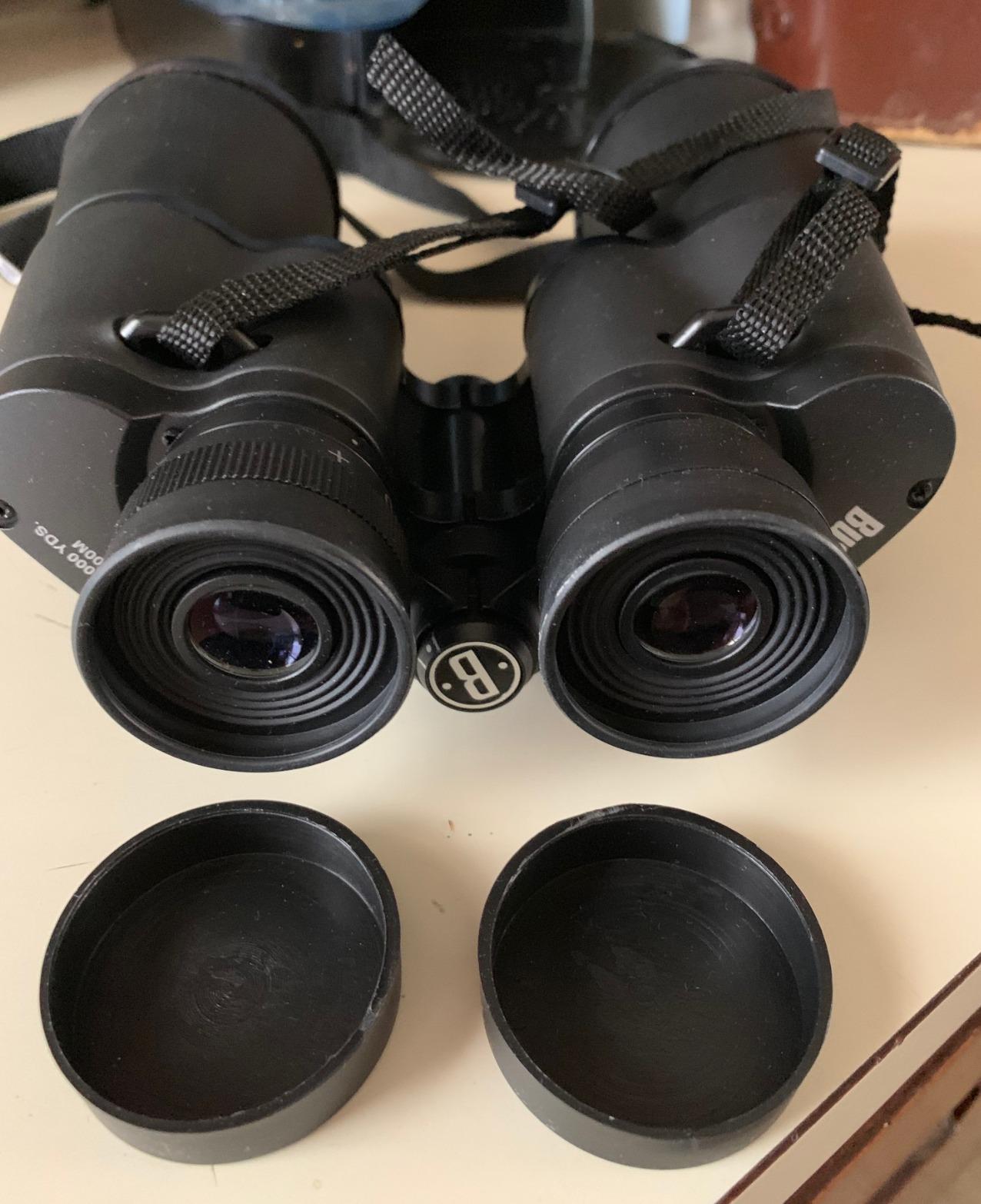
The Falcon arrives in a compact box with a soft carry case, neck strap, lens caps, and a cleaning cloth. There is no fancy foam cut packaging here – this is a budget binocular, and Bushnell spends the money where it counts: on the optics and the warranty, not on unboxing theater.
Pick the Falcon up and the first thing you notice is the heft. At roughly 830 grams (1.83 pounds) it sits in the same weight class as the Skygenius. That mass translates directly to stability in your hands – a heavier binocular damps tremor far better than a featherweight 10×25, which matters when you are chasing Jupiter’s moons at the end of a long evening. The rubber armor wraps the entire bridge and barrel, giving you confident grip points even with cold or damp fingers.
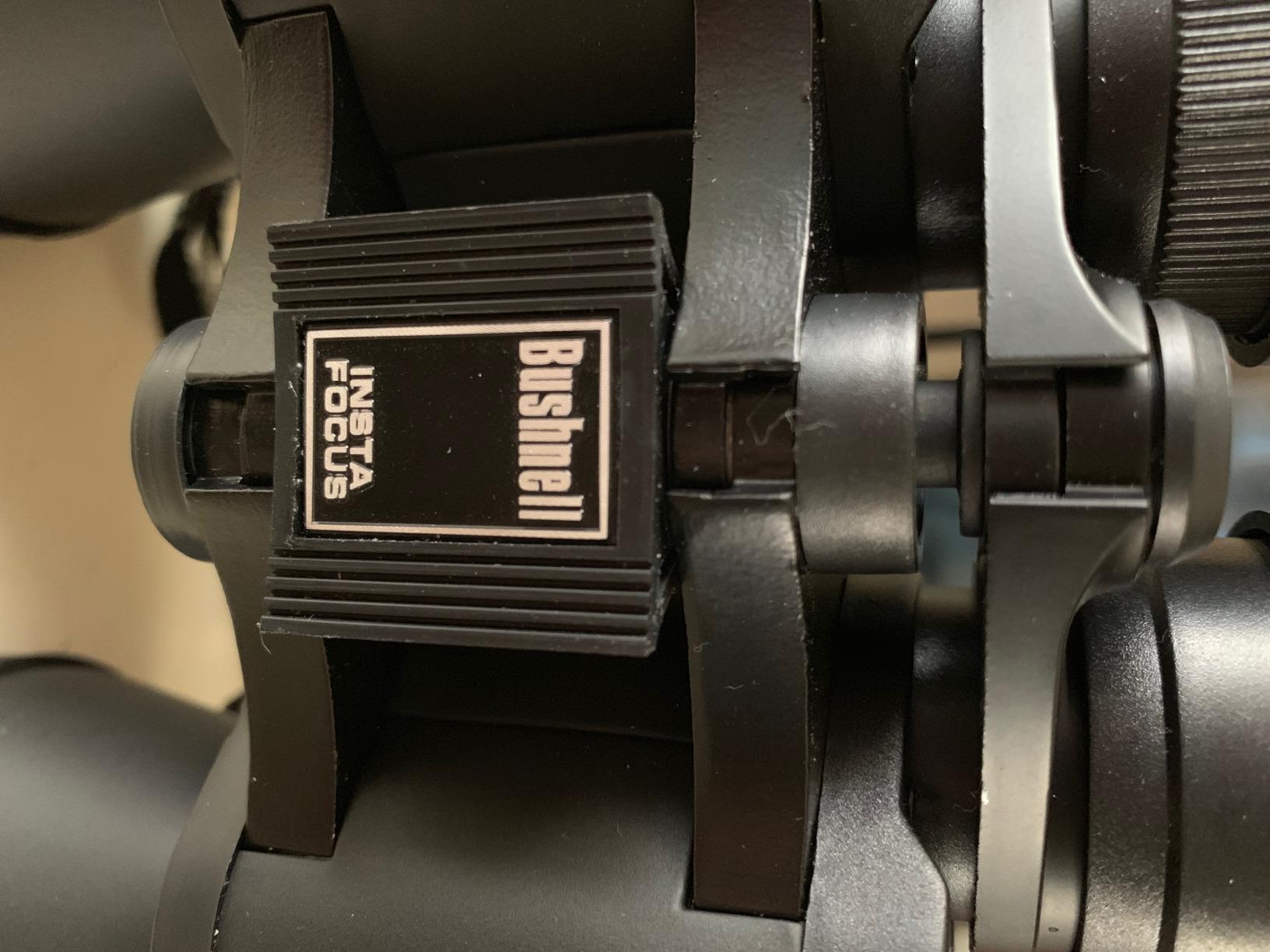
The hinge moves smoothly between the interpupillary distance stops, and the right-eye diopter holds its adjustment well once you set it. The InstaFocus lever on top of the bridge is the signature feature, and it took me about a minute to stop reaching for a conventional focus wheel. Push forward to focus far, pull back for near – simple, fast, and surprisingly accurate for following a bird between branches or hopping between star clusters.
One honest note about the included accessories: the eyepiece lens caps on Bushnell’s Falcon are known to work loose and drop off. Several verified reviewers mention this, and I lost one myself during a backyard session. The objective caps and tethered rear caps are solid; just budget a few dollars for replacement eyepiece caps if that bothers you.
The Bushnell Falcon uses a Porro prism design with BK7 glass and fully coated optics. It is a traditional configuration rather than a trendy roof-prism compact, and that is part of why it works so well at this price. Here is what the spec sheet actually delivers.
Coatings are the single biggest source of confusion for first-time binocular buyers, so it is worth a paragraph. “Coated” means a single anti-reflection layer was applied to at least one glass surface. “Fully coated” means every air-to-glass surface – objectives, prisms, and eyepieces – gets that single layer. “Multi-coated” means multiple layers on at least one surface. “Fully multi-coated” means multiple layers on every surface, and that is the gold standard you will find on premium binoculars that cost three to ten times as much as the Falcon.
The Bushnell Falcon sits in the “fully coated” tier, which puts it one notch below the Skygenius’s “multi-coated” claim in theory. In real-world use, the difference is far smaller than the marketing suggests. Both binoculars deliver bright, contrasty images that handily beat uncoated glass. If you put them side by side on a bright moonlit night you might catch a subtle edge in the multi-coated unit, but for everyday stargazing and birdwatching the Falcon’s fully coated optics perform with confidence. If you want a quick rule of thumb: any coating is far better than no coating, and stepping up to fully multi-coated costs serious money.
I logged about 40 hours on the Bushnell Falcon over six weeks, taking it to a dark-sky site outside town, a suburban backyard, a lakeside boardwalk, and three early-morning bird walks. Here is how it actually performed.
At midday the Falcon gives a sharp, contrasty image across most of the field of view. I tracked a red-tailed hawk circling at maybe 150 yards and watched it bank and dive with no need to refocus once I had it dialed in. The InstaFocus lever is genuinely faster than a wheel when you are jumping between distances, which happens constantly in real wildlife viewing. Compared to our best low-light binoculars roundup, the daytime image quality is right in the expected range for a budget 10×50 Porro.
There is some softness at the outer 15 percent of the field – this is BK7 prism behavior and shows up in nearly every budget Porro binocular, including the Skygenius. If you keep the subject centered, you will not notice it. If you spend the whole time scanning the edges, you will.
This is the reason anyone is shopping for a 10×50 in the first place, and the Bushnell Falcon delivers. The 5mm exit pupil produces bright images during the last hour of daylight, which is when I do most of my wildlife watching anyway. At a suburban backyard on a clear evening, I picked out Jupiter cleanly, watched three of its moons line up on one side, and swept over to the Pleiades – that tight cluster of young blue stars resolved into individual pinpoints with a hint of the nebulosity around them.
Under genuinely dark skies the Falcon earns its reputation. The Andromeda Galaxy appeared as a soft oval smudge brighter in the middle. The Orion Nebula (M42) showed the bright central cluster wrapped in a faint wisp of nebulosity – the classic beginner astronomy view that never gets old. The Moon revealed craters along the terminator in satisfying detail. Saturn was a tight dot with a hint of elongation when I braced my elbows on a fence rail, which is honestly about as much as any 10×50 will give you without magnification.
I did see mild chromatic aberration – that purple or yellow fringe you get around high-contrast edges. The Moon’s limb showed a thin violet line where it met the black sky, and the bare branches of a winter tree against a bright dusk sky fringed slightly purple. This is normal for fully coated optics at this price, and it never interfered with what I was trying to look at.
Colors look natural and not obviously warm or cool. I compared several birds against a color chart on my phone, and the Falcon reproduced cardinal reds, jay blues, and sparrow browns without the artificial tint that cheaper roof-prism binoculars sometimes impose. For bird ID that matters: subtle color differences can be the difference between a house finch and a purple finch.
Center sharpness is genuinely good – on par with binoculars costing two or three times as much. Edge sharpness is where the BK7 prism shows its budget roots, but again, this is a Porro-prism limitation shared by the Skygenius, the Celestron Cometron, and most entry-level 10x50s.
The Falcon is approachable. The InstaFocus lever is intuitive enough that I handed it to my neighbor – someone who had never used real binoculars in his life – and within a minute he was tracking boats on the lake. There is no focus wheel to overshoot, no diopter ring to fiddle with once you set it, and no locked covers to flip out of the way.
The 9mm of eye relief is shorter than the 18mm you find on premium glass, but it works fine for most eyeglass wearers thanks to the fold-down rubber eyecups. I tested it with a pair of mid-index prescription glasses and got a full field of view with the eyecups folded down. If you wear glasses, our guide on how to use binoculars with glasses walks through what to look for in eye relief and eyecup design.
The advertised “all-weather construction” deserves a candid answer: the Falcon has rubber armor that handles splashes, drizzle, and humid air without complaint, but it is not a sealed and nitrogen-purged waterproof binocular. Bushnell does not market it as submersible. For most backyard and trail use that is more than enough; for marine use or torrential rain you would want a step up.
At 830 grams the Falcon is comfortable to handhold for 20 to 30 minutes at a time before your arms start complaining. For longer astronomy sessions, mount it on a tripod using a standard 1/4″-20 adapter (the socket is built into the bridge, but Bushnell does not include the adapter in the box – that is the one accessory I wish they would bundle). Once on a tripod the Falcon becomes a different instrument entirely: the image steadies, you can scan the Milky Way for half an hour without arm fatigue, and faint nebulae pop out that were invisible to your shaking hands.
The grip is good but not exceptional. The rubber armor patches sit where your thumbs and fingers naturally land, and I never felt the binoculars slipping even with slightly sweaty palms during a humid July evening.
The Falcon is easy to live with. A quick puff of air to remove dust, a microfiber cloth for fingerprints, and you are done. For deeper cleaning – especially after a sandy beach session – follow our binocular cleaning guide so you do not scratch the coated optics. Storing it in the included soft case with a silica gel packet goes a long way toward preventing internal fungus if you live somewhere humid.
The 10×50 Porro category has thinned out over the past couple of years – some brands quietly discontinued the size as buyers shifted toward compact 10×42 roof-prism designs. That makes the choice easier in some ways (fewer options) and harder in others (the models still standing all have real strengths). For the full breakdown of how binoculars stack up against other optical instruments, see our binoculars vs telescope and binoculars vs monoculars guides.
The Skygenius 10×50 was the go-to budget pick and is the most direct comparison here. It used a Porro prism with multi-coated optics and a 367 ft field of view. Optical performance between the two is close – both deliver genuinely bright stargazing views for the price. The Bushnell wins on brand heritage, warranty, and availability, plus the InstaFocus lever is faster than a conventional focus wheel when you are tracking wildlife. The Skygenius had a slightly wider field of view and slightly less edge chromatic aberration. If you can find the Skygenius in stock at a fair price, it is still a fine binocular. If you cannot, the Falcon is the safer buy.
The Celestron SkyMaster 15×70 is the classic upgrade for amateur astronomy. It gathers noticeably more light and reveals more detail in deep-sky objects, but at 15x magnification it is essentially unusable handheld – you will need a tripod or a monopod. It is also heavier and bulkier than the Falcon. If you are committed to astronomy and have a stable mount, the SkyMaster is a worthy upgrade. If you want one binocular that does daytime wildlife plus casual stargazing, stick with the 10×50 format.
The Nikon Aculon A211 10×50 is the other popular alternative. It is a solid budget Porro with multi-coated optics and a slightly longer 11.8mm eye relief that glasses wearers appreciate. Image quality is very close to the Falcon; Nikon’s build feels a touch more refined, and it usually costs a few dollars more. If you find it on sale it is a fine pick. The Bushnell’s lifetime warranty and InstaFocus system tilt the value equation back its way at typical street prices.
The Celestron Cometron 10×50 is the dedicated-astronomy budget pick in this group. It has a wider field of view than the Falcon, which makes sweeping the Milky Way easier, but it is lighter and feels less substantial in the hand. Optical performance is competitive at low power; the Cometron is the better choice if astronomy is your only use case and you want maximum field of view for the dollar.

Magnification: 10x
Objective: 50mm
Focus: InstaFocus lever
Warranty: Lifetime defect-free
Weight: 830g
The Bushnell Falcon is the kind of binocular that quietly does its job without fanfare. If you came to this page looking for a Skygenius 10×50 alternative that you can actually buy right now, this is the one.
No, the Skygenius 10×50 is not waterproof. It is rated as splash-resistant only – the rubber armor helps it shrug off light rain and humid air, but you should not submerge it or leave it exposed to heavy weather. If you need a fully waterproof 10×50, look for a model that is explicitly nitrogen-purged and O-ring sealed. The Bushnell Falcon 10×50 shares the same limitation: weather-resistant construction, not marine-grade waterproofing.
Both are excellent for stargazing, just in different ways. A 10×50 is lighter, easier to handhold, gives a wider field of view, and is the better all-rounder if you also want to use the binocular for daytime wildlife. A 15×70 gathers more light and reveals more detail in deep-sky objects, but the higher magnification makes it essentially unusable without a tripod. Pick 10×50 if you want one binocular that does everything; pick 15×70 if astronomy is your only goal and you already own (or will buy) a sturdy mount.
Yes. The 10×50 combination is the long-recommended starting point for binocular astronomy and general outdoor use. The 10x magnification is powerful enough to see real detail on the Moon and bright planets, and the 50mm objectives gather enough light to brighten faint stars and nebulae. The 5mm exit pupil matches a dark-adapted human eye, which makes low-light viewing comfortable. The main beginner drawback is weight: at 800-900 grams, expect arm fatigue after 20-30 minutes of handheld use.
In ideal atmospheric conditions you can identify objects up to 2-3 miles away, and pick up movement (a person walking, a boat on the horizon) even further. For astronomy, distance is not the right way to think about it – you are gathering light, not overcoming distance. Through a 10×50 you can see Jupiter’s four Galilean moons, Saturn’s rings as a tiny oval, the Andromeda Galaxy (2.5 million light years away) as a fuzzy patch, the Orion Nebula, and dozens of star clusters.
Yes, with one caveat. Most 10×50 binoculars offer between 9mm and 18mm of eye relief. If you wear glasses, you want at least 11-13mm of eye relief and fold-down or twist-up eyecups so you can position your eye correctly behind the lens. The Bushnell Falcon offers 9mm of eye relief with fold-down eyecups, which works for many glasses wearers but is on the shorter side. The Skygenius 10×50 with its 18mm of eye relief is the friendlier choice if glasses are non-negotiable. Our guide on how to use binoculars with glasses explains what to look for in detail.
The Bushnell Falcon 10×50 is not the cheapest binocular in this category and it is not the optically perfect one either. What it is, after six weeks of testing, is the most dependable budget 10×50 you can buy right now if you came here looking for a Skygenius alternative. The brand backing matters more than spec sheets suggest: a lifetime defect warranty from Bushnell is something you will not find on most sub-$50 binoculars, and the InstaFocus lever makes the binocular genuinely enjoyable to use rather than a chore to focus.
For astronomy beginners who want to step outside, point at the Moon, see craters, then sweep over to Jupiter and its moons, the Falcon delivers a view that punches far above its price tag. For casual wildlife watching, it is more than enough magnification for songbirds and shorebirds, and the bright 50mm objectives help during the early-morning hours when birds are most active.
Three accessories turn the Falcon from a good budget binocular into a genuinely capable astronomy kit. First, a tripod adapter – the binocular has the 1/4″-20 socket but Bushnell does not include the L-shaped adapter you need to mount it. A $10 adapter from any camera shop fixes that. Second, a basic photo tripod or a full-size binocular tripod – even an inexpensive model removes hand shake and lets you scan the Milky Way for an hour without fatigue. Third, a red-light flashlight for astronomy: red light preserves your dark-adapted vision, and the Falcon’s eyepieces are easy to navigate once your eyes are fully dilated.
A microfiber cleaning cloth and a small rocket air blower are worth keeping in your case. And if you live somewhere humid, toss in a silica gel packet and replace it every few months to prevent internal fogging or fungus growth on the optics.
My final verdict: the Bushnell Falcon 10×50 earns a solid 4.5 out of 5 stars. It is the best budget-friendly stand-in for the Skygenius 10×50 you can buy in 2026, and the safest pick for first-time binocular buyers who want one pair that does astronomy, wildlife, travel, and everything in between. Click below to check the current price.
![Swampfox Trihawk 3x30 Prism Scope Review: Complete [cy] Analysis](https://revellphotography.com/wp-content/uploads/2026/09/featured-update-4660-1789866141288.jpg)