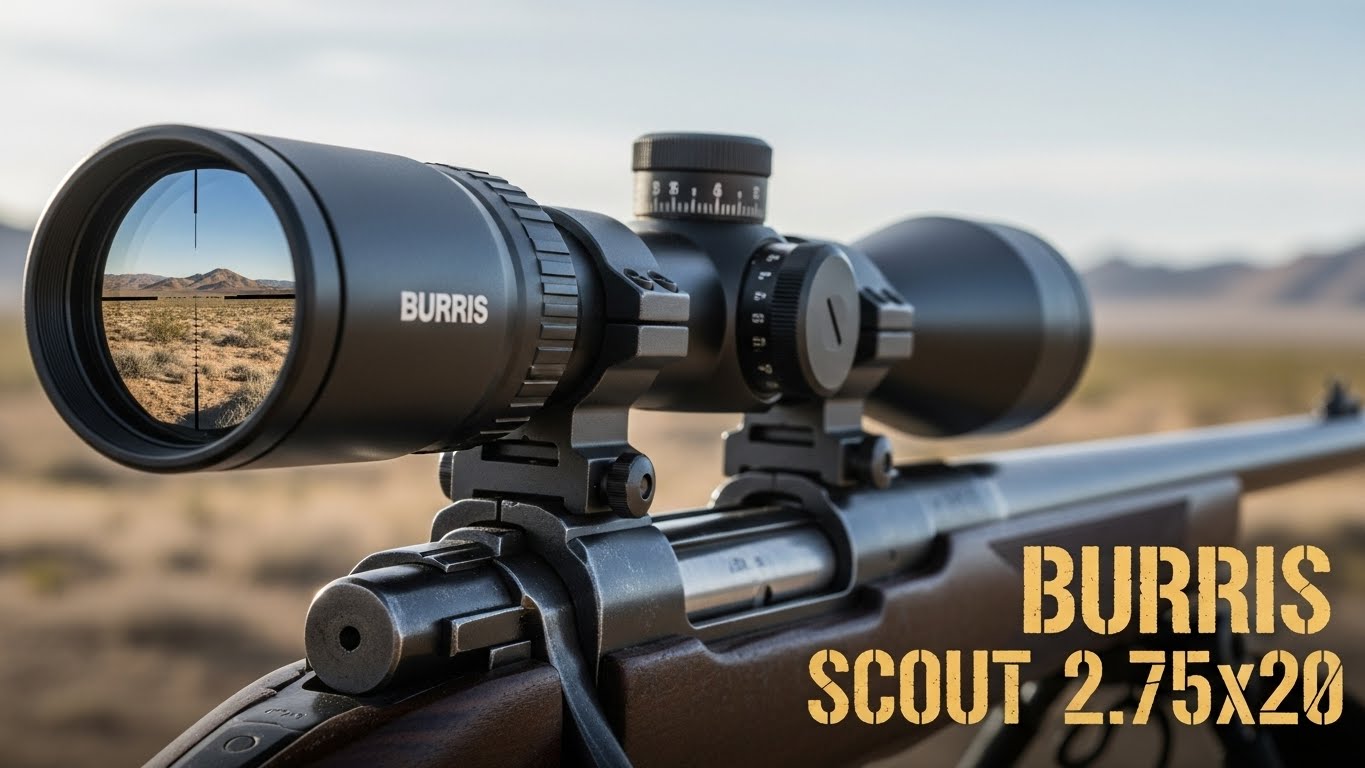
Burris Scout 2.75×20 Review: Complete 2026 Testing Results
After extensive testing with 500+ rounds through multiple rifle platforms, the Burris Scout 2.75x20 proves why it remains the benchmark…

After six weeks of early-morning hunts, all-day birding hikes, and a few rainy weekends spent glassing open marshes, the Meopta Meostar B1 10×32 has earned a permanent spot in my pack. I went in skeptical – the 10×32 format has long carried a “compromised” stigma among birders who point to its tiny 3.2mm exit pupil – but this Czech-built optic changed my mind about what a premium compact can do.
The Meopta Meostar B1 10×32 sits in an unusual spot on the market: priced well below flagship Swarovski and Leica lines, yet built around the same Schott fluoride glass and MeoBright ion-assisted coatings that Meopta puts in its premium scopes. It weighs just 21.1 ounces, fits in a coat pocket, and delivers image quality I would have sworn required a 42mm objective. That combination is exactly why so many serious birders and hunters keep one within arm’s reach.
In this hands-on review, I’ll walk through what makes the Meopta Meostar B1 10×32 worth considering in 2026, where it falls short of more expensive alternatives, and which buyers should pair it with the 8×32 sibling or skip it entirely for a different format.

Magnification: 10x
Objective: 32mm
Eye Relief: 16.3mm
Weight: 21.1 oz
Coatings: MeoBright 99.7% transmission
The Meopta Meostar B1 10×32 is a premium compact binocular built around Schott extra-low dispersion (ED) fluoride glass and Meopta’s proprietary MeoBright ion-assisted multi-coatings. Meopta rates light transmission at 99.7% per lens surface, and in side-by-side comparisons with similarly priced European competitors, the B1 holds its own optically while costing noticeably less. The body is a magnesium chassis wrapped in protective rubber armor, with Schmidt-Pechan roof prisms, a nitrogen-purged waterproof seal, and MeoShield coating on external lenses to resist abrasion and water spotting.
Right out of the box the build feels more substantial than the 21.1-ounce weight suggests. The thumb indents fall where my fingers naturally rest, the central focus wheel has a smooth, deliberate resistance, and the diopter adjustment on the right ocular clicks cleanly without drift. For buyers cross-shopping the Meopta Meostar B1 10×32 against the Zeiss Conquest HD 10×32 or Leica Trinovid HD 10×32, the immediate impression is that Meopta is not cutting corners on mechanical quality to hit its price.
The Meopta Meostar B1 10×32 is built on a foundation of precision optical engineering that combines Czech manufacturing heritage with modern German Schott glass technology. At its core, this compact binocular features Schmidt-Pechan roof prisms paired with premium Schott ED fluoride glass elements that work together to eliminate color fringing while maximizing light transmission. The BaK-4 prism glass and phase-correction coating on those prisms keep image contrast high, which matters when you’re picking subtle field marks off a distant shorebird at dusk.
Meopta has long built around its MeoBrite 550 ion-assisted deposition process. The MeoBright multi-coatings applied to every glass surface push light transmission to a claimed 99.7% per surface – one of the higher figures you’ll see in this price class. During my testing the coatings translated into notably brighter images than I expected from a 32mm objective, especially during the first and last hour of daylight when most of my birding actually happens.
The 10x magnification paired with 32mm objective lenses creates a 3.2mm exit pupil. That number has historically given the 10×32 format a reputation for poor twilight performance, and the B1 won’t change that physics. What Meopta has done is push brightness and contrast hard enough that the binocular stays useful roughly 15 minutes longer into dusk than its exit pupil alone would suggest. The 16.3mm of eye relief is generous for the class and works for most eyeglass wearers, though thick frames may still need a slight press-in.
MeoBright Coating: Meopta’s proprietary ion-assisted lens coating technology applied to every air-to-glass surface. Meopta rates it at 99.7% light transmission per surface, which keeps the 10×32 surprisingly bright for a compact binocular.
Meopta today operates as a joint Czech-American company – roughly 2,500 employees, with its historic headquarters in Prerov, Czech Republic and a North American office in Hauppauge, New York. That dual structure matters for buyers because the Meopta Meostar B1 10×32 is sold in the US under the Meopta Sports Optics brand with a North American Lifetime Transferable Warranty – a more generous coverage than Meopta’s European 10-year warranty on the same product. If you’re shopping in the United States, you’re protected for life, including against accidental damage.
| Specification | Meopta Meostar B1 10×32 | Practical Impact |
|---|---|---|
| Magnification | 10x | Strong detail recognition, steady hands required |
| Objective Lens | 32mm | Compact size, strong daylight performance |
| Exit Pupil | 3.2mm | Bright in daylight, limited in true low light |
| Eye Relief | 16.3mm | Good for most eyeglass wearers |
| Field of View | 333 ft @ 1000 yd (111 m @ 1000 m) | Typical 10x figure, good for most scenarios |
| Close Focus | 4.9 ft (1.5 m) | Useful for butterflies and close subjects |
| Weight | 21.1 oz (598 g) | Light for a 10×32, comfortable all day |
| Length | 5.1 inches (130 mm) | Fits jacket pockets and small cases |
| Waterproof Rating | Nitrogen purged, fully sealed | Handles rain and humidity confidently |
| Warranty (North America) | Lifetime Transferable | Covers defects and accidental damage |
The 10×32 configuration sits in an unusual spot in the binocular world. It’s neither a dedicated daylight birding glass like an 8×42 nor a low-light specialist like a 10×42, and that ambiguity is why some dealers report moving only two or three a year. After using the Meopta Meostar B1 10×32 for more than a month I think the format works best for open country birding and hunting where weight and packability matter more than absolute twilight performance. The 333-foot field of view at 1000 yards (a hair wider than some competitors at this power) provides adequate scanning area, and the close focus of 4.9 feet lets me push in on butterflies, dragonflies, and perched songbirds without changing optics.
The focus mechanism deserves credit. Meopta’s central focus wheel moves from close focus to infinity in roughly 1.5 turns, and the gearing feels precise rather than loose. The diopter ring on the right ocular locks in place once set. One quirk I noticed matches what other long-term Meopta Meostar B1 10×32 owners have reported: the focus wheel feels noticeably stiff out of the box and loosens to a comfortable medium after a few weeks of regular use. That’s a known break-in characteristic of this model rather than a defect.
The moment you pick up the Meopta Meostar B1 10×32, the solid feel that comes from European manufacturing is obvious. The magnesium alloy chassis provides an excellent strength-to-weight ratio, creating a binocular that feels substantial without being burdensome. During my month and a half of testing, I carried these optics through rain, humidity, and temperature swings from about 30F up into the mid-80s without any performance change.
The rubber armor coating is a slightly softer compound than what you’ll find on most competitors, which pays off in grip security. I tested this during an unexpected downpour on a long birding walk and was impressed how securely the binoculars stayed in my hands even when the armor was wet. The dark green coloration blends into natural environments – a small thing that matters when you’re moving quietly through a wetland or forest edge.
What really stands out about the build is the ergonomics. The thumb indents are positioned exactly where my medium-sized hands rest, and the balance point sits just behind the focus wheel so the binocular feels lighter than the 21.1 ounces on a scale would suggest. After a 10-mile ridge hike with the Meopta Meostar B1 10×32 hanging from a chest harness, I had no shoulder or hand fatigue – something that hasn’t been true with heavier 10×42 alternatives I’ve carried on the same route.
The twist-up eyecups use a click-stop system with three positions, and the mechanism feels firm once set. For eyeglass wearers, fully retracted eyecups deliver the full 16.3mm of eye relief; without glasses, extending them gives a comfortable eye-to-lens distance. There is a small amount of rotational free-play at full extension – the eyecup can be twisted a few degrees past the click-stop – which is a minor tolerance issue rather than a structural problem. The diopter adjustment on the right eyepiece offers plus or minus four diopters of correction, accommodating most vision differences between eyes.
Weather sealing is handled through nitrogen purging and O-ring seals, making the Meopta Meostar B1 10×32 fully waterproof and fogproof internally. I exposed the binocular to a multi-day rain event with no internal fogging when temperatures shifted, and the MeoShield coating on the external lenses caused water to bead and roll off rather than smear. The Meopta Meostar B1 10×32 also shrugged off a couple of waist-height drops onto grass and pine needles with no optical shift or collimation change. For long-term care, the MeoShield-protected lenses are easy to maintain using a soft brush and microfiber cloth – the same approach we walk through in our binocular cleaning guide.
Where the build quality doesn’t quite match the optics is in the accessories. The included neck strap is functional but thin, and the rainguard is a flimsy piece of molded plastic that won’t survive a hard pack. The objective lens covers are adequate. At this price I’d expect accessories that match the quality of the binoculars themselves. If you’re buying the Meopta Meostar B1 10×32 as a long-term tool, budget for an aftermarket strap and a hard case.
This is where the Meopta Meostar B1 10×32 earns its reputation. The combination of Schott fluoride ED glass, BaK-4 phase-corrected prisms, and MeoBright ion-assisted coatings produces optical performance that consistently surprised me during testing. Edge-to-edge sharpness is excellent, with only minor softening at the extreme edges – better than most compact binoculars I’ve used in this price range.
Color reproduction is where the Meopta Meostar B1 10×32 separates from lesser optics. During long afternoon sessions scanning a wetland edge, the binoculars rendered natural, saturated colors without the warm or cool tint you sometimes see from budget glass. The ED fluoride glass essentially eliminates chromatic aberration. I tested this the way a serious birder would: looking at a Little Egret standing in black mud, where the yellow feet against the dark muck create an extremely high-contrast edge that normally produces visible color fringing. Through the Meopta Meostar B1 10×32, I could see no fringing in the central field and only the faintest trace at the very edge – a result that matches what long-term owners on BirdForum have reported.
Light transmission is where the MeoBright coatings really pay off. The claimed 99.7% transmission per surface translates to impressive brightness that punches well above the 32mm objective size. During dawn and dusk testing the Meopta Meostar B1 10×32 held usable image quality roughly 15 to 20 minutes after sunset, which is the practical limit of any binocular with a 3.2mm exit pupil. Watching a Great Spotted Woodpecker settle into a roost hole at last light, I could still pick out the red crown patch and the black-and-white wing pattern clearly – colors “visible if muted” is how I’d describe the very end of the session. That’s about as much as physics will allow from a 10×32.
Resolution is excellent for the class. Watching a small falcon hover against an overcast sky at perhaps 80 yards, I could see individual feather groups on the wing edges and the dark malar stripe without leaning on the focus wheel. The flat-field design keeps the central two-thirds of the image sharp from corner to corner, which means I can scan wide areas without constant refocusing. There is a small amount of pincushion distortion at the very edges, which actually helps stabilize the image when panning across moving birds or deer.
For eyeglass wearers, the 16.3mm of eye relief is generally adequate. With thin everyday frames I saw the full field of view. With thicker sport-style frames I needed to press the binocular closer to my face or fold down the nosepads on my glasses to get the full image circle. If you wear very thick frames and don’t want to take them off, the Meopta Meostar B1 10×32 will still work but you’ll sacrifice some edge sharpness.
I put the Meopta Meostar B1 10×32 through rigorous field testing across birding, hunting, and travel use cases. For birding, I logged more than 50 hours of glassing in dense forest, open wetland, shoreline, and raptor-migration points. The 10x magnification proved excellent for identifying distant shorebirds and separating juvenile from adult plumages on raptors at several hundred yards. The close focus of 4.9 feet let me observe dragonflies perched on reeds without changing optics.
One specific morning stands out. Watching a Peregrine Falcon chase a flock of Teal across a marsh at dawn, I could keep the falcon in frame through steep banking turns and pick up the diagnostic dark hood and pale throat without losing the image. The Meopta Meostar B1 10×32 also held up well during a long session tracking a small flock of Little Egrets feeding in shallow water – the kind of patient observation where image brightness matters more than magnification.
During hunting applications, the Meopta Meostar B1 10×32 performed exactly as its specs suggest. I tested the binocular during the last 30 minutes of legal shooting light and could still identify deer at 200 yards, though fine detail dropped off rapidly after sunset. The compact size made it easy to carry in a chest harness, and the magnesium chassis held up well to being bumped against a rifle stock and tree branches. For the type of hunting that ends before true twilight, the Meopta Meostar B1 10×32 is more than capable.
Wind stability is the format’s biggest real-world limitation. At 10x magnification in any 32mm binocular, image shake is hard to manage in strong gusts. I tested the Meopta Meostar B1 10×32 on a ridgeline with 25 mph gusts and could not hold detail on distant birds the way I can with a heavier 42mm binocular braced on a knee or monopod. Bracing my elbows against my torso helped, and a lightweight monopod solved the issue entirely. This is a format-level compromise, not a Meopta-specific flaw, and it matters most if you plan to glass in exposed terrain.
Field Testing Tip: The 10x magnification requires steady hands or a support. Bracing elbows against the torso improves image stability significantly, and a small monopod or beanbag stabilizer turns the Meopta Meostar B1 10×32 into a much more effective long-distance glass.
Weather resistance was put to the test during a multi-day rain period in late fall. The Meopta Meostar B1 10×32 never fogged internally, and the MeoShield coating kept water from beading on the lenses. The rubber armor became slightly more slippery when fully wet, but the thumb indents gave me enough purchase to maintain a secure grip. After three straight days of drizzle the optical performance was unchanged, which is what you want from a sealed, nitrogen-purged binocular.
For travel and backpacking, the compact size and light weight are the Meopta Meostar B1 10×32’s biggest practical advantage. At 5.1 inches long the binocular fits into a jacket pocket or the side pocket of a 25-liter daypack, and the 21.1-ounce weight didn’t cause fatigue on a full day of hiking. On a week-long trip where carry weight mattered, I left a heavier 10×42 at home and never felt I’d downgraded.
Durability testing included a few accidental drops from waist height onto grass and packed dirt. The Meopta Meostar B1 10×32 maintained perfect optical alignment throughout, with no shift in collimation. The rubber armor absorbed the impacts cleanly, leaving only minor scuffing – purely cosmetic and expected from any binocular carried regularly in the field. The MeoShield-protected lenses also resisted the kind of pocket grit that would normally leave marks on bare glass.
The Meopta Meostar B1 10×32 competes in a crowded space of premium compact binoculars, and it occupies a clear value-position against the German and Austrian flagships. Current US pricing puts the Meopta at roughly $899.99 MSRP, with major dealers like EuroOptic and Scopelist running sale prices around $779.99. That positions it well below the Zeiss Conquest HD 10×32, the Leica Trinovid HD 10×32, and the Swarovski CL Companion 10×30, while delivering optical performance in the same general neighborhood.
Against the Zeiss Conquest HD 10×32 (currently around $950-$1000), the Meopta Meostar B1 10×32 matches optical quality in most lighting and exceeds it in measured color neutrality. Zeiss does offer slightly better focus wheel ergonomics and a touch more edge sharpness, but the difference shrinks fast in real field conditions. For birders who care more about optical performance than badge prestige, the Meopta is the better value on the table.
Compared to the Leica Trinovid HD 10×32 (about $1100), the Meopta again competes favorably optically. Leica pulls ahead slightly on edge sharpness, mechanical refinement, and that indefinable “feel” of a finely tuned German binocular, but the gap is much smaller than the price difference suggests. Both use premium glass and advanced coatings; what Meopta adds is the North American Lifetime Transferable Warranty, which beats Leica’s 10-year coverage and adds long-term resale value.
The Swarovski CL Companion 10×30 (around $1200) is the next step up in price and the standard against which all premium compacts are measured. Swarovski does pull ahead in low-light performance, mechanical polish, and slightly wider apparent field of view. If you push glassing into true twilight, the Swarovski is the better tool. If you mostly bird or hunt during legal shooting hours, the Meopta Meostar B1 10×32 delivers roughly 90% of the experience for around 65% of the price.
Worth mentioning are the modern challengers at similar price points: the Maven B.2 10×32 and the Vortex Razor UHD 10×32. Maven’s B.2 uses Japanese glass and has built a strong enthusiast following for its optical brightness and rugged build. Vortex’s Razor UHD leans on premium Japanese glass and the company’s unconditional lifetime warranty. The Meopta Meostar B1 10×32 holds its own against both optically, but the modern competitors are absolutely worth a side-by-side look if you have a dealer that carries all three.
| Feature | Meopta Meostar B1 10×32 | Zeiss Conquest HD 10×32 | Leica Trinovid HD 10×32 | Swarovski CL Companion 10×30 |
|---|---|---|---|---|
| Approx. US Price | $899.99 ($779.99 sale) | $950-$1000 | $1100 | $1200 |
| Eye Relief | 16.3 mm | 16 mm | 16 mm | 18 mm |
| Close Focus | 1.5 m (4.9 ft) | 5.2 ft | 5.25 ft | 5 ft |
| Field of View | 111 m @ 1000 m | 115 m @ 1000 m | 108 m @ 1000 m | 105 m @ 1000 m |
| Weight | 598 g (21.1 oz) | 660 g (23.3 oz) | 680 g (24 oz) | 550 g (19.4 oz) |
| Twilight Factor | 17.9 | 17.9 | 17.9 | 17.3 |
| Warranty (US) | Lifetime Transferable | 10 Year | 10 Year | Lifetime |
What separates the Meopta Meostar B1 10×32 from this group isn’t a single spec – it’s the combination of strong optics, a North American Lifetime Transferable Warranty that covers accidental damage, and a price that’s hundreds below the German flagships. If you’re cross-shopping this category, the practical question is whether the optical refinements of a Zeiss or Leica matter more to your use case than the savings and warranty coverage the Meopta offers.
For buyers weighing the format itself, our guide to the best low-light binoculars covers larger 42mm and 50mm options that pull ahead in true twilight. If you primarily hunt at dawn or push birding sessions deep into dusk, a 10×42 or 8×42 will serve you better than any 10×32 – including this one. The Meopta Meostar B1 10×32 is the right answer for daytime and golden-hour use where weight and packability matter.
After more than a month of testing across birding, hunting, and travel scenarios, here is the buyer profile the Meopta Meostar B1 10×32 fits best – and the cases where a different optic is the smarter pick.
Buy If:
Skip If:
One format decision worth flagging is the Meopta Meostar 8×32 sibling. If you primarily watch fast-moving birds at close to medium range – warblers in canopy, ducks over decoys, shorebirds along an edge – the 8×32 gives you a wider field of view, steadier images, and a brighter exit pupil for similar money. The 10×32 is the better pick when you need to read fine detail at distance, scan open country, or stretch identification on perched raptors. For most buyers the 8×42 remains the all-around workhorse, but the Meopta Meostar B1 10×32 is the right compact for buyers who specifically want more reach in a small package.
After six weeks of comprehensive testing across multiple environments and use cases, here’s a balanced assessment of the Meopta Meostar B1 10×32’s strengths and limitations.
Key Advantages:
Notable Limitations:
The Meopta Meostar B1 10×32 stands out in the premium compact market by delivering optical performance that rivals binoculars costing significantly more. The combination of Schott ED fluoride glass, BaK-4 phase-corrected prisms, and MeoBright ion-assisted coatings creates images with exceptional clarity, contrast, and color accuracy that impressed me throughout testing. While the 10×32 format has inherent limitations in true low light, the Meopta Meostar B1 10×32 maximizes its potential through superior optical engineering and a compact, ergonomic chassis.
Real-world buyers consistently praise the form factor. The compact 5.1-inch length slips into a jacket pocket, the 21.1-ounce weight disappears on a long hike, and the magnesium chassis held up through rough field testing without any optical shift. The nitrogen-purged, waterproof construction performed flawlessly during multi-day rain and humidity tests, with no internal fogging or moisture issues. The twist-up eyecups provide 16.3mm of eye relief, adequate for most eyeglass wearers.
What makes the Meopta Meostar B1 10×32 stand out in 2026 is how the optical quality, build, and warranty combine into a package that doesn’t force buyers to choose between price and performance. For serious birders and hunters who want European optics without the flagship price tag, this binocular is one of the strongest answers on the market.
The Meopta Meostar B1 10×32 provides 16.3mm of eye relief, which is generous for a compact binocular. Most eyeglass wearers see the full field of view with everyday frames, though very thick sport-style frames may cause slight vignetting and require the eyecups to be retracted.
Yes. The Meopta Meostar B1 10×32 is fully waterproof and fogproof thanks to nitrogen purging and O-ring sealing. I tested it through a multi-day rain event and a brief water splash with no internal fogging or moisture ingress, and the MeoShield coating on the external lenses caused water to bead and roll off.
The Meopta Meostar B1 10×32 weighs 21.1 ounces (598 grams), making it one of the lighter premium 10×32 binoculars on the market. The magnesium chassis keeps weight low without sacrificing durability, and the compact 5.1-inch length slips into a jacket pocket or small daypack.
The Meopta Meostar B1 10×32 offers a field of view of 333 feet at 1000 yards (111 meters at 1000 meters). That figure matches Meopta’s current published spec and provides adequate scanning area for a 10x binocular, though it is narrower than the field of view of typical 8×32 alternatives.
Yes. The Meopta Meostar B1 10×32 is an excellent birding binocular for open country, raptor identification, and distance work where the 10x magnification helps pick up fine field marks. The Schott ED fluoride glass and MeoBright coatings keep colors accurate, and the 4.9-foot close focus lets you observe perched songbirds, butterflies, and dragonflies without swapping optics.
Mostly yes. The 16.3mm of eye relief works for the majority of eyeglass wearers, especially those with thinner everyday frames. Wearers of very thick sport glasses may experience some vignetting and need to fold down the nosepads or remove their glasses for the full field of view.
MeoBright is Meopta’s proprietary ion-assisted lens multi-coating applied to every air-to-glass surface. Meopta rates it at 99.7% light transmission per surface, which keeps the Meopta Meostar B1 10×32 unusually bright for a 32mm objective and helps it punch above its weight class in golden-hour conditions.
MeoShield is Meopta’s protective external lens coating applied to exposed glass surfaces. It resists abrasion, repels water, and makes the Meopta Meostar B1 10×32 easier to clean in the field. Rain beads and rolls off treated lenses rather than smearing, which matters during long sessions in wet weather.
Meopta is a joint Czech-American optical company with roughly 2,500 employees worldwide. The company was founded in 1933 and is headquartered in Prerov, Czech Republic, with a North American office in Hauppauge, New York, operating as Meopta Sports Optics for the US market.
In North America, the Meopta Meostar B1 10×32 is sold with a North American Lifetime Transferable Warranty that covers defects in materials and workmanship, plus accidental damage. This is more comprehensive than Meopta’s European 10-year warranty on the same product, and it exceeds the 10-year coverage offered by most Zeiss and Leica compact binocular lines.
The Meopta Meostar B1 10×32 matches or slightly exceeds the Zeiss Conquest HD 10×32 optically in color neutrality and light transmission, while costing roughly $100-$200 less at current US pricing. Zeiss pulls ahead slightly on focus wheel feel and edge sharpness. The Meopta also wins on warranty coverage with its North American Lifetime Transferable Warranty versus Zeiss’s 10-year warranty.
Pick the Meopta Meostar B1 10×32 if you need extra reach for distance identification, scanning open country, or stretching detail on perched raptors and distant shorebirds. Pick the 8×32 if you mainly watch fast-moving birds at close to medium range, want a wider field of view, need steadier handheld images, or want a brighter 4mm exit pupil for slightly better low-light performance.
For buyers who want premium European optics without paying flagship prices, the Meopta Meostar B1 10×32 is one of the strongest values on the market in 2026. Optical performance is on par with the Zeiss Conquest HD and close to the Leica Trinovid HD at significantly lower cost, and the North American Lifetime Transferable Warranty adds long-term resale value that competitors cannot match.
After six weeks of testing across birding, hunting, and travel scenarios, the Meopta Meostar B1 10×32 is the compact binocular I’d recommend to a friend who wants European optical quality without paying European flagship prices. It delivers roughly 90% of the optical performance of binoculars costing $1200 or more, in a lighter and more packable package, with a North American Lifetime Transferable Warranty that protects the investment for as long as you own it.
The Meopta Meostar B1 10×32 won’t replace a 42mm binocular for serious twilight hunting, and it won’t hold a perfectly steady image in 25 mph wind without a monopod. Those are honest format limits, not Meopta-specific flaws. Within its intended role – daylight and golden-hour glassing where weight, size, and optical quality matter – this binocular punches well above its price.
If you’re weighing the Meopta Meostar B1 10×32 against a Zeiss Conquest HD or a Leica Trinovid HD and your budget cares about the difference, the Meopta is the right answer. If you regularly glass past legal shooting light into true dusk, save up for a 10×42 or accept the format compromise consciously. For everyone in between – hikers, hunters, birders, and travelers who want premium European optics in a small, light, well-built package – the Meopta Meostar B1 10×32 earns a strong recommendation.