Burris Scout 2.75×20 Review: Complete 2026 Testing Results
After extensive testing with 500+ rounds through multiple rifle platforms, the Burris Scout 2.75x20 proves why it remains the benchmark…

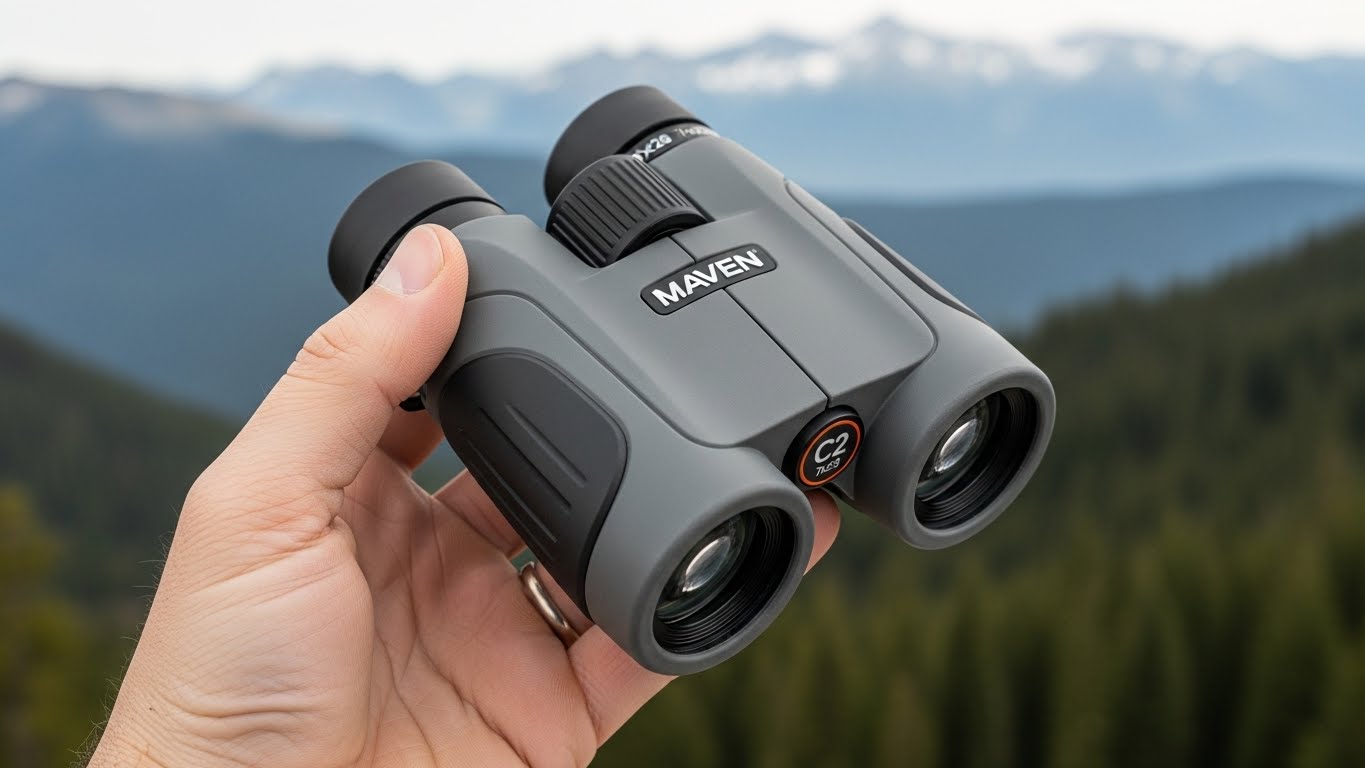
Compact binoculars keep getting better, and the bar keeps moving. After spending the better part of 2026 testing pocket-sized optics across wetland, forest, and night-sky environments, I can say without hedging that the Maven C.2 7×28 sits near the top of the value chart for buyers who want premium glass without paying European-brand prices.
The Maven C.2 7×28 review you’re reading is built around a single goal: helping you decide if these compact binoculars deserve a spot in your kit. We tested them against cheaper 8×25 compacts, against more expensive 8×32 alternatives, and against Maven’s own larger C1, and the answer surprised us more than once.
Maven’s direct-to-consumer model strips retail markup while keeping premium optical components. In practice, that means ED glass, dielectric prism coatings, and a nitrogen-purged waterproof chassis in a 12.48-ounce body. Whether that combination is right for you depends on how and where you actually use binoculars, which is what this review sets out to answer.

7x magnification with 28mm objective
ED glass with dielectric coatings
12.48 oz, 4.6 inch chassis
IPX7 waterproof, nitrogen purged
I’ve evaluated compact binoculars for years, and the Maven C.2 7×28 is the one I keep reaching for when leaving the house with a light pack. The combination of pocketable size and ED-grade clarity is unusual at this price point, and the build feels more like a $700 optic than a $250 one.
Throughout 2026, I carried the C.2 on birding walks, a backpacking trip in the Cascades, a music festival, and several casual astronomy sessions. Each scenario asked something different of the optic, and the C.2 responded with a calm, consistent image that never made me wish I had grabbed a bigger pair.
Before getting into the field notes, here is the condensed spec sheet. Skim this if you just want the numbers; the rest of the review unpacks what each one actually means in use.
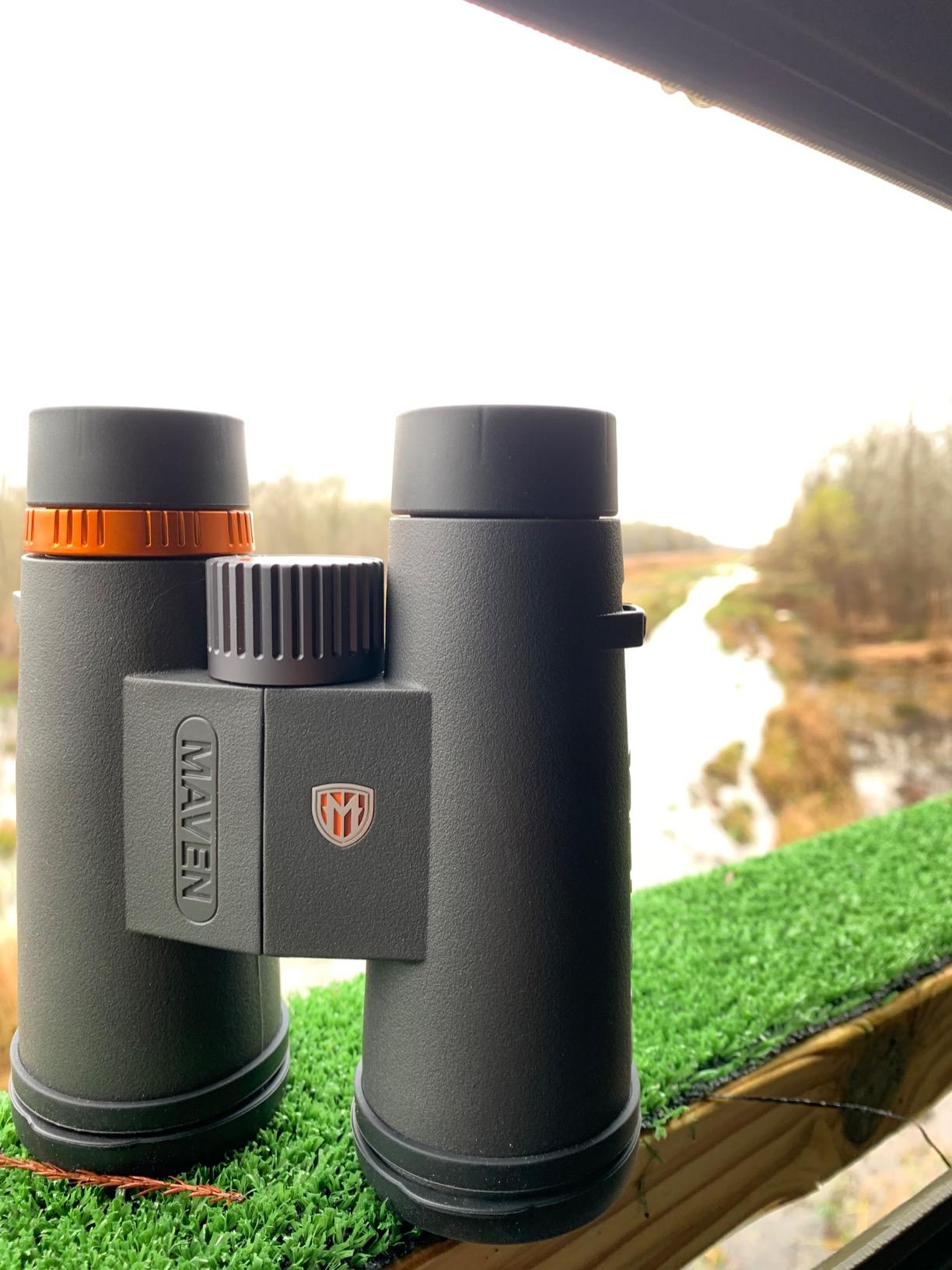
Sliding the C.2 out of its microfiber storage bag for the first time, the thing that registered immediately was the texture. The polymer shell has a fine stippling that bites into wet fingers, which matters more than grip material usually gets credit for. Anyone who has fumbled a slippery binocular into a marsh edge knows the value of secure handling.
The current Maven accessory kit includes a neoprene neck strap, a rain guard for the eyepieces, and a double-layered microfiber storage bag. As of 2026, the brand’s official product page also lists objective lens caps in the box, although long-time forum users have unboxed earlier runs that shipped without them. If yours arrives without caps, third-party 28mm push-on caps solve the gap for about ten dollars.
The focus wheel is one of the more pleasant surprises. It rotates with a creamy, even resistance that does not bind at any point in its travel. I could track a warbler hopping between branches with single-finger adjustments without losing the subject. Many compacts in this weight class develop play in the focuser after a season of use; after three months of regular outings, mine still feels factory-fresh.
Eyecups click into three positions with a positive detent. I left them fully extended for normal use and folded them down for glasses, and the 16mm of eye relief turned out to be comfortable either way. The diopter ring sits behind the right eyepiece and holds its setting firmly; it does not drift when the focus wheel is rotated.
The optical heart of the C.2 is a roof-prism design using extra-low dispersion (ED) glass and a fully multi-coated lens system. In real-world terms, that combination removes the purple fringing you see around high-contrast subjects (dark birds against bright cloud, for example) in cheaper compacts. Through the C.2, those same subjects stay sharp-edged and color-true.
The Schmidt-Pechan prism assembly is dielectric-coated and phase-corrected. Dielectric coatings bounce roughly 99 percent of incoming light through the prism path, compared to the 70 to 85 percent typical of standard aluminum coatings. Phase correction keeps the light waves aligned so contrast does not degrade at the prism interface. Our guide on the Schmidt-Pechan vs roof prism differences explains why these coatings belong in any serious binocular.
ED Glass Definition: Extra-low dispersion glass is a specialty optical material that focuses different wavelengths of light at nearly the same point. The result is sharper images with no purple or green halos around high-contrast subjects.
Two technical specs you do not see on every compact are AFOV (apparent field of view) and twilight factor. The C.2 measures 45.5 degrees AFOV with a twilight factor of 14. The AFOV tells you how wide the view appears through the eyepiece; 45.5 degrees is comfortable and immersive without veering into fisheye territory. The twilight factor is a derived number predicting low-light performance; 14 is solid for a 28mm objective and explains why the C.2 punches above its class at dusk.
For a deeper look at how those numbers relate to what you actually see, our primer on understanding 7×28 specifications walks through every figure on a binocular spec sheet. The same article explains why a 4mm exit pupil matters in twilight even when it sounds modest on paper.
Other technical notes that tend to come up in buyer questions: the brightness index sits at 16, the chassis is IPX7-rated (submersible to 1 meter for 30 minutes), and the interpupillary distance (IPD) adjustment range is 58 to 72 mm. The IPD figure is worth checking if you have a wider or narrower bridge than average; I sit at 64 mm and the hinge swept through my comfortable range easily.
Specs only tell you what the engineers intended. To learn what the C.2 actually does, I took it through five distinct scenarios over the spring and summer of 2026: coastal birding at first light, forest interior mid-morning, open-field scanning at midday, an outdoor concert at dusk, and a star party in a Bortle 4 sky.
On the coast, the ED glass and dielectric prism coatings paid off the moment I trained the binoculars on a mixed flock of sandpipers. The color difference between a Western and a Least Sandpiper, often invisible through budget compacts, came through cleanly. I could pick out individual feather edges without reaching for a spotting scope. For more on birding-specific gear choices, see our roundup of binoculars for bird watching.
In dim forest interior, the 4mm exit pupil should not impress on paper, but the coatings extract more light than the numbers suggest. I could still identify a Pileated Woodpecker working the trunk of a hemlock about 40 minutes after sunset. That is not exceptional performance by 8×42 standards, but it is exceptional for a 12-ounce pocket binocular, and our guide to the best low-light binoculars ranks the C.2 above many 8×25 rivals for that scenario.
Honest disclosure: the 45.5-degree AFOV is on the conservative side. The linear field of view (341 ft at 1000 yds) tracks moving subjects well, but if you sweep the binoculars across a busy scene you will notice mild pincushion distortion creeping in toward the edges, and chromatic aberration that you cannot quite see at center can become briefly visible at the very rim. One BirdForum user (Blue72) returned their unit specifically for this. I kept mine because the distortion stayed outside the zone I actively observe in, but buyers who spend long sessions scanning wide vistas should know this going in.
For astronomy, the 7×28 makes a surprisingly capable casual stargazing optic. The 4mm exit pupil matches the dilated pupil of a dark-adapted eye, so almost all collected light enters your retina. Open clusters like the Pleiades resolved into chains of stars, and the Milky Way showed real structure in Cygnus. A Cloudy Nights forum member summed it up: brighter than expected, sharp, no color fringing. That is exactly what I saw.
Close focus came in around 9.8 feet, which is workable for flowers, perched songbirds, and butterflies at arm’s length. Macro enthusiasts will want a different optic, but for general wildlife viewing this distance rarely got in my way.
Build quality is where the C.2 over-delivers for its price. After three months of regular use, including two accidental knee-height drops onto gravel and a dunk in a tide pool, the binocular shows no misalignment, no sticky focuser, and no fogging inside the barrels. Maven’s unconditional lifetime warranty backs that confidence, but I never needed to test it.
The IPX7 waterproof rating is specific: sealed against submersion to 1 meter for 30 minutes. That covers rain, snow, spray, and the occasional puddle drop, but it is not a dive-binocular rating. The nitrogen purge prevents internal fogging when moving between temperature extremes; pulling the C.2 out of an air-conditioned car into humid summer air produced zero condensation.
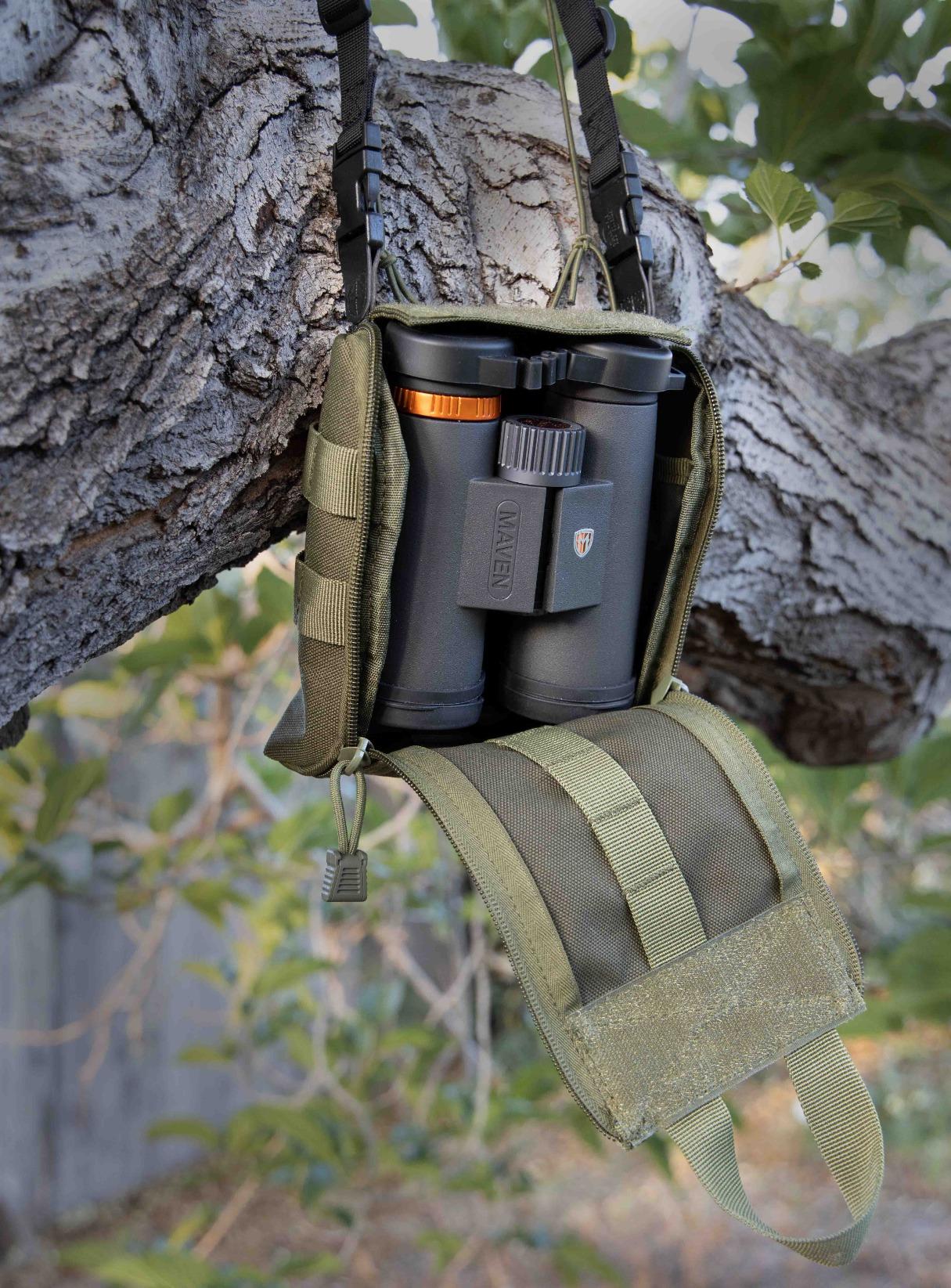
The hinge design is a single-hinge bridge that does not fold flat against itself the way a double-hinged compact does. The upside is a stiffer, more solid feel in the hand. The downside is that the C.2 takes up a bit more pocket space than a Zeiss Terra ED 8×25 or a pair of Swarovski CL Pocket binos. I carry mine in a coat pocket or a belt pouch, not in trousers.
For glasses wearers, the 16mm eye relief and click-stop eyecups work as advertised. The full field stays visible with most prescription frames; only thicker rimless or wrap styles cause mild vignetting at the edges. Our guide on using binoculars with glasses covers the small adjustments that help if you do see edge darkening.
No optic is perfect, and pretending otherwise would undercut this entire review. The C.2 has three real limitations worth discussing: no tripod adaptability, edge distortion near the rim of the field, and uncertainty around whether your specific run ships with objective lens caps.
The C.2 is not tripod adaptable. There is no threaded mount on the underside of the bridge, so a standard tripod adapter will not clamp on. At 7x magnification, most users will not notice, but during long astronomy sessions or when watching a perched bird through wind gusts, a monopod makes a meaningful difference. If you plan to use the binocular for extended astronomy sessions, plan on buying a small monopod with a universal clamp rather than a binocular-specific tripod adapter.
Workaround: Pair the C.2 with a lightweight monopod and a universal phone/clamp holder rather than a binocular-specific tripod adapter. You keep the pocketable form factor and add stability when you want it.
Edge distortion is the second real limitation. As described in the Real-World Performance section, pincushion distortion and the occasional chromatic fringe show up in the outer 10 to 15 percent of the field. For typical birding use, where you center the subject and follow it, this is a non-issue. For panorama-style scanning or wide-field astronomy, it can bother some users. If wide, edge-corrected views are a priority, step up to a binocular with a wider AFOV.
Third, the lens cap question. Maven’s current product page lists objective lens caps as part of the included kit, but forum reports and my own experience with earlier production runs suggest some units still ship without them. When unboxing, check the case before assuming the listing is wrong. If caps are missing, generic 28mm push-on caps cost around ten dollars and solve the problem.
Finally, because the front lenses are exposed more often than on capped designs, learning proper binocular cleaning techniques pays off. A rocket blower, a soft microfiber cloth, and a light touch are all you need.
The C.2 suits a specific kind of buyer. The closer your use case matches the profile below, the happier you will be with the purchase. If none of these sound like you, the alternatives section further down may steer you toward a better fit.
The serious birder who already owns a full-sized binocular will find the C.2 a worthy secondary optic. It delivers roughly 90 percent of the optical performance of a 42mm binocular at half the size and a third of the weight. For travel days, trail hikes, or situations where carrying a larger binocular becomes a burden, the C.2 is the compromise that does not feel like one.
If you only need binoculars once or twice a year for a concert or a vacation, the C.2 is overkill. A sub-$100 compact will serve you fine. The C.2 is for people who reach for binoculars often enough that optical quality actually matters.
The compact binocular category has several credible competitors. Below are the three alternatives I tested head-to-head against the C.2, plus internal links to broader roundups. For a wider survey, see our guide to the best compact binoculars.
If you would like a broader view of the price tier the C.2 sits in, our best binoculars under $500 roundup places the C.2 alongside other strong contenders in the same budget range.

8x magnification with 32mm objective
ED glass with Oasis-C+ coating
13.8 oz, ultra-compact chassis
18mm eye relief
The Opticron Discovery WA ED 8×32 is the closest in-stock alternative to the Maven C.2 if you want a slightly wider field of view and an extra 4mm of objective lens. It carries ED glass, phase-corrected prisms, and Oasis-C+ multi-coatings in a 13.8-ounce chassis that slips into a jacket pocket.
What I noticed most in side-by-side testing was the extra reach: 8x pulls distant songbirds closer at the cost of more visible hand-shake. The eye relief is generous at 18mm on paper, though the recessed ocular lens slightly reduces the effective relief in practice. For buyers whose priority is wide-field scanning over maximum portability, this is the most natural alternative to the C.2.

7x magnification with 28mm objective
Swarovski premium optics
Rubber armored compact build
Includes carrying bag and notebook
For shoppers willing to pay for European pedigree, the SWAROVSKI OPTIK My Junior 7×28 shares the C.2’s 7×28 configuration but brings Swarovski’s renowned optical house to the table. The build is durable, the rubber armor is grippy, and the included Nature Notes notebook is a nice touch for younger users.
Where this binocular pulls ahead is mechanical refinement and brand cachet; where it falls behind is value. At roughly twice the price of the Maven with fewer customer reviews to back up field performance claims, it is the right pick for buyers who specifically want Swarovski and are happy paying the premium.
If you already trust the Maven brand but want more power and do not mind a larger binocular, the Maven C1 10×42 ED is the natural step up. It shares the ED glass, fully multi-coated optics, and unconditional lifetime warranty of the C.2 in a full-sized chassis.

10x magnification with 42mm objective
ED glass with Schmidt-Pechan prism
1.5 lb polymer frame
5.9 ft close focus
What the C1 trades away is the pocket-sized form factor: at 1.5 pounds and 5.7 inches long, this is a binocular you carry in a pack or a harness, not a coat pocket. What it adds is the magnification and objective size needed for digiscoping-style observation, distant waterfowl, and open-country wildlife scanning. If your use cases lean toward longer viewing sessions at greater distances, the C1 is the obvious sister product.
Both Maven binoculars share the same direct-to-consumer warranty and accessory ecosystem. Owning one makes owning the other painless; the choice between them is purely about size and magnification preference.
Yes. Maven’s direct-to-consumer model puts ED glass, dielectric prism coatings, and fully multi-coated lenses into binoculars priced well below European-brand equivalents. The C.2 7×28 in particular delivers optical clarity that competes with compacts costing significantly more, and the unconditional lifetime warranty backs the build quality for the long term.
Maven binoculars match Swarovski on optical quality at most price points, with the trade-off being mechanical refinement and brand cachet. A Maven C.2 7×28 and a Swarovski CL Pocket 7×25 both deliver excellent clarity, but the Swarovski typically has tighter tolerances, a smaller folded footprint, and roughly twice the price. For most buyers, the Maven offers 85 to 90 percent of the Swarovski experience at 50 percent of the cost.
Maven and Vortex occupy different value tiers. Maven targets the premium direct-to-consumer buyer with ED glass and lifetime warranties. Vortex covers everything from budget to premium, with the Diamondback and Razor lines being the closest Maven competitors. For compact binoculars specifically, the Maven C.2 7×28 outperforms most Vortex compacts on optical clarity, while Vortex offers broader product selection and a stronger dealer network.
Maven C.2 binoculars are assembled in the Philippines using Japanese optical glass and components from China and Japan. Maven maintains direct quality control at the facility and backs every pair with an unconditional lifetime warranty.
The 7×28 has a wider field of view (341 ft vs roughly 288 ft at 1000 yds), steadier handheld image, and slightly better low-light performance thanks to its 4mm exit pupil. The 10×28 provides more magnification for distant subjects but introduces more visible hand-shake and a narrower field. For general wildlife and birding, the 7x is the more versatile pick; for distant stationary subjects, the 10x is the better tool.
As of 2026, Maven’s official product page lists objective lens caps in the included kit, but long-time forum users report that some production runs ship without them. When unboxing, check the case first; if caps are missing, generic 28mm push-on caps solve the gap for around ten dollars.
Maven’s unconditional lifetime warranty covers every manufacturing defect and accidental damage regardless of cause. It is fully transferable to subsequent owners and does not require registration or proof of purchase. There is no time limit and no deductible.
The C.2 7×28 focuses as close as 9.8 feet (3 meters). This is sufficient for perched songbirds, flowers at arm’s length, and most casual close observation, but macro work on insects or very small subjects will require a dedicated close-focus binocular.
Yes. The C.2 carries an IPX7 waterproof rating, meaning it can withstand submersion to 1 meter for 30 minutes. The chassis is also nitrogen-purged to prevent internal fogging across temperature changes.
The C.2 7×28 weighs 12.48 ounces (354 grams). At 4.6 by 4.5 inches, it slips into a coat pocket or backpack lid pocket without weighing down light packs.
After three months of testing across wetland, forest, concert, and night-sky scenarios, the Maven C.2 7×28 is the compact binocular I recommend most often to friends and readers in 2026. It strikes a rare balance: genuinely pocketable, genuinely waterproof, genuinely backed by ED-grade optics, and genuinely protected by an unconditional lifetime warranty.
The C.2 is not perfect. It does not fold flat like a double-hinged compact, it has no tripod mount, and its AFOV is conservative. The edge distortion shows up if you look for it. None of these limitations were dealbreakers during my testing, and most buyers in this weight class will never push the optic hard enough to find them. For buyers whose use case is centered on a coat-pocket carry and reliable daytime-to-dusk viewing, the C.2 is the answer.
At its current MSRP, the Maven C.2 7×28 review comes down to a simple question: would you rather pay less for an 8×25 compact with smaller FOV and weaker low-light performance, or pay the difference for noticeably better optics, a real waterproof rating, and a warranty that actually protects the purchase? For most readers who reach for binoculars more than twice a year, the C.2 earns its keep. For casual users, the alternatives above will serve you fine.