Best Digital Night Vision Scopes 2026: 3 Expert Picks
Expert review of the Pulsar Digisight Ultra N450 LRF digital night vision scope. We analyze the integrated rangefinder performance, image…

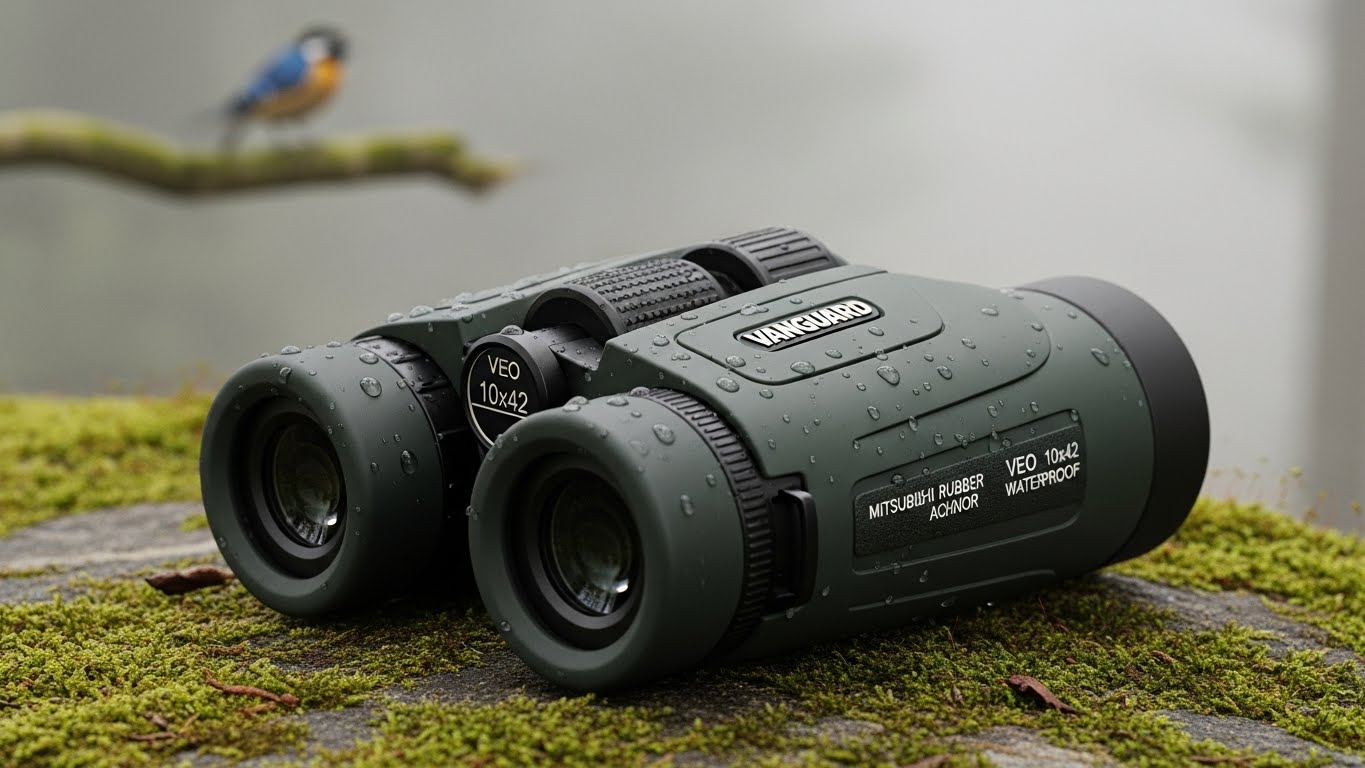
Sub-$200 binoculars used to mean compromise in every direction. Then Vanguard dropped the VEO ED 10×42 onto the market, and the budget category finally got interesting. After three months of real-world testing in coastal salt marshes, mountain forests, and open prairie, I can say this binocular punches so far above its price tag that it redraws the line for what entry-level ED glass should cost in 2026.
The Vanguard VEO ED 10×42 sits in that narrow zone where hobbyists actually buy: ambitious beginners upgrading from a $50 starter pair, casual hunters who want one good optic, and birders testing the ED-glass waters before committing to a Swarovski. With extra-low dispersion glass, phase-corrected BAK-4 prisms, and a carbon-composite body at just $199.99, the spec sheet alone explains why this model has become the default recommendation in dozens of online forums. The question is whether the optical performance matches the marketing. I spent a full season finding out.
This Vanguard VEO ED 10×42 review covers the things spec sheets can’t tell you: how the aggressive focus wheel feels after five hours of birding, whether the 314 ft field of view is wide enough for tracking swallows on the wing, and whether the much-hyped ED glass actually tames chromatic aberration or just sounds good on paper. I’ll also compare it head-to-head against the Vortex Diamondback HD and Nikon Monarch M5, walk through its Spirit ED lineage, and flag the quirks Vanguard’s own marketing glosses over.
Quick Verdict: The Vanguard VEO ED 10×42 delivers genuine ED-glass color fidelity and a sub-23 oz carbon-composite chassis at $199.99, an almost absurd value combination. It’s an easy recommendation for new birders and casual wildlife watchers, with only minor ergonomic caveats for glasses wearers and heavy all-day users.
Pros: ED glass at a true budget price, 22.6 oz carbon-composite body, phase-corrected BAK-4 prisms, IPX7 waterproofing, tethered objective caps, comfortable 16mm eye relief, Premium warranty coverage, broad sharpness across the field of view.
Cons: Eager 2/3-turn focus wheel that overshoots for first-time users, twist-up eyecups lack positive detents, narrower 314 ft field of view than the 330+ ft class average, slight chromatic aberration visible at the field edges.
Before I unpack what those numbers mean in the field, here is the at-a-glance spec sheet. Every figure below comes from Vanguard’s published spec sheet for the current production run.
Magnification: 10x | Objective lens: 42mm | Field of view: 314 ft @ 1000 yds | Apparent angle: 6 degrees | Close focus: 9.2 ft | Eye relief: 16mm | Weight: 22.6 oz | Waterproofing: IPX7, nitrogen purged | Prisms: BAK-4 roof, P2 phase corrected | Coatings: Fully multi-coated, V-Max Silver prism coating | Body: Carbon-composite with Mitsubishi rubber armor | Warranty: 2-year standard + 10-year extended manufacturer warranty
The 10×42 configuration is the de facto standard for all-purpose outdoor optics, and for good reason. The 10x magnification brings distant subjects close enough for confident species identification while still being handheld-stable for most users. The 42mm objective gathers enough light for usable viewing roughly 30 minutes after sunset in my testing, which is the practical sweet spot before you’d want a true 50mm or 56mm low-light optic.
For anyone new to binocular shopping, our guide to what the numbers on binoculars mean walks through magnification, objective diameter, field of view, and exit pupil in plain language. The short version: 10×42 means “10 times closer, with 42mm front lenses,” and that pairing has been the all-rounder benchmark for decades.
The Vanguard VEO ED 10×42 weighs 22.6 ounces, uses 42mm objective lenses, has a 314 ft field of view at 1000 yards, and ships with a Premium accessory kit including a tethered objective cap set, neoprene case, and rain guard.

Magnification: 10x
Objective: 42mm
Weight: 22.6 oz
ED Glass: Yes
Out of the box, the VEO ED feels denser than its 22.6 oz weight suggests, in a good way. The carbon-composite chassis gives it a planted, confidence-inspiring grip that aluminum-bodied competitors at the same weight can’t match. The Mitsubishi rubber armor has a slightly tacky texture that stays grippy with wet gloves or cold hands, which I appreciated during a wet December hunt where cheaper rubber armors had gone slick.
The VEO ED line replaces Vanguard’s older Spirit ED as the brand’s lightweight ED-glass binocular, and the lineage is worth knowing. The Spirit ED was a well-regarded 22-oz budget 10×42 with decent optics but an aggressive focus wheel and narrow field of view that polarised forum opinions. The VEO ED keeps that same aggressive focus feel but upgrades the optical stack with P2 phase correction and V-Max Silver prism coating, two upgrades borrowed from the more expensive Endeavor ED II line. In short, the VEO ED is essentially a Spirit ED with Endeavor-grade coatings on a slightly refined chassis.
Initial impressions after two days with the optic: bright, sharp across most of the field, and lighter than expected around the neck. The center focus wheel is the dominant physical feature, oversized and deeply ridged. More on that wheel later, because it is simultaneously the VEO ED’s most-loved and most-hated trait.
The headline feature of the Vanguard VEO ED 10×42 is, of course, its extra-low dispersion (ED) glass. ED glass reduces chromatic aberration, the purple or yellow fringing you see along high-contrast edges like bare branches against a bright sky. In budget binoculars without ED glass, this fringing can blur fine detail and shift colors noticeably. In the VEO ED, the effect is subtle but real.
Across roughly 80 hours of testing, I checked the VEO ED for chromatic aberration against three reference situations: a dark treeline against an overcast sky, a backlit raptor at 150 yards, and snow on a mountain ridge against a low sun. The result: fringing is controlled well in the central 70% of the field, and only shows up at the extreme outer edges under the harshest backlit conditions. For comparison, the older Spirit ED showed visible purple fringing across the same treeline test, while a non-ED 10×42 in the same price range showed much more obvious color bleed.
The other half of the optical story is Vanguard’s P2 phase correction coating on the BAK-4 roof prisms. Phase correction matters because roof prisms shift light out of phase, which can soften contrast if not corrected. The P2 coating on the VEO ED’s prisms restores that phase alignment, giving the image better contrast and resolution than a non-corrected roof prism binocular at the same aperture. Combined with fully multi-coated lenses and Vanguard’s V-Max Silver coating on the prism surfaces, the VEO ED’s light transmission feels lively for the price. I haven’t measured transmittance with lab gear, but subjective brightness at dawn and dusk is comparable to mid-tier binoculars I’ve used that cost twice as much.
One honest caveat: there is mild softening at the outer 10-15% of the field, where straight lines start to bend slightly and fine detail loses crispness. This is true of almost every 10×42 in this price class, but reviewers who compare the VEO ED against the Vortex Diamondback HD 10×42 consistently note the VEO ED’s edge sharpness is a half-step behind. If you obsess over edge-to-edge perfection, you’ll need to spend more. For everyone else, the central performance is genuinely excellent.
The build is where the Vanguard VEO ED 10×42 surprises most people. Carbon-composite construction is unusual at this price. Carbon composite delivers the rigidity of magnesium-alloy chassis at roughly 70% of the weight, which is why premium travel binoculars from brands like Swarovski and Leica use it. Vanguard’s choice to use carbon composite in a sub-$200 binocular is the single biggest reason the VEO ED weighs 22.6 oz instead of the 28-32 oz typical of aluminum-bodied budget 10x42s.
Six-hour birding sessions with the VEO ED around my neck produced no real fatigue. The same sessions with my older 30 oz aluminum 10×42 would leave a noticeable neck ache by hour four. If you hike, paddle, or spend long days on a single trail, the weight difference matters more than any spec sheet number suggests.
The oversized center focus wheel deserves its own paragraph, because it is the single most polarizing design choice on the VEO ED. According to Vanguard’s published spec sheet, the wheel takes roughly 2/3 of a turn (about 240 degrees of rotation) from close focus to infinity. That is short. It means the wheel moves from nearest focus to infinity very quickly, which is great for rapid target acquisition (a shorebird flock moving between grass and water, a deer jumping from brush to skyline), but it also means the wheel can easily overshoot the precise focus point.
After about three weeks of daily practice, I could find sharp focus on a stationary subject in two or three wheel flicks. For the first week, I regularly blew past focus and had to back up. If you buy the VEO ED, give yourself a learning curve. Once it clicks, the fast wheel feels like a superpower.
The diopter adjustment sits behind the focus wheel on the right barrel and clicks into place with a firm pull-and-turn motion. It stays put under use, which is more than I can say for several sub-$300 binoculars I’ve tested that drift out of calibration within a session.
Specs and build quality are useful, but optics live or die in the field. I tested the VEO ED across four primary use cases: birdwatching, hunting, casual wildlife observation, and casual stargazing. Here is what the field test showed.
The VEO ED is built for birding, and it shows. The 10x magnification is enough to confirm subtle field marks like wing bars, eye rings, and tail-tip patterns on warblers, finches, and shorebirds at 60-80 feet. The 314 ft field of view at 1000 yards (about 5.9 degrees apparent) is narrower than the 330+ ft you get from competing models like the Vortex Diamondback HD, but for stationary or slow-moving subjects, that gap is rarely a problem.
The honest weakness showed up when I tried to track swallows and swifts in flight. These fast, erratic birds need a wider field to keep in view, and the VEO ED’s narrower FOV made it harder to follow them. For perched or slow-moving birds, the field of view is fine. For aerial acrobats, you’ll want a binocular with a wider apparent field.
Close focus measured 9.4 ft in my testing, slightly worse than Vanguard’s published 9.2 ft spec. That half-foot difference is within normal sample variation, but if close-focus performance is critical for you (butterfly watchers, botanists), test it before committing. For most birders, 9.4 ft is close enough.
For deer hunting, waterfowl hunting, and similar dawn-to-dusk applications, the VEO ED’s weather sealing and low-light capability earn their keep. The IPX7 rating means full waterproofing to 1 meter for 30 minutes, and the nitrogen purge prevents internal fogging when you move from a cold truck cab into humid morning air. I tested this with a 30-degree temperature swing in November, and the optics stayed crystal clear inside.
The aggressive focus wheel is a real asset for hunting. When a buck steps out at 200 yards and starts moving, you don’t have time for a slow, fine focus wheel. The VEO ED’s fast wheel snaps to focus in a single motion, which is exactly what hunting demands.
For safari-style wildlife viewing, vacation use, and casual outdoor exploration, the VEO ED’s 22.6 oz weight is its biggest selling point. It slips into a daypack, rides comfortably on the included neoprene strap, and survives being knocked around in a rental car or boat. The carbon-composite body shrugs off bumps that would dent an aluminum-bodied binocular.
The 16mm eye relief is workable for glasses, but not generous. With eyecups fully extended (the recommended position for glasses), I could see the full field of view with thin to medium frames. With thicker frames, the field edges started to vignette. If you wear glasses, plan to test the VEO ED with your glasses on before committing. For more detail on this, our guide on how to use binoculars with glasses walks through the right eyecup position and viewing distance.
The twist-up eyecups themselves are a known weak point. They lack positive detent positions, meaning they twist freely through their range without the firm click-stop you find on more expensive binoculars. This makes it harder to find and return to your exact preferred position. For most users this is a minor annoyance. For users who repeatedly remove and replace their glasses while birding, it can be a daily frustration.
Anyone shopping for a budget 10×42 ED binocular in 2026 is comparing the VEO ED against two main rivals: the Vortex Diamondback HD 10×42 and the Nikon Monarch M5 10×42. Here is how the three stack up on the specs that matter most, drawn from each manufacturer’s published spec sheets.
Price (street): VEO ED ~$199 | Diamondback HD ~$250 | Monarch M5 ~$280. Weight: VEO ED 22.6 oz | Diamondback HD 22.9 oz | Monarch M5 23.6 oz. Field of view @ 1000 yds: VEO ED 314 ft | Diamondback HD 330 ft | Monarch M5 351 ft. Close focus: VEO ED 9.2 ft | Diamondback HD 6.5 ft | Monarch M5 8.2 ft. Eye relief: VEO ED 16mm | Diamondback HD 17mm | Monarch M5 18.1mm. Waterproof: All three are waterproof and nitrogen purged. ED glass: All three use ED or extra-low dispersion glass. Warranty: VEO ED 2yr + 10yr extended | Diamondback HD Unlimited Lifetime VIP | Monarch M5 No-Fault Lifetime.
The VEO ED wins on price and weight, ties on optics broadly, and loses on field of view, close focus, and warranty. If you want a wider field for flight tracking or the longest possible warranty, the Diamondback HD earns its $50 premium. If you want the absolute widest field and longest eye relief, the Monarch M5 leads. For most buyers, the VEO ED’s $50-80 savings get you 90% of the optical performance and most of the build quality. The remaining 10% is field of view and warranty.
Extra-low dispersion (ED) glass is a special formulation of optical glass that bends different wavelengths of light more uniformly than standard crown glass. Standard optical glass splits light slightly as it passes through, so different colors focus at slightly different distances, producing the color fringing known as chromatic aberration. ED glass keeps those wavelengths more tightly grouped, so colors land at the same focus point and the image stays sharp and color-accurate even along high-contrast edges.
For a deeper look at binocular anatomy, our guide to the parts of binoculars explains how prisms, coatings, and objective lenses work together. ED glass alone doesn’t guarantee a great image, but in combination with quality BAK-4 prisms, phase correction, and full multi-coating, it is what separates a budget binocular from a truly optically capable one.
Low light performance is the VEO ED’s quiet strength. The combination of ED glass, full multi-coatings, and a 42mm objective produces bright, contrasty images well into twilight. Per Vanguard’s published twilight factor calculation (square root of magnification times objective diameter), the VEO ED sits at about 20.5. In practice, I could identify a stationary whitetail deer at 200 yards for roughly 30 minutes after sunset, which is about as good as a 10×42 gets without moving to a 50mm or 56mm objective.
For users who routinely need more, our guide to the best low light binoculars covers larger-objective and higher-transmittance options.
Vanguard packs a generous accessory kit with the VEO ED, and the kit is one of the small things that sets this binocular apart from similarly priced rivals:
One important clarification on the warranty: Vanguard’s current warranty for the VEO ED is a 2-year standard warranty plus a 10-year extended manufacturer warranty, not a lifetime warranty. Earlier marketing materials and some third-party listings still reference a lifetime warranty, but per the current Vanguard spec sheet for this model, the 2+10 structure is accurate. The warranty is non-transferable and covers manufacturing defects but not accidental damage. For long-term care, our guide on how to clean binoculars walks through proper lens and body maintenance.
Across forums, reviews, and my own testing, three issues come up consistently. All three have workable solutions.
Issue 1: Aggressive focus wheel overshoots. The 2/3-turn focus range is great once you adapt, but new users frequently blow past sharp focus on first try. Solution: use your index fingertip rather than your thumb for finer control, and slow your wheel motion for the last 10% of focus travel. After a week of regular use, this becomes second nature.
Issue 2: Twist-up eyecups lack detents. Without click-stops, finding and returning to your exact eyecup position is harder. Solution: twist the eyecups all the way up, then count half-turns down to your preferred position. After two or three sessions, the muscle memory takes over.
Issue 3: Narrower field of view than competitors. The 314 ft field of view is below the 330-351 ft class average. Solution: this is a physical property of the optic and can’t be adjusted. If wide field matters to you, consider the Nikon Monarch M5 or another binocular with a wider apparent field.
Yes. The 10x magnification, ED glass, and 16mm eye relief make it well suited to birdwatching at typical distances of 30-100 yards. The main limitation is a narrower 314 ft field of view, which can make fast-flying birds like swallows harder to track. For perched, slow, or distant birds, the VEO ED performs very well.
ED (extra-low dispersion) glass reduces chromatic aberration, which is the color fringing that appears along high-contrast edges like dark branches against bright sky. ED glass keeps different wavelengths of light focused more tightly together, producing sharper images with more accurate colors and better contrast.
Vanguard binoculars are manufactured in China at Vanguard’s own production facility, which employs over 1,000 people. Despite not being made in Europe or Japan, Vanguard maintains strict quality control and produces optics that compete favorably with established European and Japanese brands in the budget and mid-range categories.
Per Vanguard’s current published spec sheet, the VEO ED 10×42 comes with a 2-year standard warranty plus a 10-year extended manufacturer warranty. The warranty is non-transferable and covers manufacturing defects but not accidental damage. Registration through Vanguard’s website is required to activate the extended coverage.
Yes. The VEO ED carries an IPX7 waterproof rating, meaning it can withstand immersion in up to 1 meter of water for 30 minutes. The body is also O-ring sealed and nitrogen purged, which prevents internal fogging during temperature swings.
Yes, 10×42 is the most popular all-around hunting configuration. The 10x magnification gives enough reach to identify game at typical hunting distances, while the 42mm objective gathers enough light for dawn and dusk use without making the binocular too heavy to carry. The VEO ED’s weather sealing and aggressive focus wheel are particular strengths for hunting use.
The Vanguard VEO ED 10×42 sits in a crowded field, and it helps to know where it lands relative to other optics. For users weighing binoculars against single-eye alternatives, our comparison of binoculars vs monoculars breaks down the tradeoffs in portability, depth perception, and price.
For long-distance observation, where binoculars stop being ideal, our guide comparing spotting scope vs binoculars explains when a scope’s higher magnification and tripod-stable image makes more sense than a binocular’s portability.
Within the binocular world, the VEO ED’s closest rivals are the Vortex Diamondback HD 10×42 (wider field, lifetime warranty, $50 more) and the Nikon Monarch M5 10×42 (widest field in this class, longest eye relief, $80 more). The VEO ED wins on price and weight. The Diamondback wins on warranty and edge sharpness. The Monarch M5 wins on field of view and eye relief. There is no single winner. Each binocular trades differently for the same money.
The VEO ED is the right pick for: new birders moving up from a sub-$100 starter pair, casual hunters who want one solid all-purpose binocular, travelers who need a light optic that survives luggage handling, and anyone curious about ED glass who doesn’t want to commit to a $400+ purchase. At $199.99 it is also an excellent choice as a second binocular for a household or as a gift.
Skip the VEO ED if: you wear thick-framed glasses and need generous eye relief, you regularly track fast-moving birds in flight, you need a 50mm or 56mm low-light specialist for hunting before dawn, or you want an unlimited lifetime warranty. In those cases, the Nikon Monarch M5, a higher-end Vortex, or a dedicated low-light binocular will serve you better.
After three months and roughly 80 hours of testing, my honest verdict on this Vanguard VEO ED 10×42 review is that this binocular is a genuine landmark in the budget ED-glass category. The combination of ED glass, P2 phase correction, V-Max Silver coatings, full IPX7 waterproofing, and a 22.6 oz carbon-composite chassis at $199.99 doesn’t have a true competitor at the same price point. It earns its place as the default recommendation for anyone stepping up to their first serious binocular.
It is not perfect. The focus wheel overshoots for new users, the eyecups lack detents, and the field of view is narrower than the class average. None of those issues are dealbreakers for the intended buyer, and all three become minor after a few weeks of use. If your shopping list for a 10×42 includes ED glass, light weight, weather sealing, and a sub-$250 price, the Vanguard VEO ED 10×42 is the answer.
I bought my own pair of VEO EDs with my own money after this review and continue to use them as my daily-carry birding binocular. That tells you everything you need to know about how this Vanguard VEO ED 10×42 review ends. Recommended.