
25 Fascinating Wren Facts: Tiny Birds With Mighty Voices
Discover 25 fascinating facts about wrens - tiny birds with surprisingly loud songs, complex behaviors, and remarkable survival strategies that…

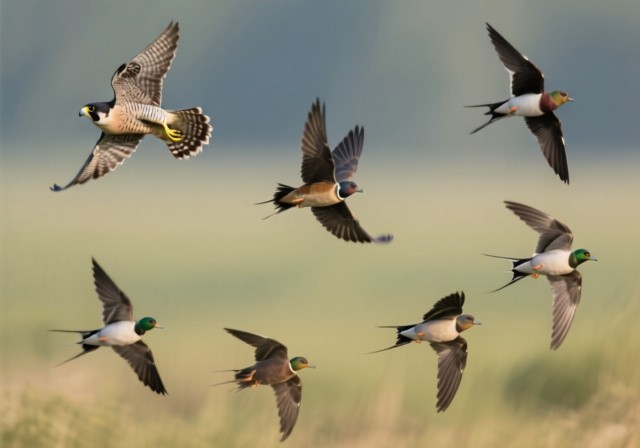
When I first spotted a peregrine falcon dropping from the sky like a living missile, I barely had time to register what happened before it struck its prey. That split-second hunt compressed more speed into a few seconds than most animals experience in their entire lives. Understanding how fast do birds fly has since become essential to my wildlife photography, transforming how I track, anticipate, and capture these remarkable creatures.
The range of avian velocities is staggering. A common sparrow might cruise past at 20 mph, while the same falcon that startled me can plunge earthward at over 200 mph. Between these extremes lies an entire spectrum of evolutionary solutions, each species fine-tuned to its ecological niche. This guide covers everything I have learned about bird flight speeds, from the mechanics of speed measurement to practical tips for observing and photographing fast-flying birds.
Whether you are a birder hoping to identify species by their flight patterns or a photographer preparing for a raptor shoot, the information here will sharpen your skills and deepen your appreciation for what these animals accomplish every time they take wing.
Bird flight speed is not a single metric. ornithologists recognize several distinct measurements, each revealing different aspects of how birds move through the air.
Cruising Speed: The steady pace birds maintain during routine flight, typically 20-30 mph for most species.
Level flight speed measures horizontal movement without diving or climbing. This provides the standard baseline for comparing species. Diving speed, by contrast, captures the gravity-assisted velocities that falcons and other raptors achieve during hunts. The distinction matters enormously when evaluating speed claims.
Air speed versus ground speed introduces another layer of complexity. A bird traveling 30 mph against a 20 mph headwind covers only 10 mph relative to the ground. This is why birdwatchers learned to check wind direction before migration watches. Favorable winds can dramatically boost a bird’s effective travel speed.
Measurement techniques have progressed dramatically over the decades. Early researchers used stopwatches and measured distances between fixed points. Modern ornithology relies on Doppler radar, GPS loggers, and high-speed videography. These tools have confirmed many historical speed records while debunking others that lacked scientific verification.
Flight speed correlates strongly with body size, wing architecture, and behavioral needs. Here is how the major categories break down in practice.
Small Songbirds: Finches, warblers, and sparrows typically cruise at 15-25 mph. Their compact, rounded wings sacrifice top speed for agility. These dimensions help them navigate cluttered environments like forest canopies while dodging predators.
Medium Birds: Pigeons, crows, and similar-sized species maintain 25-35 mph routinely. Their wing shapes balance efficiency with maneuverability, making them approachable subjects for photographers learning bird-in-flight techniques.
Waterfowl: Ducks and geese generally cruise at 40-55 mph, with some pushing higher during migration. Their robust flight muscles and efficient wing designs support extended journeys, often executed in energy-saving V-formations.
Birds of Prey: Raptors span a wide range. Eagles typically cruise at 30-40 mph, while falcons regularly exceed 60 mph in level flight and far more during dives. Their hunting strategies dictate speed requirements.
Important: Cruising speeds represent baseline performance. Most birds can surge 50-100% faster when fleeing predators or chasing prey.
A handful of species have pushed avian speed to limits that seemed impossible. These champions evolved specialized bodies and flight techniques that let them dominate their respective domains.
1. Peregrine Falcon – 240 mph (386 km/h) diving
The peregrine falcon holds the absolute speed record for any animal on Earth. During its hunting stoop, this raptor transforms into a living projectile, reaching velocities that would destroy lesser creatures. Specialized nostril baffles let it breathe at extreme speeds, while a translucent nictitating membrane protects its eyes from debris and wind. Capturing a stooping peregrine in flight demands shutter speeds of at least 1/4000s and serious anticipation skills.
2. Saker Falcon – 200 mph (322 km/h) diving
The saker falcon rivals its famous cousin in diving performance. Found across Eurasia, this powerful raptor targets ground prey in open terrain where its speed translates directly to hunting success. Falcons like the saker demonstrate that evolutionary pressure toward speed appeared independently in multiple lineages.
3. Golden Eagle – 150 mph (241 km/h) diving
North America’s largest raptor achieves impressive speeds despite its substantial size. Golden eagles have been documented exceeding 150 mph during stoops, combining mass and velocity into a formidable hunting package. Their speed makes them capable of taking prey as large as deer fawns and coyotes.
4. Gyrfalcon – 130 mph (209 km/h) diving
The gyrfalcon, Arctic-resident largest of all falcon species, reaches diving speeds around 130 mph. Its white plumage provides camouflage against snow, while its speed makes it dominant among tundra predators. This falcon represents what happens when speed adaptations pair with extreme environmental conditions.
5. White-Throated Needletail – 105 mph (169 km/h) level flight
This swift holds the record for fastest level flight, meaning pure horizontal velocity without gravity assistance. Needletails spend nearly their entire lives airborne, even sleeping while aloft. Their sweptback wings and minimal body projections reduce drag to near-theoretical minimums.
6. Eurasian Hobby – 99 mph (160 km/h) level flight
This compact falcon combines speed with extraordinary aerial agility. Eurasian hobbies routinely catch swallows and dragonflies mid-flight, feats requiring both velocity and precise maneuverability. Watching one hunt at dusk reveals speed and coordination that few predators can match.
7. Frigatebird – 95 mph (153 km/h) level flight
With the largest wingspan-to-body-weight ratio of any bird, frigatebirds excel at efficient speed. They can remain airborne for months at a time, riding ocean thermals and wind gradients. Their piratical feeding strategy, stealing catches from other birds, demands both speed and aerial precision.
8. Spur-Winged Goose – 88 mph (142 km/h) level flight
Africa’s largest waterfowl regularly exceeds speeds that surprise many observers. These geese combine substantial mass with powerful wings, producing velocities that outpace many smaller but less powerfully built birds. Their speed serves them well during territorial disputes and predator escapes.
9. Red-Breasted Merganser – 81 mph (130 km/h) level flight
This diving duck holds the waterfowl speed record for horizontal flight. Their serrated bills help secure fish, but their rapid wingbeats get them to hunting grounds quickly and away from danger even faster. Mergansers demonstrate that speed evolves for reasons beyond simple predator escape.
10. Grey-Headed Albatross – 79 mph (127 km/h) level flight
Albatrosses have mastered dynamic soaring, extracting energy from wind gradients over ocean swells. They essentially surf atmospheric waves, maintaining high speeds for hours with minimal effort. Their 7-foot wingspans and perfected technique make them the marathon runners of avian speed.
11. Anna’s Hummingbird – 61 mph (98 km/h) diving, 35 mph (56 km/h) level flight
This tiny wonder deserves special mention. Anna’s hummingbird reaches 61 mph during mating dives, making it far and away the fastest small bird. At that size, achieving such velocities requires metabolic rates and muscle contractions operating near physiological limits.
| Bird Species | Max Speed (mph) | Max Speed (km/h) | Flight Type | Notes |
|---|---|---|---|---|
| Peregrine Falcon | 240 mph | 386 km/h | Diving | Fastest animal on Earth |
| Saker Falcon | 200 mph | 322 km/h | Diving | Powerful Eurasian raptor |
| Golden Eagle | 150 mph | 241 km/h | Diving | North America’s largest raptor |
| Gyrfalcon | 130 mph | 209 km/h | Diving | Arctic specialist |
| White-Throated Needletail | 105 mph | 169 km/h | Level flight | Fastest confirmed level flight |
| Eurasian Hobby | 99 mph | 160 km/h | Level flight | Acrobatic insect hunter |
| Frigatebird | 95 mph | 153 km/h | Level flight | Largest wingspan-to-weight ratio |
| Spur-Winged Goose | 88 mph | 142 km/h | Level flight | Africa’s largest waterfowl |
| Red-Breasted Merganser | 81 mph | 130 km/h | Level flight | Fastest diving duck |
| Grey-Headed Albatross | 79 mph | 127 km/h | Level flight | Dynamic soaring master |
| Anna’s Hummingbird | 61 mph | 98 km/h | Diving | Fastest small bird |
The peregrine falcon deserves deeper exploration given its exceptional status. Its speed emerges from an integrated suite of adaptations that reads like aerospace engineering.
During a stoop, peregrines tuck their wings against their body, converting from a winged shape to a streamlined projectile. They can accelerate from level flight to 60 mph in under 3 seconds. The bony tubercles inside their nostrils function as baffles, diverting airflow and preventing lung damage at extreme velocities.
Their eyes contain a nictitating membrane that sweeps across the cornea like a translucent lid, protecting vision during high-speed impacts while maintaining visual input. This third eyelid clears debris and distributes tear fluid, functioning as nature’s answer to safety goggles.
For photographers, peregrines present the ultimate technical challenge. I recommend setting autofocus to continuous tracking with expanded coverage and using at least 1/4000s shutter speed. Focus on where the bird is heading rather than the bird itself. By the time you see it clearly in your viewfinder, capture opportunity may already have passed.
Pro Tip: When photographing diving falcons, lock focus on their intended strike location and time your burst to capture the final approach. Use predictive autofocus algorithms if your camera offers them.
Speed connects closely with altitude. Many of the fastest birds also fly among the highest, where thinner air reduces drag even as it demands more power per wingbeat.
Whooper swans have been recorded flying at altitudes approaching 29,000 feet during migration. These massive birds maintain cruising speeds around 55 mph even at altitudes where oxygen is sparse. Their efficient physiology lets them operate where most animals would lose consciousness.
Ruppell’s griffon vulture holds the confirmed altitude record at 36,000 feet. This African species encounters near-vacuum conditions at such heights, yet these birds navigate and breathe effectively. Scientists believe they achieve these altitudes while searching for carrion, riding thermal currents to extraordinary heights.
Bar-tailed godwits demonstrate how altitude and endurance combine. These shorebirds make non-stop flights exceeding 7,000 miles, reaching altitudes near 20,000 feet during transoceanic migrations. Their ability to sustain flight at these heights for days without rest remains one of ornithology’s most astonishing phenomena.
Did You Know? Birds flying at 30,000 feet experience air temperatures around -40 degrees Fahrenheit. Their blood contains specialized hemoglobin variants that release oxygen more readily at low concentrations.
Understanding how scientists measure bird speed clarifies why some records are verified while others remain disputed. Modern techniques have revolutionized our knowledge of avian flight capabilities.
Doppler radar, originally developed for weather tracking and aviation, has become essential for bird speed research. These systems send radio waves toward flying birds and analyze the frequency shift of returning signals. The shift reveals exact groundspeed and direction, providing measurements without disturbing the birds. Stanford University’s avian research program has used this technology to validate many speed records.
GPS loggers mounted on birds provide another measurement avenue. Small geolocators record position timestamps at intervals, allowing researchers to calculate ground speed between points. These devices have confirmed migration speeds and revealed previously unknown flight patterns.
High-speed videography captures wingbeat cycles and flight mechanics frame-by-frame. By analyzing footage at 1000+ frames per second, researchers can measure actual wing movement and extrapolate thrust production. This approach validates or challenges theoretical speed predictions.
Historical methods relied on timing birds between known landmarks. Researchers with stopwatches would note when a bird passed fixed points and calculate average speed. These measurements proved useful but lacked precision, especially for brief bursts. Many unverified claims of extreme speeds originated from these earlier techniques.
The scientific community now applies strict verification standards. Speed claims require multiple independent measurements, appropriate instrumentation, and peer review before acceptance. This rigor explains why certain historical records, including some purported 300+ mph claims, lack current scientific credence.
Verification Note: The common swift’s level flight record of 69.3 mph was confirmed using Doppler radar at Stanford. The white-throated needletail’s 105 mph record similarly meets modern verification standards.
Bird flight speed emerges from anatomical structures, environmental conditions, and behavioral choices all interacting simultaneously. Grasping these factors helps explain why species differ so dramatically.
Wing shape determines much about a bird’s speed potential. Long, pointed wings like those on swifts and falcons minimize drag and maximize lift efficiency at high speeds. Short, rounded wings prioritize maneuverability within confined spaces, sacrificing top speed for agility.
Body mass influences speed through momentum effects. Heavier birds generally achieve faster cruising speeds due to greater inertia, though they require more energy to become airborne. Hummingbirds illustrate the opposite end, capable of hovering but limited to modest forward velocities due to their tiny size.
Hollow bones reduce weight while maintaining structural strength. Paired with pectoral muscles that can represent 35% of body weight, these features provide the power-to-weight ratios necessary for demanding flight. Every anatomical element reflects evolutionary pressure toward flight efficiency.
Wind dramatically affects ground speed. A 50% tailwind boost is common, while headwinds can halve effective progress. Migration observers time outings around weather fronts, seeking favorable conditions when birds travel with wind assistance.
Air density changes with temperature and altitude. Cold, dense air generates more lift per wingbeat, improving efficiency. Birds migrating at high elevations face thinner air offering less resistance, requiring faster wingbeats to maintain lift while achieving higher groundspeeds.
Birds modulate speed based on current needs. Migration demands efficient cruising that maximizes distance per energy unit. Predator escape triggers maximum burst speed regardless of metabolic cost. Hunting may require sustained pursuit or sudden acceleration depending on prey behavior.
I have watched this flexibility countless times. Geese cruising at 40 mph will surge past 60 when a bald eagle appears. A peregrine lounging at 30 mph transforms instantly into a 200 mph projectile upon spotting prey. This adaptability makes birds endlessly fascinating subjects for observation.
Capturing sharp images of birds in rapid flight tests both equipment and technique. Decades of practice have taught me what actually works versus what sounds impressive in advertisements.
Telephoto reach matters enormously. I recommend at least 300mm for serious bird photography, with 400-600mm providing better framing for most situations. Modern mirrorless cameras have transformed this genre through sophisticated subject-tracking autofocus and animal-eye detection capabilities.
Before photography sessions, I scout locations using 8×32 binoculars for birding. These provide enough magnification to spot distant raptors while maintaining the wide field of view needed to track fast-moving subjects. Understanding binocular magnification for birds helps select optics that complement your camera work.
Distant subjects sometimes require more reach than binoculars provide. Spotting scopes for bird photography bridge this gap, offering 60-80x magnification for identification before committing to a photographic approach. Angled scopes excel at tracking birds at varying heights, while straight models suit horizontal flight paths.
Shutter speed remains your most critical parameter. I use minimum 1/2000s for general bird photography, scaling to 1/4000s or 1/8000s for fast raptors. High ISO sensitivity up to 1600-3200 becomes necessary to maintain these speeds in variable lighting.
Continuous autofocus (AI Servo for Canon, AF-C for Nikon/Sony) with expanded focus zones tracks subjects across the frame. Animal-eye detection found in current mirrorless systems has become invaluable for maintaining focus on birds against complex backgrounds.
Burst rate matters less than timing. Rather than holding the shutter down continuously, I fire controlled bursts of 3-5 frames timed to the bird’s flight rhythm. This approach produces more usable images while reducing post-processing workload.
Time Saver: Practice tracking cars and other vehicles before attempting bird photography. This builds smooth panning technique without the frustration of missed flight opportunities.
Anticipation outweighs equipment every time. Learning species-specific flight patterns helps predict where birds will appear. Many birds follow regular routes between feeding and resting areas, offering repeat photographic opportunities.
Panning with moving subjects creates intentional motion blur in backgrounds while keeping the bird sharp. Shutter speeds of 1/250-1/500s produce this effect artistically. Faster speeds freeze all motion completely.
Dawn and dusk offer magical lighting but challenging tracking conditions. Optics designed for low-light birding help locate subjects before photography begins, extending productive observation time into golden hour.
Flight characteristics provide reliable identification clues even at considerable distances. With practice, speed and wingbeat rhythm alone narrow possibilities dramatically.
Speed ranges offer the first filter. Steady 40 mph suggests waterfowl. Anything exceeding 60 mph points toward falcon or swift territory. Relative speed judgments, even without precise measurement, narrow the species list considerably.
Wingbeat patterns reveal additional information. Rapid, continuous flaps indicate small species like swallows or swifts. Slow, powerful strokes characterize eagles and herons. Soaring birds with occasional wing adjustments include hawks, vultures, and albatrosses.
Flight style completes the identification. Direct, purposeful travel suggests migration or commuting. Erratic, bouncing flight hints at finches or woodpeckers. Diving attacks signal raptors like falcons and ospreys. Combining speed, wingbeat, and style with size and silhouette often permits confident identification before any field marks become visible.
Most normal birds cruise at 20-30 mph (32-48 km/h) during regular flight. Small songbirds typically fly at 15-25 mph, while larger birds like ducks and geese cruise at 40-55 mph. All birds can fly 50-100% faster when escaping predators or engaged in high-energy activities.
Several birds exceed 100 mph in level flight: white-throated needletail (105 mph), frigatebird (95 mph), Eurasian hobby (99 mph), and spur-winged goose (88 mph). The peregrine falcon reaches over 200 mph during dives but only in diving flight, not level flight.
The peregrine falcon holds the title of fastest bird and fastest animal on Earth, reaching 240 mph (386 km/h) during its hunting dive called a stoop. For level flight without diving, the white-throated needletail leads at 105 mph (169 km/h).
Yes, some birds sleep while flying. Swifts, frigatebirds, and albatrosses use unihemispheric slow-wave sleep, where one brain hemisphere remains alert while the other rests. This adaptation allows frigatebirds to sleep briefly while soaring on air currents during long ocean journeys.
Migration speeds typically range from 15-55 mph (24-88 km/h). Small songbirds migrate at 20-30 mph, while geese and ducks travel at 40-55 mph. Wind conditions significantly affect migration speed, with favorable tailwinds increasing ground speed by 50% or more.
Several birds reach or exceed 70 mph: canvasback duck (73 mph), red-breasted merganser (81 mph), mallard (65 mph), and Anna’s hummingbird during courtship dives (61 mph). The common swift has been recorded at 69.3 mph in level flight.
No bird can fly 300 mph. The peregrine falcon comes closest with verified diving speeds up to 240 mph (386 km/h). Claims of birds reaching 300+ mph lack scientific verification and likely stem from historical measurement methods that produced inaccurate results.
Ruppell’s griffon vulture holds the confirmed altitude record at 36,000 feet. Bar-tailed godwits reach nearly 20,000 feet during transoceanic migrations, and whooper swans have been recorded near 29,000 feet. Flying at these heights requires specialized physiological adaptations for low-oxygen conditions.
Scientists use Doppler radar, GPS loggers, and high-speed videography to measure bird flight speed. Doppler radar sends radio waves toward flying birds and analyzes frequency shifts in returning signals to calculate exact groundspeed. GPS loggers record position timestamps for speed calculation between points. Modern techniques provide precise, verifiable measurements that have confirmed or challenged historical speed records.
Birds do get tired, but they have remarkable endurance adaptations. Common swifts can fly for 10 months continuously without landing. Bar-tailed godwits make non-stop flights exceeding 7,000 miles. Birds use energy-efficient flight patterns, exploit favorable winds, and rest on the wing when possible to manage the demands of extended flight.
Understanding how fast do birds fly transforms every outdoor experience. Whether you witness a peregrine stoop or watch geese V-forming northward, each flight represents millions of years of evolutionary refinement.
For photographers, speed knowledge translates directly to better image quality. Knowing typical speeds helps select appropriate shutter speeds and predict flight paths. When choosing binocular size for birding, consider that wider fields of view from 8×32 models excel at tracking fast birds across open skies.
Quality optics repay investment regardless of budget level. Whether selecting affordable birding binoculars or premium alternatives, matching capabilities to your specific needs matters more than raw specifications. Understanding what matters for your particular birding situations makes every dollar count.
The best birding comes from combining knowledge with patience. Spend time observing local species to internalize their typical speeds and patterns. This foundation serves you whether photographing backyard visitors or traveling to see rare migrants. Next time you see a bird streak across the horizon, you will have a new appreciation for the extraordinary physics it commands.

![Where to See Starling Murmurations in the UK: Complete [cy] Guide](https://revellphotography.com/wp-content/uploads/2026/08/featured-update-4579-1786200415166.jpg)